

Last updated: November 22, 2026
Quick Answer: in most cases, a new business location is added with an endorsement, and the update is usually a 1-step policy change rather than a full rewrite. For How to Add a New Business Location to a Freelance Insurance Policy, a home office, rented studio, coworking space, or storage unit can change what the insurer sees as your covered premises, and a location-based exclusion can leave a gap if the policy never gets updated.
Who this applies to
This applies to freelancers who already have a liability policy and are now working from a second place, such as a studio, coworking space, or off-site storage unit. It assumes you already know your policy number, the legal name used on the policy, and the address or site details for the new location. This is information rather than financial advice; a qualified adviser should be consulted for your own situation, because insurance rules, forms, and endorsements differ by country and change over time.
It also assumes the new place is for business use, even if only part-time. If the location is temporary, shared, or used only for a short project, a qualified insurance professional should confirm whether the insurer treats it as a business location that must be listed or as a transient work site that falls under another part of the policy. The NAIC and Insurance Information Institute both note that policy language drives coverage.
This page is for the setup step, not for mailing address changes, proof-of-insurance storage, or adding subcontractors. It also belongs inside the broader freelancer insurance policy setup and coverage design process, where the goal is to match the policy to how and where you actually work.
Key takeaways
- A new work site is often added by endorsement, which amends one part of the policy without starting over.
- Home offices, studios, coworking desks, and storage spaces can be treated differently; check the wording in the policy or ask a licensed adviser.
- The main risk is a location-based exclusion: a claim can be harder to defend if the place was never reported.
- The insurer may ask for the exact address, the use of the space, and what is stored there.
- If the location is shared, rented, or only used part-time, the details matter more, not less.
What is a business location endorsement?
A business location endorsement is the policy change that adds a place where your freelance work happens. It tells the insurer that the new address, unit, suite, desk, or storage site is part of the risk they agreed to cover.
That matters because liability policies are written around facts, not guesses. A home office in a spare room, a rented studio at street level, and a coworking space with shared access can create different exposure to visitors, equipment, and property damage. If the insurer never got the new location details, the policy may still exist, but the location may not be properly attached to it.
The exact form name is not universal. Some insurers use an endorsement, some use an addendum, and some issue a revised declarations page. The label changes, but the function is the same: the policy record is updated to match the place where you now work. The International Risk Management Institute and the Insurance Information Institute both use standard insurance terminology that can help with the language, but the final answer still depends on your own policy wording.
How do you add the new location step by step?
You add the new location by collecting the site details, checking the policy wording, and asking the insurer to record the place through the correct endorsement. The cleanest process has seven steps.
- Write down the exact location details. Record the street address, suite or unit number, floor, and any shared-space label, such as “Desk 14” or “Studio B.” Verify that the details match the lease, membership record, or utility bill if one exists. A problem shows up if the address is vague, missing a unit number, or only described by a building nickname.
- Identify how the space is used. Note whether it is a home office, rented studio, coworking space, or off-site storage. Verify whether clients visit, whether you handle equipment there, and whether the space is staffed or shared. A problem exists if the insurer cannot tell whether the location is exposure only, client-facing, or storage-only.
- Review the policy declarations and location wording. Look for terms such as premises, insured location, business personal property, and location-based exclusion. Verify whether the policy already lists a business address or only a residence. A problem appears if the policy has no clear place for the new site or if exclusions mention unlisted locations.
- Contact the insurer or broker with the new location data. Give the full address, use type, and start date for business activity there. Verify that the request is for a location endorsement, not a mailing change. A problem exists if the representative starts talking only about correspondence, because that does not update coverage.
- Ask what underwriting details are needed. Common follow-up questions include whether the space is leased, who controls access, and whether tools or inventory are stored there. Verify that the insurer has enough information to classify the place correctly. A problem shows up if they cannot tell whether the site is a work area, a storage area, or both.
- Check the revised paperwork before it becomes final. Confirm that the new location appears on the declarations page, endorsement, or schedule with the correct address and effective date. Verify that the old location is still listed if it remains in use. A problem exists if the date is wrong or the wrong unit number appears, because that can weaken the record of where coverage applies.
- Save the updated policy documents together. Keep the endorsement, declarations page, and any email confirmation in one place. Verify that the location is visible in the version you would show if there were a claim. A problem exists if the update is only in an email thread and not in the policy record itself.
A useful rule: if the new location changes who can enter the space, what you store there, or how clients interact with you, it deserves more than a casual mention. That is especially true for coworking spaces, where the setup can look informal but still affects liability, access, and property questions.
Which spaces usually need a review?
Most new business spaces need a review if they are more than a desk you use once in a while. A home office, rented studio, coworking space, and off-site storage site each create a different coverage question, even when the work itself stays the same.
| Space | Why it may matter | What to verify |
|---|---|---|
| Home office | The policy may already assume a residence, but the business use may need to be described | Room used, client access, and whether equipment is stored there |
| Rented studio | A lease can make the space look like a separate business site | Exact unit, business use, and whether clients visit |
| Coworking space | Shared access can raise questions about who controls the area | Assigned desk, visitor rules, and shared equipment |
| Off-site storage | Stored tools or inventory can create a separate property exposure | Facility name, unit number, and what is kept there |
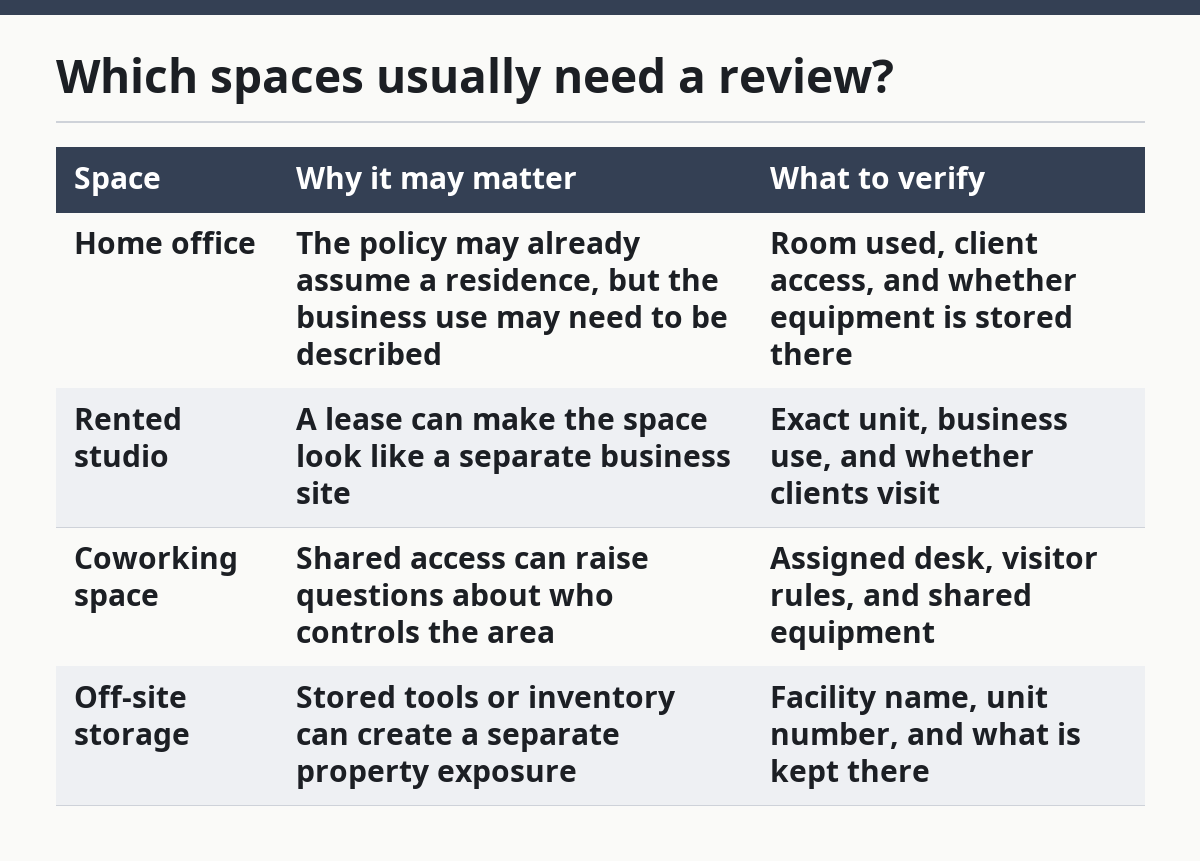
A home office is often the simplest case, but it is not automatically covered just because it is inside your house. If the policy lists the residence and your freelance work happens in one room, the insurer may still want to know how that room is used and whether clients ever come there.
A rented studio is more likely to need explicit listing because it is clearly a business place. A coworking space can be trickier, since your “location” may be a desk in a shared building rather than a room you control. Off-site storage is the easiest to overlook, yet it can matter if your tools, samples, or inventory are kept there.
What should you check before sending the request?
You should check the policy wording, the use of the space, and any location-based exclusions before you ask for the endorsement. That prevents a simple request from becoming a mismatch between what you think is covered and what the insurer records.
Start with the declarations page. If the page names one address and the new location is different, the policy may need a location update even if the work is identical. Then read the sections that define insured premises, business personal property, and any exclusion that refers to unlisted sites. These terms are not decorative; they show where the policy is meant to apply.
The next check is practical. Ask yourself whether the new space is temporary or ongoing, whether it is shared with others, and whether you will store tools, client files, or stock there. A location used one day a month may be treated differently from a rented studio used every week. The shorter the use, the more important the insurer’s classification becomes, because the policy may distinguish between permanent premises and occasional work sites. If you are unsure, ask a licensed insurance professional to review the wording.
If the insurer uses a schedule or a schedule of locations, make sure you understand whether the new place belongs there. A schedule is simply the list attached to the policy that names the covered locations. If the location is missing from that list, the problem is not solved by describing it later in an email.
For background, the National Association of Insurance Commissioners and the Insurance Information Institute both publish consumer-facing insurance education that can help with policy language, but your own wording still controls the result.
When does the standard approach not apply?
The standard approach does not apply when the location is temporary, shared in a complex way, or mixed with another business arrangement. In those cases, the issue is usually not the form itself but the policy’s classification of the risk.
The space is only used for a few days: this may fall into a short-term or project-based use pattern rather than a true new location — ask the insurer whether it needs an endorsement or whether the policy already contemplates temporary work sites, and confirm the answer with a qualified adviser if needed.
The address has no unique unit or suite number: this can make the location harder to identify — get the exact unit designation before the request goes in, because “Unit 3” and “Suite 3” are not always interchangeable.
The coworking space changes daily: that creates uncertainty about which area is being insured — list the primary site or ask whether the policy can recognize a shared workspace without naming each desk.
The studio also stores tools or stock for another line of work: that can change the exposure profile — separate the functions in your request so the insurer knows what is stored there and what is done there.
The site is partly residential and partly commercial: mixed use can trigger special wording, so consult a qualified insurance professional — verify whether the policy treats the business area as part of the home or as a separate business premise.
These are the moments when a quick address update can fail. The consequence is not usually that the policy disappears; it is that the wrong location record can create confusion during a claim review. That is why the question is not “Can I mention it?” but “Does the policy need the location formally attached?”
What mistakes cause the most trouble?
The most common mistakes are small on paper and expensive in practice. They usually involve bad labels, missing details, or assuming one location type works like another.
One mistake is treating the new place like a mailing address update. The consequence is obvious: the correspondence changes, but the insured location does not. The better alternative is to ask directly for a business location endorsement or the policy’s equivalent location schedule update.
Another mistake is leaving out the unit, suite, or desk number. The consequence is ambiguity, especially in shared buildings with several tenants. The better alternative is to provide the full site identifier and confirm it appears the same way on the revised paperwork.
A third mistake is assuming a home office needs no review because it is “just part of the house.” The consequence is that a location-based exclusion may stay in place while the use has changed. The better alternative is to tell the insurer exactly how the room is used and whether it hosts clients or stores equipment.
A fourth mistake is forgetting off-site storage. The consequence is that tools or inventory may sit in a place the policy record never mentions. The better alternative is to list the storage facility, unit number, and what is kept there.
A fifth mistake is changing the space but not checking the effective date. The consequence is a gap between the day you start using the new location and the day the endorsement begins. The better alternative is to ask for the start date to match the date the new location actually began business use, if the insurer allows that.
What should a good update look like?
A good update makes the new location easy to identify, easy to match to the policy, and easy to explain if a claim happens later. It should show the same address on the endorsement, the declarations page, and any related schedule.
The result should also answer three practical questions in one glance: where the work is done, what type of space it is, and whether anything is stored there. If the revised documents make you stop and guess, the update is not finished.
A well-handled change is usually boring in the best way. The paperwork says the right place, the policy language still makes sense, and there is no need to reconstruct the story from old emails. That matters because insurance is document-driven; what is not written clearly can be hard to rely on later.
If the location affects your broader coverage design, it can also affect how you think about limits, property schedules, and exclusions. That is why this step belongs in the larger freelancer insurance policy setup and coverage design process, not as a last-minute administrative fix.
FAQ
Do I need to list a home office on a freelance policy?
Often, yes, if the home office is a real business space rather than a casual corner of the house. The insurer may want to know that the residence includes a business area, especially if clients visit, equipment is stored there, or the policy wording refers to insured premises. If the policy already names the home address, the office details may still need to be described.
When does a rented studio need to be added?
A rented studio usually needs to be added when it becomes a regular business location. If you work there on an ongoing basis, keep equipment there, or meet clients there, the insurer may need the studio listed through an endorsement or location schedule. A short-term project space may be treated differently, so the policy wording matters.
Does location affect my liability coverage?
Yes, location can affect how liability coverage applies. Some policies limit coverage by insured premises, and a location-based exclusion can create trouble if the place is not on record. The exact effect depends on the policy language, the country, and the insurer’s forms, so the update should be checked against the declarations page and endorsement.
Drafted with AI; not yet reviewed by a person.
