
Last updated: November 22, 2026
Quick answer: use 3 buckets. If the problem already involves money, a formal demand, or a contract/policy trigger, it may need a claim or notice; if it is still a contained service issue, internal records may be enough. This article explains How to Decide Whether a Freelance Problem Needs a Claim, a Notice, or Just Internal Records. This is information, not financial advice; a qualified adviser should be consulted for your own situation.
Key takeaways
- Start with the fact pattern, not the label. The same complaint can become a notice or a claim as new messages arrive.
- A claim usually has a demand, a dispute, or a formal paper trail. A notice is a heads-up to the insurer. Internal records stay inside your files.
- Keep the client complaint, incident log, and insurer copy aligned. One missing email can change the classification later.
- If the issue touches deadlines, payment, data, or a contract clause, treat it as an escalation risk and, if needed, consult a qualified professional rather than deciding on your own.
What counts as incident classification?
Incident classification is the sorting step that tells you whether a freelance problem belongs in a claim file, an insurer notice, or only an internal record. It is the first filter in freelancer insurance claims and incident response, and it stops you from over-reporting a small hiccup or under-reporting a real exposure.
The point is not to guess the final outcome on day 1. It is to place the problem in the right lane based on what is known now. A client complaint about a 2-hour delay is not the same thing as a written demand for reimbursement, and a payment dispute is not the same thing as a simple correction request.
This page sits under the wider hub on freelancer insurance claims and incident response. The job here is narrower: decide where the problem belongs before you take the next step. If the issue is already a formal claim, the classification is easier; if it is only a concern, the harder part is avoiding both delay and overreaction.
A good classification uses three buckets: notice only, potential claim, and internal documentation. Those buckets are not legal labels, and they can change if the client sends a second email, a copy of a contract clause, or a demand for a refund.
How do I sort a freelance problem into the right bucket?
You sort a freelance problem by checking for a demand, a trigger in the contract, and any insurer reporting threshold, then writing down what you can prove. Start with the least dramatic reading of the facts, then move upward only if the paper trail points that way.
- Write the event in one sentence. Use 20 to 30 words and name the date, client, and issue. Verify that the sentence says what happened, not what you fear. If it includes blame words like “negligent” or “lawsuit,” the note is already too charged.
- Separate the client complaint from the money issue. Mark whether the client is asking for a fix, a refund, a discount, or nothing yet. Verify whether the message contains a dollar amount, even a rough one. If the complaint is only frustration, the problem may still be internal records only.
- Look for a formal notice signal. Check for phrases such as “please put your insurer on notice,” “preserve your position,” or “we reserve our rights.” Verify whether the wording suggests possible future action. If the language is vague, keep the matter in the notice-only lane for now.
- Check the contract and policy wording. Read the reporting section, claims-made language, and any notice requirement line by line. Verify whether the policy requires early notice of a circumstance, not just a filed claim. If you cannot find the clause in under 10 minutes, mark the gap and escalate the question.
- Assess the size of the exposure. Compare the issue against the project fee, any deposit, and any amount already disputed. Verify whether the problem could grow if a deadline is missed or if the client withholds payment. If the exposure is limited and the client is not escalating, internal records may be enough.
- Check for third-party fallout. Ask whether a client’s client, vendor, platform, or insurer is now involved. Verify whether someone outside the original contract has complained. If a third party appears, the issue is no longer just a private correction note.
- Write the incident log entry the same day. Record time, channel, names, attachments, and the exact words used. Verify that the log has enough detail for another person to understand the case in 5 minutes. If your note is too thin to explain the issue later, it is not a usable record.
- Decide the lane and mark the reason. Choose claim, notice, or internal records and write a one-line reason beside it. Verify that the reason points to facts, not fear. If the reason is “just in case,” the classification is probably not finished.
A useful habit is to keep the client complaint, the incident log, and the insurer copy in the same naming pattern. Use one incident ID, one date, and one client name. A file that is easy to match in 30 seconds is easier to defend later than a folder with three different labels. For a related workflow, keep the same naming convention in your contract records too.
Notice, claim, or records: how do they differ?
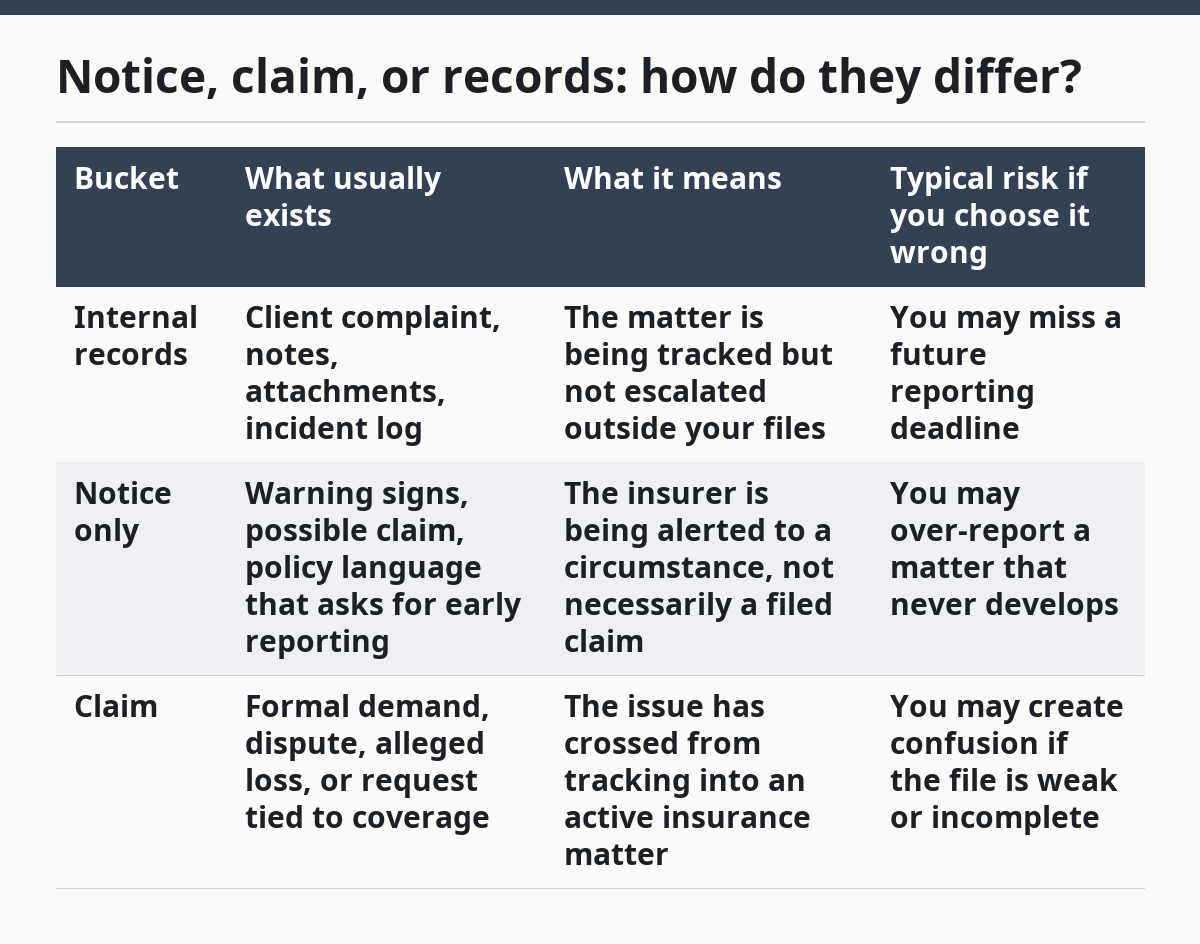
A notice tells the insurer about a problem that may matter later; a claim asks the insurer to respond to an asserted loss; internal records keep the matter documented without external reporting. The difference is driven by what has been said, who has been told, and whether the issue has crossed a reporting threshold.
| Bucket | What usually exists | What it means | Typical risk if you choose it wrong |
|---|---|---|---|
| Internal records | Client complaint, notes, attachments, incident log | The matter is being tracked but not escalated outside your files | You may miss a future reporting deadline |
| Notice only | Warning signs, possible claim, policy language that asks for early reporting | The insurer is being alerted to a circumstance, not necessarily a filed claim | You may over-report a matter that never develops |
| Claim | Formal demand, dispute, alleged loss, or request tied to coverage | The issue has crossed from tracking into an active insurance matter | You may create confusion if the file is weak or incomplete |
The key trade-off is timing. Early notice can protect a policy position, but reporting every irritation can create noise and may make it harder to spot the real problem. Internal records are low-friction, but they work only if the issue truly stays small. If the file starts to move, revisit the classification in incident response before the next reply goes out.
A claim file also carries more weight than a complaint log. Once a client demands payment, threatens action, or says they are relying on insurance, the incident has changed shape. At that point, the safer question is not “Can I ignore this?” but “What does my policy expect me to do next?”
What should go in the incident log?
An incident log should capture the who, what, when, where, and why in plain language, plus the exact wording of any complaint or demand. Keep it to facts that can be checked later, not commentary or guesses.
At minimum, include the date, the client name, the project name, the channel used, and the attachment list. If the complaint came by email, save the full thread. If it came by phone, write a call note within the same day and add the time, the person spoken to, and the gist of the conversation.
A good log also records the first sign of risk escalation. That can be a missed deadline, a payment holdback, a request to redo work, or a reference to a clause in the contract. Those details matter because they show why the file moved out of the “minor complaint” bucket.
Keep the tone neutral. An entry like “client angry and unreasonable” helps no one. An entry like “client asked for a refund of the last invoice and cited section 4 of the agreement” gives an insurer, adviser, or reviewer something concrete to work with. A 3-line log is better than a page of emotion.
When should I stop and get help?
You should stop classifying on your own when the problem touches a formal demand, a deadline in the policy, or a live dispute about money or rights. At that point, the issue is no longer just filing discipline; it can affect coverage, timing, and how the matter is framed.
At that point, a qualified adviser or broker can help you read the policy wording against the facts. A short review now is usually easier than fixing a missed step later.
A written demand for money or services: This is often more than a complaint — it can be the start of a claim. Mark the file as potential claim and prepare the notice details, because the wording may matter later.
A policy clause mentions notice within a set period: This means timing may control your rights — check the wording and escalate the question quickly. If you miss a deadline, the issue can become harder to explain.
The client mentions an insurer, lawyer, or formal process: This is a sign the matter is leaving ordinary customer service — move it out of internal records only. Keep the message, attachments, and dates together.
The dispute involves a refund, withheld fee, or unpaid invoice: Money is now part of the problem — treat it as a potential claim or formal dispute, not a casual complaint. The documentation burden usually rises with the amount at stake, so consult a qualified professional if the amount is material.
You are unsure whether a third party is involved: Unknown outside involvement can change the reporting duty — pause and check. A vendor, platform, or client’s client may create a separate exposure.
The facts are changing every day: A moving target is hard to classify cleanly — keep a dated log and seek qualified help if the file keeps shifting. A stable record is easier to classify than a fast-moving argument.
What mistakes do freelancers make here?
Freelancers most often make 4 mistakes: they wait too long, they over-report, they keep poor notes, and they use emotional language. Each mistake creates a different problem, and each has a cleaner alternative.
First, they wait for a bigger email before acting. That can push a notice past a reporting window and leave the file looking late. The better move is to log the first sign of escalation and check the policy wording as soon as the issue appears.
Second, they label every complaint a claim. That clutters the file and can hide the matters that actually need attention. The better move is to keep small customer-service issues in internal records until a demand or policy trigger appears.
Third, they keep screenshots but not context. A single image without the email thread, date, or sender can be weak evidence. The better move is to save the full chain and note what happened in the incident log the same day.
Fourth, they write conclusions instead of facts. Phrases like “the client is trying to scam me” do not help a claim file. The better move is to quote the exact request, attach the source, and leave motive out of the log.
When is internal recordkeeping enough?
Internal recordkeeping is enough when the complaint is minor, the client has not made a demand, and nothing in the contract or policy suggests immediate reporting. It works best for short-lived service issues, quick corrections, and matters that stay inside the project file.
That approach can fail fast if the issue grows. A small complaint can turn into a payment dispute in a single email, especially if the client starts mentioning a refund, a breach, or another party. If the file starts moving, the internal record should be ready to become a notice file without being rewritten from scratch.
The practical test is simple: if you can explain the matter in one neutral paragraph and no one has asked for compensation, the file may stay internal for now. If you need two versions of the story, or if the wording changes from “problem” to “loss,” the issue has probably outgrown internal records.
What should I keep in mind about country rules?
Country rules differ, and policy wording changes often, so no single reporting rule works everywhere. A notice requirement in one place may be irrelevant in another, and an insurer’s reporting threshold may not match what a client thinks counts as a claim.
That is why the same incident can be handled differently by two freelancers with similar problems. One policy may expect early notice of a circumstance; another may only care about a formal demand. The safer habit is to read the contract and policy together, then record the reason for the classification in the incident log.
For general risk language, the Financial Conduct Authority, the U.S. Securities and Exchange Commission, and the Insurance Information Institute all publish consumer-facing material on careful recordkeeping and insurance process terms. Those sources are useful for the vocabulary, but they do not replace the wording of your own policy or contract.
FAQ
When is a problem a claim?
A problem is a claim when there is a formal demand, a dispute, or a clear request for compensation tied to insurance or legal rights. A complaint alone may not be enough on its own; whether it becomes a claim depends on the policy wording, the contract, and the facts in the incident log.
What is a notice only?
A notice only report tells the insurer about a circumstance that could become a claim later. It is often used when the issue is still developing, but the policy expects early reporting. The file should still include dates, names, and the exact words used in the client complaint.
Do I have to report every complaint?
No, not every complaint needs insurer reporting. Minor service complaints can stay in internal records if they do not trigger a policy clause, a demand, or a material risk escalation. The safer rule is to log the complaint first, then check whether the wording or facts make it more than a routine issue.
Drafted with AI; not yet reviewed by a person.
