

Last updated: November 25, 2026
Quick Answer: in most cases, you need 1 written change request to the carrier, then an endorsement or new policy record that removes the former partner and matches the new owner. If the work continues under one freelancer, the carrier usually needs the dissolution record, the policy number, and the updated ownership setup. This is information, not financial advice; a qualified adviser should be consulted for your own situation. For background on partnership changes, see the IRS guidance on partnerships and the SBA overview of changing your business structure.
- Key takeaways
- Who this is for
- How do you update the policy after a partnership ends?
- What should you check before you call the carrier?
- What happens if the policy was written for two partners?
- When should you stop and get qualified help?
- What mistakes do freelancers make after a breakup?
- How long does the cleanup take, and what does “done” look like?
- FAQ
Key takeaways
- A partnership breakup changes who owns the work, who signs for the policy, and who the carrier should treat as the insured.
- The carrier usually needs written notice, not just a phone call, before it changes the policy file.
- The clean fix is often an endorsement that removes a former partner and shows the new owner or sole freelancer.
- Old certificates, invoices, contracts, and claim notices can still point to the wrong name, so the paper trail matters.
- If the policy was written for two owners and the business now has one, do not assume the old setup still works; check with the carrier or a qualified adviser. See the certificate of insurance guide and business insurance basics.
Who this is for
This applies to freelancers who insured a joint venture as a partnership and now need the coverage to match a business split. It assumes the reader already has the current policy declarations page, the names of both partners as they appear on the policy, and a record of the business dissolution or ownership change.
It is also for readers who still plan to do freelance work after the split, either alone or through a new legal setup. The carrier will care less about the personal breakup and more about who now owns the work, who signs contracts, and whose name belongs on the policy as the named insured.
The cleanest path is usually administrative, not dramatic: update the insurance record, keep the policy active if the work continues, and document the transition in writing. The messy path is waiting until a client asks for proof of insurance or a claim arrives 6 months later, when the carrier sees names that no longer match the business. For related steps, see business insurance basics and certificate of insurance rules.
How do you update the policy after a partnership ends?
You update the policy by telling the insurance carrier about the business dissolution, then asking for the policy to be changed so the coverage matches the new ownership. In practice, that means the carrier may issue an endorsement, which is a written change to an existing policy, or it may require a new policy if the old one no longer fits the risk.
Start with the policy declarations page and the current legal name on the policy. Then compare that against the new business structure, the contracts the freelancer will still sign, and any client certificate that needs to stay valid. The goal is not just to keep insurance in force for 1 more month; it is to keep the insured name, ownership, and covered operations aligned. For a general overview of policy changes, the NAIC consumer resources explain why written records matter.
- Pull the full policy file. Get the declarations page, endorsements, certificates, and any schedule showing the named insured. Verify the exact legal name, not a trade name, and note every place both partners are listed. If the file shows a name that no longer exists, that is a problem because a claim can be tied to the wrong entity.
- Write down the new ownership setup. State whether one partner is continuing alone, whether the work moved to a new sole proprietorship, or whether a new entity took over. Verify who now signs contracts and invoices. If nobody can clearly say who owns the business after the split, the carrier may not know what to endorse.
- Gather proof of dissolution or separation. Save the written partnership dissolution, separation agreement, or other business record that shows the change. Verify the date the partnership ended and the date the continuing work began. If the dates conflict, the carrier may leave the old structure in place until the mismatch is cleared.
- Contact the insurance carrier in writing. Send a request that names the policy number, the former partner, the continuing owner, and the exact change needed. Verify that the carrier has the request in the right file. If the carrier replies only with a generic service note, ask for a policy change confirmation, not just an email chat.
- Ask whether an endorsement is enough. Confirm whether the carrier can remove the former named insured through an endorsement or whether the change requires a new application. Verify the effective date of the change. If the carrier cannot place the change on the right date, there is a gap between the old partnership and the new freelance setup.
- Check every insured name and address after the change. Review the revised declarations page, endorsements, and certificates of insurance. Verify the named insured, mailing address, and business description. If the old partner still appears anywhere except a closed-file note, the policy record is not clean yet.
- Update client-facing proof. Replace old certificates, contract language, and vendor records that list the partnership name. Verify that future certificates point to the continuing business only. If a client still receives proof tied to the dissolved partnership, the paperwork can undercut the new coverage setup.
- Keep the paper trail together. Store the dissolution record, carrier email, endorsement, and revised declarations page in one file. Verify that anyone handling a later claim can trace the change in under 10 minutes. If the record is scattered across inboxes and phone notes, the insurer may ask for the same facts again.
One practical way to think about the update is by document type:
| Item | What it does | Why it matters after a breakup |
|---|---|---|
| Named insured | Identifies who the policy protects | Must match the continuing owner or business |
| Endorsement | Amends the existing policy in writing | Can remove the former partner without starting over |
| Certificate of insurance | Shows proof to clients | Often needs the new business name and insured party |
| Business dissolution record | Shows the partnership ended | Helps the carrier set the correct effective date |
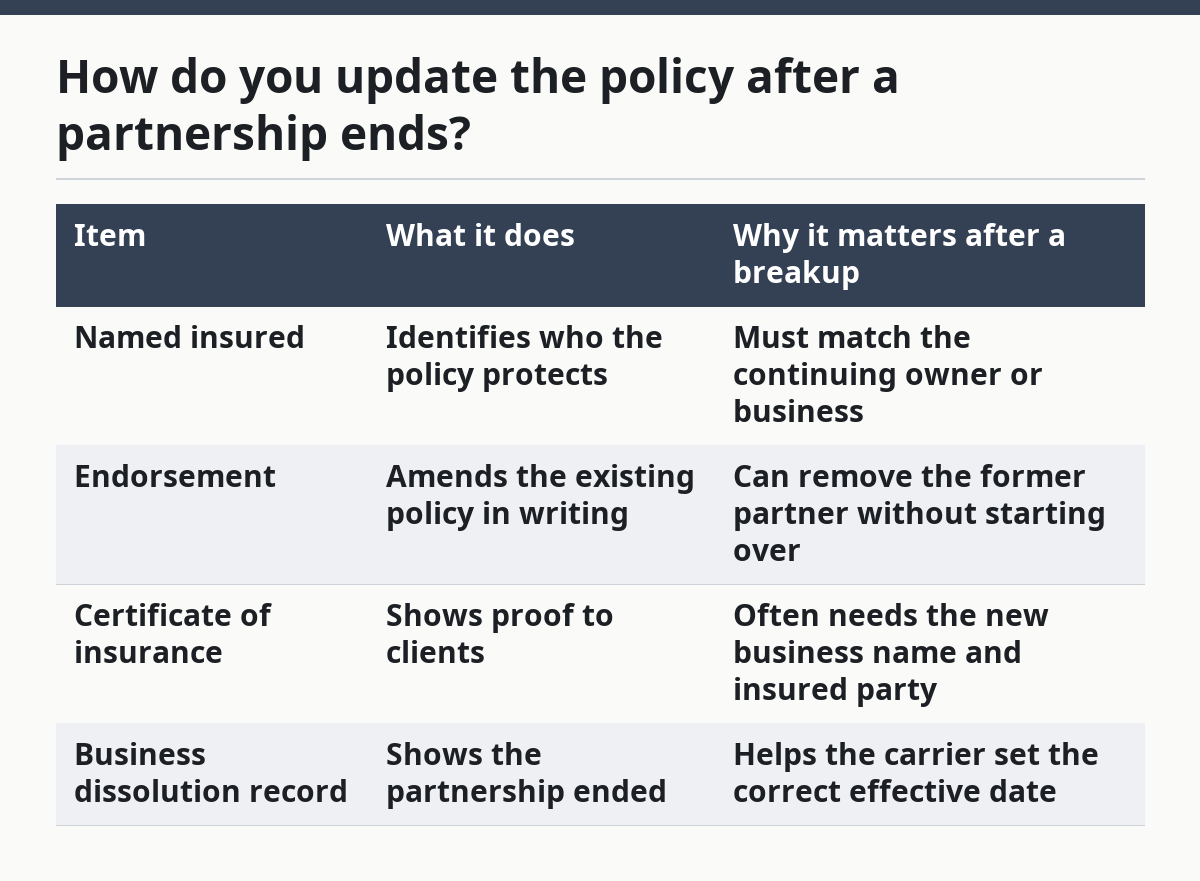
The best result is not just “insurance still exists.” It is that the policy file, the business records, and the client paperwork all show the same 1 owner or the same new legal entity.
What should you check before you call the carrier?
You should check the policy names, the business date of change, and the contracts that still run under the old partnership before you call the carrier. That saves time and helps the carrier decide whether a simple endorsement can work.
Start with the declarations page, because that page shows the named insured and the core policy facts. Then check any certificate request forms, client agreements, and banking or tax records tied to the freelance work. If the partnership used a trade name, note that too, because a trade name and a legal owner are not the same thing. See also the certificate of insurance guide and contract checklist for freelancers.
The carrier will usually ask for the policy number, the exact change, and the date it should take effect. If the breakup happened on one date but client work continued under the old name for 30 days, that lag needs to be explained. A gap between the business change and the insurance change can create a problem if a claim lands in that middle period.
What happens if the policy was written for two partners?
The policy can become inaccurate if it still lists both partners after only one continues the work. That is a problem because the carrier underwrote one ownership picture, and the business now has another.
A breakup also changes who has authority to speak for the policy. If one former partner no longer runs the business, that person should not stay on as the named insured unless the carrier has been told why. Some policies and certificates also refer to the insured’s operations, not just the name on the front page, so the description of the freelance work may need a review too.
This is where a plain comparison helps:
- Named insured: the person or entity the policy covers.
- Additional insured: a third party added for limited protection under the policy terms.
- Certificate holder: the person or company receiving proof of insurance, not the insured itself.
- Business owner: the person or entity that now controls the freelance work after dissolution.
The carrier may treat these differently, so do not assume changing one line fixes the whole record. A former partner can be removed from the named insured and still appear on old certificates, which is why the document trail matters as much as the policy file. For a related explanation, see additional insured vs. certificate holder.
When should you stop and get qualified help?
You should stop and get qualified help when the business change is more than a simple name swap on an existing freelance policy. This is a money and legal-rights issue, so a qualified adviser or broker familiar with the policy and the business setup should be consulted for the reader’s own situation.
The dissolution date is unclear: the policy period and the business split do not line up — get help before you ask the carrier to backdate anything.
The work moved into a new legal entity: the old partnership ended, but the new owner now operates under a different structure — the policy may need more than an endorsement.
A claim is already pending: the carrier may care about notice dates, prior acts, and who was insured when the work was done — do not guess at the timeline.
Client contracts still name the old partnership: the business paper trail and the insurance paper trail disagree — fix the contracts and the policy together.
The former partner still signs some work: the ownership split is not clean — the policy may need a different insured structure than a solo freelancer setup.
The policy includes shared property or joint equipment: the breakup affects more than liability coverage, so consult a qualified adviser or broker before you change the policy — inventory, tools, and records may need separate treatment. The SBA’s business structure guidance is a useful starting point.
In those situations, the wrong edit can create a bigger gap than leaving the policy alone for a day or two while the facts are sorted out. The problem is not speed; it is mismatched records.
What mistakes do freelancers make after a breakup?
The most common mistake is assuming the insurance carrier will “figure it out” once the partnership ends. It will not. The carrier works from the policy file, and if the file still shows two owners, the record stays wrong until someone changes it.
Another mistake is removing one partner from the policy but forgetting the certificates and client records. That leaves the old partnership name in circulation, which can confuse a client and create questions later if a loss happens. The fix is to update the policy and the proof of insurance together.
A third mistake is waiting until renewal to deal with the change. That can leave months of mismatch between the real ownership and the insured name. The better move is to make the change effective as soon as the dissolution takes effect, if the carrier allows it.
A fourth mistake is treating a dissolution agreement like insurance proof. It is not. The carrier still needs its own written change request, and it may still ask for the policy number, the old named insured, and the new one; if you are unsure, consult a qualified adviser or broker and verify the carrier’s process.
A fifth mistake is forgetting that old documents can keep causing trouble. If invoices, proposals, and certificates still show the dissolved partnership, the new solo setup can look inconsistent even when the work itself is fine. For document cleanup, see how to update freelancer invoices and client proof of insurance.
How long does the cleanup take, and what does “done” look like?
The cleanup is done when the carrier has issued the correct written change and every working copy of the policy record matches the new ownership. For a simple change, that can happen quickly once the carrier has the facts, but the exact timing depends on the insurer’s process and the paperwork already on file.
A finished file usually has 3 things: the dissolution or ownership record, the carrier’s endorsement or revised declarations page, and updated proof for clients. If any one of those still names the old partnership, the job is not finished yet.
A good result also has a clear trail for future questions. If a claim, renewal, or client audit comes later, the freelancer should be able to show when the partnership ended, who kept the business, and how the insurance was changed to match. That paper trail is the real cleanup.
FAQ
What happens to a policy when a partnership ends?
The policy does not automatically fix itself when a partnership ends. The carrier still needs to be told that the named insured and ownership have changed, and it may issue an endorsement or a new policy record to match the new business structure.
How do I remove a former partner from insurance?
The carrier is the one that removes the former partner after it receives a written request and the business change details. The request should identify the policy number, the former partner, the continuing owner, and the effective date so the policy file can be changed cleanly.
Can one freelancer keep the same policy after a breakup?
Sometimes, but not always. If the carrier can endorse the existing policy to show the continuing freelancer as the named insured, the policy may stay in force; if the ownership change is too large, the carrier may require a new application or a new policy setup.
Drafted with AI; not yet reviewed by a person.
