

Last updated: November 21, 2026
Temporary coverage for a short freelance project usually means matching insurance to the project dates, then asking for a short-term policy or an endorsement that starts and ends with the contract period. If the work lasts only a few weeks or a few months, the main job is date alignment: make the cover begin before work starts, stay active through the last deliverable, and satisfy any proof-of-coverage request from the client.
Key takeaways
- Temporary coverage is about timing first, not just price.
- A short project can fit a short-term policy, an endorsement, or a longer policy term with date changes.
- The client contract matters because it tells you when work starts, ends, and what proof of coverage is due.
- Gaps often happen at the edges: before kickoff, during revision work, or after the final invoice.
- If the project has unusual terms, a broker can help match the policy wording to the contract dates.
This is information, not financial advice. Because insurance terms, limits, and rules vary by country and change often, a qualified adviser should review your own situation.
Who this is for?

This is for a freelancer who has a short contract, already knows the project dates, and needs coverage that fits those dates without leaving a gap. It also assumes you can read a client contract, find the insurance section, and name the policy type you already carry or need to extend.
It is not for every project. If the contract is vague, the work crosses borders, or the client demands unusual wording, a broker should look at it before you act. The same goes for projects where the insurance certificate must name a client, a site, or a date range in a very specific way. A 2-page contract with one start date is simple; a 20-page master services agreement is not.
Temporary coverage is often used for freelance liability insurance, but the label matters less than the structure. In practice, you are choosing between a short-term policy, an endorsement, or a policy term that is adjusted to match a 30-day, 60-day, or other limited project window.
How do I add temporary coverage?
You add temporary coverage by matching the insurance start date, end date, and paperwork to the project timeline, then confirming that the policy form actually covers the work named in the contract. The cleanest way to do that is to work through the process in order.
- Read the client contract first. Pull out the project start date, end date, and any clause that asks for proof of coverage. Verify whether the contract wants general liability, professional liability, or both. If the contract names a certificate holder, a venue, or a minimum limit, that is a sign the paperwork needs more than a simple date change.
- Mark the real work window. Write down the first day you could cause a covered claim and the last day a client could still expect project work, revisions, or handoff support. Verify whether the contract period includes review rounds after delivery. If it does, ending coverage on the delivery date is a problem.
- Check the policy term against the project term. A policy term is the period the insurance stays in force, often written in the declarations page. Verify whether your current term already runs long enough or whether it ends before the project. If the term ends early, you may need a short-term policy or a change to effective dates.
- Ask about a short-term policy or endorsement. A short-term policy is coverage written for a limited period; an endorsement is a written change to an existing policy. Verify which option your insurer will actually issue for the line of coverage you need. If the insurer will not change the term or add the work by endorsement, stop and ask a broker how that carrier handles short projects.
- Match the effective date to the start of risk. The effective date is the day coverage begins. Verify that it starts before any site visit, file transfer, client meeting, or production work that could trigger a claim. If the effective date starts after work begins, there is a gap.
- Keep the end date after the last exposure. Verify that the coverage lasts through the last day you can still be blamed for project work, including final edits, fixes, or acceptance testing if the contract requires them. If the end date stops at draft delivery, the project may still be exposed.
- Collect proof of coverage early. Ask for the certificate or policy confirmation before the client’s deadline, not on the day work starts. Verify the named insured, dates, and any client name shown on the certificate. If the certificate has the wrong project date or wrong entity name, it may be rejected even if the policy is active.
- Save the contract and the policy page together. Keep the client contract, declarations page, endorsement, and certificate in one file. Verify that the dates on all 4 documents line up. A mismatch between the contract period and the policy term is one of the most common reasons temporary coverage fails in practice.
The key idea is simple: coverage has to exist during the period when a claim can arise, not only when the invoice is due. A 10-page contract can look covered on paper and still leave a 1-week gap if the policy starts late.
What should I check before I ask for coverage?

You should check the contract language, the current policy wording, and the exact dates before you request anything. That sounds basic, but it is the step that keeps a small project from turning into a coverage dispute.
Start with the work description. If the project is design, consulting, editing, coding, or site work, the insurer may treat the risk differently even if the project is only 2 weeks long. Then check whether the contract asks for proof of coverage before kickoff, before access to client data, or before final payment.
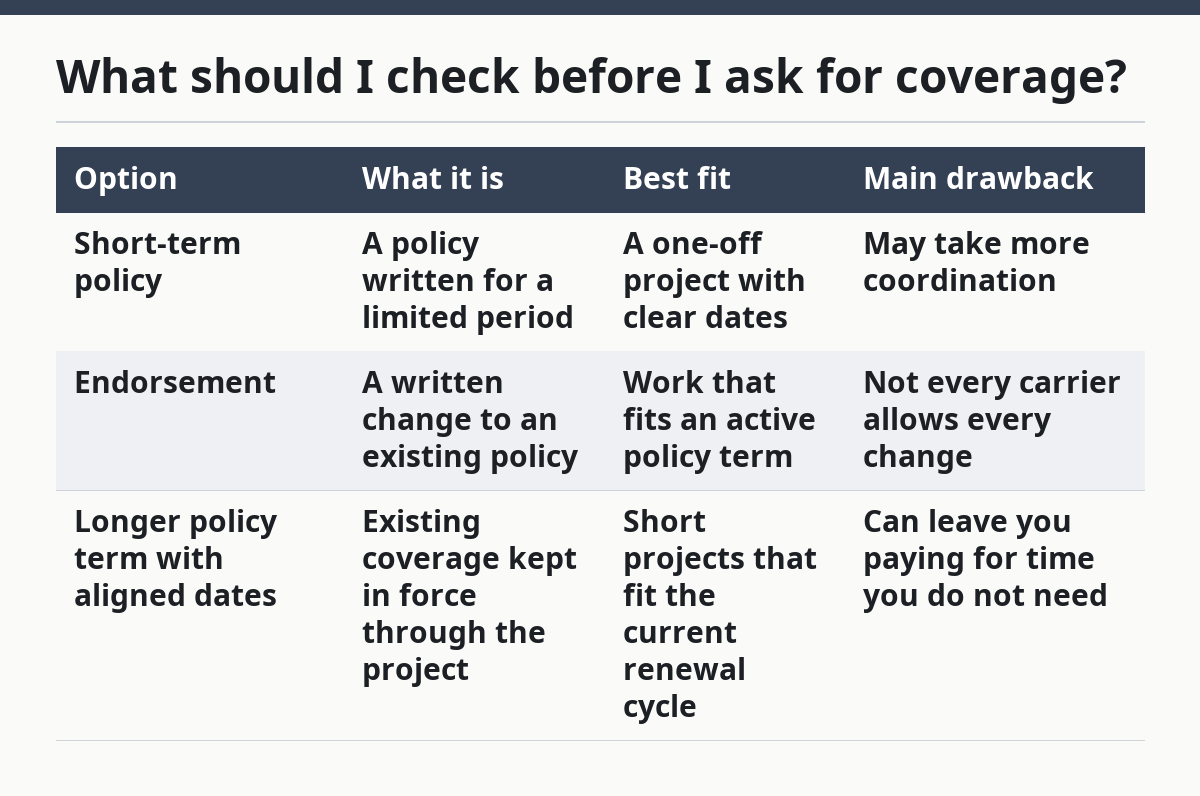
A useful way to compare the three common setups is below.
| Option | What it is | Best fit | Main drawback |
|---|---|---|---|
| Short-term policy | A policy written for a limited period | A one-off project with clear dates | May take more coordination |
| Endorsement | A written change to an existing policy | Work that fits an active policy term | Not every carrier allows every change |
| Longer policy term with aligned dates | Existing coverage kept in force through the project | Short projects that fit the current renewal cycle | Can leave you paying for time you do not need |
Also check whether the client contract uses the words “proof of coverage,” “certificate of insurance,” or “additional insured.” Those are not the same thing, and the policy may need different paperwork for each. If the contract is silent on dates, that is not a reason to guess; it is a reason to get the dates written down before you ask for cover.
When should I stop and get a broker involved?
You should stop and bring in a broker when the project terms stop matching a simple insurance change. A broker is useful when the carrier needs to interpret the contract, not just issue a date change.
The client wants specific wording on the certificate: that means the paperwork matters as much as the coverage — get a broker to confirm the insurer can issue the exact wording before the project starts.
The contract period is shorter than the policy processing time: that means a late application could leave a gap — do not assume a same-day solution exists.
The project crosses a border or uses more than one work location: that changes the insurance question — ask a broker how the carrier treats location and jurisdiction.
The contract includes revisions, warranty work, or post-launch support: that means the exposure extends past the first delivery date — align the end date to the real support window.
The insurer will only offer a full annual policy term: that may be normal for that carrier, but it can be a poor fit for a 3-week assignment — compare the dates before you decide anything.
The contract names several parties or a subcontractor chain: that can change who needs to be shown on the paperwork — have the broker check the document set, not just the premium quote.
If the project is simple and the dates are clean, you may be able to handle the paperwork yourself. If the contract has 2 or more moving parts, the risk of a gap is usually in the wording, not the work itself.
What mistakes cause coverage gaps?
The most common mistake is treating the invoice date as the coverage date. Insurance cares about when the exposure starts, which can be days or weeks earlier than payment. If work begins on Monday and the effective date is Friday, the first 4 days are exposed.
Another mistake is assuming a short project can be covered after the fact. Some insurers may accept a change to an active policy, but many do not want to backdate cover. If you wait until the job is done, the best-case outcome is paperwork trouble; the worst-case outcome is no cover at all.
A third mistake is forgetting revisions and handoff support. A project that looks like 1 deliverable can still involve another 2 rounds of edits, bug fixes, or site access. If the policy ends at the first delivery, the claim window can still be open.
A fourth mistake is relying on the certificate alone. A certificate of insurance is evidence, not the policy itself. If the certificate says the wrong project dates or the wrong client, the contract may reject it even if the policy exists.
A fifth mistake is not checking the policy term when the project is short. A 12-month term can be fine if it matches other work, but it is a poor fit if you only need 6 weeks and the carrier cannot adjust the dates. In that case, ask for the form of coverage the carrier actually offers for short-duration work.
When does the usual approach not fit?
The usual approach does not fit when the project has no clean start and end date, when the insurer will not amend the policy term, or when the contract asks for coverage that the policy form does not supply. In those cases, date matching alone will not solve the problem.
It also does not fit when the freelance work is bundled into a larger job. A 1-month design sprint inside a 9-month client relationship may need coverage tied to the larger relationship, not only the sprint. The same issue comes up when the project includes retained support after launch.
A final edge case is timing around renewals. If the project starts near the end of an existing policy term, you need to see whether the renewal date creates a gap between the old term and the new one. Even a 1-day lapse can matter if the contract requires continuous coverage. That is where a broker can compare the current declarations page, the endorsement, and the renewal date in one sitting.
For broader context on where temporary coverage fits in the wider insurance picture, see the hub on freelancer insurance gaps and coverage extensions.
What does a good result look like?
A good result is boring in the best way: the project dates, policy dates, and proof-of-coverage dates all match, and the client accepts the certificate without follow-up. The policy starts before the first exposure, ends after the last one, and covers the work named in the contract.
You should also be able to explain the setup in one sentence: the project is covered for its actual contract period, not for a random calendar month. If you can say that, and the documents agree, the temporary coverage setup is usually doing its job.
Can I buy insurance just for one freelance project?
Yes, some insurers can write coverage for a single project, but the exact form depends on the carrier and the contract. The key is not the label “one project”; it is whether the policy term, effective date, and covered work line up with the project period. If the paperwork does not match, the project may still be exposed.
How do I align coverage dates with a short contract?
You align coverage dates by using the contract period as the anchor, then setting the effective date before the first exposure and the end date after the last expected exposure. That often means including revision time, handoff time, or any post-launch support in the insurance window. If the contract is unclear, the dates are not ready yet.
Is temporary coverage cheaper than a full annual policy?
Not always, and there is no universal rule on price. A short-term policy can cost less in total because it covers fewer months, but the pricing model, fees, and carrier rules vary by country and by insurer. The safer comparison is not “cheap or expensive,” but whether the policy term matches the project term without leaving a gap.
Drafted with AI; not yet reviewed by a person.
