
Last updated: November 28, 2026
Product liability insurance matters when a freelancer sells finished work that can cause injury or property damage after it leaves their hands. If the item is a physical product, a defective product claim can reach the seller even when the seller did not make every part of it. This is information, not financial advice; rates, limits, and rules vary by country, so a qualified adviser should check your own setup.
Key takeaways
- Finished goods can create liability after handoff, not just while they are in your studio.
- The risk is about what the product does in the real world: breaks, leaks, burns, cuts, shocks, or harms someone’s property.
- Packaging and labeling can matter as much as the item itself, because warnings and instructions shape how the product is used.
- A seller can sit in the chain between maker and customer, and that middle role can bring extra exposure.
- Some work looks like “custom service” at first but still ends as a physical product, which is where this coverage question starts.
Who needs product liability insurance?
Product liability insurance is for freelancers who sell finished physical goods, not for people who only sell advice, time, or digital files. If a customer can take the item home, use it, resell it, or give it to someone else, the product can create a claim long after payment clears.
This usually matters when you make, assemble, label, package, or resell finished work. A defective product claim can arise from a flaw in the item itself, a missing warning, a bad instruction sheet, or a packaging failure that makes the product unsafe. Consumer injury is the clearest risk, but property damage can matter too, such as heat, fire, leakage, or breakage.
The key question is not whether the work was “creative.” It is whether a physical product enters the market with your name on it. A seller may be treated like a manufacturer, a distributor, or both, depending on how the item was made and sold. That is why a freelancer who sells handmade soaps, printed goods with parts, small electronics, candles, furniture, or repackaged items is in a different place from a freelancer who sells a logo file.
This page is part of the Freelancer Liability Insurance hub, but it stays focused on finished goods only. It does not cover client site accidents or errors in professional services.
What counts as a finished product?
A finished product is any physical item that is ready for a customer to use, store, gift, or resell. That can include a handmade object, a kit with parts already assembled, a wrapped item, or a product you bought and resold under your own brand.
The line that matters is handoff. If the item leaves your control in a state where a user can be injured by a defect, product liability exposure starts to matter. A 2-step assembly process may look harmless during production, but if the final item has a loose part, sharp edge, unstable base, or missing warning, the finished product is what drives the claim.
Packaging and labeling are part of the product story. A label that omits a heat warning, allergy notice, age limit, weight limit, or storage instruction can turn a normal product into a claim problem. The same goes for a box that crushes easily, a seal that fails, or a wrapper that hides the risk on first use.
One useful source of guidance is the U.S. Consumer Product Safety Commission, which explains product safety and compliance for businesses on its site. The European Commission also publishes product safety guidance for sellers in the EU. Those pages are not the same as insurance, but they show why the item itself, not only the sale, matters.
How product liability insurance works
Product liability insurance responds when a claim says a physical product caused injury or property damage after it was sold. The mechanism is simple: the policy is meant to handle the legal and settlement costs tied to the product event, subject to the policy terms, exclusions, and limits.
How do you judge your exposure step by step?
You judge exposure by tracing the product from design to resale, then matching that chain to the kinds of harm it can cause. The goal is to spot where a defect, warning gap, or handoff mistake could become a claim.
- List every finished item you sell. Write down each product category, such as candles, printed goods, toys, cosmetics, furniture, or repackaged items. Verify whether each item is physical and user-facing. If a customer can touch, store, or use it, the item belongs on the list; if not, it does not drive product liability.
- Map who touched the item before sale. Mark whether you made it, assembled it, labeled it, packed it, bought it for resale, or shipped it. Verify the chain of custody. If another maker supplied a part, that may shift some responsibility, but it does not remove yours if your brand is on the final product.
- Identify the possible harm. For each item, note whether the realistic problem is burn, cut, shock, choking, leak, collapse, contamination, or property damage. Verify the hazard against the product’s use. If you cannot name the harm, you may be underestimating the risk.
- Check your warnings and instructions. Review labels, inserts, and online listings for age limits, care steps, storage rules, and allergy or heat warnings. Verify that the warning is visible before first use. If the warning is buried in fine print, it is a problem.
- Review packaging. Confirm that the package protects the item during normal shipping and storage. Verify seals, cushioning, and closure strength. If the item can crack, leak, or shift inside the box, packaging may be part of the defect claim.
- Decide whether you act like a manufacturer or distributor. If you designed the item or changed it, you sit closer to manufacturer exposure; if you only resold it, distributor exposure may still apply. Verify your role in the chain. If your brand makes the customer think you stand behind the item, your exposure can rise even if someone else built it.
- Check handoff points. Look at marketplaces, retailers, pop-up sales, and direct shipping. Verify who receives the item and who gives the final warning. If you sell through another platform, a claim may involve more than one party, so your record of labels, photos, and batch notes matters.
- Match the product to the policy. Read the policy wording for covered products, exclusions, and any class limits. Verify whether the insurer accepts handmade goods, resale goods, or imported parts. If the policy excludes the category you sell, it does not solve the problem, even if the price looks fine.
A good result is not “no risk.” A good result is knowing which products create exposure, where the hazard sits, and whether the policy language matches the way you actually sell. That is the point where the issue becomes concrete enough to discuss with a qualified adviser.
Is product liability different from general liability?
Product liability is different from general liability because it follows the product after sale, while general liability usually centers on other kinds of third-party harm. The two can sit inside one policy form or appear as separate parts, but the trigger is not the same.
For a freelancer, the split matters. A customer slipping in your workspace is one kind of claim. A lamp you sold later causing a fire is another. The first is about a location or premises event; the second is about a finished product in the customer’s hands.
| Issue | Product liability | General liability |
|---|---|---|
| Main trigger | Injury or property damage caused by a finished product | Other third-party harm, such as a premises incident |
| Timing | Often after the item is sold and used | Often during an interaction or visit |
| Focus | Defect, warning, packaging, labeling, or design | Site conditions, operations, or other non-product harm |
| Typical evidence | Batch records, labels, instructions, photos, supplier data | Incident reports, premises conditions, witness notes |
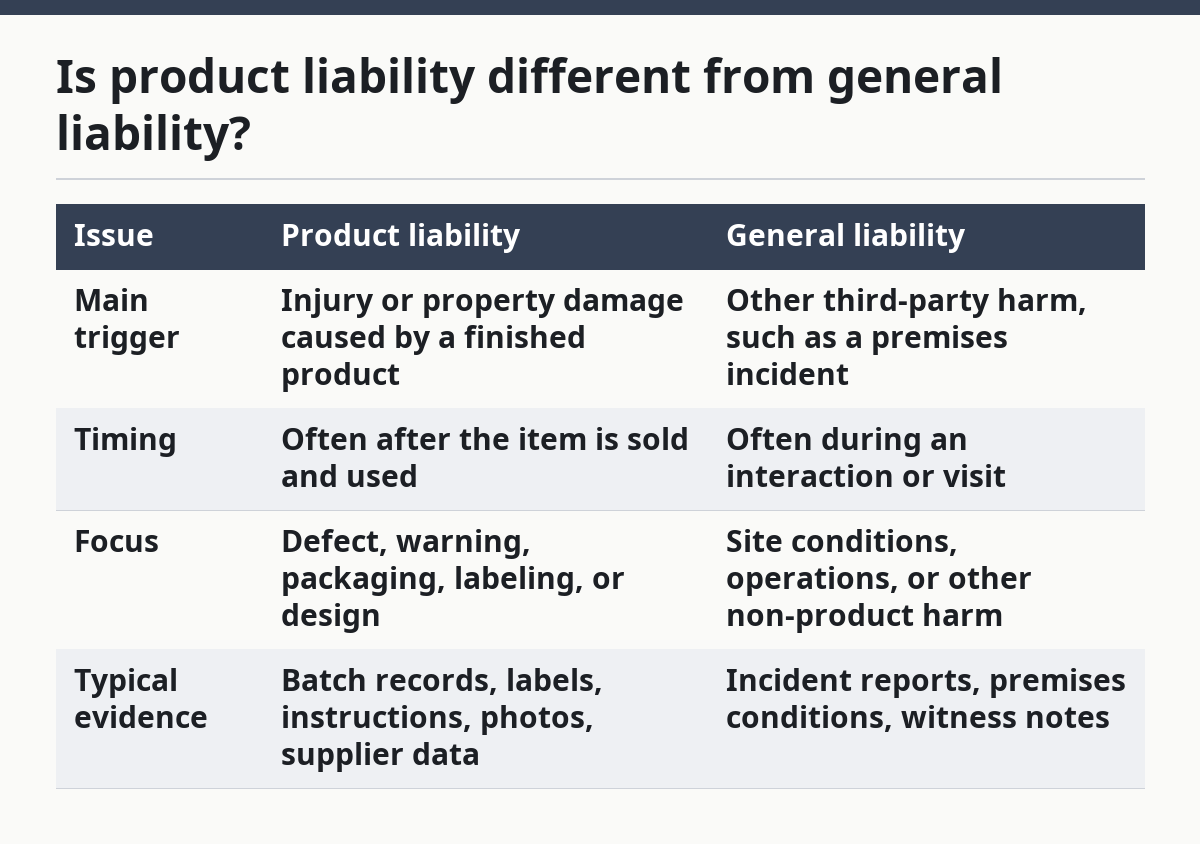
This difference is why a freelancer who sells finished work needs to ask a specific question: if the item harms someone after handoff, does the policy treat that as product risk? If the answer is unclear, the paperwork needs a closer read.
What mistakes do freelancers make?
Freelancers usually make the same few mistakes, and each one can change how a claim lands.
First, they assume handmade means low risk. A candle, cosmetic, toy, or food-adjacent item can still injure someone if it has the wrong ingredients, a loose part, or a weak container. The fix is to judge the finished product, not the craft label.
Second, they treat resale as harmless. A seller who did not make the item may still face exposure if the product is branded, repacked, or sold under a new name. The better move is to check whether the policy treats resale or handoff as covered business activity.
Third, they ignore labels and instructions. A missing warning can turn a use issue into a claim issue, because the product was not presented with the risk clearly shown. The better move is to review the box, insert, and listing together.
Fourth, they keep no records. If a batch issue comes up, the lack of photos, supplier notes, or order logs makes it harder to show what was sold and when. The better move is to keep plain records for each batch or run.
Fifth, they think one product line defines the whole business. A freelancer may have one low-risk item and one high-risk item, but the policy question should cover both. The better move is to review every physical line separately.
When should you stop and get a qualified review?
Product liability insurance needs a qualified review when the item, sales channel, or contract terms make the exposure unclear. That is especially true when the product can cause bodily injury, fire, choking, contamination, or another serious harm.
You sell items with moving parts, heat, electricity, chemicals, or small pieces: those products can injure people in ways that a simple label does not fix — get the policy wording checked before you rely on it.
You resell goods under your own name or packaging: reseller and distributor exposure can look different from maker exposure — confirm whether the policy treats your role as covered.
You import parts or finished goods from another supplier: the defect may start upstream, but the claim can still name you — ask how supplier responsibility and your own role are handled.
You changed the label, warning, or instructions: a packaging or labeling change can create new liability even when the item itself is unchanged — review the final customer-facing version.
You sell in more than one country or through several platforms: the rules can shift by place and by sales channel — get a local review rather than assuming one policy works everywhere.
Your customer contract requires proof of insurance wording: certificate language and policy limits can matter as much as the coverage itself — have the wording checked before you promise anything.
What should you check before you rely on a policy?
You should check the product class, the exclusions, the sales role, and the limits that apply to your actual goods. The policy has to fit the product you sell, not the product you wish you sold.
Start with the item itself. Does the policy name handmade goods, resale goods, imported goods, or finished physical products in a way that matches your work? If it does not, the claim may sit outside the form. Then check whether the policy excludes packaging, labeling, product recall costs, or damage tied to misuse warnings.
After that, look at the sale path. A direct sale from your own site is not the same as selling through a marketplace or a retail partner. A product can also move from “custom order” to “finished good” very quickly, so the business label on the invoice should not be the only thing you check.
The safest reading is careful, not optimistic. If you cannot explain how the policy would respond to a consumer injury caused by a defective product claim, the coverage review is not finished yet. That is the point where a qualified adviser should help you match the wording to the actual business.
Do freelancers need product liability insurance?
Freelancers need product liability insurance when they sell finished physical goods that could injure someone or damage property after sale. If the work ends as a product in a customer’s hands, the risk exists even when the business is small or the item is handmade. If the work is only a service or digital file, this coverage may not be the right fit.
Is product liability different from general liability?
Product liability is different from general liability because it deals with harm caused by a sold product, not by a premises or general operations event. A policy may bundle both, but the claim trigger is not the same. If your risk comes from a finished item leaving your control, you need to know which part of the policy answers that claim.
Does product liability apply to handmade items?
Product liability can apply to handmade items if they are physical goods that can cause injury or property damage. Handmade does not mean harmless, and a craft label does not remove the risk of a defective product claim. Warnings, packaging, parts, and final use still matter, so the item should be reviewed like any other product before sale.
Drafted with AI; not yet reviewed by a person.
