

Last updated: November 20, 2026
Quick Answer: Freelancer insurance claims management usually comes down to 5 steps — notice, evidence, valuation, follow-up, and closure — and it works best when the first packet is clear, dated, and complete. Freelancer insurance claims management is the process of spotting a covered loss, proving it with records, filing it the way your policy asks, and following it until the insurer closes the file. For a freelancer, that usually means a claim tied to professional liability, general liability, equipment, cyber, or business interruption cover, and the result depends more on paperwork and timing than on the size of the loss.
Key takeaways
- Claims management starts before the loss, because the policy wording and your records decide what the insurer can verify.
- The fastest claims are often the ones with clear dates, named files, clean invoices, and a simple story of what happened.
- A claim can fail even when the damage is real if the loss falls outside the policy period, the exclusion list, or the notice rules.
- The biggest mistakes are waiting too long, guessing at facts, and sending weak evidence in the first message.
- If the matter may affect tax, contract liability, or legal rights, a qualified adviser should review your own situation.
What does claims management mean for a freelancer?

Claims management means handling an insurance loss from the first sign of trouble to the final payment or denial, using the policy’s own rules. For a freelancer, that process is not just “tell the insurer and wait”; it is a 5-part job: notice, evidence, valuation, follow-up, and closure.
This matters because freelance work is usually small in headcount but messy in risk. One laptop can hold client files, one missed deadline can trigger a complaint, and one damaged camera can pause income for weeks. The claim file has to show what was lost, when it happened, why it fits the policy, and how the amount was calculated.
This guide on Freelancer insurance claims management is for self-employed people who already have some form of insurance and need to understand how a claim actually moves. It assumes the reader can read a policy schedule, gather files from cloud storage, and name the main dates in a project. It does not assume legal training, and it is not financial advice; if the claim could affect your contract rights, tax position, or cash flow in a serious way, a qualified adviser should review your own case.
A generic article often skips the hard part: many claims fail on wording, not on sympathy. A client may admit fault, or a photo may be clear, but the insurer still asks whether the event happened during the policy term, whether the type of loss is covered, and whether the notice was sent in time. That is why claims management starts with the policy, not the payout.
For a quick reference on consumer-facing claims rights and insurer conduct, the National Association of Insurance Commissioners has claims guidance on its consumer pages, and the UK’s Financial Conduct Authority has complaint-handling rules in its handbook. Those bodies are useful starting points, but they do not replace the wording in your own policy.
What should you check before you file?
You should check the policy, the loss date, the notice rule, the exclusion list, and the proof you already have before you file anything. Those five checks decide whether the claim is likely to be accepted, reduced, or stalled.
Start with the declaration page, sometimes called the schedule. That page shows the policy period, the cover types, the limits, the deductible or excess, and any endorsements, which are written changes to the standard policy wording. If the event falls outside the policy period, the claim can fail even if the damage is real.
Next, match the loss to the cover. A damaged laptop is not the same as a client-data breach, and a missed project deadline is not the same as a slip-and-fall at a studio visit. A freelancer often carries several policies, so the same event may involve more than one insurer.
Then check the exclusions and duties. Exclusions are the events the policy says it will not cover, such as wear and tear, dishonesty, or deliberate acts. Duties are the things the insured person must do, such as giving prompt notice, preserving evidence, and not admitting liability too early. If those duties are ignored, the insurer may limit or deny the claim.
The proof check is just as important. A clean claim file often starts with the following items: the policy schedule, the incident date, a short timeline, photos, invoices, emails, contracts, and any repair estimate or replacement quote. If a document is missing, make a note of why it is missing instead of filling the gap with guesswork.
A weak file can still be repaired, but only if you know what is absent. If the timeline has three versions of the same event, or if you cannot name the client, device, or project involved, the claim needs more work before submission.
How do you file a freelancer insurance claim step by step?

You file a freelancer insurance claim by reporting the loss, building the file, and answering the insurer’s questions in the order they ask them. A good submission is not long; it is clear, dated, and backed by the smallest set of documents that proves the loss.
- Record the loss date and time. Write down the exact date, local time if known, and location of the incident. Verify that the event sits inside the policy period shown on the schedule. If the date is unclear, the insurer may treat the file as incomplete, so it is sensible to check the policy wording and, if needed, consult a qualified adviser or broker for your own situation. See the policy conditions in your schedule and consumer guidance from the NAIC.
- Stop avoidable damage. Secure the equipment, save the file version, or isolate the account if the loss could grow. If the loss could grow, consult a qualified IT, legal, or insurance professional before taking steps that might affect evidence or recovery, because incident-response guidance from CISA emphasizes preserving systems and records where possible. Verify that you have not made the situation worse by delay or by continuing to use damaged gear. If the problem expands after the first sign, the insurer may challenge the extra cost.
- Read the notice clause. Check how the policy wants the claim reported, such as by phone, email, or portal, and note any required wording. Verify the deadline or “prompt notice” language in the policy. If notice is sent to the wrong place, the file can sit untouched for days.
- Build a 1-page timeline. List the trigger, the first notice, the damage, the response, and any client contact in time order. Verify that every line can be supported by an email, photo, invoice, or log. If the timeline relies on memory alone, it is too weak.
- Collect evidence in original form. Save the original photo, email, invoice, screenshot, or server log, not only a copied PDF. Verify that the file names show the date or source where possible. If screenshots are cropped so hard that the header disappears, the evidence may be questioned.
- Value the loss in one method. Use repair cost, replacement cost, or lost income evidence only if the policy allows that method. Verify which figure the policy uses, because “value” and “cost to fix” are not always the same, so the loss should be measured against the wording that actually applies. If you mix methods, the claim can look inflated.
- Submit a short first notice. State what happened, when it happened, what policy may apply, and what evidence you have attached. Verify that the notice answers the basic questions without side stories. If the first notice is vague, the insurer will send follow-up questions and the clock slows down.
- Track every reply. Keep the claim number, contact name, and date of each response in one place. Verify that any request for more documents is answered in the same format asked for. If messages go unanswered for several days, the file can drift.
The first submission should not try to prove every final amount. It should prove enough to open the claim cleanly and keep the file in the right category. In many small claims, a focused first packet beats a long, messy dump of unrelated files.
If the insurer asks for additional support, send only what answers the request. Extra pages can hide the useful ones. A freelancer who treats the insurer like a project client usually does better than one who treats the process like a complaint email, although it is still wise to consult a qualified adviser when the claim could affect rights, tax, or a large payment. A freelancer who sends ten invoices when the insurer asked for one signed estimate often slows the file down by making the adjuster sort through clutter.
Which claim type are you actually making?
You need to identify the claim type first because the evidence, the policy wording, and the common failure points are different for each one. A freelancer can face at least four common claim paths: professional liability, general liability, business property, and cyber or data loss.
| Claim type | What usually triggers it | Main proof the insurer expects | Common weak point |
|---|---|---|---|
| Professional liability | A client says your advice, design, code, copy, or service caused financial harm | Contract, scope, email trail, work product, complaint notice | No clear link between the work and the alleged loss |
| General liability | Someone is injured or property is damaged during your business activity | Incident report, photos, witness details, location record | No written record of how the incident happened |
| Business property | Gear, tools, or office contents are damaged, stolen, or destroyed | Purchase proof, serial numbers, photos, repair or replacement estimate | No proof of ownership or condition |
| Cyber or data loss | Files, accounts, or devices are compromised | Access logs, breach notice, affected systems list, timeline | Unclear breach date or no evidence preservation |
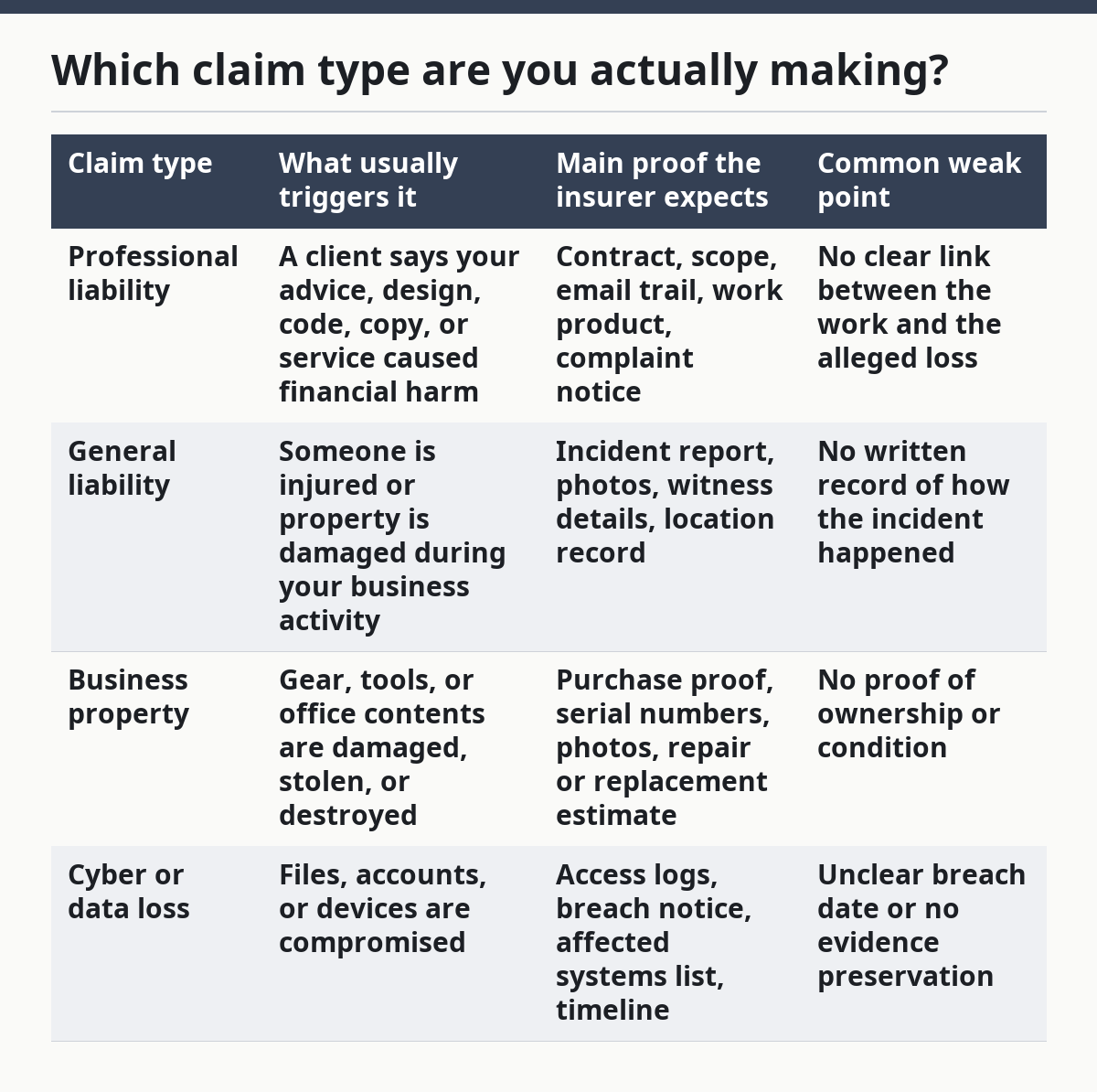
The table matters because many freelancers think “insurance claim” is one universal process. It is not. A design error claim may turn on the contract language, while a stolen camera claim turns on ownership, condition, and the serial number on the policy or invoice.
Professional liability is often the most confusing. The key term is “alleged negligence,” which means a client says your work failed to meet a duty and caused loss. The insurer may need the brief, scope of work, drafts, and any acceptance email to judge whether the allegation fits the policy.
General liability works differently. The question there is often not whether the client was unhappy, but whether a person or property was physically harmed in a covered incident. A photo, a witness note, and the location matter more than the creative brief.
Business property claims are usually the most document-driven. If you cannot show ownership, age, or condition, the insurer may reduce the payout or ask for a replacement basis instead of a repair basis. Cyber claims often move fastest when the account logs and breach notices are preserved on day one, because deleted logs can make the timeline impossible to confirm.
What mistakes do freelancers make most often?
Freelancers most often damage a claim by waiting, guessing, overexplaining, or sending the wrong proof. Those errors do not always kill the claim, but they can shrink the payout or stretch the process from days into weeks or longer.
1. Waiting to report the loss: This can break the notice clause and make the claim look avoidable — report as soon as the loss is known, even if the final amount is not yet clear. A 24-hour delay is sometimes enough to lose a clean audit trail, even when the policy does not name a precise deadline.
2. Admitting fault too early: This can create a record the insurer later has to work around — describe facts, not blame, until the claim is filed and the evidence is in place. Saying “I ruined it” in the first email can confuse coverage questions before the file is even open.
3. Sending a pile of unordered documents: This makes the adjuster spend time sorting instead of assessing — send a dated timeline, then attach the minimum proof needed. A 30-page dump without labels can slow the claim more than a 3-page packet with clear headings.
4. Using estimates that do not match the policy basis: This can lead to a payout gap — check whether the policy uses repair cost, replacement cost, or actual cash value before you attach a quote. A replacement figure on a repair-based claim can look inflated even when the gear was genuinely damaged.
5. Missing ownership proof: This can reduce or block payment for gear — keep invoices, serial numbers, and photos together for every item over time. Without those records, the insurer may accept the loss but question the amount.
6. Forgetting related policies: This can leave one loss filed under the wrong cover — check whether the event touches liability, property, cyber, or income protection. A client dispute can involve both a professional liability notice and a business interruption issue, and each one may need its own path.
The correct habit is simple: write down facts first, then build the claim packet around the policy. A freelancer who treats the insurer like a project client usually does better than one who treats the process like a complaint email.
When should you stop handling it alone?
You should stop handling it alone when the claim may affect legal rights, contract liability, tax records, or a large share of your income. At that point, the risk is not just a slower payment; the risk is saying the wrong thing or missing a procedural step that changes the outcome.
A client has threatened legal action: This means the claim may involve liability questions, reservation-of-rights letters, or defence costs — pause casual contact and get qualified help for the dispute side of the file. A casual apology can be read very differently once a claim becomes a legal dispute.
The insurer asks for a recorded statement or sworn form: This means your words may be relied on as formal evidence — prepare carefully and do not guess at dates or amounts. If you do not know, say that you do not know rather than filling the gap.
The loss could be partly excluded: This means one part of the event may be covered and another part may not — separate the facts so the covered portion does not get buried. A mixed claim that combines covered and excluded causes can stall unless the file is split cleanly.
The amount is large enough to affect cash flow for several months: This means the timing of payment matters as much as the amount — ask for the claim process in writing and keep your own records current. A payment delay can create a second problem, such as missed supplier bills or project cancellation.
The policy wording is unclear on one key term: This means the whole file may turn on a definition such as “occurrence,” “claim,” “property damage,” or “bodily injury” — get a qualified adviser to review the wording against your facts. A small wording issue can change whether the insurer has to respond at all.
You may need to accept a settlement release: This means payment could close the claim permanently — read the release before signing and confirm what rights you are giving up. Once signed, a later dispute is often much harder to reopen.
These are the points where “just keep emailing” stops working. The right move is to slow down, separate facts from assumptions, and get the file reviewed by a qualified professional who can consider your own contracts and policy wording.
How do you keep the claim moving?
You keep the claim moving by controlling the file, not by sending more messages. The fastest-moving claims usually have one owner, one timeline, one document folder, and one clear next action at any time.
A simple tracker is enough for many freelancers. Use four columns: date, action, person contacted, and next step. Keep the file names plain and dated, such as “2026-02-14_invoice_camera_repair.pdf” or “2026-02-14_client_email_notice.eml.” The point is not beauty; it is retrieval.
The insurer’s questions usually follow the same pattern: what happened, when did it happen, what does the policy say, and what is the amount. If you answer those four questions in that order, the file is easier to move. If you answer the amount first and the dates second, the adjuster still has to reconstruct the story.
Follow-up timing matters, but a hard universal rule would be false because insurers, claim types, and countries differ. A better habit is to reply on the same business day when possible and to send any missing proof in one batch rather than in fragments. A claim that grows by one document at a time often sits longer than one that arrives complete.
A freelancer should also keep the claim separate from ordinary client work. Do not bury the claim in a busy inbox. A dedicated folder and a single note with the claim number can save an hour of searching when the insurer asks for one file from 3 months ago.
What changes in harder cases?
Harder cases need tighter separation of facts, stronger document control, and more care with exclusions. The standard process still works, but three parts usually need modification: valuation, causation, and privacy.
If the loss includes both old damage and new damage, mark the dates separately. A camera with a pre-existing scratch and a new screen crack is not one clean story unless the records show the difference. The same is true for software work where a pre-existing bug and a new deployment error are mixed together.
If the claim involves client data, use the minimum necessary disclosure. Sensitive files should be shared only as needed to prove the event, and names or account details may need redaction where the policy or the insurer’s portal allows it. Privacy is not just a legal issue; it can also affect trust with clients who are not part of the claim.
If multiple policies may apply, do not assume the first insurer will sort the rest out. General liability, professional liability, equipment, and cyber cover often have different notice rules and different definitions. A claim can be slowed by filing it under the wrong policy first and then having to move the file later.
If the insurer requests an expert report or an assessment, ask what question the report is meant to answer before you pay for one. Otherwise, you risk buying a document that is thorough but not useful. A 2-page estimate may answer the insurer’s question better than a long narrative.
What does a good result look like?
A good result is a claim that is accepted, priced against the right policy basis, and closed with a record you can keep for later. It is not always the biggest number; it is the outcome that matches the cover, the facts, and the documents.
A clean closure usually has three signs. First, the insurer confirms what part of the loss is covered. Second, the payment or denial is explained with the policy language that drove the decision. Third, you keep a copy of every file item for future reference, because a second claim may need the same records.
A bad result is not only a denial. It can also be a partial payment with no explanation, a long delay because the file was incomplete, or a settlement that closes the issue before all related costs are counted. If a claim ends and you cannot tell which document convinced the insurer, the process was probably harder than it needed to be.
For freelancers, the best long-term habit is not to hope for a smooth claim. It is to keep a record set that would let the claim be handled by someone else on a busy day. A policy schedule, ownership proof, project emails, invoices, and incident notes stored together can turn a messy loss into an orderly file.
How should you prepare before the next loss?
You should prepare now by building a claim file before you need it. That means keeping the policy schedule, a current inventory, key client contracts, and a simple incident template in one place.
A practical starter list has 6 items: policy summary, equipment list, invoice folder, contact log, project timeline template, and a note on who to call first. If the policy is renewed every 12 months, review that folder at each renewal so the records stay current.
The point of preparation is not to predict every loss. It is to make sure the first 30 minutes after a problem are calm, factual, and document-led. That gives the insurer less room to question the date, the cause, or the amount later.
Frequently asked questions
How fast should I tell the insurer about a freelancer claim?
You should tell the insurer as soon as the loss is known and you can describe it clearly. Many policies require prompt notice, and delay can make the file harder to defend even when the claim is valid. If the amount is not final, you can still report the event and say that the value is being gathered.
What if I do not have every receipt?
You can still start the claim, but missing receipts can reduce the amount or slow the review. Use bank records, supplier emails, serial numbers, photos, or project files to support ownership and value where receipts are missing. If the policy wording is strict, a qualified adviser should review the file before you submit a weak estimate.
Can one event be covered by more than one policy?
Yes, one event can touch more than one policy, such as liability and property, or cyber and income loss. The hard part is making sure each part of the loss is filed under the right cover and not counted twice. The policy wording decides how overlap is handled, so read the declarations and exclusions closely.
What should I not say in the first message?
Do not guess, admit fault, or exaggerate the loss in the first message. Stick to the date, what happened, what was affected, and what evidence you have. A short factual notice is safer than a detailed explanation that later turns out to be wrong.
When is it worth getting professional help?
It is worth getting professional help when the claim could change your liability position, your contract rights, or a meaningful part of your income. That is especially true if the insurer asks for a formal statement, if the wording is unclear, or if the claim mixes covered and excluded causes. A qualified adviser can review your own situation, which this article cannot do.
Drafted with AI; not yet reviewed by a person.
