
Last updated: November 22, 2026
Quick answer: freelance insurance underwriting and eligibility usually come down to 5 checks — your work type, income pattern, claims history, business structure, and documents. Freelance insurance underwriting and eligibility come down to one thing: the insurer is checking whether your work, income pattern, and risk profile fit its rules well enough to issue a quote at all. If your freelance work is irregular, high-risk, or hard to document, the answer can change fast, even when you have the same job title as another freelancer.
This is information, not financial advice. Insurance rules, rates, and eligibility standards differ by country and change often, so a qualified adviser should be consulted for your own situation.
Key takeaways
- Underwriting is the insurer’s review process; eligibility is the set of rules that decides whether you can get a quote or a cover offer.
- Freelancers often get judged on income stability, type of work, claims history, business structure, and how clearly the work can be described.
- The same freelance role can land in different buckets depending on clients, tools, contracts, and whether work is digital, physical, or advisory.
- If your income swings month to month, the issue is usually documentation, not the word “freelance” itself.
- A denial or higher premium is not always the end of the road; sometimes a cleaner business description or better records can change the result.
What do underwriting and eligibility mean for freelancers?
Underwriting is the insurer’s risk check, and eligibility is the rulebook that decides if your freelance work fits that check. For a freelancer, that means the insurer may look at what you do, how often you do it, where clients are, how much you earn, and whether your work creates damage, injury, privacy, or payment risk.
The two terms sound similar, but they work at different stages. Eligibility is the gate at the front door; underwriting is the review after that door opens. A freelancer can be eligible in principle and still face a higher premium, tighter exclusions, or a request for extra detail before the insurer finishes the quote.
For freelancer liability insurance, the usual question is not “Are you self-employed?” It is “What exactly do you do, and what could go wrong because of it?” A graphic designer, a copywriter, a web developer, and a consultant may all be freelancers, but they can sit in different risk bands because the loss scenarios are different. One insurer may treat digital services as lower exposure, while another may focus on contractual risk, copyright issues, or client data handling; if the difference affects your application, consult a professional and check the insurer’s own guidance or consumer material from the National Association of Insurance Commissioners (NAIC) and the Financial Conduct Authority (FCA).
That is why a generic answer often fails. A blanket statement like “freelancers need liability insurance” misses the real issue: some freelance roles are easier to insure than others, and the eligibility test changes with the work itself. The sharper the job description, the easier it is for an insurer to place you in the right class.
For a general overview of how underwriting works, the NAIC explains the process on its consumer material, and the FCA has plain-language guidance on how firms assess risk and products. Those pages are useful background, even though the exact rules still depend on the insurer and the country.
Quick check: if you cannot describe your freelance work in one clear paragraph, underwriting will likely stall before the insurer reaches the premium stage.
What actually determines the result?
The result is usually driven by five things: the work you do, the money you earn, your history of claims or disputes, the way your business is set up, and the documents you can produce. If any one of those looks unclear, the insurer may ask for more detail, change the offer, or decline it.
Here is the cleanest way to think about it. If your freelance work creates low physical risk but high professional error risk, the insurer may care more about advice, deadlines, and client contracts than about tools or equipment. If your work involves people on site, property, or direct public contact, the physical side of the risk gets more attention. If your work includes sensitive data, privacy exposure can become a major factor.
Income matters because it is part of the picture, not because the insurer is trying to judge your success. A freelancer with one large client and six quiet months may look different from a freelancer with ten small clients and steady turnover, even if annual income is similar. That does not mean one is better; it means the insurer may see different concentration risk.
The business structure also matters. A sole trader, a limited company, and a partnership can present different legal and operational profiles. Insurers often want to know whether the policyholder is the individual freelancer or the business entity, because that changes who is covered and how claims are handled.
Claims history matters too. If you have had prior claims, professional complaints, or payment disputes, the insurer may want details about what happened, when it happened, and what changed afterward. A single event does not always block cover, but repeated events can push the decision the other way.
Situation | Best Path | Why Other Options Fail
| Situation | Best Path | Why Other Options Fail |
|---|---|---|
| New freelancer with simple digital work | Give a precise job description and basic income records | A vague description can look riskier than the work itself |
| Freelancer with uneven monthly income | Show tax returns, invoices, and bank records together | One document alone can look incomplete or misleading |
| Freelancer with prior claim or dispute | Disclose it fully and explain the change in process | Leaving it out can trigger later refusal or cancellation |
| Freelancer with client data access | Describe data handling, storage, and security steps | If data risk is hidden, the insurer may price or exclude it incorrectly |
| Freelancer working on-site with tools or visitors | Clarify physical exposure and who controls the worksite | A desk-based description can understate real hazard |
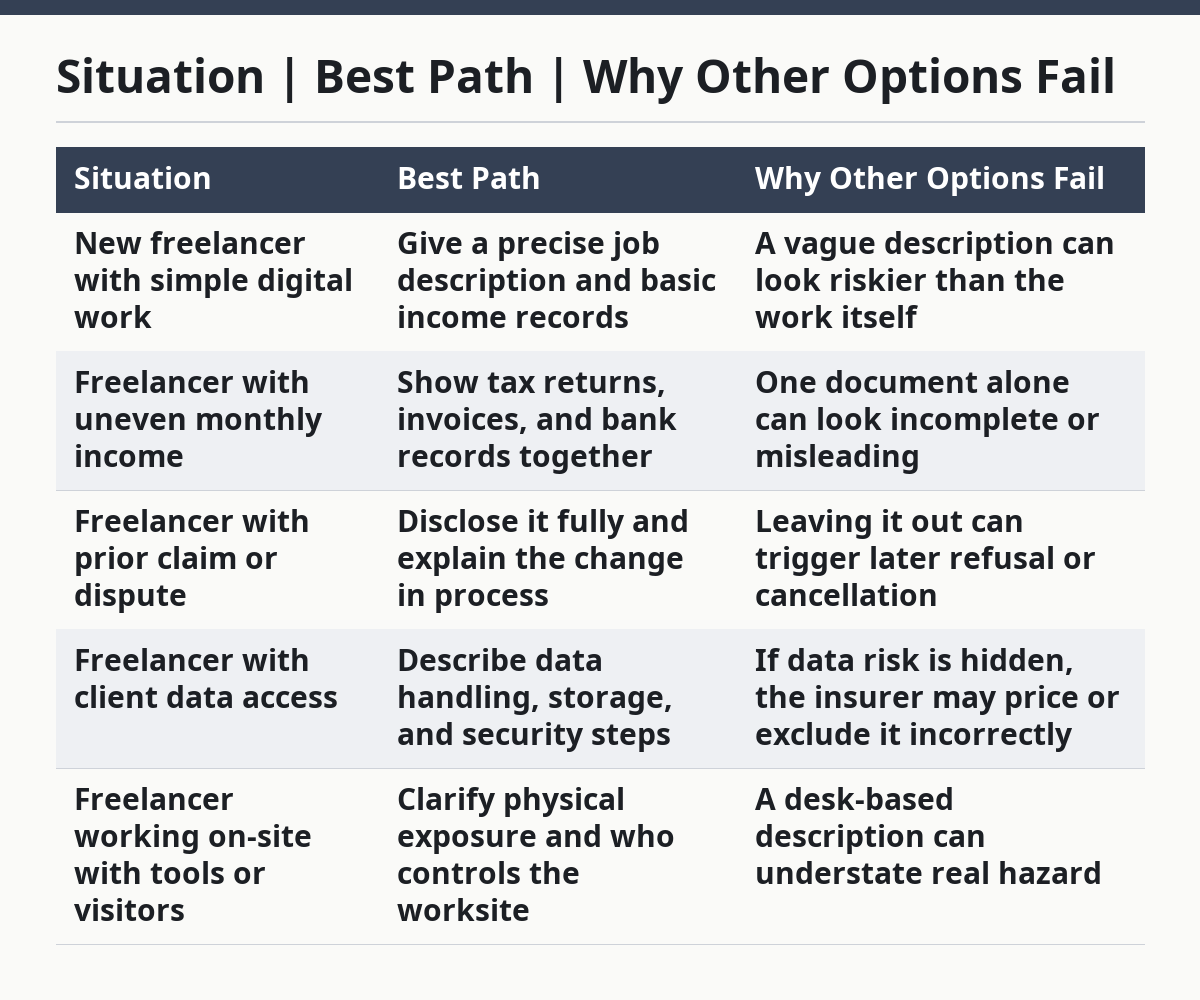
The practical lesson is simple: underwriting is less about labels and more about evidence. A better file can change the answer even when the underlying freelance work stays the same.
Quick check: if your records are scattered across email, spreadsheets, and bank apps, the insurer may read that as uncertainty, not just administration.
If you’re self-employed with uneven income, what happens?
Uneven income does not automatically block eligibility, but it often changes how the insurer reads your stability. If you earn in bursts, take long gaps between projects, or rely on one or two large clients, the insurer may ask for a longer paper trail before it decides.
That paper trail usually matters more than the monthly pattern itself. A freelancer who can show invoices, tax filings, client agreements, and bank deposits over time often looks clearer than someone with higher income but no clean records. Underwriting likes consistency in the story, even when the income is inconsistent in practice.
If you have a slow month, do not try to smooth it over with a guess. If you had a busy quarter, do not assume the insurer will average it out by itself. The safer approach is to explain the pattern in concrete terms: project-based work, seasonal demand, retainer clients, or milestone billing. The insurer is trying to classify risk, not audit your life.
There is also a difference between instability and uncertainty. Instability means income rises and falls. Uncertainty means the insurer cannot tell why it rises and falls. A clear explanation turns the second problem into the first, which is much easier to price or assess.
For a freelancer, this is where business records matter as much as the work itself. If you use a separate bank account, issue formal invoices, and keep copies of client scope documents, the insurer can trace the line between your work and your income. If everything is mixed together, the insurer may treat the file as incomplete, so it is sensible to check the insurer’s document list or ask a qualified adviser before you send it.
A useful benchmark is the tax return cycle in your country. If your records are built around that cycle and the insurer asks for “recent” evidence, recent usually means the latest filing period plus current invoices or bank statements, not just one good month. Exact document rules vary by country and carrier.
Quick check: if you can explain your income swings in one sentence and back it up with records, you are in a much better position than a freelancer who only has estimates.
What documents do insurers usually ask for?
Insurers usually ask for documents that prove what you do, how long you have done it, and how the work is organized. If the file is simple, the request may be short. If the work is specialized or the risk is less obvious, the request can expand quickly.
Common documents include a business description, invoices, client contracts, tax records, bank statements, and proof of any relevant qualifications or memberships. Some insurers also want details about subcontractors, software tools, premises, or security procedures, especially when the work involves client data or other professional exposure.
The point of the request is not paperwork for its own sake. The insurer needs enough detail to match your work to the right class of business and to decide whether any exclusions are needed. A one-line description like “freelance consultant” is rarely enough, because that phrase can cover a wide range of jobs with very different loss patterns.
If you are asked for proof of turnover, send the period the insurer asked for and keep it consistent. A clean set of records from the same period is easier to review than a patchwork of screenshots. If you are asked for your client mix, a simple count of active clients can help more than a long explanation that never gets to the point.
Here is a practical order for putting the file together:
- Write a clear work description in plain English, including the type of service, who the clients are, and where the work is done.
- Collect recent invoices, tax filings, or accounts that show the business is active.
- Gather any contracts, scopes, or statements of work that show what you promise clients.
- List tools, software, equipment, or access to client systems if they affect the risk.
- Note any past claims, complaints, or disputes and explain the outcome in one short timeline.
- Check the name on the application, the business name, and the legal entity so they match across documents.
If the insurer asks for a professional standard, the answer may be tied to an industry body or code of practice rather than a law. In some fields, the insurer will want to know whether your work follows a recognised standard, such as a published code from a professional association. If that standard exists, name it; if it does not, do not invent one.
Quick check: if your documents can be read in under 10 minutes without guesswork, underwriting tends to move more smoothly.
Which path fits your situation?
The right path depends on what kind of freelance risk you actually have, not on the generic label on your tax form. If you know the situation, you can predict the likely underwriting questions before you apply.
The table below shows the most common paths and why some alternatives fail.
| Situation | Best Path | Why Other Options Fail |
|---|---|---|
| Solo freelancer with advisory or creative work | Use a precise service description and show client agreements | A broad job title can hide the real exposure |
| Freelancer with equipment, tools, or a worksite | Explain physical risk, storage, and who controls access | A pure “office work” label misses property and injury risk |
| Freelancer handling client data | Describe access controls, passwords, backups, and retention rules | Vague data handling makes the insurer assume more exposure |
| Freelancer with subcontractors | State who does the work, who supervises it, and who carries risk | If subcontracting is unclear, cover may not fit the real setup |
| Freelancer with past disputes or claims | Disclose the issue and what changed after it | Silence can create a later coverage problem |
| Freelancer with one large client | Show how concentration risk is managed | A single client can look unstable even when revenue is strong |
If your work is mostly digital, your eligibility often turns on errors, missed deadlines, copyright, or data issues. If your work is physical, the insurer may care more about location, public contact, tools, and accidental damage. If your work is advisory, the detail in your scope of work matters more than the number of hours you bill.
The best path is usually the one that makes your risk legible. That means a title, a scope, and a record trail that all point in the same direction. The weakest path is the one that hides the real work behind a generic label and hopes the insurer will fill in the blanks.
This is also where one page of preparation can save several rounds of questions. A freelancer who can answer “what do you do, for whom, where, with what tools, and under which legal entity?” will usually get a cleaner underwriting review than someone who answers with a brand name only.
Quick check: if your freelance business has more than one type of work, treat each type separately before you apply.
When does standard advice break down?
Standard advice breaks down when the freelance setup is unusual enough that the normal risk box does not fit. If your situation is one of the cases below, the insurer may care about a detail that other freelancers can ignore.
-
You work across borders.
What changes: country rules, liability law, and cover wording can shift by market.
What to do instead: identify where clients are based, where the work is performed, and which country’s rules the insurer expects to apply. A freelancer with clients in two countries can face a very different eligibility screen from someone working only at home. -
You do both freelance and employed work.
What changes: the insurer may need to separate the freelance side from the employment side.
What to do instead: keep the freelance income, tasks, and client list distinct. If the insurer asks about full-time work, answer it separately rather than blending both roles into one description. -
You subcontract most of the work.
What changes: liability can sit with the principal, the subcontractor, or both depending on the arrangement.
What to do instead: name the subcontracted tasks, who supervises them, and whether the subcontractor has their own cover. If that line is muddy, the insurer may not know what it is really pricing. -
You handle sensitive data.
What changes: privacy exposure becomes a bigger issue than ordinary service error.
What to do instead: describe storage, access controls, backup routines, and who can see client files. A freelancer who works with personal data or confidential files needs a clearer process than one who only drafts public-facing content. -
You are newly started with little history.
What changes: the insurer has less evidence to judge stability.
What to do instead: present the business plan through records you already have, such as client letters, sample contracts, training evidence, or invoices from early work. A short history does not equal ineligibility, but it does reduce the data the insurer can use. -
You had a prior claim or complaint.
What changes: the underwriting file may focus on recurrence and controls.
What to do instead: state what happened, when it happened, and what changed afterward. If the insurer asks for a timeline, keep it tight and factual. A clear fix can matter more than the original mistake.
This is where a generic “freelancers are easy to insure” line becomes misleading. Some are easy. Some are not. The difference is usually not the word freelance; it is the shape of the work beneath that word.
Quick check: if one part of your freelance work would make sense to a client but not to an insurer, that part needs rewriting before you apply.
What should you do if you’re denied or quoted high?
A denial or high quote usually means the insurer found a part of the file it does not like, not that your freelance business is uninsurable. If the offer is poor, the first step is to find out which risk factor drove the result.
Start by asking for the reason in plain language. Some carriers will point to the work type, the territory, the claim history, the client mix, or the lack of supporting records. If the answer is vague, ask what specific change would make the file easier to assess. That question often reveals whether the issue is fixable or built into the business model.
Then review the application line by line. A broad title, a missing client detail, or a misread scope can hurt a file more than the actual risk. If the description says “marketing” but the work includes paid ad management, web edits, and client data access, the insurer may have priced something smaller than the real exposure. That mismatch can lead to a bad quote or an outright decline.
A useful step-by-step path looks like this:
- Read the declination or quote notes carefully and identify the exact concern.
- Check whether the business description matches the work you actually do.
- Gather cleaner records: invoices, contracts, tax filings, and any relevant process notes.
- Separate different service lines if your freelance business does more than one kind of work.
- Ask whether a different class, wording, or document set would change the assessment.
- Compare the revised file against the original so you can see what actually changed.
Do not assume a high quote means the insurer is overcharging. A high price can reflect uncertainty, missing data, or a risk shape the carrier does not like. It can also reflect a real exposure that the insurer sees more clearly than the applicant does. The right move is to understand the reason, not to guess at it.
For background on how insurers and regulated firms assess risk and handle complaints, the NAIC and the FCA both publish consumer material that can help a reader understand the process. If your situation turns into a formal dispute, local rules matter a great deal, and a qualified adviser should be involved.
Quick check: if the insurer’s reason for the quote does not match your actual freelance work, the file likely needs a rewrite, not just a different price.
FAQ
Is freelance insurance underwriting the same as eligibility?
No, they are related but not the same. Eligibility is the front-end rule that decides whether a freelancer can be considered at all, while underwriting is the deeper review that decides the terms, exclusions, and price. A freelancer can pass the first step and still face limits or a higher premium after underwriting.
Do freelancers with irregular income always struggle to qualify?
No, irregular income does not automatically block cover. The main issue is whether the insurer can understand the pattern from records such as invoices, tax returns, and bank statements. If the swings are explainable and documented, the file is usually easier to assess than a higher-earning file with no paper trail.
What is the fastest way to improve eligibility?
The fastest improvement is usually a clearer business description backed by the right documents. A one-line label like “freelancer” is too vague, so spell out the service, the client type, the work setting, and the legal entity. Clean records often do more than any single form field.
Can one side job affect the whole application?
Yes, it can. If the side job creates a different type of exposure, the insurer may need to assess the whole freelance setup differently. The safest approach is to describe every paid activity that could matter to risk, even if it is only a smaller part of the income.
Should I hide a past claim if it was small?
No, hiding it can create a bigger problem than the claim itself. A small past issue may still be manageable if it is disclosed with a short, factual explanation and evidence of what changed afterward. If the insurer finds an undisclosed event later, the result can be much worse than a higher quote.
Which answer matters most?
The most important answer is that freelance underwriting is a matching exercise, not a moral score. If your work, records, and risk description line up, eligibility is easier to judge; if they do not, the insurer may hesitate, price higher, or decline it. The practical job is to make the freelance business legible on paper, because a clear file is easier to assess than a clever one.
Drafted with AI; not yet reviewed by a person.
