

Last updated: November 21, 2026
Report the mix the way your records show it: gross revenue by income source, the share from freelance work, and the expected income for the next 12 months. If your income comes from a freelance business, a side business, 1099 work, or retainer jobs, the application should read like a clean summary of your tax records and accounting records, not a story.
This is information, not financial advice. For your own situation, a qualified adviser should check how your insurer wants income disclosed.
Key takeaways
- Match the application to the way money actually comes in, not to the cleanest version of the story.
- Use gross revenue unless the form clearly asks for net income.
- Keep freelance business income, side income, and part-time 1099 work separate if the form has room for it.
- Use tax records and accounting records to support the numbers you write down.
- If income swings from month to month, give a realistic expected revenue figure for the next 12 months, not a best-case guess.
What income mix means on an application

Income mix means the split between the different ways freelance work pays you. A carrier may want to know whether most of your money comes from a primary business income stream, a smaller side business, project-based revenue, or retainer revenue that repeats every month.
That matters because underwriting looks for consistency, not just total income. A freelancer with $10,000 from one retainer and $2,000 from one-off projects can look very different from someone with the same total but no repeat clients. The same rule applies if some work is 1099 income and some comes from direct client invoices or part-time freelance work.
However, the cleanest source for the split is your own records. Tax records show what was reported for the year, while accounting records show when the money came in and from which client or job. The IRS Schedule C instructions explain how sole proprietors report business income and expenses, and the self-employment tax pages show why gross and net are not the same thing:
https://www.irs.gov/instructions/i1040sc
https://www.irs.gov/businesses/small-businesses-self-employed/self-employed-individuals-tax-center
This page is for someone who already has invoices, bank statements, or accounting software records. It is not the place to sort out whether a side business belongs on the application at all; that topic needs its own form-specific review.
How should the numbers be grouped?
Therefore, report the numbers in the same buckets the form uses, and if the form gives no buckets, separate them in a short note. The goal is to show where the money comes from, not to make every stream look larger than it is.
| Income type | What it usually means | What to check |
|---|---|---|
| Primary business income | The main freelance line that brings in most gross revenue | Annual invoices, client ledger, tax return |
| Side income | Smaller freelance work outside the main line | Separate invoices, bank deposits, 1099s |
| 1099 income | Payments reported by a payer on tax forms such as 1099-NEC | Payer records, year-end statements |
| Project-based revenue | One-off jobs billed by project | Contract terms, invoice dates, completion dates |
| Retainer revenue | Repeating income for ongoing access or monthly work | Monthly invoice pattern, service agreement |
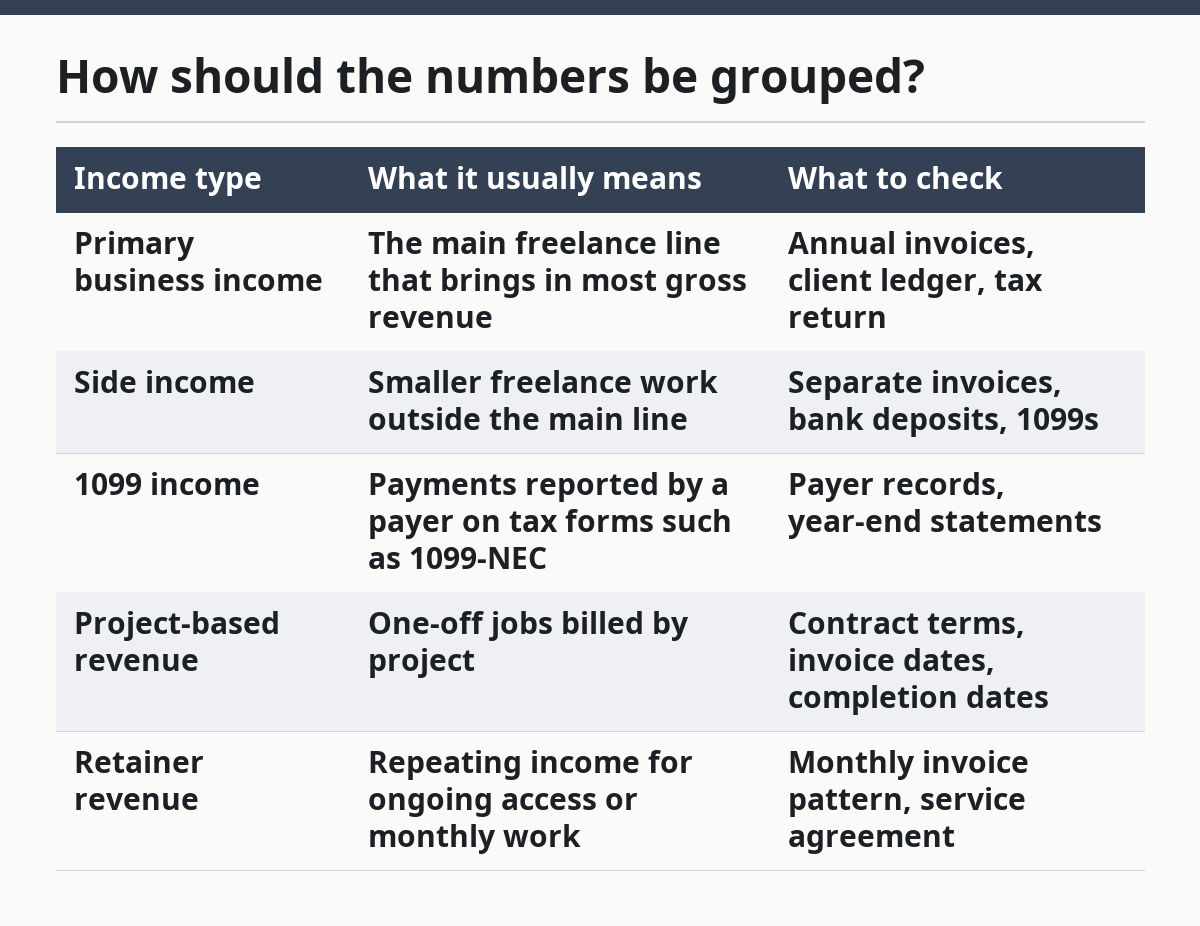
A common mistake is to collapse all of this into one number and hope it passes. That can blur a stable retainer into a spiky project load, and that can change how the application reads. The better move is to keep the split visible if the form or the agent asks for it.
How do you fill out the application step by step?

So, fill it out from your latest annual records first, then adjust for the expected revenue period the form asks about. That usually means starting with 12 months of history and then checking whether the application wants current-year or projected income.
- Open the application and find the income section before you touch the totals. Verify whether it asks for gross revenue, net income, or both, and flag any blank line marked “other” or “additional income.” If the form only offers one box for a business with multiple streams, that is a problem because the mix may get flattened.
- Gather 12 months of tax records and accounting records. Pull invoices, bank deposits, year-end 1099s, and your Schedule C if you file one. If the records do not cover the full 12 months, the mix may be incomplete and the result can look more stable than it really is.
- Separate the income into primary business income, side income, 1099 income, project-based revenue, and retainer revenue. Use one line for each stream if the form allows it, and keep the categories consistent across the page. If one stream has no documentation, do not merge it into another just to finish the form.
- Add the gross revenue for each stream before any business expenses. Gross revenue is the full amount billed or received before costs, while net income is what remains after expenses. If the form asks for net income and you write gross, the figure may be too high for underwriting.
- Cross-check the total against the tax return and bank deposits. The total should make sense when compared with the annual tax record and the monthly flow in the accounting records. If the application total is far above the records, the carrier may question the numbers.
- Estimate expected revenue for the next 12 months using the same split. Keep retainer revenue steady only if the agreement is ongoing, and keep project-based revenue variable if that is how it really works. If the estimate depends on two new clients that are not signed yet, the projection is too soft to trust.
- Explain any sharp drop, spike, or gap in one sentence on the form or in the notes field. Use a plain reason such as “three-month lull between contracts” or “new retainer started midyear.” If the explanation needs a long story, the application may need a separate underwriting note.
- Review the final entry for consistency across the whole application. The business name, income split, and expected revenue should all point to the same freelance business model. If one page says full-time retainer work and another says occasional side income, stop and correct it before submitting.
Next, the main check is simple: can a person reading the form understand how the money is earned without guessing? If the answer is no, the form is still not ready.
Do you report gross or net income?
However, report whatever the application asks for, and do not swap one for the other. Gross revenue is the top-line amount before expenses, while net income is the amount left after business costs such as software, supplies, or subcontractors.
Most insurance applications care about the size and stability of the business, so gross revenue often gives the clearer picture. But some forms ask for net income because they want the profit figure after expenses, and using gross in that spot can make the business seem larger than it is. A 1099 for $8,000 and a net profit of $5,000 are not the same figure.
The right move is to read the label on the form, then pull the matching number from the same record set. If the form is unclear, use the notes section to say which figure you entered and where it came from, such as annual accounting records or tax records.
What mistakes change the result?
The biggest mistakes are the ones that make the income look cleaner than it is. That can lead to follow-up questions, a slower review, or a form that no longer matches the real freelance business.
- Combining every stream into one number: This hides the difference between steady retainer revenue and uneven project-based revenue. The fix is to split each stream if the form gives room, or note the mix in a short comment.
- Using net income when the form wants gross revenue: This can understate the business size and make the application look inconsistent with tax records. The fix is to match the field label exactly and check the form language twice.
- Leaving out side income: A small side business still counts if it is part of the freelance picture. The fix is to include it in the right bucket instead of pretending it does not exist.
- Guessing at expected revenue: A projection built on hope is weak underwriting material. The fix is to base expected revenue on signed work, recurring retainers, and recent invoices.
- Ignoring 1099 records: Missing a payer statement can make the annual total too low or too high. The fix is to line up every 1099 with the matching deposit and invoice.
Even so, the cost of these errors is usually practical, not dramatic: extra questions, a need to resubmit, or a record that does not match the business model. On a money form, that is enough reason to slow down.
When does the standard approach not fit?
In contrast, the standard approach does not fit when the income pattern is too uneven to summarize cleanly in one annual figure. In those cases, a short note or a fuller accounting record is better than forcing a neat answer into a bad box.
No 12-month history: The application cannot show a stable pattern — use the records you do have and explain that the business is new.
Large swings between months: A project-heavy business may have one strong quarter and one weak quarter — show the mix and avoid averaging away the swing.
Two business lines under one name: Design, writing, consulting, and other streams can sit in one freelance business, but the split still matters — separate them if the form allows.
Income changes after the last tax year: A new retainer or a lost client can make last year misleading — add current expected revenue if the form asks for it.
Records do not match deposits: Missing invoices or unrecorded refunds can distort the picture — fix the records before filing, or ask a qualified adviser to review the numbers.
These are the moments when a careful form is not enough by itself. The issue is not the application; the issue is that the business record needs cleanup first.
What should the final review catch?
Therefore, the final review should catch any mismatch between the story the form tells and the numbers in the records. That review takes only a few minutes, but it can stop a bad submission before it goes out.
Check that the main business is named the same way in every place on the form. Check that the income mix, the gross or net figure, and the expected revenue all line up with the last 12 months of tax records and accounting records. If the form has a notes box, use it for a short explanation of retainer revenue, part-time freelance work, or any period with almost no project work.
A good result is usually straightforward. The form reads like a summary of the real freelance business, not a puzzle.
How to make the application easier to read?
Because the reviewer needs to scan quickly, make the income mix easy to follow by using the same wording the form uses and the same categories your records use. A carrier reviewer should not have to guess whether “content work,” “copy gigs,” and “writing jobs” are three streams or one.
Use one term for each stream, one annual total for each stream, and one short explanation for any unusual gap. If the form allows attachments, a simple summary page built from tax records and accounting records can help, but the application still needs the main numbers filled in clearly.
The practical standard is plain: if a stranger can follow the income trail in under a minute, the application is in good shape. If not, the form needs another pass.
Do I report gross or net income on a freelance insurance application?
Use the figure the form asks for, and do not switch them. Gross revenue is the full amount before expenses, while net income is what remains after costs. If the label is unclear, check the instructions or ask a qualified adviser before submitting.
How do I include side income from freelance work?
Include it in the same income mix, but keep it separate from the main freelance business if the form has room. A small side business still matters if it changes the size or pattern of your income. Often, a year of invoices, deposits, or 1099 records is the simplest support.
What if my freelance income is inconsistent?
Show the inconsistency instead of smoothing it out. Use 12 months of records, then explain the pattern with a short note if the form allows it. If the swings are large or the business is new, a qualified adviser should review how the expected revenue should be described.
Drafted with AI; not yet reviewed by a person.
