

Last updated: November 22, 2026
Quick Answer: Close out a freelancer claim after the client issue is resolved only when 3 things line up: the final written status matches the outcome, the insurer has no open requests, and the file includes the closure letter. In How to Close Out a Freelancer Claim After the Client Issue Is Resolved, the last step is administrative, and the record should show the claim number, the date, and the final disposition.
This article is information, not financial advice. Claims rules, settlement terms, and document retention periods can vary by country and insurer, so a qualified adviser should be consulted for your own situation. For general recordkeeping guidance, see the FTC’s advice on keeping records and NAIC consumer resources on insurance disputes.
Key takeaways
- A claim is ready to close when the dispute, payment, or withdrawal is settled and nothing is still pending.
- The clean finish is administrative: confirm the final status, save the closure letter, and keep the file together.
- A claim can be closed without a payout, but the record still matters if the issue resurfaces.
- If the insurer still asks for forms, signatures, or payment proof, the claim is not at the finish line yet.
- A closed file that matches the settlement, the withdrawal, or the final denial on record is the least confusing end state.
Who this applies to

This applies to a freelancer who already reported a client issue, has a response from the insurer or claims adjuster, and wants to end the claim in the right way. It assumes the main dispute has been resolved, the settlement amount or withdrawal terms are known, and the policy file already contains the core claim records.
It does not apply if the dispute is still active, if the insurer is still asking for evidence, or if the settlement has not been accepted in writing. It also does not fit cases with legal action, fraud concerns, or unclear coverage, where the next step may need qualified help rather than a simple close-out.
For a broader map of the process, the hub on freelancer insurance claims and incident response is the right place to start, then return here for the final stage.
A useful rule is simple: if there is still a live question about money, liability, or paperwork, the claim is not ready for closure. The final step is administrative, not just emotional.
What counts as claim closure?
Claim closure means the insurer has marked the matter as finished and the file is no longer active. In plain terms, the claim has reached a final status: settled, withdrawn, denied, or otherwise ended under the insurer’s process.
That final status should match the last written step in the record. If the file says “settled,” the settlement letter should show the agreed terms. If it says “withdrawn,” the note should show who withdrew it and when. If it says “closed,” that should still line up with the last communication from the claims adjuster.
A closure letter is the paper trail that proves the end point. It may be brief, but it should show the claim number, the date of closure, and the final disposition. Without that, the policy file can look finished on one side and unfinished on the other.
This is also where a generic article often gets it wrong. It treats closure as a shrug: “the problem is over, so stop.” In insurance work, the record matters because a later question may turn on whether the claim was settled, withdrawn, or simply parked; if you are unsure, consult a qualified professional and check the insurer’s written guidance. See also the NAIC consumer help pages for dispute-related recordkeeping.
How do you close it out step by step?

You close it out by confirming the final outcome, matching every document to that outcome, and getting written closure from the insurer. The process is usually administrative, but it should be done with the same care as the original notice.
- Confirm the final outcome in writing. Ask for the last written position from the claims adjuster and check that it names settlement, withdrawal, denial, or another end state. The result should be clear on one page or in one email thread. If the answer is only verbal, the file is still open, and you should consult a qualified professional if the status is unclear.
- Check the settlement terms line by line. If there is a settlement, make sure the amount, any release language, and the payment timing all match the agreed terms. A mismatch of even one clause means the closure letter may not be valid for the file. If the terms are not consistent, stop and ask for correction.
- Verify that all conditions have been met. Look for any request for a signed release, receipt, or proof of payment. A claim should not be marked closed while a required document is still missing. If the insurer still has an open request after 7 days or after the agreed deadline, the close-out is not ready, and you may want to consult a qualified professional before relying on the status.
- Save the closure letter and the final message chain. Keep the closure letter together with the last email, the settlement note, and any final payment confirmation. The file should show the path from issue to resolution in one place. If pieces are scattered across devices or accounts, the policy file is incomplete.
- Confirm the claim number and final status on every record. Each document should refer to the same claim number and the same closure date. Mixed claim numbers or different closure dates are a warning sign that the wrong file was updated. If the identifiers do not match, ask for a corrected version before the file is archived.
- Check whether the insurer wants a withdrawal notice. If the claim was withdrawn rather than paid, the insurer may need a short written notice saying the matter is resolved and no further action is requested. A withdrawal without written acknowledgment can leave the file in limbo. If the insurer has no signed acknowledgment, do not assume the case is closed, and consult a professional if the wording is unclear.
- Record any final follow-up date. Note whether the insurer said the file will close immediately or after a short internal review. Some files need a final administrative pass before the system reflects closed status. If that date passes and the status has not changed, follow up once with the adjuster.
- Archive the file in one place. Put the final set of papers in one folder, digital or paper, and label it with the claim number and closure status. A tidy archive reduces confusion if the issue returns later. If the folder is missing the settlement or closure letter, it is not complete.
The figure that matters here is not a dollar amount; it is the document count. A finished claim should have enough records to show who ended it, how it ended, and when. If that chain is broken, the claim may be over in practice but not closed in the file.
Settlement, withdrawal, or final status?
These are not the same thing, and the label changes what the closure means. Settlement ends the claim with an agreed result, withdrawal ends it because the claimant no longer wants to pursue it, and final status is the insurer’s administrative label for the end point.
| End state | What it means | What should be in the file | Main drawback |
|---|---|---|---|
| Settlement | The parties reached a final agreement | Settlement letter, payment note, any release language | A missing term can cause later confusion |
| Withdrawal | The claim was pulled back before a final payout | Written withdrawal notice and insurer acknowledgment | A bare withdrawal can leave no clear end record |
| Final status | The insurer has marked the file closed | Closure letter and final claim note | The label may hide what actually happened unless the documents are saved |
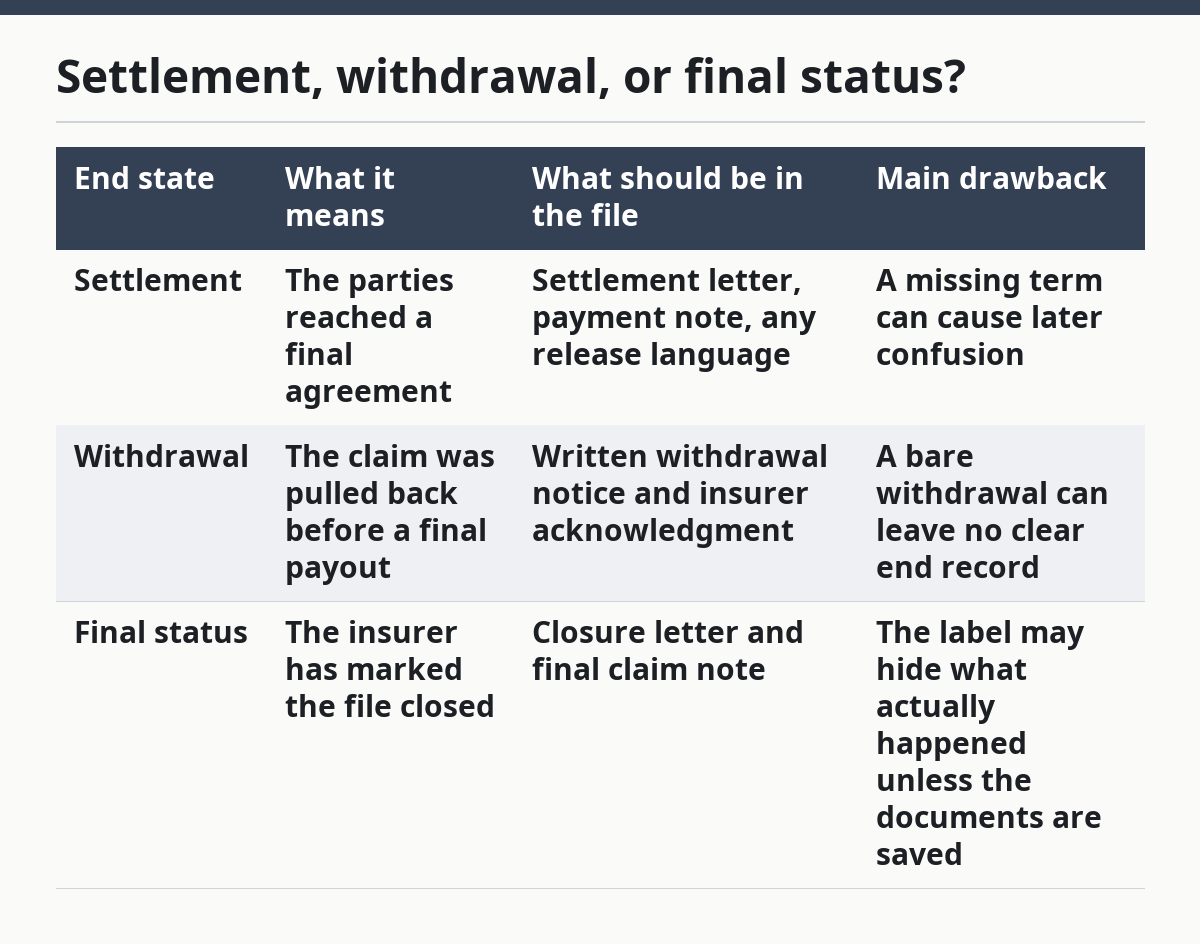
The table is a practical guide, not an absolute rule. What matters is matching the paper trail to the actual outcome. A claim closed as a settlement needs a different record from a claim closed because the freelancer withdrew it. If those are mixed up, the policy file becomes hard to trust later.
This is also where a reader may overread the word “closed.” Closed is an administrative term, not proof that every side issue vanished. A closed file can still matter if a payment goes missing, a release was never signed, or the same client issue comes back with new facts.
What should the insurer send back?
The insurer should send a closure letter or a final status notice that says the claim is ended. That note should identify the claim, the final outcome, and any remaining steps, even if those steps are just record retention on the insurer’s side.
The claims adjuster may also send a final email saying no further action is needed. That is useful, but it is weaker than a closure letter because email chains can get buried. If the file is ever reviewed again, the closure letter is the cleaner record.
Check the closure notice for three things: the claim number, the final status, and the date. If any of those are missing, ask for a corrected version. A file with a vague note like “all set” is not a strong end record.
When the insurer does not send anything after a settlement or withdrawal, a short follow-up is reasonable. Keep it factual and brief: ask for written confirmation that the policy file is closed. If the reply is delayed, that may signal the file still needs an internal step. See the consumer complaint guidance if you need a written paper trail.
When should you stop and ask for help?
You should stop the normal close-out and get qualified help when the file is no longer routine. The issue is not whether the claim is annoying; the issue is whether the next step could affect money, rights, or a formal record.
The insurer says the matter is under review again: That usually means the file is not actually closed — ask for the reason in writing and do not treat the claim as finished. If the status is unclear, consult a qualified professional.
The settlement terms changed after acceptance: That means the end state is disputed — do not sign a closure document until the new terms are clear, and consider getting professional advice.
A release form is unclear or incomplete: That means you may be giving up more than you intended — get the wording checked before signing, and consult a professional if needed.
The claim was withdrawn but the insurer still shows it as open: That means the administrative record is behind the real event — ask for written acknowledgment of withdrawal and seek advice if the file does not update.
The client issue returned with new facts after closure: That means the old file may not cover the new problem — open a fresh review rather than relying on the old close-out.
The file involves fraud concerns or formal legal action: That means the routine claim process is the wrong tool — stop the close-out and get proper guidance.
These are the points where a tidy folder is not enough. The consequence of pushing ahead is a messy record that can be harder to sort out later than the original claim.
What mistakes cause trouble later?
The mistakes that cause trouble later are usually small at the time and costly after the fact. Most of them come from closing the file too fast, or from saving the wrong paper.
One common error is treating a verbal update as closure. That leaves no proof if the file later reopens, and it can cause a mismatch between the adjuster’s note and your own records. The fix is simple: ask for a written closure letter or final email, and consult a qualified professional if the status is still unclear.
Another mistake is deleting the message thread after the problem is solved. A later question about settlement, withdrawal, or payment can be impossible to answer without the last 2 or 3 messages. The better move is to archive the full thread in one folder.
A third mistake is ignoring a required release or acknowledgment. If the insurer needed a signed document and never got it, the file may still be open on their side even if the matter feels finished. The alternative is to check the closure conditions before you file anything away.
A fourth mistake is mixing old and new versions of the same document. One wrong date, one changed clause, or one outdated attachment can make the policy file look inconsistent. The safer approach is to keep only the final version and label it clearly.
A fifth mistake is assuming that closure means the same thing everywhere. It does not. Some insurers use “closed” for settled files, while others use it for withdrawn or denied files too. The correct alternative is to read the final status in context, not by the label alone.
How long should you keep the records?
You should keep the records for as long as your insurer, contract terms, or local rules require, and those rules vary by country. The safe habit is to keep the settlement, closure letter, final email chain, and any withdrawal acknowledgment together in one place.
This is one area where a generic answer fails. There is no universal retention period that fits every freelancer, every insurer, or every jurisdiction. If the claim involved money, liability, or a client dispute that could recur, the file is worth keeping in a way that is easy to retrieve later.
A practical archive usually includes the claim number, the final status, the date of closure, and the last correspondence. That gives you a clean record if the same issue resurfaces 6 months later or if the insurer asks for a prior claim history. If the folder is incomplete, the file is not truly closed in any useful sense. For a related checklist, see document retention guidance.
FAQ
What does claim closure mean?
Claim closure means the insurer has ended the claim and marked the file as finished. The closing record should match the final outcome, such as settlement, withdrawal, or another final status. A closure letter is the clearest sign that the file is no longer active.
Should I keep records after closure?
Yes, keep the records after closure. Save the settlement, closure letter, final email chain, and any withdrawal acknowledgment in one place. If the issue comes back later, those papers show what was decided and when.
Can a closed claim reopen?
Yes, a closed claim can sometimes reopen if new facts appear, paperwork was missing, or the final status was not recorded correctly. That is why the closure letter and final file matter. If the insurer says the matter is active again, treat it as open until you get written confirmation, and consult a qualified professional if you need help interpreting the status.
Drafted with AI; not yet reviewed by a person.
