
Last updated: November 22, 2026
A freelance policy deductible change makes sense when your cash flow can handle a bigger out-of-pocket hit, or when small claims are rare enough that the premium difference is worth it. If your freelance work has thin margins, uneven income, or a realistic chance of a claim in the next 12 months, a lower deductible can be easier to live with. This is information, not financial advice; a qualified adviser should review your own situation, and the National Association of Insurance Commissioners and Insurance Information Institute explain deductibles in plain language.
Key takeaways
- A deductible is the part of a covered loss you pay before the insurer pays the rest.
- A higher deductible usually shifts more claim cost to you and can reduce the premium, but it raises short-term cash strain.
- A lower deductible usually makes a claim easier to absorb, but it can cost more in premium.
- The right change depends on claim frequency, emergency cash, and how much of a loss you could cover without breaking payroll or missing tax payments.
- If a claim would stress your business more than the premium change would, keep the smaller deductible.
What a deductible change really changes
A freelance policy deductible change changes how much of a covered claim stays on your side of the ledger. On a general liability insurance or professional liability insurance policy, the deductible is the amount paid before the insurer pays covered costs, subject to the policy terms and any country-specific rules.
The practical effect is simple. A higher deductible lowers the insurer’s share of a small or mid-sized claim and usually lowers premium, while a lower deductible does the opposite. That trade-off shows up most clearly when a claim is just above the deductible, because the difference between two deductible levels can change how much cash leaves your business in the first 30 days.
This is the basic point to check before changing anything: the deductible is not just a number on the declarations page. It is a cash-flow decision. The National Association of Insurance Commissioners explains deductibles in consumer terms, and the Insurance Information Institute also has plain-language material on how deductibles work.
How do I know if my freelance deductible should change?
You know a freelance policy deductible change should happen when the current amount no longer matches your claim pattern and cash reserve. The right answer depends on whether a claim would be unusual, occasional, or likely in your line of freelance work.
Start with the last 12 months of your business. Count any claim, incident notice, or legal demand tied to your work, even if it was later closed. Then ask a harder question: if a covered claim hit tomorrow, could the business pay the deductible without delaying rent, software bills, payroll, or tax payments? If the answer is no, a higher deductible may be too much for now.
Use this check against the policy terms you already have, including professional liability insurance and general liability insurance, because the deductible can work differently by coverage. Some policies apply it per claim, while others may treat related losses together; because policy wording varies, consult a qualified insurance professional or adviser before you assume how your deductible will apply. That detail can change the real cost of a claim by a lot, even when the number on the page looks small.
A quick decision rule helps: if your business keeps a cash buffer large enough that the deductible would be annoying but manageable, a higher deductible may fit. If the deductible would force you to use personal savings or scramble for short-term cash, the lower deductible is often the cleaner fit.
What should I check before I change the deductible?
You should check four things before changing the deductible: your claim history, your spare cash, your client mix, and the policy wording. Missing any one of those can make the change look good on paper and painful in real life.
First, look at claim frequency. If you have had more than one claim-related event in a short stretch, the savings from a higher deductible can disappear quickly when you keep paying it. Second, map your cash flow by month, not by year. A freelancer with strong annual income but weak monthly cash can still be unable to absorb a large deductible in the wrong month.
Third, review your client work. Work with tighter deadlines, higher stakes, or more opinion-heavy deliverables can create more claim risk than one-off low-stakes jobs. Fourth, read the deductible wording itself. Some policies use one deductible for each claim, while others may treat related losses together; because this can change the out-of-pocket result, consult a licensed agent, broker, or attorney if the wording is unclear. That detail can change the real cost of a claim by a lot, even when the number on the page looks small.
A simple worksheet is enough. Put the current deductible, the proposed deductible, and the difference in three rows. Then ask what that extra amount means if 2 claims arrive in the same year. If the answer is “it would be awkward but possible,” the change may be workable. If the answer is “it would break the budget,” that is a sign to pause.
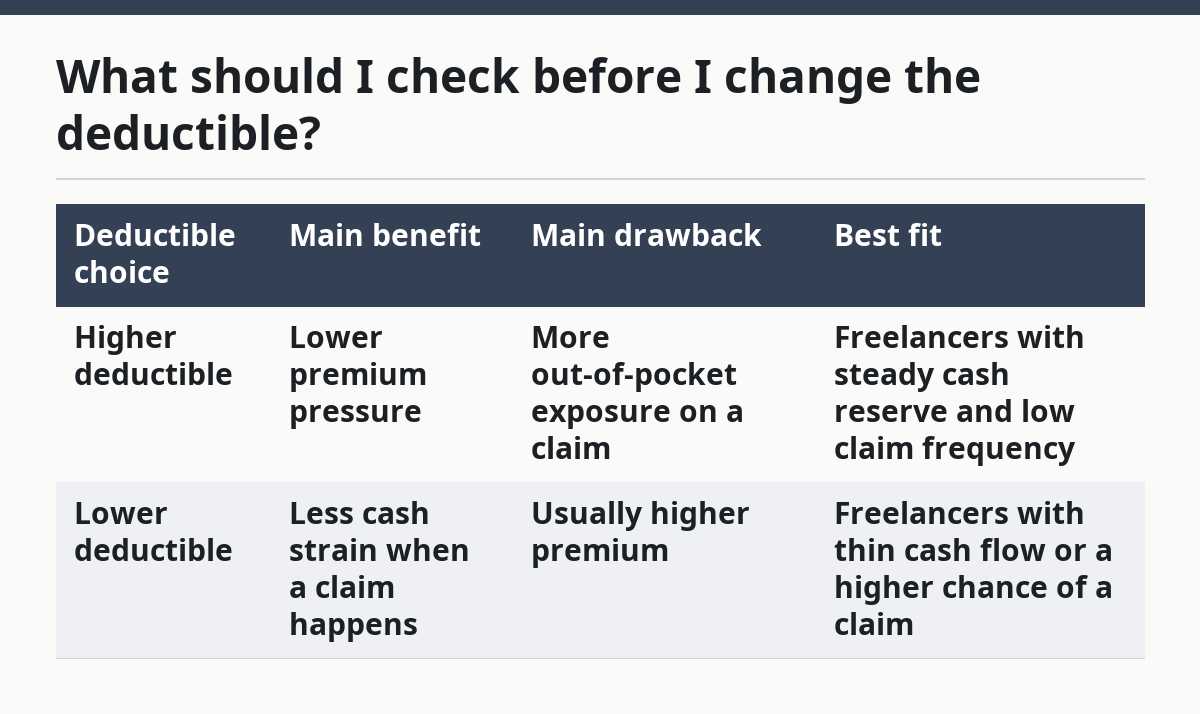
| Deductible choice | Main benefit | Main drawback | Best fit |
|---|---|---|---|
| Higher deductible | Lower premium pressure | More out-of-pocket exposure on a claim | Freelancers with steady cash reserve and low claim frequency |
| Lower deductible | Less cash strain when a claim happens | Usually higher premium | Freelancers with thin cash flow or a higher chance of a claim |
What is the step-by-step way to decide?
The step-by-step way to decide is to compare the deductible difference against your worst reasonable cash month, then see whether the policy still fits your business if a claim happens. That process takes about 20 to 30 minutes if your policy papers and bank figures are in front of you.
- Find the current deductible on the declarations page. Write down the exact amount and the coverage line it applies to, such as general liability insurance or professional liability insurance. Verify whether it is per claim or per occurrence. A mismatch here means the wrong number is being compared.
- List the deductible options available on the policy. Note each option exactly as shown, even if the difference seems small. Verify that you are comparing the same coverage line. If the quote mixes lines, the result is not clean enough to use.
- Measure your liquid cash for the next 90 days. Use cash already available, not money tied up in unpaid invoices. Verify that the deductible change would not force you to miss rent, software subscriptions, or tax deposits. If it would, the higher deductible is a problem.
- Review the last 12 months of claim activity. Count formal claims, demand letters, and incident reports tied to work. Verify whether the pattern is zero, one, or recurring. If the pattern is recurring, a higher deductible can turn into repeated out-of-pocket hits.
- Estimate how a claim would land in your business. Think in simple buckets: small claim, medium claim, and stressful claim. Verify that the deductible is affordable even in the stressful bucket. If the deductible only works in the small-claim bucket, it is not much protection.
- Compare the premium change against the deductible change. Look at the quoted premium difference for the new amount, not a guess. Verify that the premium savings are meaningful in your monthly budget. If the savings are tiny and the deductible jump is large, the trade-off is weak.
- Check for policy features that affect out-of-pocket cost. Review whether defense costs, claim expenses, or related losses are treated separately. Verify how the policy handles multiple claims from the same work. If the wording is unclear, ask a qualified insurance professional to explain whether the deductible could apply differently than you expect.
- Stress-test the choice against a bad month. Ask whether you could still operate for 30 to 60 days if the deductible had to be paid while income slowed. Verify that the answer is yes without borrowing against personal money. If the answer is no, the deductible is too aggressive.
This process is not about squeezing the premium lower at any cost. It is about fitting the deductible to the business you actually run, not the one you hope to have later.
When should a freelancer not change the deductible?
A freelancer should not change the deductible when the new amount would create a cash problem, because that means the policy is asking the business to carry risk it cannot comfortably absorb. In that case, the cheaper premium may hide a more expensive problem later.
Your cash reserve is smaller than one deductible payment: that means a single claim could disrupt operations — keep the current amount or get advice before changing it.
Your claim history shows repeated small claims in 12 to 24 months: that means the deductible may be paid more than once — a higher deductible can backfire quickly.
Your work has short deadlines and client disputes are common: that means claim frequency may be higher than average — do not raise the deductible without checking the full loss pattern.
The policy wording is unclear on per-claim treatment: that means the true out-of-pocket cost is uncertain — ask for a written explanation before making a change, and consult a qualified insurance professional if needed.
A deductible increase would force you to skip tax payments or bill clients late: that means the change hurts the business’s core cash flow — do not treat that as a minor trade-off.
You are changing several coverages at once: that means the deductible effect is hard to isolate — separate the changes so the result stays readable.
A freelance policy deductible change is also the wrong tool if the real problem is not the deductible at all. If the issue is a weak reserve, irregular invoicing, or coverage that does not match the work, changing the deductible only moves the pressure around. The hub on freelancer insurance policy setup and coverage design is the better next stop for the broader structure.
What mistakes do freelancers make here?
Freelancers usually make the same mistake: they focus on the premium first and the claim second. A lower monthly cost looks good until the first covered loss shows up and the deductible is larger than the business can handle.
One mistake is choosing the highest deductible just because it sounds efficient. The consequence is a bigger cash hit if a claim comes in, which can be rough for a solo business with no reserve. The better alternative is to compare the deductible against at least one bad month of cash flow.
Another mistake is assuming one claim means one deductible forever. If the policy treats separate claims separately, the total out-of-pocket amount can rise fast, so a qualified insurance professional should confirm how the deductible applies before you rely on a savings estimate. The better alternative is to check whether the deductible applies per claim, per occurrence, or in another way defined by the policy.
A third mistake is ignoring the type of work. A designer, consultant, writer, or developer may face different claim patterns, and professional liability insurance is often more sensitive to allegation-heavy disputes than a simple property loss. The consequence is choosing a deductible that fits the wrong risk.
A fourth mistake is using annual income instead of available cash. Annual income can look healthy while the bank balance is weak in March or September. The better alternative is to test the deductible against cash on hand and not against a hoped-for busy season.
A fifth mistake is changing the deductible and then not checking the rest of the policy. If the deductible changes but the claim handling rules do not fit, the savings can be smaller than expected. The better alternative is to read the change in the context of the whole policy, not as a standalone number.
What about unusual cases?
Unusual cases need a smaller, more careful change because the normal “raise it to save premium” advice does not fit every freelance business. A change that works for one-person work with stable income may fail for a freelancer whose jobs come in bursts.
If your income is seasonal, use the low-income months as the test, not the high ones. A deductible that seems fine in a busy quarter can become a burden when invoices are slow. If your work has many small client projects, a lower deductible may make more sense than a large one because repeated small disputes can add up.
If you carry both general liability insurance and professional liability insurance, check each deductible separately. They can behave differently, and one can be manageable while the other is not. If your policy has a deductible only on one coverage line, changing the wrong line will not solve the real problem.
If the policy is written on a claims-made basis, timing matters because when a claim is reported can matter as much as when the work was done. That can change how a deductible feels during a busy year. The safe move is to read the reporting terms before changing anything.
If you work across countries, do not assume the deductible rules are the same everywhere. Insurance terms and legal rules differ by country and can change over time, so the local wording matters more than a generic rule of thumb. A qualified adviser can help sort that out for your own setup.
What result should you expect?
The right result is not the lowest deductible or the highest one; it is the one that fits your cash flow and your claim risk without making either side of the trade-off painful. A good result leaves the business able to handle one covered claim without panic and without turning a premium bill into the main problem.
If the deductible change leaves you with a payment you can cover in a normal month and still keep operating, that is a workable sign. If the change only looks good because it trims a small amount from premium while putting a large loss on your side, it is not a good fit.
A clean decision usually ends with one of three outcomes: keep the deductible, lower it, or raise it a little rather than a lot. That last option is often the most practical when the current setup is close but not quite right.
When should a freelancer raise a deductible?
A freelancer should raise a deductible when the business can cover the extra out-of-pocket amount without damaging operating cash. That usually means the policy change fits a low-claim pattern and a steady reserve, not just a wish for a smaller premium.
If the extra amount would be easy to pay in a normal month and claims are rare, a higher deductible can make sense. If the business would need to borrow, delay bills, or pull personal money, the increase is too aggressive.
How does a deductible affect a claim?
A deductible affects a claim by setting the amount the freelancer pays before the insurer starts paying covered costs. If the claim is smaller than the deductible, the policy may provide little or no payment for that loss, depending on the wording.
That is why the same claim can feel very different under two deductible levels. One setup might leave the business with a manageable bill, while another turns the same event into a cash problem.
What is the tradeoff between premium and deductible?
The tradeoff between premium and deductible is simple: one usually moves down when the other moves up. Lower premium can help monthly cash flow, but it shifts more loss back to the business if a claim happens.
The right balance depends on claim frequency, cash reserve, and how much out-of-pocket exposure the business can bear. For a freelancer with thin cash flow, the cheaper premium may not be the better deal if the deductible is hard to absorb later.
Drafted with AI; not yet reviewed by a person.
