

Last updated: November 21, 2026
Quick answer: most freelancers can prepare in 30 to 60 minutes if they gather one business summary, basic revenue figures, client types, and any claims or loss history first. Freelancers prepare for an insurance application interview by organizing clear facts about their work, revenue, clients, subcontractors, and loss history before the underwriter asks. The goal is not to sound impressive; it is to give the underwriter a clean, consistent picture of the business so the insurance application can be assessed without avoidable follow-up.
This guide is for freelancers who already know their basic business details and need to get ready for the live call, questionnaire review, or email follow-up that often comes with How Freelancers Prepare for an Insurance Application Interview. It assumes the reader has a real business, not a side hobby, and can describe what they do in plain language. If the interview touches coverage limits, legal structure, or a disputed claim, a broker or qualified adviser should handle the situation, because those details can change the result.
Key takeaways
- The interview is a fact-check, not a sales pitch.
- The underwriter wants consistent details about work, clients, income, and past losses.
- Short, plain answers usually work better than long explanations.
- Vague descriptions create delays because they force more follow-up.
- A written summary and a few records ready in one place make the call easier.
What is an insurance application interview?

An insurance application interview is a live question-and-answer step where the underwriter checks the information in the application against the reality of the freelance business. It usually comes after the application questionnaire and before a quote decision or final underwriting review.
The underwriter is the person or team that evaluates risk for the insurer. They are not asking for a performance review of the business; they are checking facts that affect exposure, such as business activities, client types, service descriptions, project history, claims history, subcontractor use, and revenue sources. If the answers conflict with the written application, the file often slows down.
For a freelancer, the interview is usually short and practical. It may be a 10-minute call or a set of follow-up questions by email, but the exact format differs by insurer, broker, and country. That is why it is usually best to prepare facts rather than memorize a script. General guidance from the NAIC and the IRS Self-Employed Individuals Tax Center is useful for record-keeping, but the insurance interview itself is driven by the insurer’s own application process.
What should be ready before the call?
The freelancer should have a one-page business summary, basic financial figures, and a clean record of past claims or incidents before the call begins. That is often enough for a basic application interview, and it can reduce the common problem of answering one question with three different versions of the same story. If the insurer asks for more detail, consult a broker or qualified adviser and check the NAIC guidance on business insurance records.
Start with the business activity summary. Write what the business does in one or two sentences, using plain terms instead of jargon. A designer, editor, developer, photographer, consultant, or marketer should be able to explain the work in under 30 seconds. If the work changes by client or project, note the main service lines and the ones that matter most for risk.
Next, list client types and service descriptions. A solo freelancer serving small businesses is different from one serving enterprises, agencies, or the public. Then gather project history for the last 12 months if possible, including the kind of work done and any unusual jobs. If the business has claims history or loss history, have the dates, type of incident, and outcome ready. Even one unresolved claim can change how the file is reviewed.
Revenue sources matter too. If the business earns from direct clients, retainers, referrals, marketplaces, or subcontracted work, write that down. If subcontractors are used, note what they do and whether they work under the freelancer’s direction. A simple list with dates, client categories, and service types is usually better than a stack of loose notes.
How do you answer the underwriter clearly?

You answer the underwriter clearly by giving the exact fact asked for, in the shortest form that is still complete, and by keeping your answers consistent with the application questionnaire. The underwriter is listening for accuracy, not polish.
-
Write a 10-line business summary before the call. Include business name, service type, main client type, years in business if known, and whether subcontractors are used. Verify that the summary matches the insurance application line by line. If it conflicts with the questionnaire, that is a problem.
-
List your main services in plain language. Use the service description you would put on an invoice or website, not a slogan. Verify that the description matches the actual work performed during the last 12 months. If the description is too broad, the underwriter may ask for more detail.
-
Prepare a client profile for each major client type. Note whether clients are individuals, small firms, agencies, or larger organizations. Verify whether any one client type creates most of the revenue. If the answer changes during the call, the file may be flagged for clarification.
-
Summarize project history by category, not by story. For example, group work by editing, design, consulting, or development rather than naming every project. Verify that unusual work is disclosed if it changes the risk picture. A problem appears when a “standard” business has a specialty service that is not mentioned until the end of the call.
-
Track claims history and loss history separately. A claim is a request for payment under an insurance policy; a loss history is the record of past incidents, claims, or losses that matter to underwriting. Verify dates, outcomes, and whether a matter is still open. If the answer is vague, the underwriter may ask for documents.
-
Explain subcontractor use plainly. State whether other people do billable work, what they do, and whether they are used regularly or only sometimes. Verify if their work is part of the same business or a separate arrangement. A mismatch between “solo” and “uses subcontractors” is a common source of delay.
-
State revenue sources in a simple split. Even without exact percentages, identify the main ways money comes in. Verify that the revenue story makes sense beside the client list and project history. A business that says it does only consulting but shows regular product sales will invite more questions.
-
Pause when you do not know. Say you need to check the record rather than guessing. Verify the answer later against the application questionnaire or broker notes. An uncertain answer is less damaging than an invented one, because an invented one can turn into a contradiction.
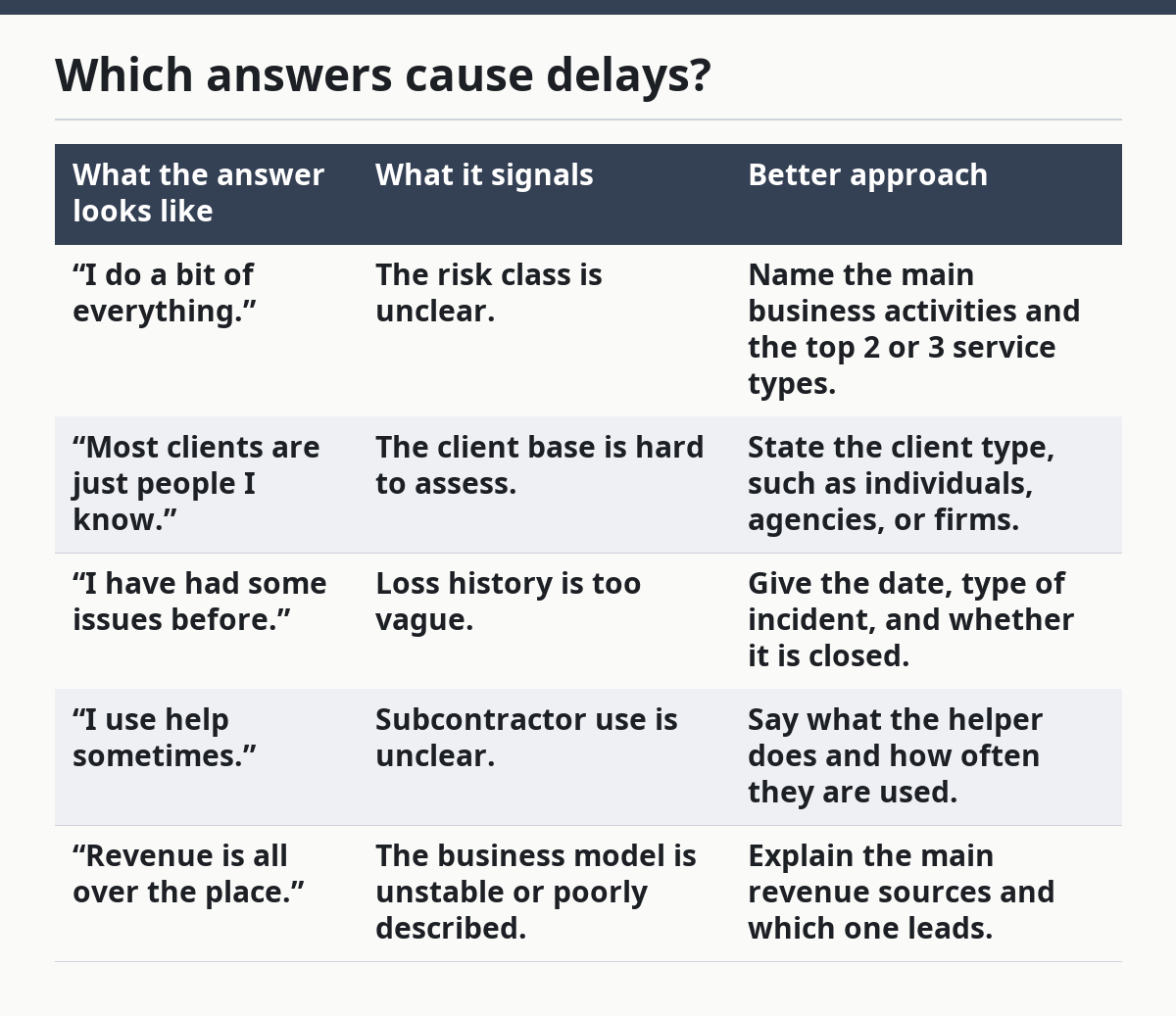
Which answers cause delays?
The answers that cause delays are the ones that sound broad, incomplete, or inconsistent with the written insurance application. Underwriters do not usually reject a file for one ordinary detail; they slow it down when the story does not match itself.
| What the answer looks like | What it signals | Better approach |
|---|---|---|
| “I do a bit of everything.” | The risk class is unclear. | Name the main business activities and the top 2 or 3 service types. |
| “Most clients are just people I know.” | The client base is hard to assess. | State the client type, such as individuals, agencies, or firms. |
| “I have had some issues before.” | Loss history is too vague. | Give the date, type of incident, and whether it is closed. |
| “I use help sometimes.” | Subcontractor use is unclear. | Say what the helper does and how often they are used. |
| “Revenue is all over the place.” | The business model is unstable or poorly described. | Explain the main revenue sources and which one leads. |
A common mistake is treating the interview like a chance to “upgrade” the business description. That can backfire, so it is best to keep the description consistent and, if the insurer seems to want a broader classification, consult a broker or qualified adviser and check the NAIC or similar insurer guidance. If the application says the freelancer edits blog posts and the interview says they also manage compliance documents or technical deliverables, the underwriter may ask for a fresh review. A more detailed answer is not always a better answer.
When should you stop and get help?
You should stop and bring in a broker or qualified adviser when the interview moves beyond basic fact-checking into a situation that could change the insurance decision or the meaning of the answers. This is information, not financial advice, and a qualified adviser should be consulted for the reader’s own situation.
- The application asks about a legal structure you cannot explain: This means the business form may affect how the insurer reads the file — pause and verify the entity details before answering.
- There is an open or disputed claim: This means the loss history is still active — do not guess at the status; get the exact record first.
- The business has mixed work across several fields: This means the risk class may not be obvious — ask a broker how the insurer will group the work.
- The freelancer uses subcontractors regularly: This means the exposure is not a pure solo operation — confirm how the insurer wants that described.
- The interview asks for limits, exclusions, or pricing judgments: This means the conversation is moving into coverage advice — stop and get qualified help rather than improvising.
- The answers on the call differ from the questionnaire: This means the file may need correction — do not paper over the gap; fix the record first.
The wrong move in these situations is to keep talking and hope the mismatch disappears. It will not. The better move is to slow the process down for one day and check the facts.
What mistakes do freelancers make most often?
Freelancers make the most common mistakes by giving too much detail in one place and too little in another, which leaves the underwriter with an uneven picture. A clean application is not the same as a long one.
The first mistake is overexplaining the business model. That can bury the core facts under a long story, and the underwriter may still not know what the business actually does. The better alternative is a short summary, then specifics only when asked.
The second mistake is using website language instead of operational language. “Creative solutions” and “full-service support” do not tell the underwriter much. A better alternative is to name the actual service, such as editing, illustration, bookkeeping, web design, or consulting.
The third mistake is forgetting older incidents because they felt small. A minor claim, a payment dispute, or a project loss can still matter if it belongs in the loss history. The better alternative is to review records first and list anything that the application asks for, even if it seems minor.
The fourth mistake is not matching the application questionnaire. If the written form says one thing and the interview says another, the file may need a second review. The better alternative is to read the completed application before the call and keep it beside the phone.
The fifth mistake is guessing at revenue sources or client types. That can create contradictions fast, especially if invoices or tax records tell a different story. The better alternative is to use records, not memory, when the answer affects the application.
How long does the preparation actually take?
Preparation usually takes less time than the interview itself, because most of the work is gathering facts and putting them in one place. A simple business summary, a list of client types, and a short loss history can be organized in a single sitting if the records are already available.
What matters is not speed; it is consistency. A good result looks like this: the application questionnaire, the business summary, and the interview answers all point to the same business profile. The underwriter can then make a cleaner assessment, and the freelancer avoids a chain of follow-up questions that stretch the process out.
A bad result looks like this: the call ends with “we need more information,” because the service description, revenue sources, or subcontractor use was not clear enough. That does not always mean trouble, but it does mean extra delay. For a freelancer working with deadlines, that delay can matter almost as much as the outcome.
What if the business is unusual?
The standard approach needs modification when the freelance business has more than one line of work, a changing client mix, or a history that does not fit a simple solo profile. In those cases, the safest method is usually to separate the business into its parts before the interview.
If the freelancer has both direct client work and subcontracted work, describe each separately. If the business has seasonal revenue, identify the typical months rather than smoothing the numbers into a fake average. If past claims came from one kind of project only, say so. The underwriter needs to see where the risk comes from, not a polished version of the business.
This is also where a broker can help translate the facts into the language the insurer expects. That is not about buying advice; it is about making sure the application says what the business actually does. For the reader who wants a fuller checklist around quote readiness, the hub on freelance insurance application and quote readiness fits better than this page.
What does an underwriter ask during a freelance insurance application interview?
An underwriter usually asks what the business does, who the clients are, how revenue is earned, whether subcontractors are used, and whether there is any loss history or claims history. The questions are designed to confirm the insurance application, not to test the freelancer. If the answers stay consistent and concrete, the interview is usually straightforward.
What documents should I have ready for a freelance insurance application interview?
A freelancer should have the completed application questionnaire, a short business summary, basic project history, client type notes, and any records tied to claims history or loss history. If subcontractors are used, notes on their role are useful too. The documents do not need to be fancy; they need to match the answers given on the call.
How long does an insurance application interview take?
The length varies by insurer and by how complex the business is, but a simple interview is often short when the facts are ready. The call takes longer when the underwriter has to sort out mismatched answers, unclear service descriptions, or missing records. Good preparation usually saves time because it reduces back-and-forth afterward.
Drafted with AI; not yet reviewed by a person.
