

Last updated: November 20, 2026
Choose the insurance carrier that can pay a claim, handle endorsements without delays, and give you usable service after the sale. For freelance business coverage, the carrier matters as much as the policy form, because claims handling, renewals, and online servicing can affect how the policy works when you actually need it. This is information, not financial advice; for your own situation, a qualified adviser should review the policy details with you.
Key takeaways
- A carrier is more than a logo on the declaration page; it is the company that decides claims, endorsements, and renewals.
- Strong carrier choice starts with stability, then moves to claims process, service tools, and policy changes.
- The cheapest quote can be a poor fit if the carrier is slow, hard to reach, or restrictive on endorsements.
- Freelancers should pay close attention to certificate access, renewal notices, and how the carrier communicates after purchase.
- If your work changes often, the renewal process and endorsement turnaround matter as much as the base premium.
Who this guide is for
This guide is for freelancers who already know they need business coverage and now need to choose the insurance carrier behind it. It assumes you have at least one quote, know the policy type you are looking at, and can read basic terms like deductible, exclusion, endorsement, and policyholder.
It also assumes you are trying to avoid a bad fit after purchase, not just find the lowest premium on page 1 of a comparison site. If you need to compare freelance insurance quotes side by side, that is a different task; this page is about the carrier that will service the policy after it is issued.
A freelancer with unusual revenue swings, multi-state clients, or contract-heavy work should pay extra attention to service and endorsements. A policy can look fine on paper and still become frustrating if the carrier takes days to issue a simple change or gives vague answers on claims. In those cases, an independent broker can help interpret carrier behavior, while an insurance agent tied to one company can only explain that company’s rules.
How do I choose an insurance carrier?
Choose the carrier by checking 5 service points in a fixed order: stability, claims handling, online servicing, endorsement support, and renewal process. That order matters because a carrier that looks fine today can still create problems later if it is hard to reach or slow to act on changes.
-
Check the carrier’s financial strength using a rating agency such as A.M. Best, then verify whether the rating is current. A stronger rating does not make a policy perfect, but it helps you judge whether the insurer looks built to stay in business. A warning sign is a carrier whose rating information is hard to find or appears stale.
-
Review the claims process for the exact type of coverage you need, then verify how a claim gets opened, who reviews it, and whether the carrier gives written claim steps. If the process is unclear before you buy, it will not become clearer after a loss. A problem sign is a carrier that hides claims contact details behind multiple logins or gives only general language.
-
Test the online servicing tools by checking whether you can reach the policy documents, ID cards, and billing records in one portal. Good service tools save time when you need a certificate, a proof of insurance, or a copy of the declarations page. A problem sign is a portal that requires repeated manual requests for routine documents.
-
Ask how endorsements are handled, then verify whether the carrier can process common changes such as address updates, added work locations, or coverage tweaks without a long paper trail. An endorsement is a formal policy change, and freelancers often need those changes mid-policy. A problem sign is a carrier that routes every small change through multiple approval layers.
-
Compare renewal rules for notice timing, underwriting review, and any new information the carrier asks for at renewal. A smooth renewal process matters because freelancers often renew while also dealing with tax season, client turnover, or a shift in services. A problem sign is a carrier that waits until the last minute to ask for new documents.
-
Read the exclusions and service conditions that affect claims handling, then verify how the carrier defines your business activity. If your work involves consulting, media, design, or subcontracting, the wording can matter more than the brand name. A problem sign is a broad exclusion that cuts across the work you actually do.
-
Check whether an independent broker can explain the carrier’s rules in plain language, then verify that the broker is not glossing over service limits. A broker can help you sort carriers, but the carrier still controls the contract. A problem sign is a broker who only talks about premium and not about claims service.
-
Confirm that the carrier can support the way you work now, not only the way you worked when the quote was generated. Freelancers change scope often, so a good fit in month 1 should still work at month 11. A problem sign is a carrier whose process breaks when your business adds a new service line.
What should I check before I choose?
Check the carrier’s behavior at the points where freelancers usually need help: claims, changes, billing, and certificates. Those are the places where a policy becomes a working tool instead of a stack of paper. If the carrier is weak there, the policy may still be valid, but it can be unpleasant to use.
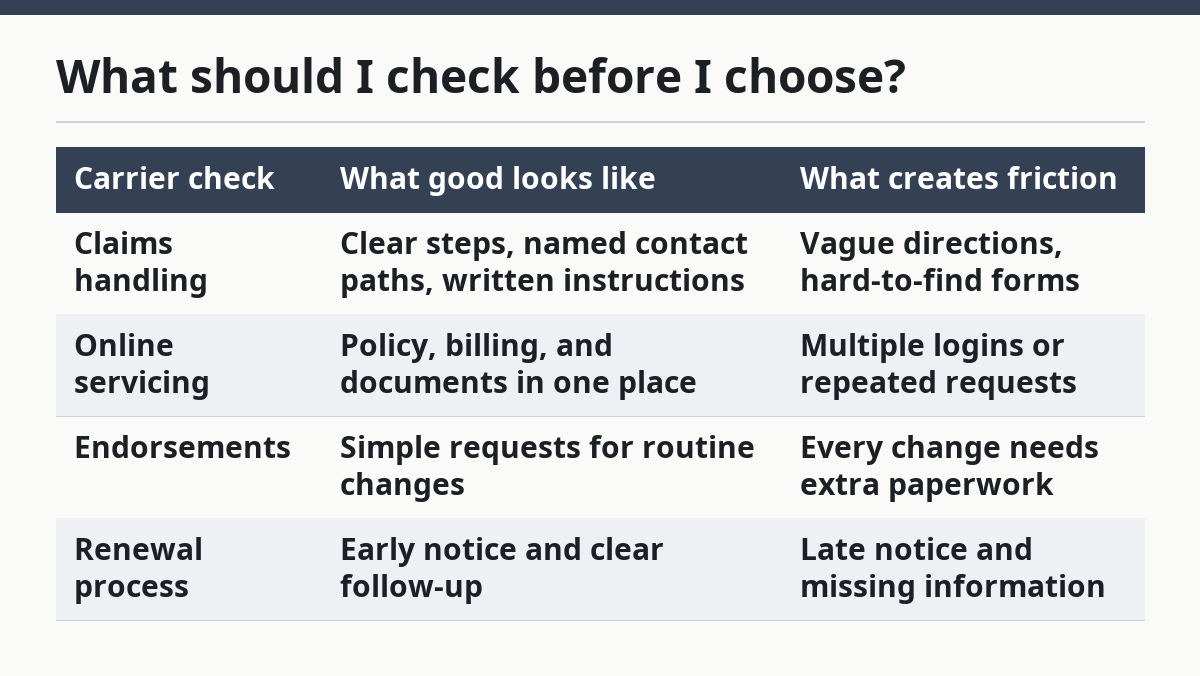
Here is a simple way to compare carriers without turning the process into a quote hunt. Use the same four questions on every carrier: How do claims start, how fast do endorsements move, how is billing handled, and how easy is it to reach a person when something goes wrong? That gives you a fair comparison across 3 or more carriers without drifting into price-only thinking.
| Carrier check | What good looks like | What creates friction |
|---|---|---|
| Claims handling | Clear steps, named contact paths, written instructions | Vague directions, hard-to-find forms |
| Online servicing | Policy, billing, and documents in one place | Multiple logins or repeated requests |
| Endorsements | Simple requests for routine changes | Every change needs extra paperwork |
| Renewal process | Early notice and clear follow-up | Late notice and missing information |
A freelance business insurer should also be able to explain whether a change is handled as a service update or a policy endorsement. That distinction matters because a small change can be routine in one carrier and slow in another. If the answer sounds improvised, keep asking until it is specific.
Which carrier traits matter most after you buy?
Claims handling matters most after you buy, because that is when the policy has to perform. A carrier can sound excellent during sales and still be difficult when you file a claim, request an endorsement, or wait on renewal paperwork.
Look for carriers that make the policyholder’s next step obvious. That includes where to send a notice, how to upload documents, and what to expect after a report is filed. It also includes whether the carrier gives status updates, since silence is often what turns a manageable issue into a long one.
Carrier stability matters too, but not in the abstract. Stability means the company looks capable of standing behind the policy throughout the policy term and into the next renewal cycle. A.M. Best is one of the names people see most often in this context, and its ratings are a useful starting point, not a full answer.
Service speed matters in daily use. If you need a certificate for a client contract or a revised policy record after a business change, a carrier with weak online servicing can slow the whole project. For a freelancer, a delay of even a few business days can be a real problem when a client needs paperwork before work starts.
When should I stop and get help?
Stop and get qualified help when the carrier questions start to affect policy wording, claims rights, or tax treatment. At that point, the issue is no longer just carrier shopping; it is coverage interpretation, and the wrong assumption can cost more than the premium difference.
If the carrier’s claim wording conflicts with your contract: that can change whether a loss is covered — ask a qualified adviser or broker to review the policy language before you rely on it.
If your work crosses state lines or countries: jurisdiction rules may change the policy fit — get help from someone who understands the location rules that apply to your business.
If the carrier wants a long list of business changes at renewal: that can signal a harder underwriting review — prepare your records and ask for help if the request is not clear.
If the carrier cannot explain an exclusion in plain language: you may not know what is left covered — pause and get a second set of eyes on the policy.
If a claims response seems to depend on a verbal promise only: that is too fragile for a financial product — ask for written confirmation before you proceed.
For many freelancers, this is where an independent broker becomes more useful than an insurance agent tied to one company. The broker can compare how different carriers handle the same kind of business change, while the agent can only speak for the carrier they represent. That difference matters most when the policy is being renewed or amended.
What mistakes do freelancers make with carriers?
Freelancers often choose the carrier that is easiest to quote, not the one that is easiest to live with. That mistake shows up later when a policy needs a change or a claim needs movement.
Focusing only on premium: a lower price can hide slow claims service or tight endorsement rules — compare how the carrier behaves after purchase, not just on day 1.
Ignoring the renewal process: a smooth first term does not guarantee a smooth renewal — verify how far in advance the carrier sends notices and what it asks for.
Skipping the portal test: if you cannot find documents or billing tools in the online account, you may be stuck on email for routine tasks — check the portal before binding coverage.
Treating every carrier as interchangeable: different companies can use different claim procedures and underwriting habits — keep the carrier name in the decision, not just the policy type.
Assuming an agent and a carrier do the same job: the agent helps place the policy, but the carrier controls claims and policy changes — know which one is responsible for each step.
Not asking about endorsements: a freelance business can change fast, and a carrier that makes changes difficult can become a burden — ask how common updates are processed before you buy.
Each of these errors costs time, and time matters when a client wants proof of insurance or a claim has to be opened quickly. The right alternative is to judge the carrier as a service company that also happens to insure risk.
What changes the choice for freelancers?
Freelancers with changing work should give extra weight to endorsements and renewal rules. If your services, locations, or client mix move around during the year, a carrier with rigid paperwork can create more friction than a policy with a slightly higher premium.
A second edge case is a freelancer who works through multiple contracts at once. In that setting, certificate requests, additional insured wording, or proof of coverage may come up more often, and a carrier with weak administrative support can slow contract starts. The issue is not just whether the carrier will insure the work; it is whether the carrier can keep up with the paperwork around the work.
A third edge case is a business that is still changing shape. If you are adding services, hiring subcontractors, or shifting from one client type to another, the best carrier is usually the one that gives clear answers when the policy needs to evolve. A carrier that only works for a static one-person setup may not fit a business that is already moving.
For readers building a broader selection process, the hub on Freelancer insurance policy selection is the better next stop after this page. This page stays focused on the carrier, because that is the part many people notice too late.
How do I compare insurance carriers?
I compare carriers by looking at claims handling, online access, endorsement speed, and renewal process in the same order every time. That keeps the decision tied to the part of the policy you will actually use, not just the sales pitch.
What should freelancers look for in an insurer?
Freelancers should look for a carrier with clear claim steps, usable online tools, and a renewal process that does not create surprises. A strong financial strength rating from an agency such as A.M. Best is helpful, but it should sit alongside service quality, not replace it.
Does carrier choice affect claims service?
Yes, carrier choice can affect claims service because the carrier sets the claim process, the contact path, and the pace of review. Two policies with similar coverage language can still feel very different once a loss is reported, which is why service quality matters before purchase.
Drafted with AI; not yet reviewed by a person.
