
Last updated: November 20, 2026
Quick answer: disclose the contract terms that change your risk, name the signed document, and answer in 3 clear parts: clause, page, and effect. In How to Answer Insurance Application Questions About Client Contracts, the goal is simple client contract disclosure: give the insurer enough facts about scope, indemnity clause language, additional insured wording, and termination terms to price the risk without guessing.
Key takeaways
- Use the signed contract, not a draft, when you answer.
- Focus on clauses that shift loss or expand your duty, not every sentence on the page.
- If a question asks about additional insureds, indemnity, or contract copies, answer directly and keep the wording plain.
- Short answers are better than vague answers; “yes” with a copy is usually clearer than a long explanation.
- If the contract language is unusual, missing, or changed after signing, stop and get qualified help before you complete the form.
This is practical information, not financial advice, and a qualified adviser should be consulted for your own situation.
Who should answer these questions this way?
This approach fits freelancers, contractors, and solo business owners who have signed client contracts and are filling out an insurance application for professional liability insurance or a related policy. It assumes you have the current contract, or at least the final signed version, and can see the clauses that mention indemnity, additional insureds, scope, and termination.
However, it is not the right approach if you cannot tell which version of the contract was signed, if the contract is under negotiation, or if a lawyer has already told you a clause may create legal exposure. It is also a poor fit when the insurer asks for a legal interpretation of a clause, not just the clause itself. In those cases, the safer move is to pause and get qualified help before you submit a written answer.
A good rule is simple: answer what the document says, not what you think it means. If the form asks about a client contract, underwriters usually want the facts that affect claims handling and contract liability, not a speech about your business model. For guidance on the broader application process, start with the hub on freelancer insurance application and quote readiness.
How do I answer the application step by step?
Answer the application by copying the material facts from the signed contract into plain language and attaching the contract if the form asks for it. The steps below keep your answer tied to the document instead of memory or guesswork.
- Pull the final signed contract. Use the executed version, not a redline or draft, and check the signature page for the date and parties. If the version in your inbox differs from the signed copy, that is a problem because underwriters care about the actual obligations.
- Find the clauses that change your risk. Look for indemnity clause language, additional insured requirements, insurance requirements, scope of work, and termination terms. If a clause adds a duty to defend, cover another party, or keep insurance in force for a set period, mark it for disclosure.
- Answer the question in the same terms the form uses. If the form asks whether client contracts require insurance, say yes or no and then name the clause type. If it asks for contract copies, attach the contract or the pages that contain the relevant terms. Leaving the answer vague is a problem because it forces the underwriter to guess.
- Keep the project scope specific. State the kind of work, the client type, and any unusual deliverables. A two-page design project is not the same as a 12-month consulting retainer, and a short answer should reflect that difference. If the scope has changed since signing, the answer no longer matches the contract.
- State any insurance requirements exactly as written. If the contract asks for professional liability insurance, a certificate of insurance, or additional insured status, repeat the requirement in plain language. Do not soften it or turn it into a general statement about being insured. If the application asks for limits or policy details you do not know, stop rather than inventing them.
- Note termination terms only if they affect exposure. If the client can terminate for convenience, gives short notice, or leaves post-termination duties in place, disclose that the contract allows early ending or continued obligations. That matters because unfinished work and closeout duties can still create a claim after the job stops.
- Review for one clear answer per question. Each question should have one direct response, plus a short note if needed. If the answer takes a paragraph, the form may be asking for too much detail, or your contract may contain a term that needs separate review.
- Attach only what the form requests. If it asks for the contract, send the contract. If it asks for the relevant pages, do not upload ten extra pages just to be safe unless the insurer requests the full agreement. Extra pages can bury the clause that matters and slow the review.
A strong answer usually does two things at once: it states the clause type and it shows where it appears in the contract. A weak answer says the contract is “standard” or “normal,” which tells the underwriter nothing and can create follow-up questions.
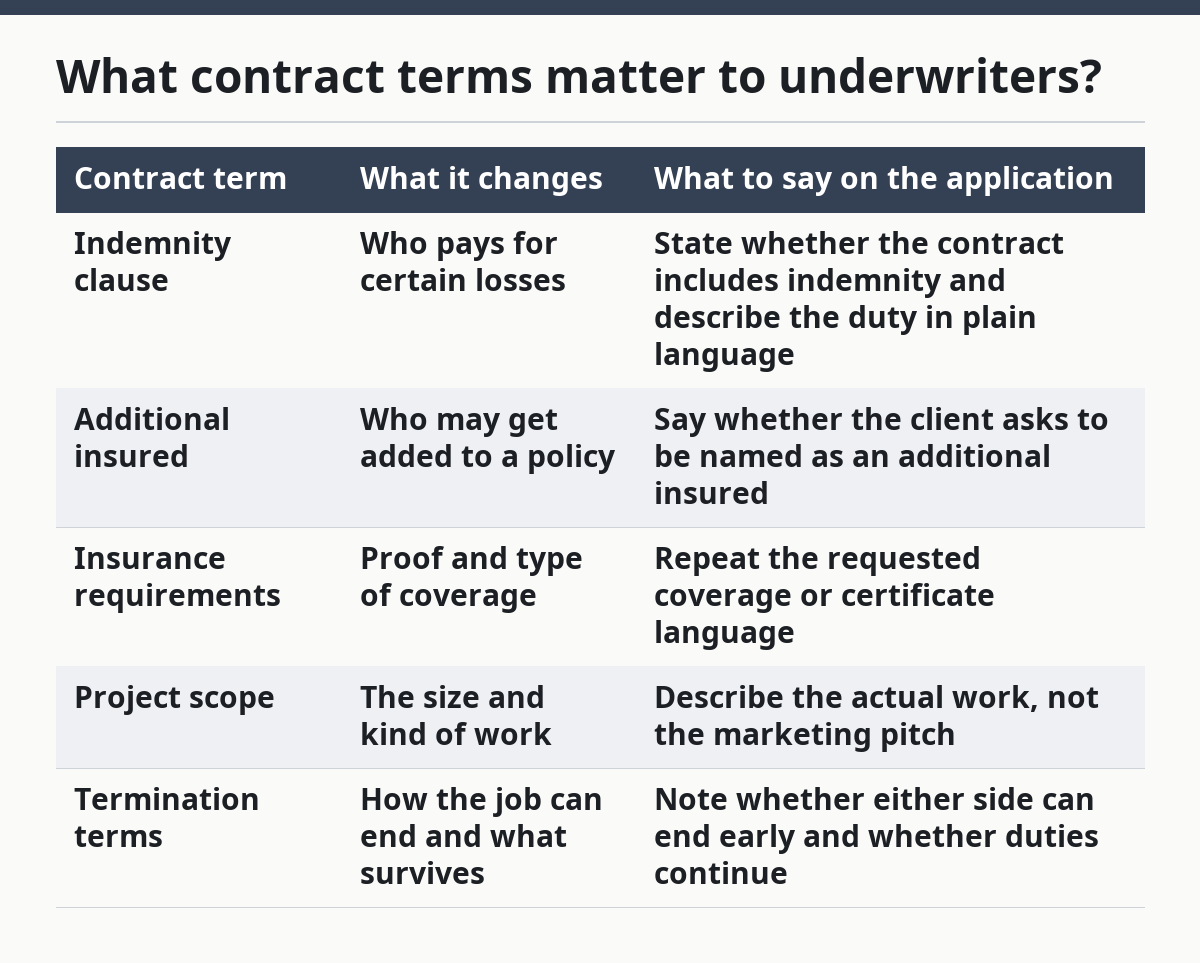
What contract terms matter to underwriters?

Underwriters care most about terms that move liability from the client to you, expand who gets protected, or create obligations after work ends. The main terms are indemnity clauses, additional insured wording, insurance requirements, project scope, and termination terms.
For example, an indemnity clause is language where one party agrees to cover certain losses or claims tied to the work. If your contract says you must indemnify the client, the insurer may want to know whether that duty is narrow, broad, or tied to your negligence only. Additional insured wording matters because it can extend protection to the client or its affiliates, which may change how the insurer views the contract.
Because of that, insurance requirements matter because they show whether the client expects proof of coverage, a certificate of insurance, or a specific type of policy. Project scope matters because a limited editing job does not carry the same exposure as ongoing strategy work, software development, or advice tied to a business decision. Termination terms matter because a contract that can end on short notice may leave unfinished deliverables, disputed fees, or closeout duties behind.
The table below shows the usual difference between these clauses.
| Contract term | What it changes | What to say on the application |
|---|---|---|
| Indemnity clause | Who pays for certain losses | State whether the contract includes indemnity and describe the duty in plain language |
| Additional insured | Who may get added to a policy | Say whether the client asks to be named as an additional insured |
| Insurance requirements | Proof and type of coverage | Repeat the requested coverage or certificate language |
| Project scope | The size and kind of work | Describe the actual work, not the marketing pitch |
| Termination terms | How the job can end and what survives | Note whether either side can end early and whether duties continue |
If the insurer asks whether a clause exists, answer yes or no first. If it asks for details, give the clause type, not a legal lecture. That keeps the response useful without pretending to interpret the contract for the underwriter. For a broader overview, see the related professional liability insurance page.
Should I mention insurance clauses in the application?
Yes, mention insurance clauses in the application if they require coverage, a certificate, or a change to who is protected. If the contract has an indemnity clause, additional insured requirement, or any insurance language that affects your obligations, leaving it out can make the application incomplete.
A practical rule is to disclose the clause and describe it briefly, rather than making an absolute claim that every clause must be explained the same way. For example, if the contract says the client wants to be named as an additional insured, say that the contract includes an additional insured requirement and attach the relevant page if asked. If the contract only asks for general proof of insurance, say that without turning it into a bigger issue than it is.
Do not hide insurance language because it looks technical. Underwriters see these clauses all the time, and a short, accurate answer is better than silence. If the clause is unusual, broad, or unclear, that is exactly the kind of fact a form should capture. A certificate of insurance request is different from a request to change who is covered, so treat the two separately.
What if the contract is messy or unusual?
The standard approach needs adjustment when the contract is missing pages, uses mixed templates, or contains clauses that do not match the work. That includes contracts with blank fields, handwritten edits, side letters, or a signature page that does not clearly match the text.
Missing pages: The contract may be incomplete — get the full signed version before you answer, because a missing indemnity or insurance page can change the disclosure.
Conflicting versions: The draft and signed copy differ — use the signed copy only, because the underwriter needs the binding text, not the version you hoped would stay in place.
Broad indemnity language: The clause may shift more risk than you expected — do not summarize it loosely, and get qualified help if you do not understand the duty it creates.
Additional insured request for third parties: The client may be asking for broader protection than a single client name — disclose the request exactly and do not assume the wording is standard.
Short termination notice or ongoing duties: The contract can end fast, but obligations may continue — note that the work can stop early while liability can still remain after termination.
Contract says one thing, invoice says another: Your paperwork may not match your real arrangement — fix the record before you answer, because mismatched documents can slow underwriting.
These are the points where a clean form answer stops being enough. If the issue is a legal term, a coverage match problem, or a clause that changes who pays for a claim, pause and get qualified help before you submit.
What mistakes do people make?
People usually make five mistakes, and each one creates a different problem for the quote or the policy record. The right alternative is to keep the answer tied to the signed contract and the exact question.
One mistake is answering from memory instead of from the contract. That can lead to a wrong yes-or-no answer about indemnity or additional insureds. The fix is to open the signed agreement and quote the clause type before you respond.
Another mistake is treating all contracts as “standard.” If a clause is unclear or unusually broad, check with your broker, attorney, or insurer before you treat it as routine. That hides the real difference between a simple scope of work and a contract with extra insurance duties. The better answer is to name the clause and its effect in plain language.
A third mistake is uploading the wrong version. A draft, redline, or unsigned PDF can mislead the underwriter and delay review. The correct alternative is the executed copy, or the precise pages the form asks for.
A fourth mistake is oversharing with a long explanation. Long notes often bury the point and can create more questions than they answer. Short, direct language is stronger when the form asks for facts.
A fifth mistake is leaving out termination terms because they seem unrelated to insurance. They matter because claims can arise after a project ends, especially when closeout duties remain. The right move is to disclose whether the contract can end early and whether any duties survive.
How long should this take?
It should take only as long as it takes to find the signed contract, check the relevant clauses, and answer the form without guessing. For a straightforward agreement, the task is mostly document matching, not legal analysis.
A good result looks like this: the underwriter can see the contract, see the clause that matters, and see that your application answer matches both. The answer is brief, specific, and consistent with the signed document. If you need several paragraphs to explain one question, the form may be asking for a detail you should verify before you submit.
The answer is not to write more; it is to write the right fact. That is especially true when the clause mentions an indemnity clause, additional insured status, or a requirement to carry professional liability insurance.
When should I stop and get help?
Stop when the question turns into a legal reading of the contract, a coverage-match problem, or a missing-document problem. In those situations, a guess can do more harm than a delay.
The contract is unsigned or partly signed: you may not have a binding agreement — wait for the executed version before answering.
The clause says you must defend or indemnify beyond your own work: the duty may be broader than a simple insurance question — get qualified help before you describe it.
The insurer asks for a clause interpretation rather than a copy: the form may require legal judgment — do not guess at meaning.
The contract requires a specific insurance structure you cannot confirm: you may not know whether the wording matches your current policy — pause and verify the record first.
The document set includes side letters or amendments: the contract terms may have changed — answer only after you collect every signed amendment.
You cannot tell which page contains the insurance clause: the risk is that you omit the key fact — stop and find the clause before you submit.
In these cases, the right action is not to force an answer. It is to slow down, confirm the document, and get qualified help if the clause could affect your coverage or your legal exposure. For general consumer guidance on insurance records, the NAIC and your state insurance department are useful starting points.
Do insurers want to see client contracts?
Yes, some insurers do want to see client contracts, especially when the contract contains indemnity, additional insured, or insurance language. If the application asks for contract copies, send the signed contract or the specific pages the form requests.
The purpose is usually fact-checking, not fault-finding. A contract helps the underwriter see how your work is structured and whether the client is shifting risk to you. If the form does not ask for the contract, do not assume it wants one; answer the question that is actually on the page. The NAIC consumer resources page is a useful place to start if you want broader insurance background.
Which contract terms matter to underwriters?
The main terms are indemnity clauses, additional insured wording, insurance requirements, project scope, and termination terms. Those clauses can change who bears loss, who gets protected, and how long duties continue after the work ends.
If a clause does not affect risk, it usually does not need a long explanation. If it does affect risk, name it plainly and attach the relevant page if the insurer asks for support. When in doubt, compare the wording with your contract review checklist before you submit.
Should I mention insurance clauses in the application?
Yes, if the contract includes insurance clauses that change your obligations, you should mention them. That includes requests for additional insured status, proof of coverage, or any clause that expands your duty to another party.
A short, accurate note is enough in most cases. If the clause is unusual or broad, say so plainly and do not try to rewrite it into something safer-looking.
Drafted with AI; not yet reviewed by a person.
