

Last updated: November 28, 2026
Quick answer: liability exposure usually changes in 3 main ways by engagement type — a retainer keeps the duty open longer, a project compresses it around one deliverable, and subcontracting can add a second layer of responsibility. In Retainer, contract, or project: how liability exposure changes by engagement type, the label matters less than the agreement, the scope of work, and how the work is handled. This is information, not financial advice; a qualified adviser should be consulted for your own situation.
Key takeaways
- The name of the deal matters less than what you promise to do, how long you are on the hook, and who can blame whom if something goes wrong.
- Ongoing work tends to create more chances for small mistakes to compound across months, even when each task seems minor on its own.
- A project contract often concentrates exposure around a single deliverable, while a retainer can keep exposure open through repeated work and repeated advice.
- Subcontracting can reduce direct contact with the end client, but it can add extra layers of duty through the prime contractor’s instructions and deadlines.
- Liability insurance questions change with the engagement type because the claim pattern changes: timing, scope, and who controls the work all matter.
Who this applies to
Therefore, this applies to freelancers who already use a client agreement, a scope of work, or a subcontractor setup and want to understand how engagement type affects liability exposure.
It assumes you know the difference between a retainer, a fixed project, and ongoing services, even if the terms are used loosely in the market.
The core issue is simple: exposure rises when your duty lasts longer, your work is reused more often, or the client can point to a chain of decisions instead of a single deliverable. A 1-page scope of work for a 2-week job creates a different risk shape than a 6-month retainer with weekly calls and rolling edits.
This page is for learning, not for deciding whether a specific policy fits a specific contract. If your agreement contains unusual indemnity, insurance, or warranty language, that is the point to get qualified help.
How do retainers, projects, and subcontracting differ?
They differ because the duty, timing, and control points are not the same. A retainer is usually a continuing arrangement for availability, advice, or repeated work; a project contract is usually tied to one defined output; subcontracting means you are working under another business’s contract chain rather than directly under the end client’s agreement.
| Engagement type | Typical duty | Exposure pattern | Common fault line |
|---|---|---|---|
| Retainer | Ongoing service over weeks or months | Repeated advice, repeated revisions, and a longer claim window | Missed issue that keeps affecting later work |
| Project contract | One defined deliverable or milestone set | Exposure clusters around scope, deadline, and final handoff | Output does not match the agreed scope of work |
| Subcontractor | Work performed under a prime contractor | Exposure can be shared, but blame may travel through the chain | Instructions, handoffs, and who approved what |
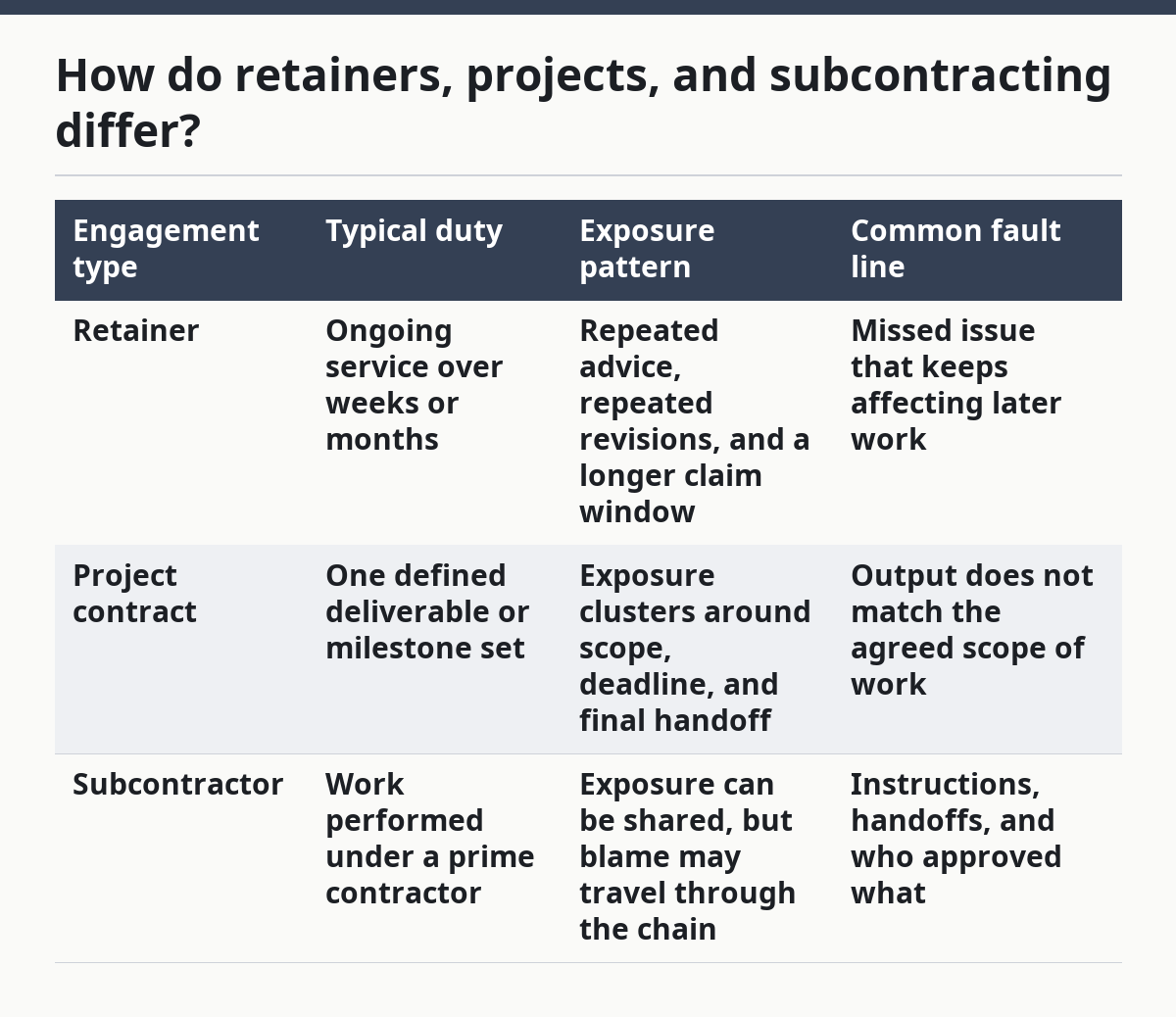
A generic article often gets this wrong by treating all three as if they create the same insurance need. They do not. A 30-day project with a signed brief is not the same risk shape as a standing retainer with monthly deliverables, and a subcontractor may face claims from both the prime contractor and the end client.
The difference also shows up in who controls the work. If the client controls the brief but not the method, your exposure may center on the result. If you control the method and the client keeps changing the brief, the exposure shifts toward scope drift and dispute over what was actually promised.
Why does a retainer usually increase exposure?
Therefore, a retainer usually increases exposure because the duty repeats, the advice can be reused, and one missed issue can spread across several months of work. That is especially true when the retainer covers 3 or more types of service, such as review, edits, and strategy calls, instead of one narrow task.
The problem is not just duration. Ongoing services create more chances for the same error to be repeated in different forms, and a client may say the later work relied on the earlier work. If a client agreement says you will provide “ongoing support” but never narrows what that means, the duty can become broader than the original fee suggested.
Retainers also create exposure through silence. If a client sends 10 emails over 6 weeks and you answer only the last one, an earlier warning can be missed. That can matter because a claim may focus on what should have been caught, not just what was actually sent.
This does not mean every retainer is riskier than every project. A tiny retainer for one clearly defined monthly task may carry less exposure than a high-value project with a hard deadline and a complex handoff. The point is that a retainer tends to keep the door open longer, so there are more ways for something to go wrong over time.
What changes in a fixed project?
In contrast, a fixed project usually narrows liability exposure to the agreed deliverable, the deadline, and the handoff. That narrower frame helps because the client can more easily compare the finished work to the scope of work and see where the dispute starts.
The flip side is that project work can be sharp-edged. If the scope is vague, the client may expect extras that were never priced or promised. A 5-page brief that says “complete the launch materials” can create more exposure than a 20-page scope that spells out revisions, file formats, and approval steps.
Project work also tends to create a concentrated claim window. The risk often peaks near delivery and shortly after, when the client reviews the output and uses it. If the project includes 2 rounds of revisions but the contract is silent on what happens after that, the final revision can become the fault line.
A common mistake is thinking “project” automatically means “lower risk.” It can mean lower ongoing exposure, but the claim can still be large if the deliverable is central to the client’s business or if the handoff is messy. The label does not control the claim; the content of the client agreement does.
What about subcontractor work?
However, subcontractor work can lower direct client friction, but it can increase chain-of-responsibility problems. When you work under a prime contractor, the prime may owe the end client while still pointing back to you for the mistake, delay, or omission.
That matters because the subcontractor is often following a tighter instruction set. If the prime contractor changes the brief on short notice, your exposure can rise even though you never spoke directly with the end client. The risk is not only what you did; it is also what you were told to do, when you were told to do it, and who signed off.
Subcontracting also creates a paper trail problem. If the job moves through email, text, and a shared file over 2 weeks, the record can get fuzzy fast. If a dispute later turns on who approved a change, the answer may depend on whether the subcontractor kept the written handoff clear.
This is one place where a generic article leaves too much out. A subcontractor is not automatically “safer” because someone else owns the main contract. The end client may still point to your work, and the prime may still pass the loss down the chain through the subcontract terms.
How does liability insurance fit each engagement type?
Therefore, liability insurance fits each engagement type by matching the likely claim pattern, not by matching the job title. A retainer points toward repeated-service exposure, a project points toward deliverable exposure, and subcontracting points toward shared or passed-through responsibility.

For a retainer, the key question is whether the work is broad enough to create repeated advice or repeated omission risk. For a project, the key question is whether the scope is tight enough that a dispute will be about one deliverable rather than ongoing conduct. For subcontracting, the key question is how the duty sits between the prime contractor’s agreement and the subcontractor’s own scope.
That is why contract type affects liability insurance needs even when the profession stays the same. A designer on a 6-month retainer, a designer on a one-off project, and a designer working as a subcontractor can face different claim shapes from the same software, the same client base, and the same deliverables.
The right way to think about it is mechanism, not labels. Longer duty can mean more chances for error. Broader scope can mean more chances for dispute. More links in the chain can mean more chances for blame to move sideways or upward before it settles anywhere.
For background on worker status and contract relationships, the IRS page on independent contractor status and the U.S. Department of Labor’s guidance on misclassification are useful reference points: IRS and U.S. Department of Labor.
When does standard guidance not apply?
However, standard guidance does not apply when the engagement has features that change the duty, the blame chain, or the time window. In those cases, the simple retainer-versus-project label is not enough.

The client agreement includes a broad indemnity clause: that can move more loss onto you than the job title suggests — get qualified help to read the risk allocation before signing.
The scope of work is open-ended or says “as needed”: that makes the duty harder to measure — narrow the scope in writing before work starts.
You are acting as a subcontractor under a prime contractor: that creates a second contract layer — check how the chain handles changes, approvals, and blame.
The work involves repeated advice over 3 months or more: that raises the chance that one mistake affects later work — if you are unsure, consult a qualified adviser and treat the engagement like an ongoing duty, not a single task.
The client can reuse your work in later systems or campaigns: that can extend the life of one error — clarify what counts as delivery, approval, and reuse.
In all of these situations, the problem is not just liability insurance. The contract itself may be doing part of the damage before a claim ever appears. A qualified adviser can help interpret the exact exposure created by the wording, not just by the label on the invoice.
What mistakes change the risk the most?
The biggest mistakes are usually paper mistakes, not technical ones. A freelancer can do solid work and still create avoidable exposure through a loose scope, a missing approval step, or a bad handoff.

The first mistake is treating a retainer like a project. That often leaves duty limits vague, which can let a client assume ongoing coverage that was never clearly priced. The correct alternative is to spell out what happens each month, what is excluded, and how changes are approved.
The second mistake is using the same client agreement for every project. That can hide real differences in deadline pressure, revision limits, and deliverable size. The correct alternative is to tailor the scope of work so the contract fits the actual job.
The third mistake is assuming subcontracting removes direct exposure. It does not. The correct alternative is to map who controls approval, who communicates with the end client, and who carries the loss if the chain breaks.
The fourth mistake is letting ongoing services run past the original term without a fresh written reset. That can blur what period the duty covers. The correct alternative is to renew the scope or issue a new agreement when the work changes shape.
The fifth mistake is ignoring how the final handoff works. A project with a poor handoff can produce the same dispute pattern as a longer retainer because the client cannot tell what was delivered, when it was delivered, or who approved it. The correct alternative is a written closeout step.
What should a reader leave with?
Overall, a reader should leave with one clear rule: the engagement type changes liability exposure because it changes how long the duty lasts, how often the work repeats, and how many people can argue over the result. Retainers stretch the risk window, fixed projects compress it, and subcontracting adds another layer of blame and instruction.
That means the label on the invoice is only the starting point. The real exposure sits in the client agreement, the scope of work, and the way the work is actually handled over 2 weeks, 2 months, or longer. If those three pieces do not match, the risk is usually broader than it looks at first glance.
Is retainer work riskier than project work?
Therefore, retainer work is often riskier in the sense that the exposure lasts longer and can repeat across several tasks. That said, a short project with a vague scope or a high-stakes deliverable can still be more dangerous in practice. The better question is which arrangement creates more chances for error, dispute, or reused advice.
Does contract type affect liability insurance needs?
Yes, contract type affects liability insurance needs because it changes the claim pattern. A retainer tends to create ongoing exposure, a project tends to concentrate exposure around one deliverable, and subcontracting can add a second contract layer. A qualified adviser should be consulted for your own situation because the wording in the agreement can matter more than the label.
What liability issues come from ongoing service agreements?
Specifically, ongoing service agreements can create repeated omission risk, repeated advice risk, and confusion about when the duty ends. If the scope stays broad for months, a small mistake can affect later work, and the client may say the later work depended on the earlier work. That is why a written scope reset matters when the work changes shape.
Drafted with AI; not yet reviewed by a person.
