
Last updated: November 28, 2026
Personal and advertising injury coverage is the part of a liability policy that can respond when a freelancer is accused of libel, slander, copyright infringement in an ad, privacy invasion, or misappropriating someone else’s advertising idea. This is information, not financial advice, and a qualified adviser should be consulted for your own situation.
Key takeaways
- This coverage is about reputational and ad-related claims, not every business dispute.
- The exact wording matters; the same phrase can mean different things from one policy to the next.
- Libel and slander are about false statements; privacy claims are about using or exposing personal information without permission.
- Copyright in ads may be included, but many policy forms narrow that promise with exclusions.
- A policy can still leave gaps if the claim is really about a contract fight, cyber incident, or professional mistake.
Who this applies to
This applies to freelancers who publish, promote, post, or quote other people’s work as part of business, and who want to know what “personal and advertising injury” means in plain English. It assumes you already have a general liability policy or are reading one before you buy, and that you can spot terms like “coverage grant,” “exclusion,” and “endorsement” on a declarations page.
It is most useful for writers, designers, marketers, social media managers, photographers, and consultants whose work appears in ads, websites, newsletters, or social posts. It is less useful if you are trying to solve a client-data privacy problem, a pure contract dispute, or a professional negligence claim; those are different coverage questions and often sit in different parts of a policy.
The term sounds broad, but it is not a blank check. In many policies, the standard form is the commercial general liability form known as CG 00 01, and the wording in that form is the starting point for what is covered and what is not. That is why two policies with the same label can react very differently to the same complaint.
What does personal and advertising injury actually mean?
Personal and advertising injury means a defined set of offenses, usually tied to speech, publication, or ad content. The usual list includes libel, slander, privacy invasion, and certain copyright claims connected to advertising or on a website.
Libel is written defamation. Slander is spoken defamation. If a freelancer publishes a false statement that harms someone’s reputation, the claim may land here, but only if the policy language and facts fit.
Copyright infringement can appear in this coverage when the alleged use is in an advertisement or in the way the business promotes itself. A stock photo used in a paid ad, a line copied into a banner, or a logo used in marketing can raise this issue. The hard part is that many policies narrow the promise with exclusions, so the word “copyright” alone does not tell you the full story.
Privacy claim is the phrase many policies use for injuries tied to private information, publicity rights, or the wrongful use of someone’s name or likeness. That can matter if a freelancer uses a person’s image, quotes a private message, or publishes material that should not have gone live. Misappropriation of advertising ideas is another named offense, usually aimed at taking the look, slogan, or style of someone else’s promotion.
Which claims are usually inside the box?
The claims usually inside the box are the ones the policy names, not every business dispute that feels unfair. A good way to think about it is this: if the harm comes from what was said, shown, printed, or posted in an ad or other public-facing business message, personal and advertising injury is the part to examine first.
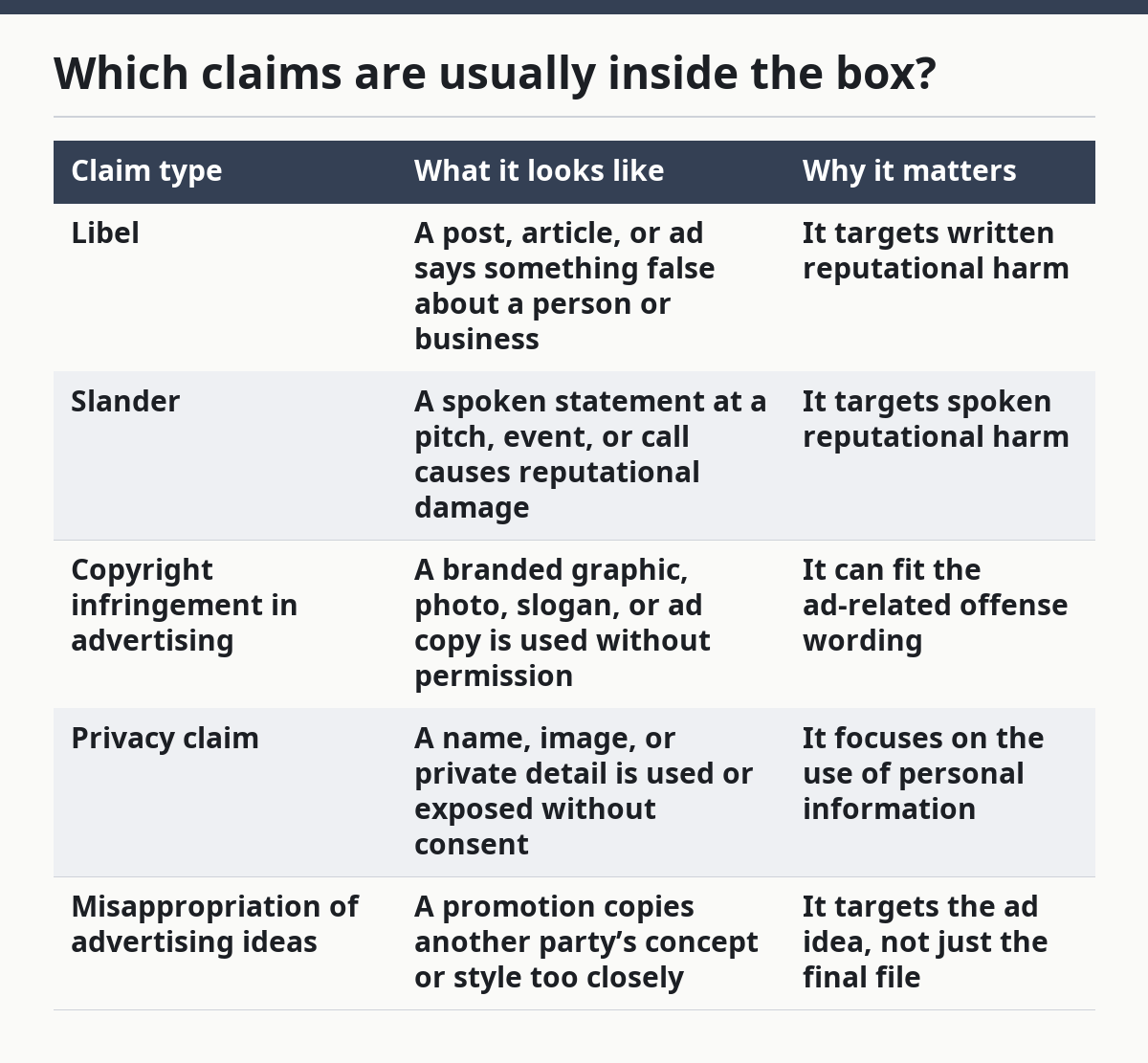
Here is the usual fit, using the policy terms a reader is likely to see:
| Claim type | What it looks like | Why it matters |
|---|---|---|
| Libel | A post, article, or ad says something false about a person or business | It targets written reputational harm |
| Slander | A spoken statement at a pitch, event, or call causes reputational damage | It targets spoken reputational harm |
| Copyright infringement in advertising | A branded graphic, photo, slogan, or ad copy is used without permission | It can fit the ad-related offense wording |
| Privacy claim | A name, image, or private detail is used or exposed without consent | It focuses on the use of personal information |
| Misappropriation of advertising ideas | A promotion copies another party’s concept or style too closely | It targets the ad idea, not just the final file |
The policy does not care whether the claim is embarrassing or expensive by itself. It cares whether the alleged act matches the offense named in the form and whether an exclusion removes it. That is why a copied headline can be covered in one situation and excluded in another, especially when the claim starts to look like a professional mistake rather than an ad injury.
A useful outside reference is the U.S. Copyright Office’s general guidance on copyright basics, which helps explain what copyright protects in the first place. The FTC’s advertising and endorsements guidance is also worth reading if your work touches influencer posts or promotional claims.
https://www.copyright.gov/help/faq/faq-general.html
https://www.ftc.gov/business-guidance/advertising-marketing/endorsements-influencers-reviews
How do I check a policy step by step?
You check a policy by matching the claim to the wording, then checking the exclusions one by one. The goal is not to guess whether a claim sounds covered; it is to test the facts against the actual form.
- Find the exact policy form. Look for the form number on the declarations page, such as CG 00 01, and note every endorsement attached to it. Verify that you have the current year’s wording, not a summary sheet. If the form is missing, coverage questions are already a problem.
- Locate the personal and advertising injury definition. Read the section that lists the covered offenses, usually in a numbered set of terms. Verify that libel, slander, privacy claim, or advertising idea language appears there. If the wording is narrower than you expected, the gap matters more than the title.
- Match the claim to the act. Write down exactly what happened in 1 or 2 sentences: posted, said, emailed, published, or used in an ad. Verify whether the alleged harm comes from publication or promotion. If the dispute is really about late payment or a broken contract, that is a warning sign that this section may not fit.
- Check the exclusion list. Read the exclusions that mention contract, professional services, electronic data, criminal acts, or knowing violations. Verify whether the claim is pushed out of coverage by one of those exclusions. A single exclusion can remove what the coverage grant seemed to include.
- Look for the consent or authorization issue. See whether the policy asks if the use was with permission, and whether that permission was written, oral, or implied. Verify whether you can show a license, release, or approval. If the answer is no, privacy and copyright claims become harder to defend.
- Check where the alleged injury happened. Identify whether the claim arose from a website, social post, newsletter, brochure, or live pitch. Verify whether the policy treats online publication the same as print or oral speech. If the policy has a special internet endorsement, do not skip it.
- Confirm the duty to notify. Find the notice language and any reporting deadline or prompt-notice wording, even if the policy does not give a fixed number of days. Verify who must be told, in what form, and what documents to send. Late notice can create a coverage fight before the claim is even evaluated.
If any step turns up a mismatch, the coverage question changes. At that point, the issue is not “does personal and advertising injury exist?” but “does this policy still respond after the exclusions and conditions are applied?”
What does it not cover?
It does not cover every claim that comes from a business website, ad, or social post. That is the main trap for freelancers, because the label sounds broader than the actual promise.
Professional advice gone wrong: If the dispute is really about a bad recommendation, missed deadline, or flawed deliverable, it often belongs in a professional liability analysis — not here. The consequence is a false sense of protection. The fix is to read the policy form for service-based exclusions and separate the claim from ad content.
Cyber incident first, speech claim second: If the problem starts with hacked accounts, stolen logins, or exposed client files, the issue may be cyber-related rather than personal and advertising injury. The consequence is that the wrong policy gets blamed. The fix is to treat the data incident as its own question and not assume this section will absorb it.
Client breach of contract: If a client says you missed a deadline, ignored instructions, or used the wrong deliverable, the injury is usually contractual. The consequence is a coverage dead end if you force it into libel or privacy language. The fix is to read the claim letter for the legal theory, not the annoyance behind it.
Knowing or intentional conduct: If the facts suggest you knew the statement was false or meant to cause harm, many policies narrow or bar coverage. The consequence is that the carrier may dispute the claim from the start. The fix is to avoid assuming “I did not mean it” solves everything; the policy wording controls.
Unauthorized use outside advertising: A photo, clip, or slogan used in a portfolio, blog post, or product may not fit the ad-related offense if the policy ties coverage to advertising activity. The consequence is a narrower path to coverage. The fix is to check whether the use was promotional, not just public.
What mistakes do freelancers make most often?
Freelancers most often mistake the label for the promise, and that leads to avoidable gaps. The policy title can sound broad while the definitions and exclusions quietly cut it down.
One common error is assuming any online post is automatically covered. A post can be public and still fall outside the policy if it is not a covered offense or if an exclusion applies. The safer alternative is to ask whether the claim is about defamation, privacy, or ad content, and then test the exact wording.
Another error is treating copyright and advertising injury as the same thing in every case. They are not the same in every policy, and copyright can be carved back in or out with endorsements. The better move is to check whether the infringement is alleged in the ad itself, not just in business content generally.
A third mistake is ignoring how permission works. If you used a model’s image, a quoted review, or a brand asset without clear approval, the claim can shift fast from “seems minor” to “written demand.” The correct alternative is to keep releases, licenses, and approvals in writing, then store them with the project record.
A fourth mistake is reading only the coverage grant and stopping there. The policy can mention libel or privacy claim and still exclude the exact situation later. The better habit is to read the definitions and exclusions in the same sitting, with the claim facts beside you.
When does the standard answer not fit?
The standard answer does not fit when the claim sits at the edge of advertising, publication, and professional work. In those cases, the same fact pattern can point to different coverage parts, and the first label you see may be the wrong one.
If the claim mixes ad content with a client deliverable, the policy may need a closer reading than a one-line summary can give. A website rewrite, branded campaign, or social strategy can trigger multiple theories at once, which is why one claim letter can mention defamation, contract, and copyright in the same paragraph. That does not mean one section will solve all of it.
If you freelance across borders, the wording can matter even more. Coverage terms, privacy rules, and ad standards differ by country and can change often, so a claim that looks ordinary in one place may need a different read elsewhere. That is one more reason not to treat a general explanation as a final answer for your own policy.
The safest use of this coverage is as a map, not a verdict. It tells you where to look first, what offense names matter, and which exclusions can break the fit. For the bigger picture on liability insurance for freelancers, the Freelancer Liability Insurance hub is the place to start; this page only covers the personal and advertising injury piece.
FAQ
Is copyright infringement covered as advertising injury?
Sometimes, but not always. The policy has to include copyright infringement in the personal and advertising injury section, and the claim usually has to arise from advertising or promotion. If an endorsement removes that offense, or if the facts fit another exclusion, the coverage can disappear even when the word “copyright” is in the complaint.
Does liability insurance cover online defamation claims?
It can, if the policy treats the post as libel or slander and no exclusion blocks it. Online publication is often treated like other publication, but the exact wording matters. A social post, review response, or blog statement can still be excluded if it is tied to knowing falsity, professional services, or another barred category.
What counts as advertising injury for freelancers?
Advertising injury usually means a named offense connected to promotion, such as libel, slander, privacy invasion, copyright use in an ad, or misappropriation of advertising ideas. The key question is whether the claim comes from the way you advertised, published, or promoted your business. A general client dispute does not become advertising injury just because it happened online.
Drafted with AI; not yet reviewed by a person.
