

Last updated: November 23, 2026
Quick answer: update 3 things on your freelance insurance after a payment model change — your billing description, your income pattern, and your invoice dates. If you moved from one-off project fees to retainers, subscriptions, or another recurring setup, the insurer may need a new description of your billing structure, income, and invoice pattern. The topic is How to Update Freelance Insurance After Changing Your Payment Model, and this page shows how to keep that record current.
- Key takeaways
- Who needs to update this, and what does it change?
- How do you update freelance insurance after a payment model change?
- What should stay the same on the form?
- Which payment-model changes matter most?
- When should you stop and get help?
- What mistakes do freelancers make most often?
- What if the change is only temporary?
- FAQ
Key takeaways
- A payment model change can change how your work is described on an insurance application.
- Retainer, project fee, and subscription income are not the same in an underwriting form.
- The main job is to keep your policy facts aligned with your invoices and reported income.
- Some changes are simple updates; others need a fresh review of coverage terms.
- If your billing setup has changed, do not let old wording stay on the policy.
Who needs to update this, and what does it change?

This applies to freelancers who have changed from one-time project fees to retainers, subscriptions, or any other recurring billing setup. It assumes you already have freelance insurance, know your current policy basics, and can describe how clients pay you now. A payment model change can affect what the insurer thinks your income looks like and how stable it is, which is why the update matters.
The change is not only about money coming in more often. A retainer is usually ongoing work for a client over a set period, a project fee is tied to a single job, and a subscription is a recurring service with repeated billing. Those are different billing structures, and insurers often ask for them in different terms on an application or renewal form. The Financial Conduct Authority says customers should answer insurance questions carefully and honestly, and that rule becomes especially relevant when your billing pattern changes. (Source: FCA)
The update matters most if your old application said you only billed by project, but you now send monthly invoices or receive recurring income. If the policy still describes your work as one-off jobs, the record can drift away from your real business. That can create problems later when you renew, add a claim, or answer underwriting questions.
This section is about disclosure accuracy, not about changing your trade or opening a new service line. If your service itself changed, that is a separate issue. A reader who needs help with that should use the hub on freelance business changes and policy updates, because that topic belongs there rather than on this page. For more on keeping policy details current, see the update steps and the FAQ.
How do you update freelance insurance after a payment model change?
You update it by matching your insurance records to your current invoice and income pattern, then telling the insurer what changed in plain terms. The steps below are most useful when the main change is the payment model, such as moving from project fees to a retainer or subscription.
- Review your current policy and application, then mark the exact wording that describes how you bill clients; verify whether it says project fee, retainer, subscription, or a generic billing method; a problem is any phrase that no longer matches your invoices.
- Gather your last 3 to 12 months of invoices and income records, then sort them by project fee, retainer, or subscription; verify that each income stream is clear; a problem is mixed labels that blur recurring revenue and one-off work.
- Compare your new billing structure with the old one, then note what changed in frequency, invoice cycle, and payment timing; verify whether clients now pay monthly, per project, or on another schedule; a problem is assuming the insurer will infer the new model from the old file.
- Prepare a short disclosure summary for the insurer, then list the old model, the new model, and the date the change started; verify that the dates match your invoices; a problem is using a vague phrase like “recently changed” with no start point.
- Update the policy record, then replace any stale description of income reporting with the new one; verify that the application or renewal form reflects the change in billing structure; a problem is leaving old project-only wording in place.
- Ask the insurer or broker whether the change affects underwriting questions, then confirm if they need a revised income breakdown; verify that the answer is specific to retainer work, subscriptions, or project fees; a problem is guessing that the change is too small to mention.
- Keep a copy of the updated form, the invoice record, and the confirmation in one file; verify that the documents line up on model, date, and income source; a problem is updating one record and forgetting the rest.
The key idea is consistency. If your invoices show recurring fees but your insurance file still reads like a one-off project business, the mismatch should be fixed before renewal or any coverage question. For many freelancers, the update takes less time than a normal renewal because the work is mostly about clean records, not a new policy. For example, a 12-month billing history is easier to review than a single month of mixed invoices.
What should stay the same on the form?
Your core business description should stay the same unless the work itself changed. A graphic designer who shifts from project fees to a subscription model is still a graphic designer; the billing structure changed, not the occupation. That distinction matters because insurers look at what you do and how you are paid as separate pieces of the file.
Keep the parts that still fit: your main service, your client type, and the kind of invoice you send. Change the parts that no longer fit: whether you bill by retainer, project fee, or subscription, and how that shows up in income reporting. If a form asks for annual revenue or other income details, the numbers or ranges should reflect the current model, not the old one. In practice, that often means updating one set of figures, not every policy term.
A good check is to line up three items on one page: the policy wording, the invoice terms, and the income records. If those three disagree, the insurance file is not current. That is true even when the total income has not changed much, because the payment model itself can still matter for underwriting. Use the current invoice cycle as the reference point, not the old one. See the payment-model table.
Which payment-model changes matter most?
Retainers, subscriptions, and project fees matter most because they change how income appears over time. A retainer usually means recurring work and recurring billing. A subscription usually means a repeat service with a set cycle. A project fee usually means a one-time invoice tied to a defined job.
| Payment model | What it usually signals | What to check on insurance records |
|---|---|---|
| Retainer | Ongoing work with repeat billing | Whether the policy mentions recurring income or monthly invoices |
| Project fee | One-off work for a single job | Whether the application still shows project-only billing |
| Subscription | Repeated service with a billing cycle | Whether the insurer sees the income as recurring and contract-based |
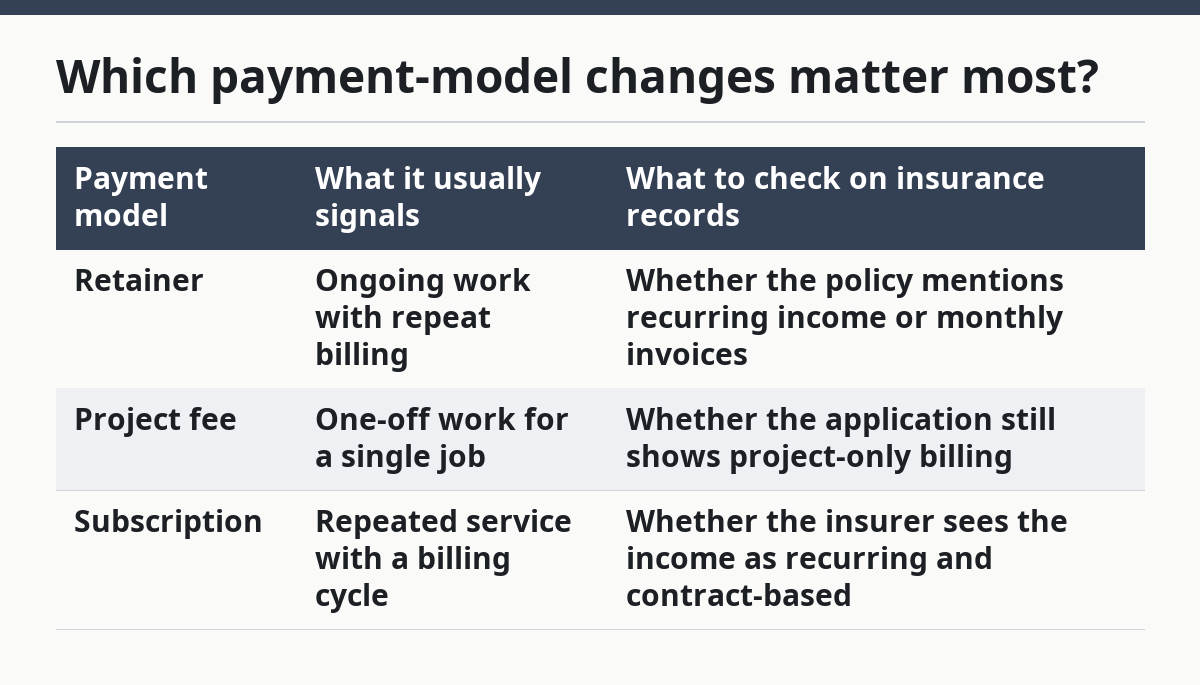
The difference is not just the label. A retainer can look steadier than one-off work, while a project fee can be more episodic. A subscription can also create a different cash flow pattern from a single invoice. That is why the billing structure should be spelled out clearly rather than hidden in a general “freelance” description. If you are updating a policy, the label should match the invoice cycle you actually use.
When should you stop and get help?
You should stop and get qualified help when the change is not just a billing update. That is the point where the insurance question becomes broader than a simple record correction. The wrong move is to guess, because a mismatch in disclosure can leave the policy file out of step with your business.
Your work changed, not just your billing: This means the insurer may need a new risk review, not a simple update — get help before you file another form.
Your income now comes from several different payment models: This means the file may need a fuller breakdown of project fees, retainers, and subscriptions — ask for guidance before you average the numbers.
Your invoices no longer match your old income reporting: This means the paperwork is already inconsistent — fix the records before renewal.
The insurer asks for details you cannot verify from invoices: This means your records are too thin for a clean update — pause and gather support documents.
You are unsure whether the change started before or after your last renewal: This means timing may matter on the disclosure — get a qualified adviser to help you sort the dates.
This page is not for readers who want to decide whether a new model is better for their business. It is for readers who need the insurance file to match the current setup. If the change is large enough to affect contract language, service scope, or revenue reporting, the update may need more than a quick message to the insurer. In that case, the insurer or broker may want a more detailed review of the current setup. Return to the update steps.
What mistakes do freelancers make most often?
The most common mistake is leaving the old billing model on the policy after the business has changed. That can happen when a freelancer moves to monthly retainers but never updates the original project-based description. The result is a paper trail that tells two different stories.
Another mistake is treating recurring income as if it were the same as a single project fee. Because underwriting forms can treat these differently, consult your insurer, broker, or a qualified adviser if you are unsure how to report the change, and keep a record that the new setup is disclosed accurately. A practical source on careful insurance disclosure is the FCA, which expects clear and honest answers to insurer questions.
A third mistake is changing the invoice format without changing the insurance record. A subscription invoice may look routine on the accounting side, but the insurer still needs the business description to match. The fix is to update both places at the same time.
A fourth mistake is waiting until renewal and then trying to reconstruct the change from memory. That usually leads to vague dates and incomplete details. The better alternative is to keep a short change note as soon as the payment model changes.
A fifth mistake is assuming the insurer does not care because the service itself stayed the same. Payment structure can still matter because it changes how income is reported and how the business is described. If the file says one thing and the invoices say another, the mismatch should be corrected. For a quick refresher, review what should stay the same on the form.
What if the change is only temporary?
Temporary changes still deserve a record if they affect the way income is billed for more than a single invoice cycle. A brief switch from project fees to a 2-month retainer, for example, is still a real payment model change. The insurer may not need a major overhaul, but it may still need the current facts.
If the change is truly short-lived and does not alter the ongoing billing structure, the update may be smaller. Even then, keep the dates and invoice trail. The issue is not whether the change feels minor; it is whether the policy record still describes the business correctly. A 2-month retainer is still long enough to justify a note in your file.
If you expect to switch back and forth between models, write that pattern down before renewal. A business that alternates between project fee work and recurring subscription income should not be described as only one or the other. That kind of inconsistency is easier to fix early than after a claim. If needed, compare the pattern with the table above before you submit a change.
FAQ
Do retainers change underwriting questions?
Yes, they can. A retainer changes the way income is billed and may prompt the insurer to ask about recurring revenue, invoice cycles, or contract length. The exact questions vary by insurer and country, so it is usually best to describe the retainer plainly and keep the invoices that show the pattern.
Should I report new recurring revenue?
Yes, if the recurring revenue changes how your business is described on the policy or application. Repeated income from subscriptions or retainers is different from a single project fee, even when the work itself is similar. If the change is material, the insurer should have the current facts rather than the old setup. If you are unsure, ask a qualified adviser or the insurer before you file.
Does the way I bill clients matter?
Yes, it matters because billing structure is part of how the insurer understands your freelance business. Project fees, retainers, and subscriptions can show different income patterns and different invoice timing. If your billing method changes, the insurance record should change with it. Use the current invoice pattern as your guide, not the old policy wording.
Drafted with AI; not yet reviewed by a person.
