
Last updated: November 19, 2026
Key Takeaways
- Stop the damage early, preserve the record, and avoid emotional replies.
- Treat the dispute as a controlled event: identify, contain, investigate, and close it with proof.
- Collect documents that show agreement, performance, and notice.
- Reply with facts, a calm tone, and one clear next step.
Freelancer claims and incident response — The Complete Guide covers payment, scope, and conduct disputes that can erupt when a client and a freelancer work without the guardrails of payroll and HR. The right response is to preserve evidence first, then decide whether the issue is a contract breach, a platform dispute, or a legal claim. The steps below sort out what to do, what to say, and what to avoid.
Freelancer claims and incident response — The Complete Guide has two jobs at once: stop the damage now and keep the record clean for later. That means email, screenshots, invoices, access logs, and a written timeline.
What counts as a freelancer claim?
A freelancer claim is any formal complaint tied to a freelance job: nonpayment, late payment, scope creep, chargeback fights, ownership disputes, confidentiality breaches, or a claim that the work caused loss. In practice, the trigger is often one missed payment, one rejected deliverable, or one message that says “we’re disputing this.”
Picture this: you finished the project, the client says the work “isn’t usable,” and the payment is paused. You need to know if this is a simple invoice dispute or the start of a bigger incident. The first move is to classify the claim, because the next step depends on the type.
- Payment claims: invoice not paid, partial payment, delayed payment, duplicate payment, refund demand.
- Scope claims: client says extra work was never agreed, or says the freelancer didn’t deliver the agreed work.
- Quality claims: client alleges defects, missed specs, or a breach of acceptance criteria.
- Access and security claims: account misuse, file deletion, lost login access, or data exposure.
- Conduct claims: harassment, threats, plagiarism, or misuse of confidential material.
The difference matters because a nonpayment claim and a confidentiality claim do not follow the same path. A missed invoice may be solved with a demand letter or platform dispute. A data incident may need immediate access shutdown and written notice.
What should you do in the first hour after a claim appears?
You should stop the bleeding, save the record, and avoid emotional replies. The first hour is about containment, not persuasion.
Picture this: your inbox fills with an angry note, a payment reversal, or a warning from the client’s legal team. Your instincts say to argue point by point. That usually makes the record worse. The better move is to freeze the facts while they are still fresh.
Because of that, save every message thread in full, including headers if possible.
Download the signed contract, statement of work, change orders, and invoices.
Then screenshot project boards, file timestamps, approval notes, and delivery receipts.
Write a short timeline with dates, deliverables, and payment milestones.
Pause any nonessential replies until you know who owns the next move.
If the claim involves access, revoke shared passwords, API keys, and admin rights that are no longer needed. If the claim involves money, stop casual side chats and move payment talk into a written channel. A loose Slack thread is bad evidence.
The truth is, early mistakes are often small and very costly later. A deleted email, an edited invoice, or a heated message can change how the dispute looks.
- Do not admit fault in a rush.
- Do not threaten the client.
- Do not delete files or chats.
- Do not alter timestamps, invoices, or work logs.
How incident response works for freelancer disputes
Incident response for freelancer claims means you treat the dispute like a controlled event, but it is wise to do so carefully and consult a qualified professional when the stakes are high. That process is best known in security work, but it fits freelance disputes too, especially when accounts, data, or access are involved. The NIST Computer Security Incident Handling Guide is a useful reference for the structure of that response, even when the issue is commercial rather than technical.
Picture this: the client says a shared folder was deleted, or a password was reused, or a deadline slipped because the brief changed three times. You need a method that works whether the problem is money, scope, or data. A four-step response keeps the facts organized.
- Identify the incident: What happened, when, and who noticed it?
- Contain the issue: Stop further access, payment movement, or file changes.
- Investigate the record: contract, scope, approvals, file history, and communications.
- Close with a written summary: what was found, what was resolved, and what remains open.
For security-related claims, the response has a second layer: preserve evidence in a way that keeps it usable. That means note file paths, export logs, keep original versions intact, and avoid “cleanup” that destroys metadata. If the matter involves personal data, look to the ICO’s data breach guidance or your local privacy regulator’s breach rules; the exact notice duty depends on the jurisdiction and the kind of data involved.
A clean response also assigns one owner. One person should collect evidence, one should speak for the response, and one should track deadlines. Chaos comes from three people answering the same question with three different versions.
A practical incident-response checklist
- Record the claim in writing the moment it arrives.
- Mark the date and time of first notice.
- Identify all systems, files, or payment tools touched.
- Preserve copies before anyone edits them.
- Decide whether outside counsel, a platform, or a client escalation path is needed.
Freelancer claims: what to collect before you reply
You should collect documents that prove agreement, performance, and notice. Without those three things, most claims become a memory fight.
Picture this: a client says the deliverable missed the brief, but the brief changed in three emails, and the final approval sits in a chat thread. Your best defense is not a long speech. It is a paper trail that shows what was asked for, what was sent, and what was accepted.
The most useful evidence usually includes the contract, the scope of work, the invoice, delivery emails, milestone approvals, change requests, and any written complaint. If the claim is about quality, keep drafts, revision notes, and the exact acceptance criteria. If it is about payment, keep the invoice date, due date, and proof of submission.
A strong record often beats a loud argument. A weak record does not improve just because the story sounds fair.
- Contract or master services agreement
- Statement of work or brief
- Signed change order or written scope change
- Invoice and payment terms
- Delivery receipt or acceptance note
- Messages about defects, delays, or revisions
- Access logs, file history, or platform timestamps
- Any notice deadline in the contract
The useful question is not “Did I do good work?” It is “Can I prove what the agreement was and what happened next?” That is the standard that tends to matter in claims, platforms, and legal review.
How do you answer a client claim without making it worse?
You answer with facts, a calm tone, and one clear path forward. The strongest reply is usually short enough to quote later and specific enough to use later.
Picture this: you want to explain the whole history, but every extra sentence gives the other side more material to twist. A response that is too long often sounds defensive. A response that is too vague sounds evasive. The sweet spot is a written answer that names the disputed point, cites the record, and asks for the next step.
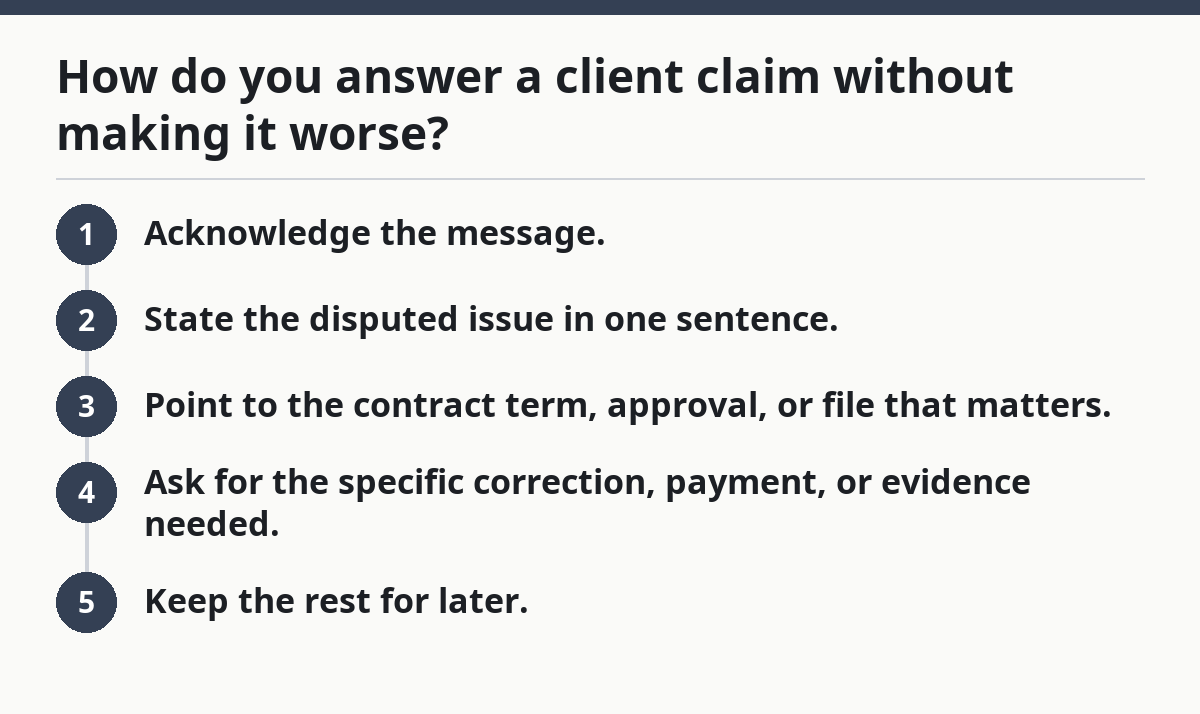
So, use this order:
- Acknowledge the message.
- State the disputed issue in one sentence.
- Point to the contract term, approval, or file that matters.
- Ask for the specific correction, payment, or evidence needed.
- Keep the rest for later.
For example: “I received your note about the March invoice. The contract states net 14 after delivery, and the delivery email was sent on March 12. If there is a specific defect you want me to review, please send it in writing so I can compare it against the agreed scope.”
That wording works because it is neutral. It does not admit liability, and it does not insult the client. It also creates a better record if the matter later moves to a platform dispute, mediation, or court filing.
- Keep replies in the same channel when possible.
- Avoid sarcasm, threats, or side comments.
- Do not rewrite the timeline in your head and then send it.
- Do not promise fixes you cannot deliver.
When should you stop talking and escalate?
You should escalate when the other side sends a legal notice, threatens chargeback abuse, alleges data loss, or refuses to engage with the written record. At that point, continuing to improvise can make things worse. The safer move is to route the matter through the platform, an internal process, or a qualified professional.
Platform disputes, chargebacks, and legal claims are not the same thing
They are different tracks, and confusing them wastes time. A platform dispute follows the marketplace rules, a chargeback follows card-network and bank rules, and a legal claim follows contract and court rules.
Picture this: the client paid through a platform, then reversed the card payment, then sent a separate complaint about the work product. Those are three different pressure points. Each one needs a different response and a different deadline.
A platform dispute usually turns on proof of delivery and scope. A chargeback often turns on whether the cardholder authorized the transaction, whether the service was delivered, and how the merchant records look. A legal claim may turn on contract language, jurisdiction, damages, and notice requirements. The same invoice can be relevant to all three, but the response packet is not identical.
Here’s the catch: each system moves at its own speed. A payment platform may want a fast upload of evidence. A card dispute can have strict timing windows. A court claim can involve formal service rules and response deadlines that should not be guessed at.
- Platform case: follow the marketplace form and upload the record they ask for.
- Chargeback: provide proof of authorization, delivery, communication, and refund terms.
- Legal claim: read the notice carefully and preserve the original documents before responding.
If you are not sure which track you are in, ask one question first: “Who is demanding what, under what rule?” That clarifies whether you are dealing with a support ticket, a bank dispute, or a legal complaint. For more on consumer dispute processes, see the U.S. Federal Trade Commission and your payment provider’s dispute rules.
What are the biggest mistakes in freelancer claim handling?
The biggest mistakes are bad records, emotional replies, and vague contracts. Those three problems create most of the pain.
Picture this: the project started on a handshake, the deliverables moved twice, and the payment terms live in scattered messages. Then the claim lands, and both sides think they are obviously right. That is exactly how an avoidable dispute turns expensive.
The most common errors are easy to name. People skip written scope terms, miss approval checkpoints, and accept changes without documenting them. They also mix personal feeling into professional replies, which helps nobody and hurts the record.
- No signed scope or no clear deliverables
- No written change control
- No proof of acceptance
- No backup of files, messages, or invoices
- No clear escalation path
- No written rule for late payment or revision limits
Another mistake is waiting too long to respond. Silence can look like acceptance of the complaint or indifference to the deadline. The better move is a short acknowledgment and a promise of a written follow-up by a specific time.
A different mistake is overreacting to every complaint as if it were a lawsuit. Many claims are just broken process. Fix the process first if the facts allow it. If the facts do not allow it, keep the record tight and move to the proper channel.
When does a freelancer claim need outside help?
A freelancer claim needs outside help when money, access, or legal exposure is large enough that a bad reply could cost more than the dispute itself. That threshold is often lower than people think.
Picture this: the client says confidential files may have been exposed, or a chargeback hits a large milestone payment, or the dispute crosses a country border. At that point, the issue is no longer just a billing problem. It can become a contract, privacy, tax, or platform problem at the same time.
Outside help is worth considering when:
- the contract is silent on the disputed issue,
- the amount at stake is material,
- the claim mentions data, IP, or confidentiality,
- the other side has already mentioned counsel,
- the platform or bank process is not moving,
- the client is in another jurisdiction.
Consulting a professional can narrow the fight. A lawyer, accountant, security lead, or platform specialist can tell you which facts matter and which facts only make noise. They can also help with formal notice language, which is where many freelancers make avoidable mistakes.
There is no need to turn every dispute into a legal event. But once the claim touches regulated data, serious money, or formal deadlines, improvisation becomes a bad bet.
What does a clean resolution look like?
A clean resolution leaves a written record showing what was disputed, what was changed, and what was paid or closed. If the issue ends with no admission, that should be clear too.
Picture this: both sides agree to a partial refund, a revised deliverable, or a final release of claims. The matter is not really over until the paperwork matches the settlement. If the note in the file does not say what was resolved, the same dispute can return later in a new form.
Since the invoice often anchors the timeline, keep the date, keep the payment term, and keep the acceptance note together. A good closeout memo usually includes the claim type, the key dates, the documents reviewed, the result, and any future obligations. If payment moved, the record should show the amount and reason. If access was shut down, note the date. If a platform case was closed, keep the final decision.
A clean close does not need drama. It needs clarity.
- What was claimed
- What evidence was reviewed
- What was agreed or denied
- What was paid, fixed, or returned
- What remains restricted, if anything
The right close also protects future work. If the client stays on, the next project should start with a cleaner contract, clearer approval steps, and a better change process. That is how one bad incident becomes a better system instead of a repeat event.
Which response path should you choose?
Choose the platform path if the job was booked through a marketplace and the platform gives you a dispute process. Choose the legal path if the claim involves formal notice, serious money, or rights that the platform cannot fix. Neither if the record is so thin that you cannot prove the agreement, the delivery, or the payment terms.
Picture this: you are trying to decide in the middle of a fast-moving dispute. The wrong path can burn time and weaken your case. The right path depends on what kind of claim this is, who controls the money, and what evidence exists right now.
Here is the clean rule:
- Use the platform process when the platform can still reverse, mediate, or document the dispute.
- Use formal legal help when the issue is outside platform control or carries confidentiality, IP, privacy, or high-value exposure.
- Use self-managed resolution when the claim is small, the facts are clear, and both sides are still writing things down.
The practical winner is the path that matches the forum. A bank dispute is not solved by a long Slack note. A contract claim is not solved by arguing in the comments section of a marketplace. Match the channel to the claim.
FAQ
What is the first thing to do when a freelancer claim comes in?
The first thing to do is preserve the record. Save the contract, messages, invoices, and delivery proof before anyone edits them or moves the conversation into a less reliable channel.
Can a freelancer claim be handled without a lawyer?
Yes, many small payment or scope disputes can be handled without one if the contract is clear and the facts are well documented. Once the claim involves data, IP, serious money, or formal legal notice, the safer move is to get qualified help.
What evidence matters most in a freelancer dispute?
The most useful evidence is the signed agreement, the exact scope, the invoice, proof of delivery, and any written approval or complaint. If the project changed, keep the change request too, because that often decides who was right about the scope.
Is a platform dispute the same as a legal claim?
No, a platform dispute follows the marketplace rules, while a legal claim follows contract law and court rules. A chargeback follows bank and card rules, which can create a separate track with its own deadline and proof requirements.
How do I keep a claim from getting worse?
Reply in writing, stay brief, and stick to the documents. Avoid emotional language, avoid deleting records, and avoid guessing at facts you cannot prove.
Drafted with AI; not yet reviewed by a person.
