
Last updated: November 20, 2026
Quick answer: use a 7-step written request for How to Ask for a Coverage Opinion on a Freelance Claim, attach the policy language, and ask the claims adjuster to point to the exact clause that supports the insurer’s position. That is often the quickest way to get a clear answer on a freelance claim, especially if the insurer has sent a reservation of rights letter or hinted at a coverage denial.
Key takeaways
- A coverage opinion is the insurer’s written view on whether the policy may respond to the claim.
- Ask for it in writing so you can match the insurer’s response to the policy language, not to a phone call.
- The request works best when it is narrow, specific, and tied to one claim number.
- A reservation of rights letter is not the same thing as a denial, and the difference matters.
- If the insurer is already denying coverage, the question shifts from “Can I ask?” to “What does the denial rely on?”
What is a coverage opinion?
A coverage opinion is the insurer’s written explanation of whether a freelance claim fits the policy language. It usually comes from the claims adjuster or another claims representative, and it should point to the clause, condition, exclusion, or definition that drives the answer.
For a freelancer, this matters because the claim may sit in a gray area. Professional liability, media liability, and general liability policies do not all treat the same dispute the same way, and the key word in the policy can change the result; for a policy-specific read, consult the insurer’s claims team or a coverage professional, and compare the wording with a source such as the IRMI glossary on reservation of rights and the NAIC consumer guidance on filing complaints and policy disputes. A “claim” is often defined in a specific way, and a “wrongful act” or “professional services” clause may matter more than the headline on the policy.
A generic article can get this wrong by treating a coverage opinion like a verdict, so consult a coverage professional if the answer could affect a denial or defense obligation. It is the insurer’s position at that stage, based on the facts, the notice sent, and the wording in the policy.
If you want the shortest version: the request is a written ask for a policy-based explanation, not a complaint about the claim. That distinction keeps the exchange focused and gives you something you can compare against the reservation of rights letter or later coverage denial.
How do you ask for one?
You ask for a coverage opinion by sending a written request that names the claim, quotes the policy language, and asks the claims adjuster to explain the insurer’s view in plain terms. Keep the request to one claim number and one policy, if possible, so the response does not drift into side issues.
Use this 7-step structure.
- Identify the claim number, policy number, and loss date in the first line, and verify that each matches the insurer’s records; if any number is missing or wrong, the response can be delayed or attached to the wrong file.
- Request a written coverage opinion, not just a status update, and ask for the answer in email or letter form; if the reply is only a phone call, you lose the exact wording.
- Quote the policy language that matters, including the definition of “claim,” any reservation of rights clause, and any exclusion the insurer has already mentioned; if you cannot point to the clause, the insurer can answer too generally.
- Ask for the insurer’s position on coverage for defense and indemnity, because those are not always treated the same way; if the response only addresses one and ignores the other, the opinion is incomplete. For policy-specific wording, consult a coverage professional and compare it with the insurer’s letter.
- Attach the claim notice, the reservation of rights letter, and any coverage denial or partial denial, so the adjuster sees the paper trail; if those documents are not attached, the insurer may answer as if they do not exist.
- State the factual points in 2 or 3 short paragraphs, and separate facts from argument; if you mix opinion into the facts, the insurer may treat the request as a dispute letter instead of a coverage request. If the file is complex, consult a coverage lawyer or adviser before sending the request.
- Set a reply expectation in ordinary business language, such as asking for a written response within the normal claims process time frame used on the file; if the insurer gives no target at all, follow up on the same thread so the request stays visible.
A clean request sounds like this: “Please provide a written coverage opinion for Claim No. [number] under Policy No. [number]. Please identify the policy language you are relying on and explain whether the insurer is accepting or denying defense and indemnity, in whole or in part.” That is direct, and it keeps the focus on policy language.
The key check is simple: can a third person read your request and tell exactly what answer you want? If not, rewrite it. A vague ask invites a vague answer, and vague answers are hard to use when the insurer later changes position.
What should you include in the request?
You should include the minimum facts the claims adjuster needs to map the claim to the policy. That usually means the claim number, the policy period, the date of the alleged work, the date you first received notice, and the specific document you want interpreted.
Do not send a long narrative. A 1-page email is often enough if it is structured well. The adjuster does not need a novel; the adjuster needs the parts of the file that bear on coverage analysis.
A useful way to organize the request is to separate the file into three buckets: policy language, claim facts, and insurer response. The policy language bucket should include the exact clause text. The claim facts bucket should stay factual and brief. The insurer response bucket should include the reservation of rights letter or any coverage denial already issued.
Here is the comparison that matters most:
| Document | What it means | What it is not |
|---|---|---|
| Coverage opinion | The insurer’s written view on whether the policy may respond | A court ruling |
| Reservation of rights letter | Notice that the insurer may defend while keeping coverage issues open | A denial |
| Coverage denial | The insurer’s written position that the policy does not cover the claim, in whole or in part | A promise that the issue can never be revisited |
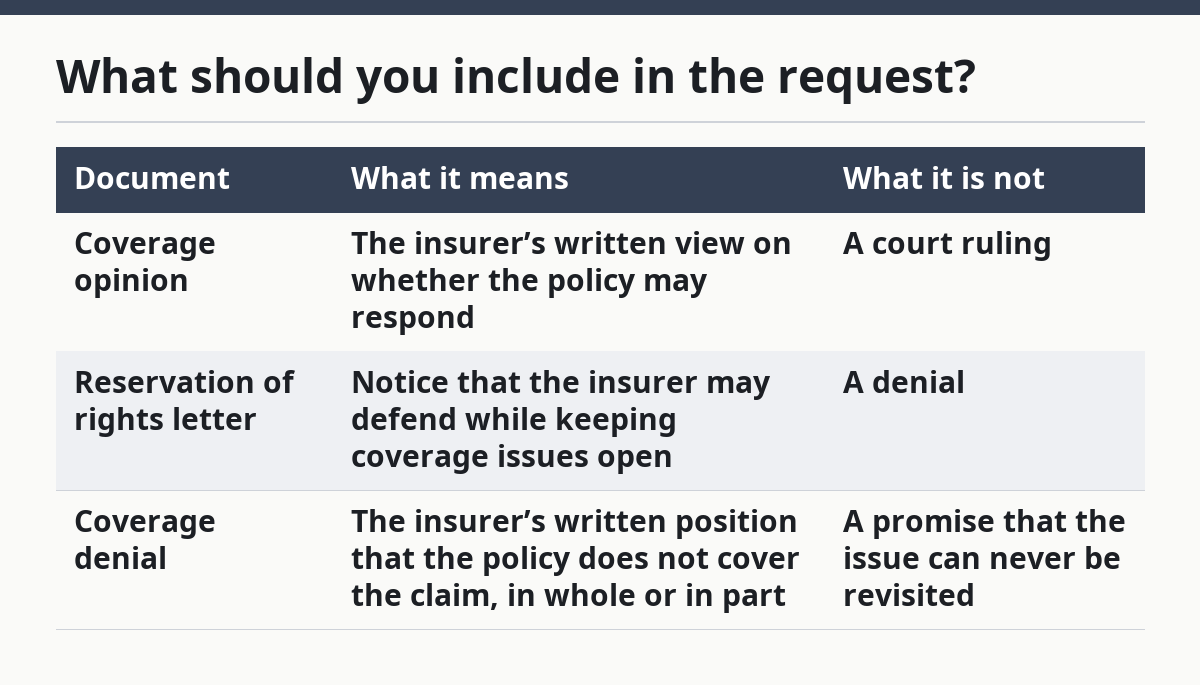
That table matters because many freelancers read a reservation of rights letter as if it were a denial. It is not. It is a warning that coverage is being reserved while the insurer investigates or continues the claim-handling process.
What if the insurer already sent a reservation of rights letter?
Because the insurer is preserving its ability to deny coverage later, a reservation of rights letter is the right moment to ask for a coverage opinion. In plain English, the insurer is saying, “We may help with the claim, but we are not giving up our coverage arguments.”
That is the moment to ask for a coverage opinion, not later. You want the insurer to identify which clause is in play and whether the insurer sees a defense duty, an indemnity duty, both, or neither. If the letter names exclusions, definitions, or notice issues, your request should quote those lines back to the adjuster.
A common mistake is to argue the whole case in response to the reservation of rights letter. That can bury the question you actually need answered. The better move is to ask for a policy-based explanation of the insurer’s position on the specific issue raised in the letter. For background on the letter itself, see the IRMI explanation of reservation of rights and the NAIC consumer resources.
This is also where a short paper trail helps. Keep the exchange to email if possible, and keep each reply in the same chain. If the insurer later shifts from “reserved” to “denied,” the timeline matters.
When should you stop and get help?
You should stop trying to handle it alone when the coverage issue turns into a dispute about rights, timing, or policy interpretation that could affect a denial. At that point, the request still matters, but the problem is no longer only administrative.
The insurer has issued a full coverage denial: that means the policy is being used to refuse the claim, in whole or in part — get qualified help to review the denial and the wording it cites.
The reservation of rights letter cites exclusions you do not understand: that usually means the insurer is relying on technical policy language — ask for help before you respond in a way that harms your position.
The adjuster asks for a recorded statement or broad factual supplement: that can expand the claim file fast — slow down and make sure you know what the question is before answering.
The claim involves multiple policies or policy periods: that means one request may not capture all coverage issues — map the file carefully before you send anything.
The claim includes a demand for money, not just a complaint about work: that raises the stakes of the coverage analysis — get qualified help if the response could affect your financial exposure.
The policy language uses terms like “professional services,” “interrelated wrongful acts,” or “prior knowledge”: those terms can control the outcome — do not guess at their meaning from the title alone.
The line here is simple: if the insurer’s response may decide whether the policy applies, the issue is no longer just about asking nicely. A coverage opinion is still useful, but the file may need a more careful review than a standard email chain can provide.
What mistakes cost the most?
The biggest mistakes are the ones that turn a clear coverage question into a messy record. A messy record gives the insurer room to answer narrowly, delay, or treat the request as a general complaint.
One mistake is asking, “Am I covered?” with no policy language attached. That forces the adjuster to guess what part of the policy matters. The better alternative is to ask whether the insurer is accepting or denying coverage under the specific clause already in the file.
Another mistake is mixing facts, argument, and emotion in one long message. That can distract from the clause you want explained. Keep the facts in short paragraphs and save the debate for a separate response if needed.
A third mistake is ignoring a reservation of rights letter because the claim is still being handled. That can leave you without a written record of the insurer’s position at the moment it mattered. The better alternative is to reply while the letter is fresh.
A fourth mistake is treating a coverage denial like a billing dispute. It is not the same thing. A denial is about whether the policy responds at all, and the wording in the denial matters more than the tone of the email.
A fifth mistake is asking for too much at once, such as a full coverage analysis, an appeal, and a reconsideration in the same note. That can slow the answer. One focused request gets a cleaner reply.
When does the standard approach need to change?
The standard approach needs to change when the file is not a single, ordinary claim. A freelance claim can involve several policies, several dates, or several layers of notice, and the request has to match the structure of the file.
If the claim spans more than one policy period, say so in the first paragraph and ask the insurer to identify which period it thinks applies. If the insurer believes a date of loss falls outside the policy period, the opinion should say that directly. A vague request will not force that issue.
If the claim touches a claims-made policy, the timing of notice can matter as much as the underlying allegation. That is one reason the request should include the date you first learned of the claim and the date you told the insurer. Do not assume the adjuster will infer those dates from the file.
If there is more than one insurer, keep the request separate for each carrier. A coverage opinion from one insurer does not bind another. That sounds obvious, but it is a common way files get tangled.
For related claims handling guidance, the hub on Freelancer insurance claims management covers the broader claims path. This page stays with the narrower question: how to ask for the coverage opinion itself.
What does a good answer look like?
A good answer is short, written, and tied to policy language. It names the clause, says what the insurer thinks it means, and explains how the claim fits or does not fit inside it. The answer may still be disappointing, but it should not be vague.
You want to see the insurer do three things in the reply. First, identify the policy provision. Second, connect that provision to the facts of the claim. Third, state whether the insurer is defending, reserving, denying, or partially denying coverage.
A weak answer says only that the claim is “under review” or “not clearly covered.” That is not a coverage opinion; it is a pause. If you get that response, ask again in writing and point back to the exact clause you want explained.
The best result is not necessarily agreement. The best result is a clear written position you can read against the policy language without guessing. That is what lets you decide what to ask next.
What is a coverage opinion?
A coverage opinion is the insurer’s written view on whether a claim fits the policy language. It usually explains the clause, exclusion, or definition the insurer thinks controls the file.
Can a freelancer challenge a denial?
A freelancer can ask the insurer to explain the denial and point to the policy language it relies on. A denial is not the end of the story, but the next step depends on the wording in the letter and the file facts.
How do I ask an insurer to explain coverage?
Ask in writing, name the claim number, and ask for the exact policy language behind the insurer’s position. Keep the request short, factual, and attached to the reservation of rights letter or denial if one has already been sent.
Drafted with AI; not yet reviewed by a person.
