

Last updated: November 21, 2026
Freelancers should reject or redline insurance clauses that demand unlimited indemnity, vague extra coverage, or proof deadlines they cannot realistically meet. The worst clauses can force a freelancer to cover losses far beyond the job, name the client as an additional insured for every risk, or treat a missing certificate as a contract breach. This is information, not financial advice; a qualified adviser should review any clause against your own policy and contract.
Key takeaways
- Some insurance clauses shift a client’s business risk onto the freelancer’s balance sheet.
- The biggest red flags are unlimited indemnity, vague “all claims” wording, and extra insured demands that reach beyond the work.
- A certificate of insurance is proof of coverage, not a promise that every client demand is met.
- Deadlines matter: a 24-hour certificate request can be impossible if the insurer or broker needs more time.
- The safest response is not always refusal; sometimes the clause needs tighter wording, narrower scope, or a clear cap.
Which insurance clauses are most dangerous?
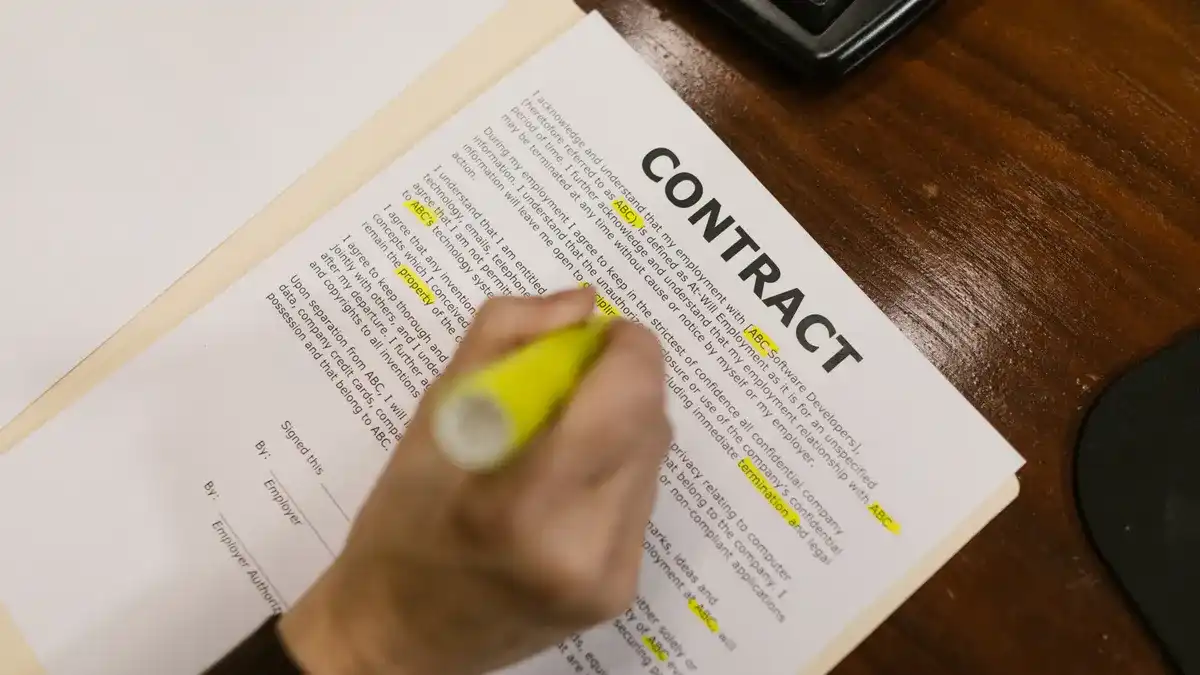
The most dangerous insurance clauses are the ones that move open-ended risk onto the freelancer without matching the work. Indemnity clauses, additional insured requirements, waiver of subrogation language, and strict insurance certificate rules are the four patterns that most often need a redline.
An indemnity clause says who pays if a claim comes up. In a freelance contract, that can be fair when it tracks the freelancer’s own mistake. It becomes a problem when the clause covers the client’s own negligence, a third party’s conduct, or losses with no link to the freelancer’s services.
An additional insured is a party added to a policy so that party gets some of the policy’s protection. That sounds harmless until the contract demands that every affiliate, parent company, contractor, and “related entity” be included. A small freelance policy usually cannot follow that chain forever.
A waiver of subrogation means the insurer gives up its right to recover money from someone else after paying a claim. Clients often ask for it as a routine line. For freelancers, it can erase a useful protection and may not fit the policy form at all.
Insurance certificate language can be just as risky. A certificate is only evidence that coverage exists on the date shown; it is not the policy itself. If a contract says the certificate must prove every special term, or must arrive before work starts with no time cushion, the clause can create a default risk over paperwork, not coverage.
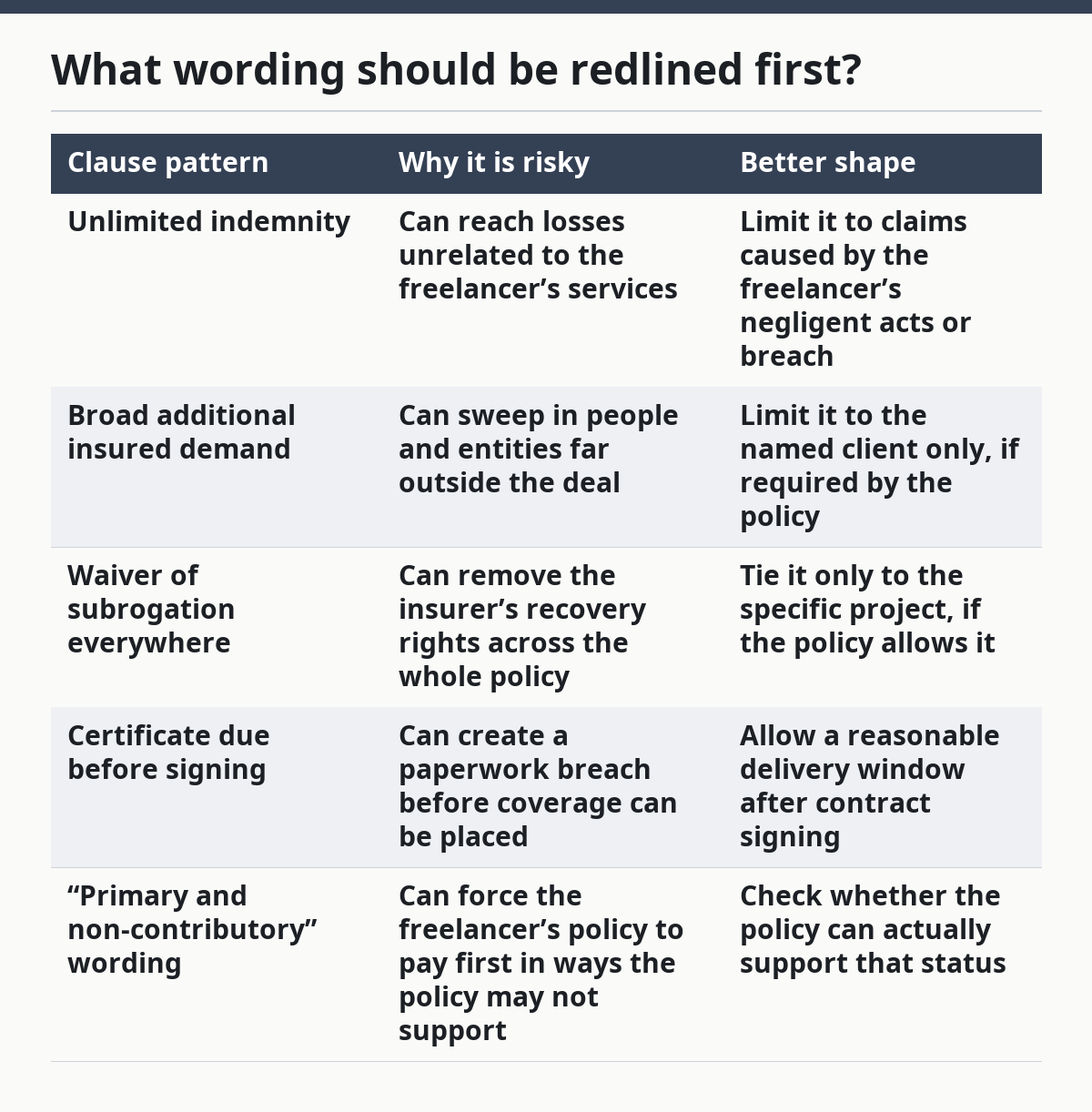
What wording should be redlined first?
The first wording to redline is any clause that says the freelancer must cover “any and all claims” without tying the duty to the freelancer’s own work. That phrase is often broader than the contract, the project, or the actual insurance.
Look for these exact pressure points:
| Clause pattern | Why it is risky | Better shape |
|---|---|---|
| Unlimited indemnity | Can reach losses unrelated to the freelancer’s services | Limit it to claims caused by the freelancer’s negligent acts or breach |
| Broad additional insured demand | Can sweep in people and entities far outside the deal | Limit it to the named client only, if required by the policy |
| Waiver of subrogation everywhere | Can remove the insurer’s recovery rights across the whole policy | Tie it only to the specific project, if the policy allows it |
| Certificate due before signing | Can create a paperwork breach before coverage can be placed | Allow a reasonable delivery window after contract signing |
| “Primary and non-contributory” wording | Can force the freelancer’s policy to pay first in ways the policy may not support | Check whether the policy can actually support that status |
A practical redline keeps the insurance promise tied to the actual job. If the work is a short copywriting assignment, a clause that reads like a construction contract is a mismatch. If the clause uses terms like “affiliate,” “successor,” or “all related parties,” that is a clue the wording is too wide for a one-person business.
The same rule applies to third-party coverage. If the clause requires protection for anyone who might later sue the client, the freelancer may be taking on a risk that is impossible to price into the fee. A narrower clause usually names the client, defines the covered services, and limits coverage to direct losses from those services.
How do freelancers review an insurance clause step by step?

Freelancers should review the clause line by line, then compare it to the actual policy forms before agreeing to anything. A 10-minute skim is not enough when the contract can change who pays if something goes wrong.
- Read the clause once for plain meaning, then again for insurance terms such as indemnity, additional insured, waiver of subrogation, and certificate of insurance. Circle each term and note whether it appears once or several times. If the clause uses more than 1 of these terms, it likely needs a closer look.
- Check whose losses are covered and whose are not. Verify whether the clause covers only the client’s direct loss, or also claims from affiliates, contractors, vendors, and end users. If “third parties” appears with no definition, that is a scope problem.
- Match the clause to the work. Write the exact service in the contract against the clause’s wording. A 2-page social media project does not need the same wording as a building-site contract. If the clause reaches beyond the actual service, it is too broad.
- Look for any unlimited language. Words such as “all,” “any,” “every,” and “without limit” can make the promise larger than the policy. If there is no cap, carve-out, or link to the actual claim, the clause may be unworkable.
- Check whether the client wants to be named on the policy or only shown on a certificate. If the contract demands additional insured status, verify that the policy can actually add that party. If the contract asks for a certificate only, the risk is lower than a policy endorsement.
- Review timing rules for certificates. If the contract requires delivery before work starts, before payment, or within 24 hours of signing, confirm whether your insurer or broker can meet that deadline. A deadline with no buffer is a breach trap.
- Compare any waiver of subrogation language with the policy wording. If the contract asks for a waiver across the entire policy, check whether the policy allows it for that type of claim. If not, the clause may need to be narrowed or removed.
- Mark every place where the clause asks for coverage you do not actually carry. If the agreement requires general liability, professional liability, cyber, and workers’ compensation, but the project only supports one or two of those lines, the clause is misaligned. That is the point where a redline should be specific, not vague.
A good result is a clause that names the actual parties, limits coverage to the actual services, and gives enough time for insurance paperwork. A bad result is a contract that sounds complete but cannot be matched to the policy in hand.
For plain-language background on policy terms, the Insurance Information Institute and the UK Financial Conduct Authority both publish useful consumer material on insurance documents and coverage wording. Those sources do not replace a contract review, but they help separate policy language from marketing language.
When should a freelancer refuse the clause?
A freelancer should refuse the clause when the risk is larger than the project and the wording cannot be narrowed. That usually happens in at least five situations.
Unlimited indemnity for all claims: This can expose the freelancer to losses far beyond the fee earned — refuse it or narrow it to claims caused by the freelancer’s own negligence or breach.
Coverage for the client’s own negligence: This shifts the client’s business risk onto the freelancer — refuse it because the clause is no longer tied to the freelancer’s work.
Additional insured demand for many entities: This can require policy changes that do not fit a small freelance policy — refuse the expansion or limit it to one named client.
Certificate deadline with no buffer: A demand for a certificate before signing, or within 1 business day, can create a default over paperwork — refuse the deadline or ask for a longer window.
Waiver of subrogation across the whole policy: This can remove a useful insurer right on claims outside the project — refuse the broad version or narrow it to the specific job if the policy allows.
Coverage type that does not match the work: If the clause asks for lines such as workers’ compensation or product liability for a service-only job, the clause may be the wrong tool — refuse or revise it to match the service.
The consequence of saying yes to a bad clause is not just a messy contract. It can lead to uninsured exposure, a claim dispute, or a client accusing the freelancer of breach before any claim is even made.
What mistakes do freelancers make with these clauses?
Freelancers usually make the same 4 mistakes, and each one creates a different kind of problem. The fix is usually to read the insurance words as contract terms, not as background noise.
First, many people treat a certificate of insurance like a shield. It is not one. A certificate can show that coverage exists, but it may not prove the client got every endorsement the contract asked for. The better move is to compare the certificate with the policy or endorsement language.
Second, freelancers often accept broad “additional insured” wording because it sounds routine. The consequence is that the clause can reach beyond the named client to parent companies, affiliates, or subcontractors. The better move is to keep the list narrow and tied to the actual project.
Third, people miss timing language. A clause can require proof of insurance on day 1, yet insurers and brokers may need time to issue documents. The consequence is a contract breach risk over a 2-day delay. The better move is to ask for a realistic delivery window.
Fourth, freelancers sometimes ignore the claim trigger. If the clause applies to “any claim arising out of the work,” that may be broader than a fault-based standard. The consequence is that the freelancer may be asked to pay even where the facts are disputed. The better move is to tie the clause to negligence, willful misconduct, or a clear breach if those terms are already in the contract.
Fifth, some people leave vague words in place because they assume the client will never use them. That is dangerous thinking in any contract, and especially here. The better move is to redline the exact phrase, not just the general idea.
How do insurance clauses change in edge cases?
Insurance clauses need different treatment when the project, policy, or client structure is unusual. A 6-month retainer, a cross-border client, or a subcontracting chain can change what a normal clause means.
If the work is through a platform or agency, check who the named client actually is. A clause that names the end client, the agency, and the platform may create three separate coverage demands. That is a problem if the policy only supports one additional insured endorsement.
If the contract is for work in more than 1 country, the insurance forms may not line up across borders. A certificate that satisfies one market may not satisfy another. In that case, the clause should be read with the policy territory, local rules, and the place where the work is actually performed.
If the project is tiny but the clause is large, that mismatch matters. A 1-page logo job should not carry a clause that reads like a long-term facilities contract. The larger the indemnity wording, the more likely the clause needs trimming.
If the client asks for a waiver of subrogation and a primary policy position at the same time, that combination can be hard to support. The clause may be trying to shift every possible loss away from the client. That is a signal to slow down and compare the contract to the policy form before agreeing.
Which insurance clause should stay, but narrower?
A narrow indemnity clause often can stay; a broad one usually should not. The goal is not to strip every clause out of the contract, but to keep the promise tied to the actual work and the actual policy.
A balanced clause usually does three things. It limits the duty to losses caused by the freelancer’s own negligence or breach. It names the client only, not an open list of related parties. It gives enough time for a certificate, often measured in business days rather than hours.
That narrower version still has a trade-off. The client may want broader protection, and a client with a standard form may resist edits. But the reason to redline is clear: a clause that cannot be matched to the policy is not a useful promise. It is a paper risk.
For the broader freelancer liability insurance context, this page sits inside the main guide to freelancer client contract insurance requirements. The practical next step is not to memorize every line, but to identify which clause type is being asked for and whether it fits the job.
FAQ
Which insurance clauses are risky for freelancers?
Insurance clauses are risky when they expand the freelancer’s duty beyond the work being done. Unlimited indemnity, broad additional insured language, waiver of subrogation, and tight certificate deadlines are the main ones to watch. The problem is not the label alone; it is how wide the wording reaches and whether it matches the policy.
What contract wording should a freelancer redline?
Freelancers should redline words like “any and all claims,” “without limitation,” “all affiliates,” and “at no cost to the client” when those phrases are not tied to the freelancer’s own fault. A clause that demands a certificate within 24 hours or names several third parties as insureds also deserves a markup. Narrowing the scope usually matters more than deleting the whole paragraph.
When should a freelancer refuse an insurance clause?
A freelancer should refuse a clause when it asks for protection that no sensible policy can support, or when the clause makes the freelancer pay for the client’s own risk. That is especially true for unlimited indemnity, broad third-party coverage, and unrealistic certificate timing. When the clause cannot be aligned with the policy, refusal may be the cleanest answer.
Drafted with AI; not yet reviewed by a person.
