
Last updated: November 25, 2026
Most freelance copywriters need professional liability insurance first, then general liability insurance if they meet clients, handle events, or use a physical space; cyber insurance is the next layer if they store client files, login details, or drafts online. This is information, not financial advice, and a qualified adviser should be consulted for your own situation.
Key takeaways
- Copywriters face claim risk from bad advice, missed facts, and client losses tied to the work itself.
- Professional liability insurance is the core policy for a copywriter because it addresses work-related disputes, including intellectual property claim issues.
- General liability insurance matters when a client visits, you use rented space, or there is a physical accident or property damage claim.
- Cyber insurance is worth checking if your files, passwords, or client data live in email, cloud storage, or shared drives.
- Your client contract can reduce confusion about revisions, approvals, and copyright ownership, but it does not replace insurance.
What does a freelance copywriter actually need?
A freelance copywriter usually needs professional liability insurance, and may also need general liability insurance and cyber insurance depending on how the business runs. The right mix depends on whether the work is purely digital, whether clients ever visit, and how much client data sits in email or cloud tools.
Professional liability insurance is the main policy because copywriting can trigger claims about missed deadlines, inaccurate wording, failed results, or copyright problems. In this field, the work itself is the exposure. A client can say the copy caused a loss, and that is a different problem from a coffee spill in an office.
This page is for freelance copywriters who already know they need business insurance in some form and want to understand which parts matter most. It is not for someone trying to compare every type of freelancer policy across all niches; the hub on freelance specialty coverage by work type covers the broader map.
Why professional liability comes first
Professional liability insurance comes first because it is built for claims tied to the service you provide. For a copywriter, that often means a client saying the copy was wrong, late, unusable, or caused a dispute about the end result. It also matters when a client claims an intellectual property claim, which is a claim that your work copied, reused, or infringed someone else’s protected material.
That matters in copywriting because words can create legal and commercial trouble even when nobody touches a physical object. A line in a sales page, ad, email sequence, or landing page can trigger a correction demand or a dispute over who owns the final draft. A client contract helps define ownership and revision terms, but a contract alone does not pay for defense costs or settlements if a dispute turns into a claim.
This is the one policy most freelance copywriters should understand before anything else. It is the closest match to the job itself. It is also the policy that is least likely to help if the problem is a broken laptop, a visitor injury, or a hacked inbox.
Does a copywriter need general liability insurance?
A copywriter needs general liability insurance only when the business has physical exposure, not because the writing itself is risky. General liability is the policy that deals with bodily injury, property damage, or similar on-site problems, so it matters more if you meet clients in person, use a rented studio, or attend events with equipment.
If a copywriter works entirely from home and never hosts clients, the need is often lower, but not always zero. A delivery driver slipping at the front door, a client damaging a property, or a rented meeting space claim can still happen around the work. The question is not whether copywriting is physical; it is whether the business creates a physical footprint.
Here is the practical split:
| Policy | What it responds to | Why a copywriter might need it |
|---|---|---|
| Professional liability insurance | Claims about the work, advice, wording, or missed expectations | A client says the copy caused a loss or includes an intellectual property claim |
| General liability insurance | Physical injury or property damage | A client visit, event, or rented space creates exposure |
| Cyber insurance | Digital theft, hacked accounts, or data incidents | Client files, passwords, and drafts live online |
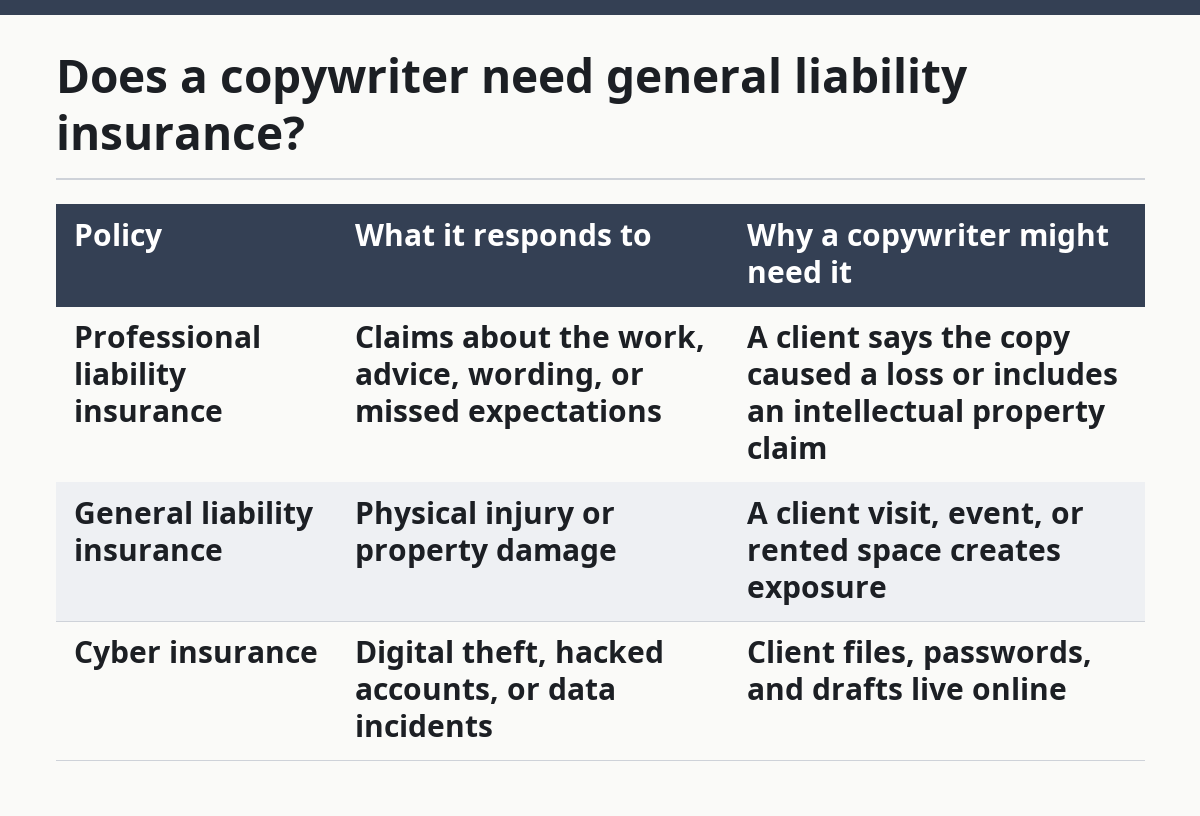
That table matters because many people try to use one policy for every problem. That usually fails. A writing dispute is not the same as a slip-and-fall, and neither is the same as an email account breach.
How should a freelance copywriter think through coverage?
A freelance copywriter should match coverage to the way the business actually works, not to the label on the insurance brochure. The cleanest way to do that is to check the risks in the business model, then match each risk to the policy that addresses it.
- List the services you sell, such as web copy, ads, email sequences, or brand messaging, and verify whether the work includes claims about results or performance. If the work is purely informational, the risk profile is different from persuasive marketing copy; if you promise outcomes in writing, that is a warning sign that the exposure is more than routine editing.
- Review your client contract and check whether it covers revisions, approval steps, and copyright ownership. If the contract is silent on ownership or usage rights, the problem is not only legal confusion; it also increases the chance of a client dispute after delivery.
- Check whether any client can say your copy caused a financial loss, delay, or marketing failure. That points toward professional liability insurance, because the claim is about the service itself, not a physical accident. If the only obvious risk is a dropped monitor or a visitor injury, that points elsewhere.
- List every place client data lives: email, cloud drive, shared folders, password manager, or project tool. If those systems hold drafts, logins, briefs, or contact details, cyber insurance deserves a close look. If all files are offline and access is tightly limited, the cyber exposure is lower, though not erased.
- Check whether clients ever visit your space, meet you in person, or receive you at a rented office. If yes, general liability insurance becomes more relevant because the risk is tied to the space, not the word count. If no one ever comes near the work area, that policy may be less central.
- Review how you hand off work and whether clients reuse your copy inside their own legal or regulated materials. If the content is used in high-stakes marketing, a dispute over wording can spread fast. That is where professional liability matters most, because the claim often arrives after the copy has already been published.
- Look at who could realistically accuse you of copying, reusing, or missing a source. If your process includes research, reworking competitor themes, or using client-supplied material, intellectual property claim risk rises. If the work is original and tightly documented, the risk is lower, but not gone.
- Sort the risks by the damage they could cause: client claim, physical accident, or digital breach. That gives you a simple map of which policy responds to which problem. If you cannot place a risk into one of those three buckets, the coverage review is incomplete.
This is the most useful way to approach the question because it avoids one-size-fits-all advice. A solo copywriter who writes from home and stores files in one cloud account does not have the same exposure as someone who meets brands in rented offices and handles sensitive client data all day.
What should the client contract cover?
A client contract should define the work, the handoff, and who owns what after delivery. For a freelance copywriter, that usually means scope, revision limits, approval steps, usage rights, and what happens if the client changes the brief after the draft is done.
That does not make the contract an insurance policy. It does help reduce arguments by setting expectations before the first draft is sent. If a client later says the copy was not what they wanted, the contract can show what was agreed, but it does not pay the claim or defend the business by itself.
The most useful contract terms for a copywriter are the ones that close the gaps between creative work and legal ownership. Copyright is a real issue here because copy can be reused, edited, reposted, or embedded in a client’s wider campaign. If the handoff terms are fuzzy, the dispute can become a copyright issue, a scope issue, and a payment issue at once.
A good contract also works hand in hand with insurance. The contract narrows the dispute; the policy is there if the dispute still turns into a claim.
When does the standard setup not fit?
The standard setup does not fit when the copywriter’s work is tied to regulated industries, heavy client data, or unusual delivery terms. In those cases, the exposure changes even if the job title stays the same.
Client work includes sensitive personal data: This raises cyber risk because exposed files or login details can create a separate loss — review whether cyber insurance is needed and tighten data handling.
Clients regularly meet you in person: That creates physical exposure that professional liability does not cover — general liability insurance becomes more relevant.
The contract gives away broad usage rights with no clear revision limit: This can turn a routine edit dispute into a larger ownership fight — tighten the contract before the next project starts.
You ghostwrite or adapt existing material: That can increase the chance of an intellectual property claim — document source material and check the wording in the agreement.
The work is published into a high-stakes sales or legal setting: Small wording errors can have outsized consequences — the copy needs more careful review, and the professional liability question becomes more serious.
You use multiple collaborators or subcontractors: That can blur responsibility if something goes wrong — the contract should spell out who is doing what, and the insurance setup should match the team structure.
What mistakes do freelance copywriters make?
Freelance copywriters usually make the same few mistakes, and each one creates a different kind of gap. The error is often not that they bought the wrong policy, but that they assumed one policy covered everything.
First, many people think general liability insurance covers bad copy. It does not, because general liability is about physical injury or property damage, not the quality of the writing. The correct alternative is to look at professional liability insurance for service-related claims.
Second, some copywriters skip cyber insurance because they assume they are “just a writer.” That misses the fact that client briefs, drafts, passwords, and contact lists often live online. If the files are digital, the exposure is digital too.
Third, people rely on the client contract alone. That can reduce confusion, but it does not pay defense costs if a claim lands. The better approach is to use the contract to define the work and use insurance to deal with the claim if the contract fails to stop it.
Fourth, some writers assume copyright trouble only affects designers, photographers, or agencies. Copywriters can face an intellectual property claim when a client says the language copies another source or uses protected material too closely. The correct alternative is to treat wording itself as an asset that can trigger a dispute.
Fifth, people ignore business setup details like where clients meet them or where files are stored. That matters because a home office with no visitors is not the same as a shared studio with traffic and equipment. The right policy mix depends on those facts, not on a generic freelancer label.
Which policy matters most if money is tight?
Professional liability insurance matters most if money is tight, because it is the closest fit to the copywriter’s main risk. If the budget only allows attention to one question, start with the policy that addresses the claim most likely to come from the work itself.
That does not mean general liability or cyber insurance are unimportant. It means the decision should follow the business’s actual exposure. If the business has no visitors and little physical contact, general liability may be less urgent. If the business stores only minimal data and uses very tight access, cyber exposure may be lower, though still worth checking.
This is also where the client contract earns its place. A clear contract can reduce the chance of a claim by setting rules for revisions, ownership, and approvals. It cannot remove every risk, but it can keep a small disagreement from becoming a bigger one.
If you are unsure, this is the point to speak with a qualified adviser who can look at your own work mix, contract terms, and location rules. Insurance rules and thresholds differ by country and can change, so a generic answer is not enough for every freelance copywriter.
FAQ
Do copywriters need professional liability insurance?
Yes, most freelance copywriters need professional liability insurance because the main risk comes from the work itself. A client can claim the copy caused a loss, missed a brief, or created an intellectual property claim. That is different from a physical accident, and it is the exposure this policy is built to address.
Does a copywriter need general liability insurance?
Sometimes, yes, but not always. General liability insurance matters when the business has physical exposure, such as client visits, events, or rented space. If the work is done entirely from home with no client traffic, the need is often lower, though the rest of the business setup still matters.
What coverage protects a freelance copywriter?
Professional liability insurance is the core protection for work-related claims, general liability insurance covers physical accidents or property damage, and cyber insurance addresses digital incidents. A client contract helps define the terms of the work, but it does not replace coverage. For a freelance copywriter, the right answer depends on how the business handles clients, files, and space.
Drafted with AI; not yet reviewed by a person.
