

Last updated: November 24, 2026
Quick Answer: most freelancers need 2 core cover types, and many need 3 if they carry equipment or meet clients in person. Freelance insurance policy options and buying decisions start with one question: what loss could end your work, empty your savings, or trigger a claim? The right policy mix usually depends on the kind of freelance work, the clients involved, the equipment used, and whether mistakes could cost money, cause injury, or delay a project. This is general information, not financial advice; a qualified adviser should be consulted for a personal recommendation.
Key takeaways
- Freelance insurance is not one policy. It is usually a mix of cover types aimed at different risks, from claims about your work to stolen gear.
- The biggest buying mistake is choosing by premium alone. A cheaper policy can leave out the one event that matters most.
- Two policies can sound similar and still behave very differently at claim time. “Professional indemnity” and “public liability” are not the same thing.
- The best buying decision starts with your work, not the policy name. A designer, photographer, consultant, and tradesperson face different losses.
- Country rules, tax treatment, limits, and exclusions vary; consult a local professional and check official guidance such as the UK Financial Conduct Authority’s insurance guidance or the U.S. National Association of Insurance Commissioners consumer resources.
What does freelance insurance actually cover?
Freelance insurance covers the cost of specific business losses, and it usually does that through separate policy types rather than one all-purpose plan. For a freelancer, the practical job of insurance is to move a loss from your balance sheet to an insurer’s, but only inside the policy terms and limit.
The first risk bucket is claims from other people. That can include a client saying your advice caused a financial loss, or a passerby saying your kit injured them. The second bucket is your own business property: laptop, camera, tools, portable drives, stock, or rented office contents. The third is income interruption, where work stops after an accident, illness, fire, or theft and invoices slow down. A fourth bucket is digital and legal exposure, such as data loss, privacy claims, or contract disputes.
Therefore, a generic article often skips the difference between a loss you cause and a loss you suffer. That difference matters because it drives the policy type. A writer with a laptop and a few clients may need different cover from a wedding photographer carrying €5,000 or £5,000 of kit, or a consultant whose advice appears in contracts and reports. The policy names can sound similar, but the trigger can be totally different.
Two authoritative starting points are the UK Financial Conduct Authority’s insurance guidance and the U.S. National Association of Insurance Commissioners consumer resources. Those sources explain how insurance is regulated and why wording, exclusions, and claims handling matter. Country rules still differ, so consult a local adviser if the policy will affect your tax return, visa status, or contract compliance.
Which policies do freelancers usually compare?
Freelancers usually compare five or six policy types, and each one protects a different hole in the budget. The right bundle depends on whether your work is advisory, hands-on, digital, or equipment-heavy, and on whether clients require proof of cover before they pay. For a quick comparison, see the table below and the more detailed notes in What does freelance insurance actually cover?
| Policy type | What it usually covers | Common use case | Main drawback |
|---|---|---|---|
| Professional indemnity / errors and omissions | Client financial loss from your advice, design, drafting, or professional mistake | Consultants, designers, developers, writers, marketers | Often excludes intentional acts, known issues, and some contract promises |
| Public liability | Injury to a third party or damage to their property connected to your business activity | On-site work, events, home visits, deliveries | Does not usually cover bad advice or failed work |
| Business equipment / contents | Theft, damage, or loss of work gear and office equipment | Cameras, laptops, tools, portable devices | May limit cover outside the home or abroad |
| Cyber insurance | Data breach response, some first-party cyber losses, and certain liability claims | Anyone storing client data or using cloud tools | Exclusions can be strict; not all cyber losses are covered |
| Business interruption / income protection | Lost income after an insured event or after illness/injury, depending on the policy | Solo workers whose income stops when they cannot work | Waiting periods and strict definitions can reduce payouts |
| Personal accident | Lump sum or scheduled benefits after specified injuries | Physically active freelancers | Not the same as income replacement; definitions are narrow |
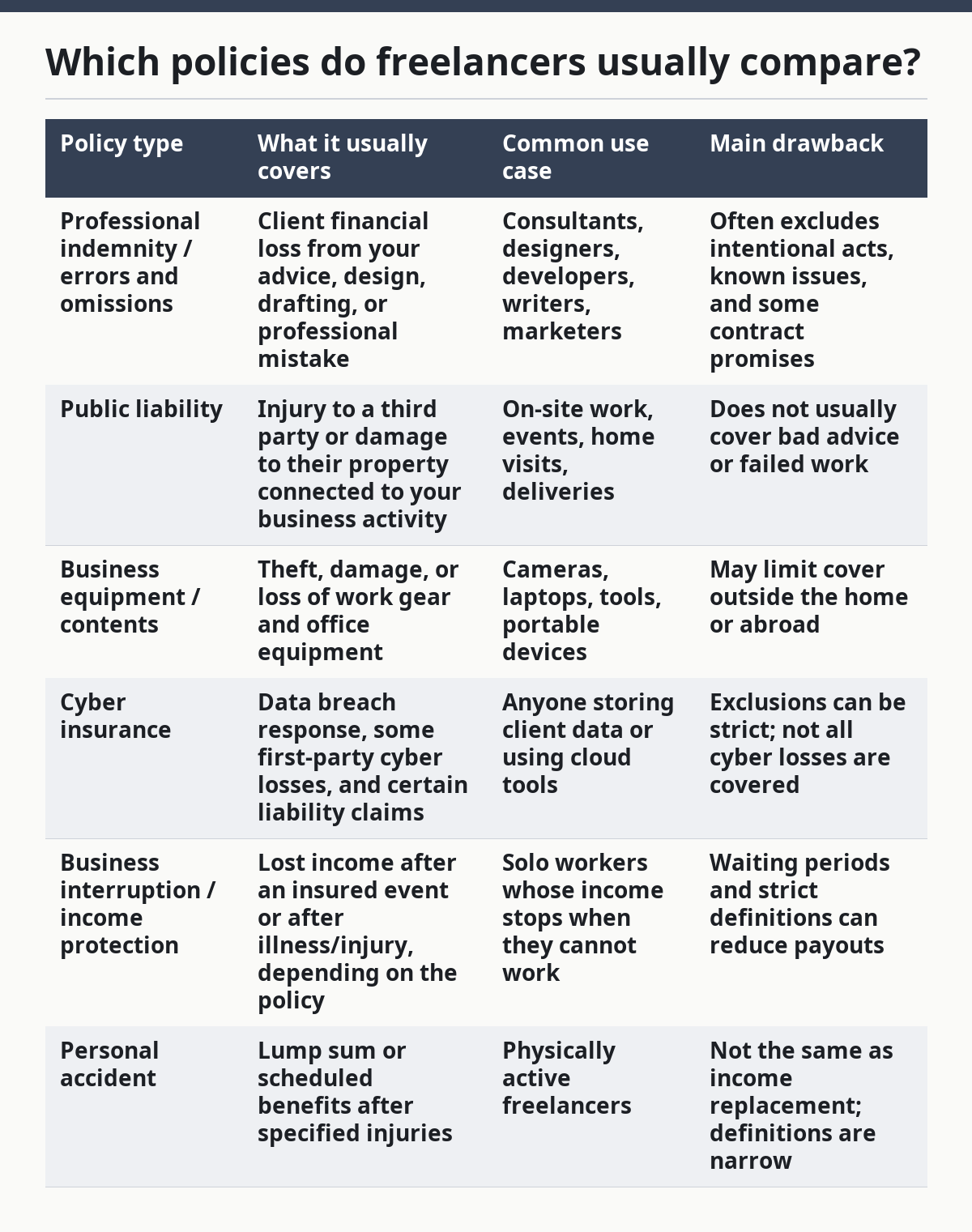
Professional indemnity is the policy most people mean when they ask about freelance liability insurance. It is aimed at professional mistakes, not broken bones or smashed cameras. If a client says your deliverable missed the brief and cost them money, this is the policy that is often examined first.
Public liability is about bodily injury or property damage to other people. A freelance photographer knocking over a client’s display stand, or a contractor damaging a venue floor, points toward this policy rather than professional indemnity. Many freelancers need both because the risks are different.
Business equipment cover is easy to underestimate because the loss feels smaller until the laptop, tablet, and camera bag disappear at once. A policy can protect the tools that keep a freelancer trading, but it may set conditions for unattended vehicles, overnight storage, or use outside the home.
Cyber insurance matters even to freelancers who do not think of themselves as “tech businesses.” If client files sit in cloud storage, email, or project systems, a breach can create notification costs, recovery work, or third-party claims. The detail that matters is not the label “cyber”; it is what events and response costs the policy actually includes.
Income protection and business interruption are often confused. Business interruption usually depends on a covered event affecting the business, while income protection can be tied to the freelancer’s inability to work because of illness or injury. The policy language, waiting period, and benefit formula matter more than the title on the brochure.
How do I choose the right cover step by step?
The right cover comes from matching policy triggers to the way you earn, then testing the exclusions against real client work. A clean buying process has seven steps, and skipping any one of them can leave a gap that looks small until the claim form arrives.
- List every way your work can fail. Write down 5 to 10 real loss scenarios: missed deadline, wrong specification, data breach, client injury, damaged property, theft, illness, or a payment dispute. Verify that each scenario is linked to a policy type and not just a vague risk. If you cannot name the loss, the policy choice will likely be too broad or too thin.
- Separate liability from property. Mark each scenario as “someone else’s loss” or “my own loss.” Professional indemnity usually handles the first category when the issue is professional error, while equipment cover handles your gear. If one scenario sits in both groups, check whether you need two policies or a package. A problem sign is assuming one policy will answer every question.
- Read the exclusions before the price. Look for exclusions tied to subcontractors, overseas work, cyber incidents, prior knowledge, pollution, contractual liability, or unattended equipment. The problem sign is a long list of exceptions that removes the main thing you do for money. A policy with a low premium can be poor value if the exclusions match your job.
- Check the claim trigger and time limit. Some policies respond when the claim is made during the policy period; others depend on when the event happened. Verify whether notice must be given quickly and whether you need continuous cover to protect old work. If you have changed insurers and the wording is not aligned, a gap can appear between policy years.
- Set the deductible or excess at a level you can absorb. The excess is the amount you pay before the insurer pays, and it should fit your cash flow for a 1-week or 1-month setback, not a best-case month. If the most likely claim would be hard to fund at that level, the excess may be too high. If one small claim would hurt your trading account, the excess may be too high.
- Confirm where the policy applies. Check whether cover is local, national, or worldwide, and whether it includes remote work, travel, rented studios, or client sites. Verify any country exclusions if you work across borders. A problem sign is assuming a home-country policy automatically follows you to every client in another country.
The key buying decision is not “Do I need insurance?” but “Which loss would hurt me enough that a contract, a repair bill, or a legal demand would force a change in how I work?” That question is practical. It also stops the common mistake of buying broad cover for a narrow job, or narrow cover for a broad one.
A useful rule of thumb is to match the policy to the loss-maker, not the job title. A freelance bookkeeper is closer to professional indemnity risk than public liability risk. A videographer carrying equipment into venues often needs both. A solo developer may need professional indemnity and cyber more than physical property cover. The structure of the work tells the story better than the title on a LinkedIn profile.
What should I check before buying a policy?
You should check the policy wording, the claim trigger, the exclusions, and the evidence your client may ask for before you pay the premium. That sounds basic, but it is where many freelance policies go wrong because the sales page is shorter than the contract.

Start with the policy wording, which is the legal text of the contract. Read the definitions of “professional services,” “insured event,” “equipment,” “territory,” and “claim.” Those four or five definitions can change how the whole policy works. If the wording is hard to find, that is a warning sign.
Next, check whether the policy is written on a claims-made basis or an occurrence basis. A claims-made policy responds when the claim is made during the policy period, subject to its rules. An occurrence policy responds to an event that happened during the policy period, even if the claim comes later. The difference matters because a claim made after you cancel or switch insurers may still need old cover, run-off cover, or continuous cover to stay protected.
Then review the exclusions that cause the most surprise. Contractual penalties are a classic issue. If you promise a result in a contract that goes beyond ordinary professional duty, the policy may not treat that extra promise as insured liability. Known issues, deliberate acts, and work done before the policy started are also common exclusions. If your business has been trading for 12 months or 10 years, prior work can matter.
Look at the insurer’s process for evidence. Some insurers want invoices, serial numbers, repair quotes, client contracts, or breach reports. That is not paperwork for its own sake; it is how the insurer decides whether the loss fits the policy. A freelancer who keeps serial numbers for a camera body, a laptop, and an external drive is in a better position than someone who cannot prove ownership or value.
Finally, check the certificate your client may need. Some clients do not care what the policy is called, but they do care that the certificate names the right business entity and shows the required cover type. If the policy is in your own name but the contract is through a company or trading name, that mismatch can cause delays.
When does the standard advice not fit?
The standard advice does not fit when your work crosses borders, uses subcontractors, or creates a risk profile that changes by project. In those cases, a single “freelancer package” can be too blunt.
If you work in more than one country: territory limits may exclude key jobs. That means a client in one country could trigger a claim that the policy only partly covers. The fix is not guessing; it is checking the territory wording and asking whether the policy follows the work location, the client location, or both.
If you use subcontractors: your policy may not automatically cover their mistakes. That means a claim could bounce between your policy and theirs, or fail if the contract chain is unclear. The fix is to check whether subcontractor work is included and whether you need evidence that they carry their own cover.
If you take deposits or handle client money: some policies exclude or limit cover for theft, fraud, or misappropriation. That means money moving through your account can create a different risk from ordinary professional error. The fix is to separate client funds from business funds where the local rules allow it and to confirm whether the policy handles that exposure at all.
If your work is physically risky: public liability may matter more than professional indemnity. That means a site visit, a venue setup, or tool use can create damage or injury claims even when your deliverable is fine. The fix is to treat on-site activity as a separate exposure, not a side note.
If you depend on one large contract: one claim can hurt more than the premium looks like it should. That means the size of the contract, not just the type of work, should shape the limit. The fix is to think in terms of loss concentration, because a single client can represent a large share of your monthly income.
What mistakes do freelancers make most often?
The biggest mistakes are buying the wrong policy type, choosing a limit that does not match the work, and ignoring exclusions that remove the real risk. Each mistake has a cost that shows up later, usually when it is hardest to fix.
-
Buying public liability when the main risk is professional error. The consequence is a claim about bad advice, a design flaw, or an incorrect report may not fit the policy at all. The correct alternative is to match the cover to the source of the loss and add public liability only if you also meet clients on-site or handle their property.
-
Choosing the cheapest premium without checking the excess. The consequence is a claim may be technically covered but too expensive to use because the out-of-pocket amount is high. The correct alternative is to compare premium and excess together, since a low premium can hide a painful deductible.
-
Ignoring prior work and retroactive cover. The consequence is old projects can fall outside protection if the policy only starts from a certain date. The correct alternative is to ask how past work is treated and whether continuity matters when switching insurers.
-
Assuming equipment cover works everywhere. The consequence is theft from a car, loss while travelling, or damage in a rented studio may not be fully covered. The correct alternative is to check the territory, security conditions, and unattended-vehicle rules before leaving home with the gear.
-
Failing to keep proof of ownership and value. The consequence is an insurer may delay or reduce payment while serial numbers, receipts, or photos are gathered. The correct alternative is to store a simple inventory with model names, purchase dates, and replacement estimates, updated when gear changes.
-
Treating client contract language as separate from insurance. The consequence is a contract can demand cover or assume liability the policy does not take on. The correct alternative is to read the insurance clause before signing, because the contract and the policy need to match each other.
A freelancer with small, occasional jobs can sometimes get away with simple cover for a while. That is not a reason to stay vague. It is a reason to keep the policy aligned with the work as soon as the work becomes repeatable, larger, or more public.
What should a freelancer compare before deciding?
A freelancer should compare policy type, claim trigger, limit, excess, exclusions, territory, and required documents before deciding. Those seven points tell you more than the monthly price, and they are the quickest way to spot a bad fit.

A clean comparison looks like this:
| Decision point | What to compare | Why it matters |
|---|---|---|
| Policy type | PI, public liability, equipment, cyber, income protection | Different losses need different triggers |
| Claim trigger | Claims-made or occurrence | Affects whether old work stays protected |
| Limit | Per claim and total limit | Prevents underinsurance on a large job |
| Excess | Amount you pay first | Determines whether small claims are worth making |
| Exclusions | Subcontractors, cyber, overseas, prior knowledge | These often remove the real risk |
| Territory | Home country, region, worldwide | Important for travel and remote work |
| Evidence | Receipts, serials, contracts, notices | Affects how smoothly a claim can be handled |
The table matters because a policy that is acceptable on price can still be a poor choice on structure. A freelancer who travels 3 or 4 times a year may need a different territory clause from someone who works only from a home office. A consultant with signed scope documents has different exposure from a photographer who works in public spaces every week.
The decision also depends on whether a client, platform, landlord, or venue requires proof of insurance. That requirement can be a hard gate, and it often specifies a policy type rather than a generic “insured” status. If a contract asks for professional indemnity and public liability, one of those cannot quietly stand in for the other.
How do tax and paperwork affect the decision?
Tax and paperwork affect the decision because premiums, claims, and coverage rules are not identical across countries, and the tax treatment can change how expensive a policy really is. That is one reason the same policy can feel cheap to one freelancer and expensive to another.
Country rules differ on whether premiums are business expenses, whether some benefits are taxable, and how losses are recorded. A policy that helps with income interruption may interact with local tax rules in a way that changes the net value of the cover. For that reason, a qualified accountant or local adviser is the right person to ask about the tax side of a policy decision.
The paperwork side is simpler but still easy to miss. Keep the certificate, policy wording, renewal date, and claims contact in one place. If the business name changes, the address changes, or the work changes, update the insurer quickly. A mismatch between the policy and the actual business setup can slow a claim or force a correction during renewal.
If you invoice through a company, make sure the insured entity matches the one on the contract. If you use a trading name, check whether the insurer lists the trading name, the legal name, or both. The names on the paperwork should tell the same story, or the cleanest cover can still be awkward to use.
What does a sensible buying decision look like?
A sensible buying decision looks like a policy mix that fits the job, the contracts, and the assets, with exclusions understood before payment. It is not the biggest policy on the market, and it is not the one with the lowest headline premium.
For a service freelancer who gives advice, drafts content, codes, or designs, the core comparison is usually professional indemnity versus public liability, then equipment and cyber if the work needs them. For a hands-on freelancer who visits sites, the balance shifts toward public liability and equipment, with professional indemnity added if the work also includes advice or planning. For a freelancer whose income stops when they cannot work, income protection or a similar income-replacement policy deserves attention, but only after the definitions and waiting period are clear.
Ultimately, there is no universal “best” policy set for every freelancer. A policy can be correct for one person and unnecessary for another. The right answer is the one that covers the losses your work can realistically create, in the country and contract setting you actually use, without paying for layers that never get touched.
Frequently asked questions
Do I need professional indemnity if I only freelance part time?
Yes, if your part-time work can still cause a client financial loss through advice, design, writing, coding, or another professional service. The number of hours does not remove the claim risk; the type of work does. A single small project can still create a claim if a mistake affects a deadline, a launch, or a contract.
Is public liability the same as freelancer liability insurance?
No, public liability is only one piece of freelancer liability insurance, and it usually deals with injury or property damage to other people. Professional indemnity is the other common liability cover, and it deals with professional mistakes or bad advice. Many freelancers need both because they face both kinds of risk.
What is the difference between claims-made and occurrence cover?
Claims-made cover responds when the claim is made during the policy period, while occurrence cover responds to an event that happened during the policy period. That difference matters when you switch insurers or stop trading. If the wording is unclear, ask for an explanation before you buy, because a gap in timing can matter as much as a gap in limits.
Can one policy cover my laptop, my clients, and my income?
Sometimes, but not usually in one simple policy without trade-offs. Laptop cover is property insurance, client claims are liability insurance, and income loss is a different kind of cover again. A bundled policy can simplify paperwork, but you still need to check the wording for each part and make sure the limits and exclusions fit each risk.
What should I do if I work across borders?
Check the territory clause before buying, because country coverage varies and may not follow you everywhere. Ask how the policy treats remote work, foreign clients, travel, and claims brought in another country. If your contracts cross borders often, a local adviser is worth speaking to, because the legal and tax rules can change the right choice.
Drafted with AI; not yet reviewed by a person.
