

Last updated: November 24, 2026
Freelance insurance for a solo business is there to cover claims, losses, or legal costs that can hit one person hard. If one client says your work caused damage, if a project slips, or if your gear disappears, the right policy can keep the problem from becoming a business-ending bill. This guide explains what the main types do, when they matter, and how a solo freelancer can check what fits their work. This is information, not financial advice; a qualified adviser should be consulted for your own situation.
Key takeaways
- A solo freelancer usually needs protection for three things: claims from clients, damage to other people’s property, and loss of tools or data.
- The right cover depends on the work, not the job title. A designer, copywriter, carpenter, and consultant face different risks.
- Cheap cover can still leave big gaps if the policy excludes the exact thing your work is likely to trigger.
- Contracts can demand insurance even when local law does not.
- The hardest mistake is buying a policy before checking exclusions, limits, and the claims process.
What does freelance insurance actually cover?
Freelance insurance covers specific risks that come with working for clients as one person, not as a large company. It usually refers to a mix of policies, such as public liability, professional indemnity, and business equipment cover, rather than one single product. The point is simple: if a claim lands on a solo business, there is no payroll department or legal team to absorb the shock.
The common split is easy to miss. Public liability insurance is about injury to other people or damage to their property. Professional indemnity insurance covers alleged mistakes in your advice, design, writing, or service that cause a client financial loss. Business equipment insurance covers tools, laptops, cameras, and other working gear that gets lost, stolen, or damaged.
A solo business may also see cover for cyber incidents, legal expenses, or income interruption, but those are not automatic. Many policies are built with conditions, exclusions, and caps. If a contract asks for “insurance,” that does not mean one policy will tick every box.
This matters because freelance work often looks low risk until a client complaint arrives. A consultant can face a claim over advice. A photographer can face loss of equipment on the way to a shoot. A web developer can face a dispute over a missed launch date. The risk comes from the work, not from the size of the business.
Which policies matter most for a solo business?
The most useful policies for a solo business are the ones that match the way money can leave your business fast. That usually means starting with public liability, professional indemnity, and business equipment, then checking whether cyber or legal cover is relevant. The right mix depends on the services you provide, the places you work, and what your client contracts demand.
| Policy type | What it usually responds to | Common gap to watch | Who often needs it |
|---|---|---|---|
| Public liability | Injury to a third party or damage to third-party property | Work performed only online may still have exceptions; some policies exclude pure advice | Freelancers who visit client sites, work in shared spaces, or handle client property |
| Professional indemnity | Advice, errors, omissions, negligent service, or alleged breach of professional duty | Excludes deliberate acts and often excludes known problems before the policy starts | Consultants, designers, writers, developers, marketers, and anyone giving specialist work |
| Business equipment | Theft, loss, accidental damage to tools and devices | May exclude unattended items, wear and tear, or items left in vehicles | Freelancers with laptops, cameras, audio gear, or specialist tools |
| Cyber cover | Data breach, phishing, ransomware, some recovery costs | Often limited by setup requirements and notification rules | Freelancers storing client data, handling online payments, or relying on email and cloud tools |
| Legal expenses | Certain disputes and defence costs | May not cover every dispute or every jurisdiction | Freelancers with contracts, late-payment risks, or recurring client disputes |
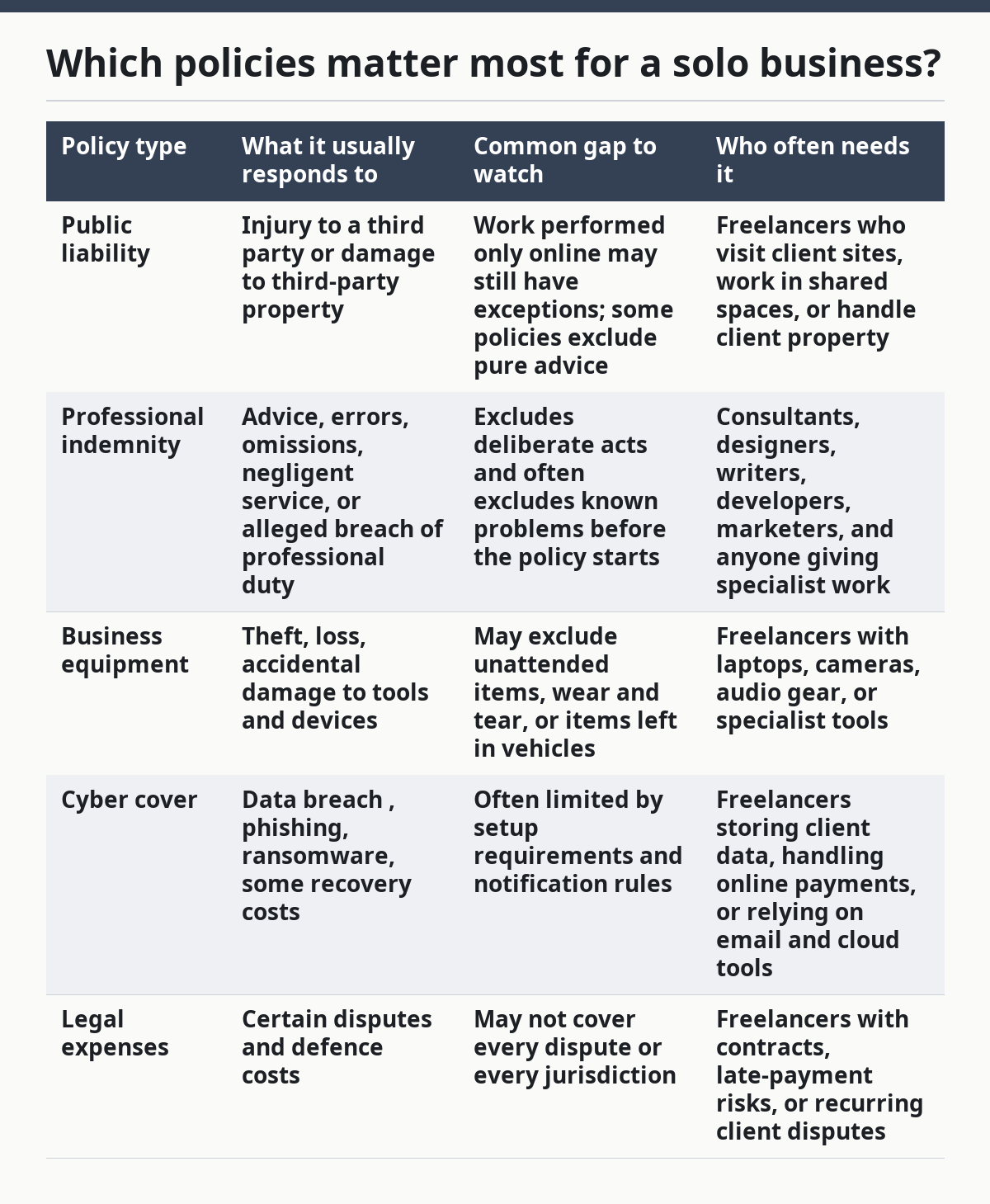
Public liability is often the first policy people think of, but it is not the whole picture. If your work is mainly advisory or creative, professional indemnity may matter more. If your main asset is a laptop or camera, business equipment cover may be the more practical starting point.
The trap is assuming that one policy covers all three. Many do not. A policy that protects against a broken client laptop in your office may say nothing about a design mistake that costs a client a launch date, and a professional indemnity policy may not replace a stolen laptop unless equipment cover is added.
How do you choose the right cover?
You choose the right cover by matching the policy to the actual ways your solo business can lose money, then checking the limits, exclusions, and proof your clients require. That sounds obvious, but the details matter more than the title on the policy. A freelance business that gives advice, enters client premises, or handles data needs a different shape of cover from a business that only sells finished files online.
- List the work you do in plain terms. Write down every service line in 1 sentence each, such as “brand design,” “management consulting,” or “on-site repairs.” Verify that the list includes anything done in the last 12 months. A problem is any task you do not write down, because that task can be left uncovered.
- Map the worst realistic loss for each task. For each service, name the likely claim: injury, property damage, wrong advice, data loss, or missed deadline. Use one concrete example per service, not a vague risk list. A problem is any service with no matching loss type, because it usually means the policy search is too broad.
- Check whether client contracts demand a specific policy. Look for words such as public liability, professional indemnity, cyber, or minimum limit. Read the contract before you quote or sign. A problem is a contract that asks for cover you do not plan to hold, because non-compliance can block the job or trigger a dispute.
- Review the policy limit and excess. The limit is the most the insurer will pay; the excess is the amount you pay first. Verify that the limit is not obviously low for the size of your client work and that the excess is not larger than your cash reserve. A problem is a low premium with a high excess, because small claims may become pointless to file.
- Read the exclusions section line by line. Look for exclusions tied to subcontractors, overseas work, claims made before the start date, data breaches, or services outside your stated occupation. A problem is any exclusion that removes the main risk you wrote down in step 2.
- Check whether the policy is claims-made or occurrence-based. A claims-made policy usually responds when the claim is made during the policy period, while occurrence-based cover responds to when the incident happened. Verify the wording and any retroactive date. A problem is a past project that happened before the cover started, because it may not be included.
- Ask what proof the insurer needs after a claim. Keep invoices, emails, contracts, and photos for at least the policy term and often longer if the policy can be claimed later. Verify the record list before you buy. A problem is weak paperwork, because the insurer can ask for evidence of the work and the loss.
- Compare the policy against your actual working setup. Check home office use, shared studio use, travel, rented gear, and remote work with cloud tools. A problem is a policy built for an office business when your work happens in kitchens, cafés, cars, or client sites.
This process does not tell you which insurer to pick. It tells you whether a policy matches the business you really run. For a solo business, that check is the difference between useful cover and a document that looks good until a claim arrives.
Why do freelancers need it if they work alone?
Freelancers need insurance because one person can still face a large claim, and there is no team structure to spread that risk. A solo business can be small in headcount and still exposed to client claims, third-party damage, or equipment loss. A laptop, a set of tools, or a single piece of advice can create a problem that is much bigger than the fee for the job.
The legal form of the business does not erase exposure. If you work as a sole trader, sole proprietor, or one-person company, a dispute can still land on you. A contract can say a client is not responsible for your losses, and that shifts more risk back to you unless your own cover steps in.
Freelancers often underestimate how quickly a small dispute turns into a real cost. A simple complaint can become time spent gathering records, answering letters, and defending your work. Even if the claim is weak, the process can still be expensive in time and stress. That is why professional indemnity and legal expenses cover are often discussed together.
There is also the client side. Some clients, especially larger businesses, ask for proof of insurance before work starts. They may want to see the policy type and a certificate. If you cannot show it, the job may stall even if your work is otherwise ready to go.
When should you stop and get qualified help?
You should stop the DIY approach and get qualified help when the policy question turns into a legal, tax, or contract issue you cannot verify on the page. The line is not about being cautious for its own sake; it is about avoiding a bad fit that can leave a gap at claim time. Insurance wording can be narrow, and a 1-page summary is not enough for every case.
Your client contract names a minimum limit or a specific policy type: this means the contract controls the deal, not a generic checklist — get help if you cannot match the wording exactly. A mismatch can delay payment, block onboarding, or breach the contract.
Your work includes regulated advice, finance, health, law, or other high-consequence services: this means the claim risk is not just property damage or a simple mistake — get help before assuming a normal freelance policy is enough. A standard policy can exclude specialist services.
You use subcontractors, even occasionally: this changes who may be responsible for an error, and some policies treat subcontracted work differently — check the wording with an adviser if you do not know how that applies. A gap here can leave the wrong person uninsured.
You work across more than one country: this can change the applicable law, claim process, and policy territory — get help before assuming one policy works everywhere. Territorial limits can matter more than the headline price.
You have had a previous claim, complaint, or cancelled policy: this can affect disclosure and eligibility — get help if you are unsure what must be stated. A mistake in disclosure can cause a later dispute over cover.
Your equipment or data setup is unusual: for example, specialist kit, client databases, or custom software systems can create terms that standard policies treat differently — get help if the policy wording is not clear. The wrong assumption can leave your most valuable asset uncovered.
If the situation is ordinary and the contract is simple, careful reading may be enough. If the work is specialized or cross-border, a qualified adviser is safer than guessing from a quote page.
What do people get wrong most often?
The most common mistake is buying based on the cheapest monthly figure and ignoring the exclusions. That can leave the freelancer with a policy that looks acceptable until the exact problem happens. A low premium is not a feature if the policy avoids the main risk you were trying to cover.
Another mistake is assuming public liability and professional indemnity are the same thing. They are not. Public liability is usually about injury or property damage; professional indemnity is about a service error or bad advice. If you do design, consulting, writing, coding, or strategy, the difference matters.
A third mistake is forgetting that some policies are claims-made. That means a claim must usually be made during the policy period, and sometimes the incident must also fit within a retroactive date. A freelancer who switches insurers without checking those dates can create a gap without realizing it.
A fourth mistake is under-insuring equipment. A laptop, camera, or tool bag can be central to the job, but some policies treat them like ordinary household items. The consequence is slow replacement or an unreimbursed loss after theft or damage. The fix is to confirm the item type, location, and use are named clearly.
A fifth mistake is assuming a home contents policy replaces business cover. Many home policies limit business use, especially for client visits, stock, or specialist tools. If the gear earns income, it should be checked as business property, not household property. That distinction is easy to miss and expensive to ignore.
A sixth mistake is failing to keep records. When a claim starts, the insurer may ask for contracts, emails, invoices, and evidence of ownership. If those records are missing, the claim can slow down or fail. A simple folder structure and regular backups are not glamorous, but they matter.
How do claims work in practice?
A claim starts when the insured event happens and the insurer is told within the policy’s time rules. That event may be a client alleging loss, a third party saying you caused damage, or a theft of covered equipment. The claim process is less about drama and more about documentation.
First, the insured person should gather the contract, invoice, relevant emails, photos, and any timeline notes. Those records show what was agreed, what was delivered, and when the problem appeared. Without them, the insurer may struggle to separate a real claim from a vague complaint.
Second, the claim must fit the policy wording. A professional indemnity policy may require that the error or omission happened in the insured business activity. A public liability policy may require that a third party was injured or property was damaged. A cyber policy may require prompt notice after a breach or attack.
Third, the insurer checks whether any exclusions apply. If a freelancer was providing a service outside the stated occupation, or if the claim was known before the policy started, that can change the outcome. A claim can be valid in a general sense and still fall outside the policy.
The practical lesson is to keep paperwork from day one. A 15-minute admin habit after each job can matter more than the size of the premium. If the claim process starts with missing records, the freelancer is already behind.
What about countries, tax rules, and contracts?
Country rules matter because insurance terms, required disclosures, and tax treatment differ from place to place. A freelancer in one country may face different product names, contract norms, and tax treatment from a freelancer elsewhere. That is why this guide stays at the level of how the cover works, not what it must be in every market.
For tax, business insurance may be treated differently depending on local law. In some places, some premiums may be deductible as a business expense; in others, the treatment can be narrower. Do not assume the tax rule from a forum or from another country applies to your return. A qualified tax adviser should confirm the local treatment.
The same caution applies to contracts. Some clients require evidence of cover before a start date, while others only ask after onboarding. A freelance contract can also shift responsibility for errors, data handling, or property damage. That is why reading the insurance wording without reading the work contract is only half the job.
Two authoritative starting points are the U.S. Small Business Administration’s business insurance guidance and the IRS guidance on self-employed health insurance for tax questions in the United States.
https://www.sba.gov/business-guide/launch-your-business/get-business-insurance
https://www.irs.gov/credits-deductions/individuals/self-employed-health-insurance
What does a good setup look like?
A good freelance insurance setup matches the real work, not the broad label on the business card. It covers the most likely ways money can leave the business, it fits client contracts, and it avoids obvious gaps in equipment, advice, or site visits. That is a practical standard, not a promise of protection.
A sensible setup usually has three parts. The first is a clear list of services and work settings, such as home office, client site, or online-only delivery. The second is a policy or set of policies that maps to those services. The third is basic recordkeeping: contracts, invoices, gear records, and email trails.
A bad setup looks tidy on paper but breaks under a real claim. It often has a low premium, a large excess, and vague wording around the main work activity. It may also rely on the assumption that “small business” means low risk. For a solo freelancer, the size of the business says little about the cost of a mistake.
A useful test is this: if a client asked, “What happens if this goes wrong?” and the only answer is “I think I’m covered,” the setup is not ready. The answer should be tied to a policy type, a limit, and an exclusion check.
Can a solo freelancer rely on one policy alone?
A solo freelancer can rely on one policy only when one clear risk dominates and the policy wording matches that risk exactly. That is more common in very narrow work than in mixed freelance businesses. Most solo businesses face more than one exposure, so a single policy often leaves a gap.
A designer may need professional indemnity for errors and equipment cover for a laptop. A photographer may need equipment cover and public liability for client sites. A consultant may need professional indemnity and legal expenses for disputes. One policy may cover one of those, but not all.
The danger is not complexity for its own sake. It is assuming that one cover title means one full solution. Insurance works by wording, exclusions, and conditions, not by the general feeling that a policy sounds complete. A freelancer who checks only the label is taking the weakest possible view of the risk.
A simple rule helps here: if the business has more than one place where money can be lost, do not assume one policy covers every place. Check each loss path separately. That is slower than buying the first quote, but it is safer for the business.
FAQ
Do freelancers really need insurance?
Yes, many freelancers do because client disputes, property damage, and equipment loss can hit even one-person businesses. The need depends on the work, the contracts, and the money at risk. A writer, designer, consultant, or tradesperson may all need different cover.
What is the difference between public liability and professional indemnity?
Public liability is usually about injury to other people or damage to their property. Professional indemnity is about a mistake in your service, advice, or work that causes financial loss. A freelancer often needs one, the other, or both depending on the job.
Is home insurance enough for freelance work?
Often no, because home insurance may limit business use, business equipment, or client visits. A laptop used to earn income is not always treated the same as a household device. The policy wording should be checked before assuming home cover is enough.
What should I check before I buy a policy?
Check the policy type, the limit, the excess, the exclusions, and whether the cover is claims-made or occurrence-based. Also check any client contract that names insurance requirements. If the wording is unclear, get qualified help before the work starts.
Does insurance replace careful contracts and records?
No, insurance and paperwork do different jobs. The policy may respond to a claim, but contracts and records help prove what happened and what was agreed. A freelancer who keeps contracts, invoices, and email trails is in a stronger position if a claim starts.
Drafted with AI; not yet reviewed by a person.
