
Last updated: November 22, 2026
Quick Answer: 2 policies usually cover 2 different risk types. Choose professional liability if your biggest risk is a client claiming your work caused a loss. Choose general liability if your bigger risk is a bodily injury or property damage accident at a client site. If your freelance work creates both kinds of exposure, one policy does not replace the other.
This is general information, not legal advice. Rules vary by jurisdiction, so consult a qualified professional for advice that fits your situation. For a broader map of freelance coverage choices, see the site’s hub on Freelancer insurance policy selection — The Complete Guide.
Key takeaways
- General liability and professional liability protect different kinds of claims.
- General liability is about accidents: bodily injury, property damage, and similar premises-style events.
- Professional liability is about the work itself: negligence, errors and omissions, bad advice, or a missed deadline that caused loss.
- If you meet clients, visit work sites, or handle client property, general liability matters more.
- If you give advice, create deliverables, or make decisions for a client, professional liability matters more.
- Many freelancers need both because one policy leaves a gap the other does not fill.
- The U.S. Small Business Administration explains the basic split in business insurance risk, and the Insurance Information Institute explains general liability in plain language.
What is the real difference?
The real difference is that general liability covers accident claims, while professional liability covers work-performance claims. That split is the whole decision.
General liability insurance usually responds when someone is hurt on your premises or at a job site, or when you damage someone else’s property during the job. Think bodily injury and property damage, not the quality of your advice or deliverable. The SBA business insurance guide treats this as a core small-business risk.
Professional liability insurance is built for negligence, errors and omissions, and other claims tied to your services. If a client says your work was late, wrong, incomplete, or misleading and it caused a financial loss, this is the policy category that fits that kind of dispute. The Insurance Information Institute describes this coverage as service-error protection.
| Criteria | General Liability | Professional Liability | Winner for [condition] |
|---|---|---|---|
| Main risk type | Accidents and physical damage | Service mistakes and financial loss | Depends on the claim |
| Common trigger | Client slips, equipment knocks over property | Wrong advice, missed spec, bad deliverable | Depends on the claim |
| Bodily injury | Usually covered | Usually not the main fit | General liability |
| Property damage | Usually covered | Usually not the main fit | General liability |
| Negligence tied to service work | Usually not the main fit | Usually the point of the policy | Professional liability |
| Errors and omissions | Usually not the main fit | Core exposure | Professional liability |
| Client site visits | Strong fit | Weak fit on its own | General liability |
| Work product disputes | Weak fit on its own | Strong fit | Professional liability |
| Best use case | In-person freelance work | Advice, design, code, consulting, or other service work | Depends on work type |
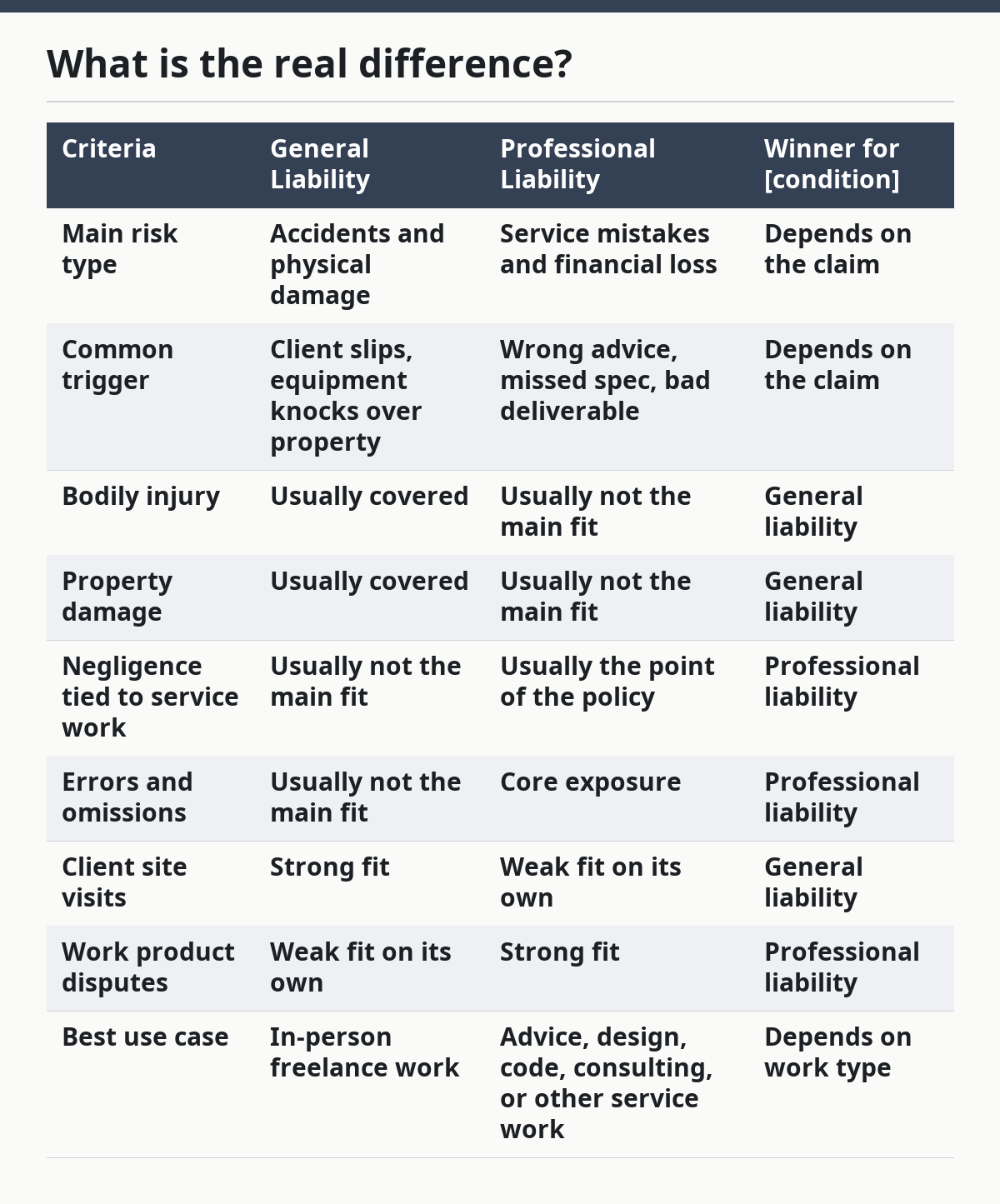
The mistake many freelancers make is treating these as substitutes. They are not. A client who trips over your bag does not care that you have professional liability, and a client who says your report cost them money does not get much help from a general liability policy.
Two authoritative places to start reading are the U.S. Small Business Administration’s business insurance guidance and the Insurance Information Institute’s insurance explanations. Those sources are useful because they separate common business coverages by risk, not by sales language. For a related overview, see general liability coverage basics and professional liability coverage basics.
When does general liability make sense?
General liability makes sense when your freelance work puts you in physical spaces where accidents can happen. It is the cleaner fit for bodily injury and property damage.
That matters most if you visit client offices, shoot on location, transport gear, set up displays, or handle items that do not belong to you. A dropped light, a spilled drink, or a client’s injury near your work area points toward this policy. The policy is not about whether your work was good; it is about whether your presence or setup caused physical harm or damage. For more on that distinction, see what general liability covers.
Its strength is also its limit. General liability does not solve a client’s complaint that your deliverable was late, incomplete, or wrong. If the dispute is about the work’s result, this policy is the wrong tool. A freelancer who only buys general liability can still be exposed to a claim that sounds harmless at first but is really about service negligence.
For freelancers who mostly work in a studio, at home, or through a screen, general liability can feel optional until the first in-person assignment. That is why it is often the better match for people whose work involves a client site, even if the work is short and occasional. In practice, that is why many people compare it alongside home-based freelancer insurance and on-site freelancer insurance.
When does professional liability make sense?
Professional liability makes sense when your income depends on judgment, advice, analysis, or a deliverable that can be challenged after the fact. It is the policy that matches negligence, errors and omissions, and similar work-performance disputes.
This is the stronger fit if you give recommendations, prepare plans, write copy, design assets, build systems, or make decisions that shape a client’s business result. The claim is not usually “you broke my chair.” It is “your work caused a loss,” which is a different kind of risk and often a different kind of evidence. See also what professional liability covers.
Its biggest strength is that it speaks directly to service failure. Its biggest weakness is that it usually does not answer the client-site accident problem. If you drop a camera on someone’s laptop, or a visitor trips over your setup, professional liability is not the natural match.
This policy is the better starting point for freelancers whose work is mostly intellectual, advisory, or deliverable-based. It is the one that often matters when the client’s complaint is about what you produced, not where you stood while producing it. For adjacent details, see errors and omissions insurance basics.
Which one fits the claim your client would make?
The right policy is the one that matches the story in the claim. If the complaint is “someone got hurt” or “property was damaged,” general liability is the first place to look. If the complaint is “your work was wrong” or “your advice caused loss,” professional liability is the first place to look.
That distinction can change the outcome in minutes, not months. A client-site accident can happen in 10 seconds. A work-performance dispute can take weeks to surface. Both can cost money, but they come from different facts and different policy language.
The table below puts the comparison in one place:
| Criteria | General Liability | Professional Liability | Winner for [condition] |
|---|---|---|---|
| Body injury at a client site | Fits the exposure | Usually not the main fit | General liability |
| Damage to client property | Fits the exposure | Usually not the main fit | General liability |
| Negligence in your service work | Usually not enough | Core purpose | Professional liability |
| Errors and omissions | Usually not enough | Core purpose | Professional liability |
| Client says your advice caused loss | Weak fit | Strong fit | Professional liability |
| Client trips over your equipment | Strong fit | Weak fit | General liability |
| Work performed at a home office only | May be less urgent | Often more relevant | Professional liability |
| On-site client meetings | More relevant | Less direct | General liability |
The buyer mistake here is trying to force one policy to do both jobs. That can leave the most obvious risk uncovered.
Why would a freelancer need both?
A freelancer needs both when the job creates two kinds of exposure: a physical accident risk and a service-error risk. That is common when the work includes client visits, shared spaces, or hands-on setup, while also involving advice, judgment, or deliverables.
For example, a project can start with a site visit, move into planning, and end with a client relying on the final output. A general liability policy may address the first part. A professional liability policy may address the last part. One policy does not absorb the other. For a related breakdown, see when freelancers need both policies.
The drawback is cost and complexity, which is why some freelancers hesitate. The trade-off is simple: fewer policies can mean cheaper coverage, but also a larger gap. If a claim lands in the gap, the savings were not worth it.
It depends on whether your work creates both a premises-style accident risk and a service-performance risk. If it does, both policies deserve attention.
What are the common exclusions and gaps?
The common gaps are easy to miss because the policy names sound broader than they are. General liability is not a catch-all for bad work. Professional liability is not a catch-all for physical accidents.
General liability often misses claims tied to your advice, design choices, planning, or other service judgments. Professional liability often misses claims tied to bodily injury and property damage. That is the central exclusion pattern to watch for when comparing them. For policy language details, check general liability exclusions and professional liability exclusions.
Another gap is assuming client property automatically means professional liability. It does not. If you break or damage a client’s physical item, the claim may point more naturally to general liability. If you only made a strategic mistake, the claim may point to professional liability.
When you compare the two, ask what happened and what loss followed. If the loss came from a physical accident, one policy category fits. If the loss came from the content or quality of your work, the other category fits.
What is the verdict?
Choose professional liability if your main exposure is a client saying your work, advice, or deliverable caused a financial loss. Choose general liability if your main exposure is bodily injury or property damage at a client site. Neither if you want one policy to cover both kinds of claims without reading the exclusions.
That is the cleanest answer for freelancers comparing these two coverages. If your work stays mostly behind a screen, professional liability usually deserves the first look. If you go on site, carry equipment, or work around client property, general liability becomes harder to ignore.
Do freelancers need both general liability and professional liability?
Often yes, if the work creates both accident risk and service-error risk. General liability handles bodily injury and property damage, while professional liability handles negligence, errors and omissions, and other claims tied to the service itself. If only one kind of risk exists, one policy may be enough, but the other exposure still needs a look.
Which policy covers client mistakes?
Professional liability covers client mistakes only if the claim is really about your work, advice, or service performance. If the issue is that your deliverable was wrong, late, or incomplete and caused loss, that points to professional liability. If the mistake is a physical accident or damaged property, that points elsewhere.
Which policy covers accidents at a client site?
General liability covers accidents at a client site when the claim involves bodily injury or property damage. A trip, fall, spill, or broken item is the usual shape of that risk. Professional liability is not the main policy for that kind of claim, even if the accident happened while you were working.
Drafted with AI; not yet reviewed by a person.
