

Last updated: November 22, 2026
Quick answer: most freelance social media managers need 2 core policies — professional liability insurance and, if they handle logins or client data, cyber insurance. Social media management insurance is the practical label for that risk mix: mistakes in posts, campaign setup, client approvals, and account access can all turn into a claim.
Key takeaways
- Professional liability insurance addresses service mistakes, bad advice, and missed deliverables tied to your work.
- Cyber insurance matters when you store passwords, use client accounts, or handle data tied to login access.
- Client approval workflows lower risk, but they do not remove it.
- Public posts, ad launches, and account handoffs create different exposures, so one policy type is rarely enough on its own.
- Insurance pricing and rating plans can vary by state, and some rating structures reflect market trends rather than one person’s loss history.
This article is information, not financial advice. A qualified adviser should be consulted for your own situation, because policy terms, limits, and rules differ by country and change often.
Who needs social media management insurance?

Social media management insurance is for freelancers who post, schedule, edit, or manage client accounts as part of paid work. That includes solo managers, part-time contractors, and niche specialists who handle content publishing, platform access, or paid campaigns.
Therefore, the key assumption is that the work is client-facing and digital. If the job only involves one-off graphic design with no account access and no posting authority, the insurance needs can be narrower. If the work includes brand voice, ad setup, comments, DMs, or password storage, the risk grows fast.
This page is not for general marketing strategy or advisory work outside social media management. It is also not for a freelancer trying to solve tax, pricing, or contract questions. Those need separate guidance, because the insurance issue here is tied to account access, publication mistakes, and campaign-management exposure.
For the wider picture, the hub on Freelancer insurance by work type sits above this page in the site structure and covers the broader categories. This page stays on the narrow question: what a freelance social media manager should understand before choosing cover.
Which policies matter most?
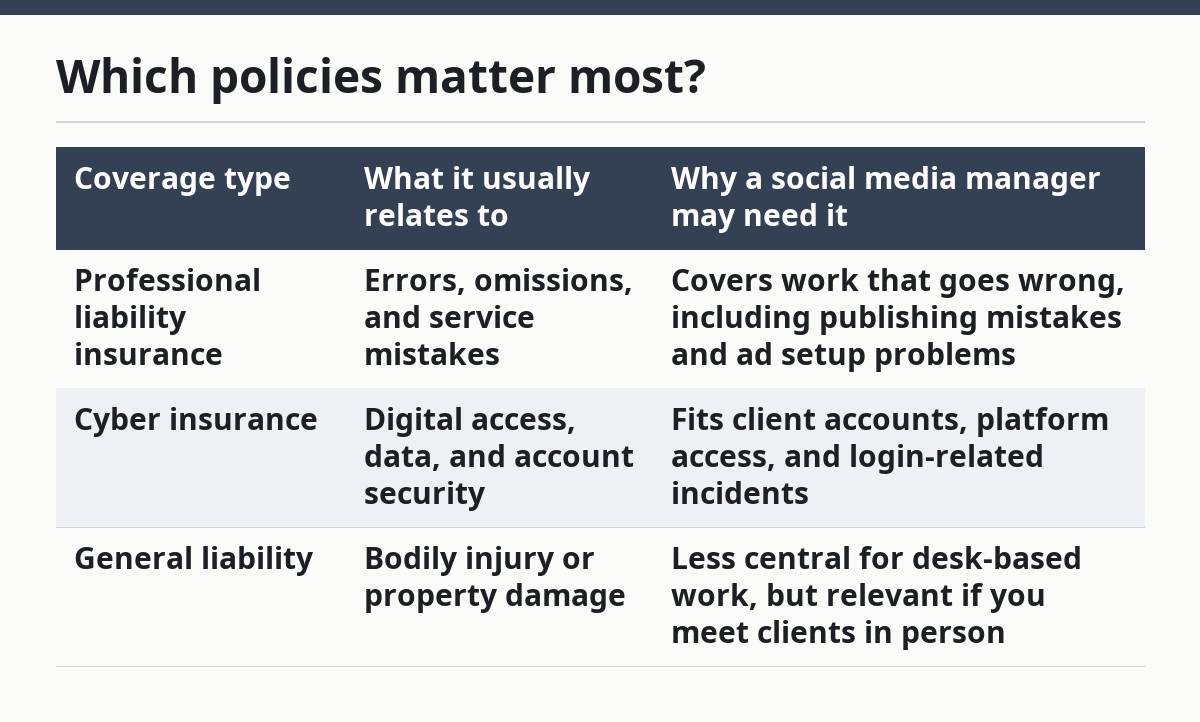
The main policies are professional liability insurance and cyber insurance, and some freelancers also need general liability depending on how they work. Professional liability insurance is the one most closely tied to service errors. Cyber insurance is the one that speaks to account access, stolen credentials, and data-related incidents.
A simple way to think about it is this: professional liability follows the work product, while cyber insurance follows the digital exposure. If a post goes out with the wrong claim, the problem is often about your service. If a password is exposed or a client account is compromised, the problem may sit in cyber territory.
For example, the professional liability insurance page explains service-error cover in more detail, while the cyber insurance page covers digital incidents and login-related risk.
| Coverage type | What it usually relates to | Why a social media manager may need it |
|---|---|---|
| Professional liability insurance | Errors, omissions, and service mistakes | Covers work that goes wrong, including publishing mistakes and ad setup problems |
| Cyber insurance | Digital access, data, and account security | Fits client accounts, platform access, and login-related incidents |
| General liability | Bodily injury or property damage | Less central for desk-based work, but relevant if you meet clients in person |
The drawback is that one policy does not do every job. A freelancer who only edits captions may not need the same setup as someone who runs paid social campaigns, manages passwords, and posts from client profiles every day. Rates and rating plans can vary by state, according to State Farm, so the same type of cover may price differently in different places.
What can go wrong in client work?

The biggest risks come from publishing mistakes, account access, and campaign setup errors. A mistaken post can go live before approval, a scheduled draft can publish on the wrong day, or an ad can point to the wrong page. Those are ordinary working errors, and they can still lead to a claim.
Client approval workflows reduce the chance of a mistake, but they do not erase the risk. A workflow with 2 approvals is better than one with none, yet the freelancer can still click the wrong account or misread a brief. Social platforms also move fast, so the gap between draft and publication is where errors often show up.
The other common problem is access. If a freelancer stores login details, shares them through insecure channels, or manages more than one brand in the same tool, cyber exposure rises. For that reason, a freelance social media manager should consult a licensed insurance professional about policy wording, and the FTC’s business data security guidance is a useful starting point on password and access controls (FTC). That is why cyber insurance belongs in the conversation for many social media managers, even if they never write a line of code.
A generic business policy can miss these details. The point is not just “I work online.” The point is that social media work uses client accounts, platform permissions, and scheduled content, which creates a narrow but real kind of risk.
How do client approvals change the risk?
Client approvals lower risk by creating a paper trail, but they do not replace insurance. A written approval before posting helps show who signed off on copy, creative, and timing. That matters when the work involves several drafts, comments, and last-minute changes.
The strongest workflows are simple and clear. A 2-step approval process, such as draft review and final sign-off, is easier to track than a loose stream of messages across email, chat, and platform comments. If approvals live in too many places, mistakes become harder to spot.
One limitation is that approvals can fail at the exact moment a campaign is most sensitive. A client may approve a typo, miss a broken link, or rush a launch into the wrong audience. Insurance does not fix the workflow, but it can respond when the workflow fails.
For a freelance social media manager, the real question is not whether approvals exist. It is whether the approvals are documented well enough that a dispute does not turn into a larger financial problem. That is where professional liability insurance and cyber insurance often work side by side.
How do you judge the right cover?
Therefore, the right cover matches the way the work is actually done, not the way a profile bio describes it. A freelancer who only drafts captions has a different risk profile from someone who logs into client ad accounts, publishes posts, and changes campaign settings. The policy should reflect those tasks.
A practical check starts with five items: whether you have client account access, whether you publish directly, whether you touch ad campaigns, whether you store passwords, and whether you manage approvals. Each item points toward either professional liability insurance, cyber insurance, or both. If none of those apply, the need may be lighter.
Retrospectively rated insurance is a separate pricing structure sometimes used on large commercial accounts, where the premium is set after the fact. The rating formula is guaranteed in the insurance contract, according to Investopedia, but that model is not the usual starting point for a solo freelancer. Some rating structures also reflect market trends rather than individual loss experience, which is another reason pricing can feel uneven.
Independent rating agencies provide information and rate insurers’ financial viability, and insurance companies are rated by agencies such as AM Best, according to Insurance – Wikipedia. That does not tell a freelancer which policy to choose, but it does show that carrier strength is a real part of the insurance conversation.
What should you check before buying?
The most useful check is whether the policy wording matches your actual workflow. A freelancer should look for how the policy treats client accounts, platform access, publication errors, and campaign management. If the wording talks only about generic consulting, it may not fit the job well enough; a licensed broker or insurance adviser can help interpret it, and the NAIC consumer resources are a useful second source.
The second check is the claim trigger. Some problems begin with a wrong post, while others begin with unauthorized access or a password issue. Those events are related, but they may sit in different policy buckets. The more your work includes direct access to client systems, the more important that distinction becomes.
The third check is the approval trail. If your process depends on client sign-off, the policy should not assume that every mistake is purely yours or purely the client’s. That split can matter after a disputed launch, a deleted post, or a campaign that runs with the wrong asset.
The last check is the business structure behind the policy. Even with similar work, pricing can vary by state because insurance prices are based on rating plans that can vary by state, according to State Farm. The right result is not always the cheapest option. The right result is a policy that matches the work with enough clarity that a claim does not fall into a gap.
When does the standard approach not fit?
The standard approach does not fit every freelance social media manager, and that is where trouble starts. If the job is mostly behind-the-scenes content support with no posting authority, the main exposure may be smaller than a full social media management setup. If the job includes ad buying, account recovery, or password storage, the exposure is larger.
Only advisory work with no posting access: This is not the same risk as account management — focus on the narrower service you actually provide, because a broader insurance setup may not match the work.
Multiple client accounts in one tool: This increases the chance of cross-posting or misrouting content — use a tighter approval workflow and check whether cyber coverage speaks to account access.
Paid ads and campaign edits: This raises the impact of a mistake — make sure professional liability insurance covers service errors tied to campaign setup.
Password storage or shared logins: This creates digital exposure — look closely at cyber insurance language, since account access is part of the risk.
Short-term or one-off contracts: Fast projects can compress review time — keep approval steps simple and document who approved what before anything goes live.
The main consequence of ignoring these edge cases is not just confusion. It is a policy that looks suitable on the surface but fails the moment a claim follows the path of the actual work.
What mistakes do freelancers make?
Therefore, the most common mistake is assuming one small business policy covers every social media task. That can leave gaps around publishing errors, ad changes, or client account access. The better alternative is to map the policy to the real tasks, not the title on the invoice.
A second mistake is treating client approval as a shield. Approval lowers risk, but it does not stop every bad post, broken link, or mistaken audience setting. The better alternative is written approval plus insurance that matches service mistakes and digital access. For a tailored read on that risk split, consult a licensed insurance professional and compare the policy wording against the actual workflow.
A third mistake is ignoring cyber risk because the work feels “creative.” Social media management is creative, but it is also technical enough to involve logins, permissions, and account control. The better alternative is to ask whether passwords, shared drives, or platform access are part of the job.
A fourth mistake is choosing cover without checking how pricing works. Insurance prices are based on rating plans that can vary by state, according to State Farm, so a quote comparison that ignores local rules can mislead. The better alternative is to compare the policy language and the rating basis, not just the top-line cost.
A fifth mistake is assuming all insurers measure risk the same way. Some rating structures reflect market trends rather than individual loss experience, according to Insurance – Wikipedia, so the way a premium is shaped can differ from one insurer to another. That is a reminder to read the contract, not just the headline.
FAQ
Do social media managers need professional liability insurance?
Yes, many freelance social media managers do need professional liability insurance because the work can involve mistakes in content, timing, approvals, or campaign setup. A wrong post or a missed step can become a service dispute. That is especially true when the freelancer publishes directly or manages ad accounts.
Does insurance cover a mistaken post or campaign error?
Often, professional liability insurance is the policy type that speaks most directly to a mistaken post or campaign error. The exact answer depends on the wording and exclusions, which differ by policy and country. If the mistake involves client accounts or access, cyber insurance may also matter.
What coverage protects client account access?
Cyber insurance is the coverage most closely tied to client account access, stolen logins, and related digital incidents. A social media manager who handles passwords, shared tools, or platform permissions should check that the policy language matches those tasks. Professional liability insurance still matters for service mistakes, but it does not usually stand alone for access-related problems.
Drafted with AI; not yet reviewed by a person.
