

Last updated: November 25, 2026
Freelance insurance usually costs less for a solo business with low risk and no gear, and more when the work has client-facing liability, cyber exposure, or expensive equipment. The premium for a one-person business is shaped more by the kind of work, the coverages chosen, the limits, and the deductible than by the word “freelance” itself. This is general information, not financial advice; a qualified adviser should be consulted for a reader’s own situation.
Key takeaways
- A solo designer, writer, consultant, or tutor often pays a very different premium from a photographer, technician, or contractor because the risk profile is not the same.
- Professional liability insurance, general liability insurance, cyber insurance, and equipment coverage do not all affect price in the same way.
- Higher limits usually raise the premium; a higher deductible often lowers it, but shifts more cost to the business after a claim.
- The number of clients, the type of work, and the value of tools or data can matter as much as business size.
- A quote that looks low can be missing a coverage line that matters more than the savings.
What does freelance insurance cost?
Freelance insurance costs whatever the policy’s risk model says it costs for a given line of coverage, and there is no single price that fits every solo business. A writer with no client visits and little equipment usually sits in a different cost band than a photographer carrying cameras, a consultant handling client data, or a contractor working on-site.

The best way to think about the premium is by coverage type, not by one all-purpose number. Professional liability insurance covers claims tied to work errors or bad advice; general liability insurance covers third-party injury or property damage; cyber insurance addresses data incidents; and equipment coverage protects tools such as cameras, laptops, or specialized gear. For a plain-language overview of business insurance types, the U.S. Small Business Administration’s insurance guide and the Insurance Information Institute’s general liability page are useful references.
Business size still matters, but “size” for a solo business usually means more than headcount. Insurers look at annual revenue, number of projects, client type, whether work happens in person, and how much could go wrong if one job fails. Two one-person businesses can look nothing alike to an underwriter.
Which solo businesses pay more?
Solo businesses pay more when their work can cause bigger claims, need more limits, or involve more assets. A graphic designer and a mobile mechanic are both freelancers, but they do not create the same kind of exposure. The mechanic has more bodily injury and property damage exposure; the designer may need stronger professional liability and cyber protection.
Here is the practical pattern.
| Solo business type | Typical risk driver | Coverages that often matter most | Cost pressure |
|---|---|---|---|
| Writer, editor, coach, consultant | Advice, missed deadlines, client loss claims | Professional liability, cyber insurance | Usually lower to moderate |
| Designer, marketer, web developer | Error claims, data issues, client property | Professional liability, cyber insurance, general liability | Moderate |
| Photographer, videographer, event freelancer | Gear loss, client-site damage, public interaction | Equipment coverage, general liability, professional liability | Moderate to higher |
| Bookkeeper, accountant, virtual assistant | Sensitive data, errors, client reliance | Professional liability, cyber insurance | Moderate |
| Tradesperson, installer, on-site contractor | Property damage, bodily injury, tools | General liability, equipment coverage, professional liability if advising | Often higher |
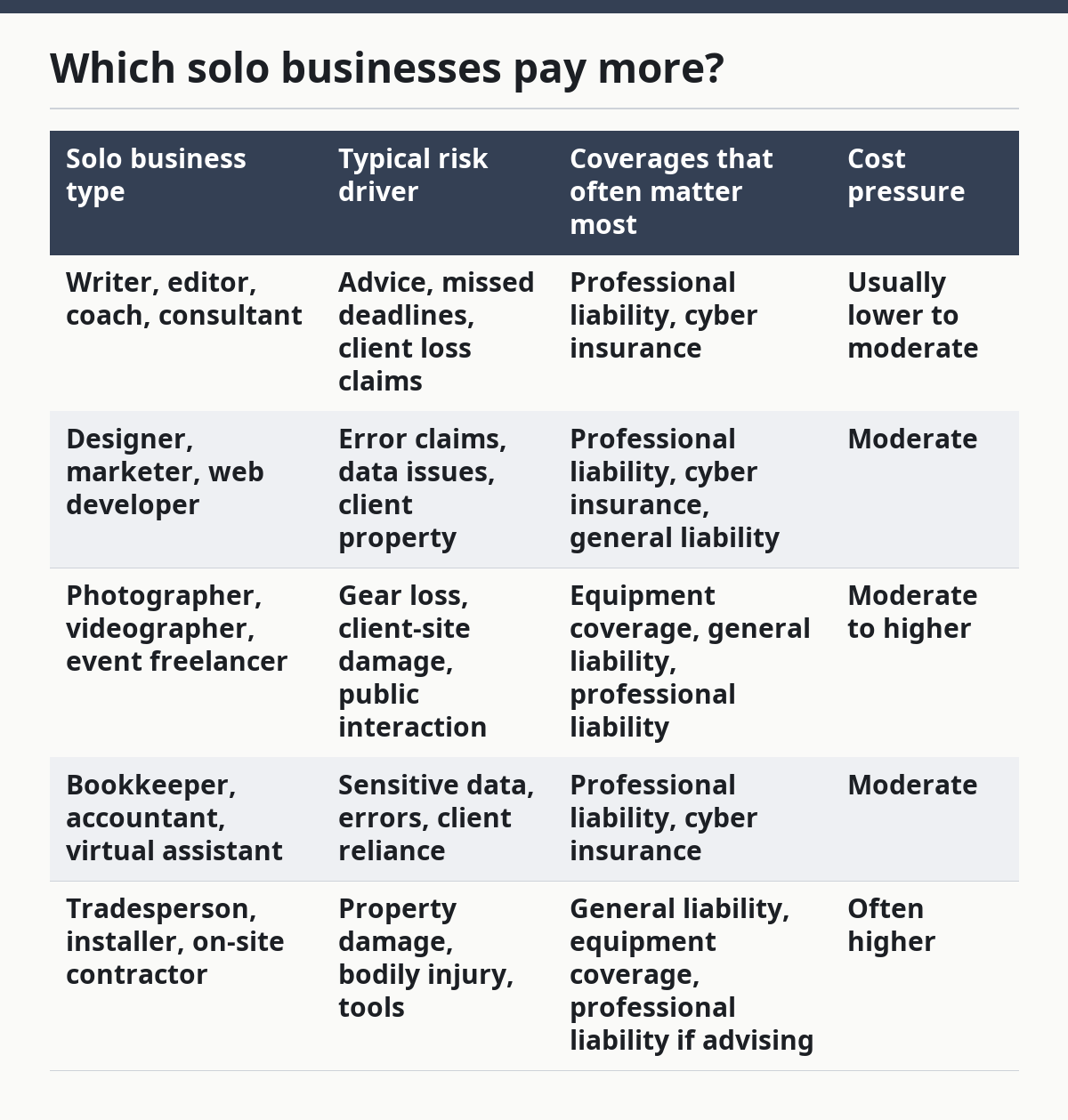
This is where a generic article gets things wrong: it treats “freelancer” as one risk class. A solo business with no physical work may pay much less than one that enters homes, handles expensive tools, or stores client records. The work type often changes the premium more than the word “solo” does.
Why does the kind of work change the premium?
The kind of work changes the premium because insurers price the chance and size of a claim. A business that gives advice can face an error or omission claim, which is why professional liability insurance matters. A business that meets clients on-site can trigger slip-and-fall or property damage claims, which is where general liability insurance comes in.
Cyber insurance becomes more relevant when the freelancer keeps client files, payment details, login credentials, or sensitive records. A laptop with a cloud backup still creates exposure if the data behind it is confidential. Equipment coverage matters when replacing one device would hurt the business enough to stop work for days or weeks.
A common mistake is assuming the cheapest policy is the right one because the business is small. Small does not mean simple. A one-person bookkeeping business can have more data exposure than a five-person landscaping business, and the premium should reflect that difference.
How do limits and deductibles affect the price?
Higher limits usually raise the premium, and a higher deductible often lowers it. A limit is the most the insurer may pay under the policy, while a deductible is the amount paid out of pocket before coverage applies. Those two settings are among the strongest cost drivers in freelance insurance.
That trade-off can be easy to miss. A low deductible may feel safer at purchase time, but it can push the premium up. A high deductible can lower the premium, but it also means a bigger bill if a claim happens. The right balance depends on cash on hand, not just the monthly quote.
One useful rule is to compare the price change against the risk you are actually trying to cover. If a policy saves a small amount by cutting limits to a level that would not help much in a real claim, the savings may not be useful. The limit is not decoration; it is the ceiling that controls how much protection the policy can provide.
How to estimate the cost for your solo business
The cost estimate starts with the work you do, the assets you carry, and the claims you could face. A freelancer who wants a realistic premium picture can follow a simple order: define the work, pick the needed coverage types, choose limits, then set the deductible. That is the logic insurers use, just in reverse.

- List the exact services you sell in one line, such as “copywriting,” “mobile pet grooming,” or “IT support.” Verify that the description matches the real work, not a broad label. If the description hides on-site work, client data, or tool use, the quote may come back wrong.
- Separate work into risk buckets: advice, physical service, client property access, and data handling. Verify which bucket applies to each service. If a job touches more than one bucket, the premium may rise because the exposure is broader.
- Choose the coverage types you actually need: professional liability insurance, general liability insurance, cyber insurance, and equipment coverage. Verify whether each one has a clear purpose in the business. If a coverage line has no real risk to match, it may add cost without much value.
- Set a deductible you can pay without disrupting the business. Verify that the amount would still be manageable after a claim. If the deductible would strain cash flow, the policy may be too aggressive on price.
- Set limits based on the size of a realistic claim, not on the cheapest premium you can find. Verify that the limit is high enough to matter in a worst-case event. If the limit is too low, the premium may look good while the coverage does not do enough work.
- Check whether you need equipment coverage for laptops, cameras, tools, or other gear. Verify the replacement cost of the items that would stop work if lost. If one stolen bag would halt income for a week, leaving gear uninsured can be expensive in a different way.
- Review whether cyber insurance is relevant for client files, passwords, or payment data. Verify how much data the business stores and where it lives. If the business handles no sensitive information, cyber coverage may still be useful, but it may not be the first dollar to spend.
- Revisit the quote after the business changes. Verify after a new service line, higher revenue, more gear, or more in-person work. If the work changed but the policy did not, the price may be based on an old risk picture.
The useful result here is not a magic number. It is a premium that fits the actual solo business, with each line of coverage tied to a real exposure and each deductible matched to the cash the business can absorb.
When is the standard approach wrong?
The standard approach is wrong when the business has a risk that the basic package does not touch. A solo business that mostly files documents online may not need the same mix as a freelancer who enters homes, handles expensive equipment, or stores regulated data. Those are not minor differences; they change the claim shape.
Client contracts require specific limits: the insurance has to match the contract, not the cheapest quote — get the policy checked before signing.
Work is done on-site in homes or offices: bodily injury and property damage exposure rise — general liability becomes more important.
Client data is stored or transmitted: cyber exposure is real — review cyber insurance rather than assuming a laptop backup is enough.
Tools or gear are expensive enough to stop work if lost: the business can stall after theft or damage — add equipment coverage if replacement would hurt operations.
The business gives advice that clients rely on: error claims matter more than physical accidents — professional liability becomes central.
These are the points where a low-cost policy can be the wrong tool. The issue is not paying more for its own sake; the issue is paying less for protection that does not match the job.
What mistakes make freelance insurance cost more later?
The biggest cost mistake is buying the wrong type of coverage and finding out after a claim. A writer who skips professional liability because the business is “small” can face a claim tied to bad advice or a missed deadline. A photographer who skips equipment coverage can face a much larger self-funded loss than the premium would have been.
Another mistake is setting limits too low to save money. That can keep the premium down, but it also makes the policy less useful if the claim is larger than expected. The premium is only part of the cost; the uncovered gap matters too.
A third mistake is undercounting equipment. One laptop, camera body, light kit, or specialist tool can be the business’s main production asset. If the replacement cost is ignored, the quote may look affordable while the business is exposed.
A fourth mistake is treating cyber risk as a problem only for big firms. Solo businesses store client files, invoices, and login access too. If those records are part of the work, cyber insurance may affect price because the exposure is real.
A fifth mistake is assuming every freelancer should aim for the same policy mix. A consultant, a visual artist, and a tradesperson do not face the same premium drivers. The right comparison is work type, coverage mix, limits, and deductible — not just the word “freelance.”
FAQ
What affects freelance insurance cost?
Freelance insurance cost is driven by the work type, the coverages chosen, the limits, the deductible, and the value of any equipment or data exposure. A solo business that gives advice, visits client sites, or stores sensitive information usually faces a different premium profile from one that works remotely with little risk of physical loss.
Why do freelance insurance quotes vary?
Freelance insurance quotes vary because insurers weigh the same business details differently and may package the coverages differently. One quote may include professional liability and cyber insurance, while another may leave one of those out or use different limits and deductibles. That changes the premium even when the business name is the same.
How do limits change the price of freelance insurance?
Higher limits usually increase the premium because the insurer is taking on more possible loss. Lower limits can reduce the price, but they also reduce how much the policy can pay if a claim grows. The best limit is the one that fits the business’s real risk, not the lowest number that trims the quote.
Drafted with AI; not yet reviewed by a person.
