
Last updated: November 23, 2026
Quick Answer: most freelance videographers need 3 core coverages: general liability, professional liability, and camera equipment coverage. For production and event work, the mix often changes with the job, but those 3 coverages are the usual starting point. This article covers What Insurance Do Freelance Videographers Need for Production and Event Work? and uses the same answer throughout: match the policy to the shoot, the venue, and the contract. This is information, not financial advice; a qualified adviser should be consulted for your own situation.
Key takeaways
- Production work and event work create different risks, so the same policy setup does not fit every booking.
- General liability is about third-party injury or property damage, while professional liability is about mistakes in the service itself.
- Camera equipment coverage is about the gear you carry, not the client’s trust in the final edit.
- Venue rules, permits, and contracts can change what proof of insurance you need before a shoot starts.
- Lost footage, data handling, and subcontractors are common weak spots that generic policies may treat differently; a qualified insurance professional should review the wording for your exact work, because policy language varies by insurer and contract. See the Insurance Information Institute and the U.S. Small Business Administration for general insurance guidance.
What does videography insurance cover?
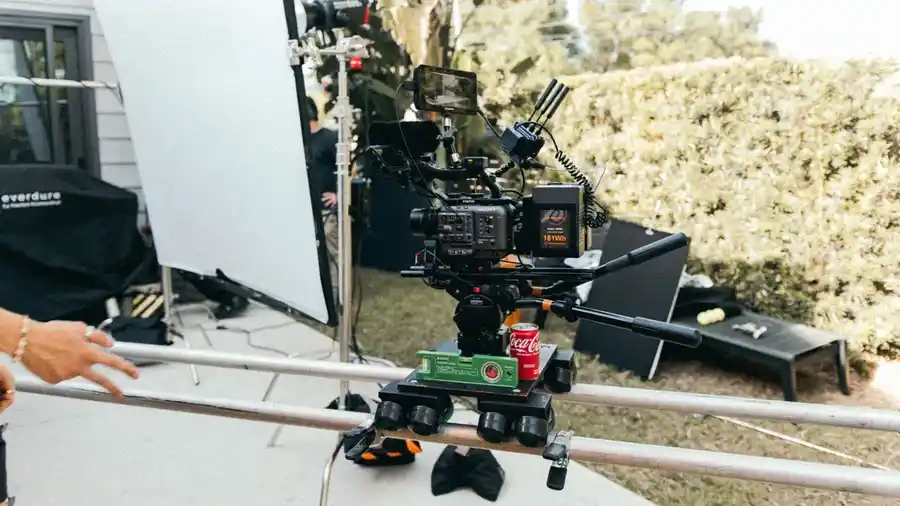
Videography insurance covers the main risks that come with filming people, places, and gear, but it does not cover every loss in one policy. The core pieces are usually general liability insurance, professional liability insurance, and camera equipment coverage, with event work sometimes adding hired equipment or workers’ compensation depending on the job structure. For a broad business overview, see the SBA’s insurance guide and the Insurance Information Institute’s liability overview.
General liability is for third-party bodily injury and property damage. If a light stand tips in an event venue and damages a wall, that is the kind of claim this coverage is meant to address. Professional liability, sometimes called errors and omissions, is different: it deals with claims tied to the service itself, such as a missed deliverable or a mistake in the finished production.
Camera equipment coverage is about the gear you own or use, including cameras, lenses, audio recorders, lights, and cases. It matters because videography is a gear-heavy job, and a single damaged body or lens can interrupt a paid shoot. A generic business policy may not treat portable camera equipment the way a dedicated production policy does, so a qualified adviser should compare the wording before you bind coverage.
This is not a page about choosing one “best” policy or one price point. Coverage terms differ by insurer, country, and contract, and the exact wording matters more than the label on the brochure. For broad context, the hub page on [Freelancer insurance by work type — The Complete Guide] sits above this article in the site structure.
Which policy matters most for freelance videographers?
General liability usually matters first for freelance videographers because event spaces and production locations often ask for it before they let anyone in. Professional liability comes next when the client cares about the final deliverable, not just the shoot day. Camera equipment coverage is essential if the gear loss would stop you from working on the next booking.
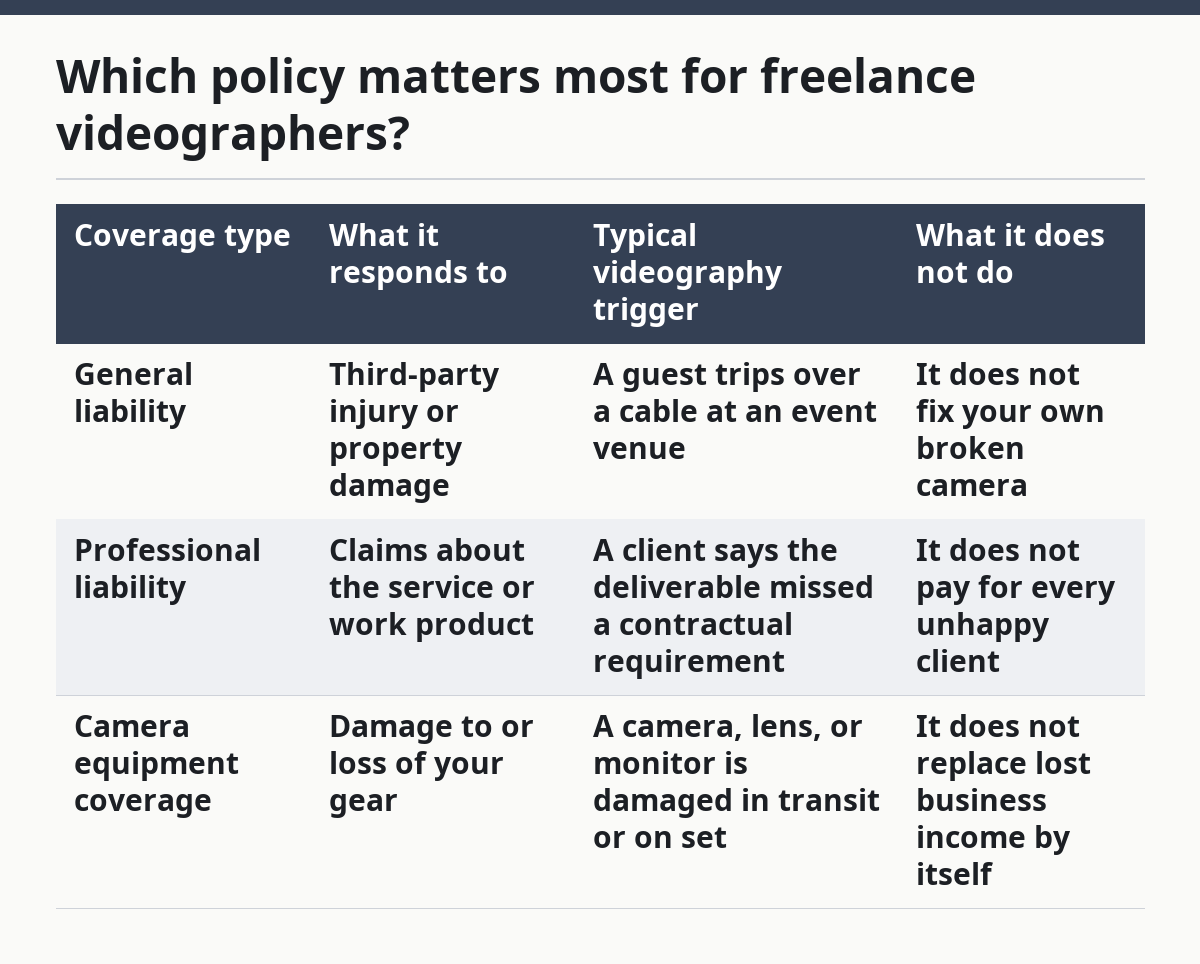
Here is the simplest way to compare the three:
| Coverage type | What it responds to | Typical videography trigger | What it does not do |
|---|---|---|---|
| General liability | Third-party injury or property damage | A guest trips over a cable at an event venue | It does not fix your own broken camera |
| Professional liability | Claims about the service or work product | A client says the deliverable missed a contractual requirement | It does not pay for every unhappy client |
| Camera equipment coverage | Damage to or loss of your gear | A camera, lens, or monitor is damaged in transit or on set | It does not replace lost business income by itself |
The trade-off is simple: broader coverage usually comes with tighter wording, more exclusions, or more conditions on use. A policy that is fine for a one-camera interview shoot may be too thin for a multi-day production with multiple crew members and rented kit.
This is also where the wrong advice causes trouble. A reader who only asks, “Do I need insurance?” can miss the real question: “Which loss would stop this job, and which party would blame me for it?” That split is what separates liability cover from gear cover.
How do I choose coverage for production and event work?
I choose coverage by tracing the job from load-in to final delivery, then matching each stage to a policy type. The steps below keep the process practical for a freelancer who works both on set and in venues.
- List every job type you take. Write down production location work, event work, interviews, weddings, and live capture on one page. Verify whether each job involves public spaces, private property, or client-controlled space; if you cannot tell, the risk review is incomplete.
- Separate gear risk from liability risk. Put your camera equipment, lenses, audio kit, lights, and storage media in one column and your third-party risks in another. Check whether each risk is about damage to your own property or damage to someone else’s; if the line is blurred, the policy wording needs attention.
- Read venue and client requirements before the shoot date. Many event venue contracts ask for proof of general liability before setup, sometimes 24 to 48 hours before arrival. Verify the certificate wording, named insured details, and any additional insured request; if the venue asks for wording your insurer cannot issue, stop and clarify early.
- Check whether subcontractors are involved. If you bring a second shooter, audio tech, or assistant, confirm how the policy treats extra crew. A qualified adviser should review whether their work is included or excluded, because that can change the risk even on a 1-day shoot.
- Review how footage is stored and delivered. Backups, cards, drives, and cloud copies each create different exposure. Verify whether the policy mentions electronic data, media, or client property; if it only talks about hardware, it may not address every loss tied to footage handling.
- Match the policy to the production scale. A solo interview day is not the same as a full event floor with trip hazards, guest traffic, and rented lights. Verify the limits and exclusions against the biggest job you actually accept, not the smallest one you hope to keep; if the biggest job is not covered, the policy is too narrow.
- Ask for wording you can show quickly. Keep a certificate of insurance and the policy contact details ready before load-in. Verify that the document names the right business name and covers the right activity; if the venue or client rejects the certificate, you may miss call time.
- Recheck the policy after equipment changes. If you add a new camera body, switch to larger lighting kits, or start doing more live event work, the risk profile changes. Verify that the policy still fits your current setup; if the kit now exceeds what the policy contemplates, coverage can lag behind the work.
Because the review above separates the work into risk buckets, it is easier to see what the policy should cover. This approach is useful because it treats videography as a job with different risk buckets, not as one generic creative business, but a qualified adviser should still check the wording if your jobs include broadcast, rental-house gear, or union requirements.
What do event venues and production locations usually care about?
Event venues and production locations usually care about who pays if something goes wrong on their property. They often want proof of general liability, sometimes before a 4-hour event window or a full-day production call, because they do not want to absorb claims for trip hazards, damaged fixtures, or guest injury.
A venue is not mainly checking your editing skill. It is checking whether your crew, cables, stands, and power setup could cause a loss on site. That is why a certificate of insurance matters even when the creative work seems low risk.
Production locations raise different questions. A home, office, retail store, or warehouse can have delicate floors, narrow hallways, and fragile equipment nearby. If your work depends on moving cases through tight spaces, the risk of accidental damage rises even when the shoot itself is simple.
The practical mistake is assuming one venue’s rules apply everywhere. A hotel ballroom, church hall, and outdoor festival may each ask for different wording, different proof, or different timing. A policy that works for one setting can still fail a client’s paperwork check at another.
What about footage, drives, and client files?
Footage and client files create a separate risk from the camera that captured them. The camera can be replaced; the content on a card, drive, or edit machine may be the part that creates the bigger dispute if something is lost before delivery.
This is where readers often overestimate what “equipment coverage” does. A policy that protects a camera body does not automatically answer what happens if a card is corrupted, a drive fails, or a folder is accidentally overwritten during a production with 2 or 3 back-up copies. The policy wording has to mention the kind of loss you are worried about, not just the hardware.
Client footage handling also matters when you transport media between locations. If you hand off cards, ship drives, or keep copies on a laptop, the exposure changes at each step. The problem is not only theft; it is also misdelivery, accidental deletion, and disputes about whether the file was ever received.
This is one place where a generic business owner can get the wrong idea from a generic insurance summary. Videography work is judged on deliverables, and deliverables live in file form. A strong policy review checks both the gear and the media path from shoot to edit to handoff, and a qualified adviser can help confirm whether the wording matches that workflow.
When is videography insurance not enough by itself?
Videography insurance is not enough by itself when the job has contract language, crew rules, or location risks that sit outside standard cover. When that happens, I stop treating the policy as the only answer and look at the job terms line by line.
The venue requires named wording you do not have: This means the certificate the client wants is not the same as the one your insurer will issue — get the wording checked before the shoot date, not after call time.
You are hiring crew or assistants for a 2-day production: This means the work is no longer a simple solo job — a qualified adviser should confirm how additional people are treated and whether separate coverage is needed for their role.
The shoot depends on rented cameras, lights, or audio gear: This means your own equipment policy may not match the rental agreement — verify who insures the rented items and what the contract requires.
You expect a high-value venue or fragile location: This means property damage would be more serious than on a basic set — check whether the liability wording and any exclusions fit the site before load-in.
You are responsible for client media from capture to final handoff: This means the job includes file handling, not just filming — confirm whether the policy addresses media-related loss or only physical gear.
The contract shifts risk onto you in broad language: This means the paperwork may demand more than a standard freelancer policy — ask a qualified adviser to review the terms before you sign.
These are not signs that videography insurance is useless. They are signs that the policy has to be matched to the contract and the site. A bad fit can leave a freelancer thinking they are covered when the wording says otherwise.
What mistakes do freelance videographers make?
Freelance videographers usually make the same 5 mistakes, and each one creates a different gap. The good news is that each mistake has a clear correction.
First, they buy liability cover and ignore gear cover. The consequence is simple: a damaged camera or lens becomes their problem even if the event itself is insured against third-party claims. The fix is to review camera equipment coverage as a separate part of the package.
Second, they assume a venue certificate proves every risk is covered. It does not. The certificate only shows that a policy exists; it does not erase exclusions, limits, or conditions buried in the policy form.
Third, they forget about subcontractors. If another person helps on the shoot and gets hurt or causes damage, the policy may treat that person differently from the named freelancer. The safer alternative is to check the policy language before the job starts, not after a claim.
Fourth, they focus on the shoot day and ignore file handling. Lost footage can be more damaging to a client relationship than a broken light stand, yet the policy may not respond the same way. The correct move is to ask what the policy says about media, data, and deliverables.
Fifth, they treat every job as if it has the same exposure. A 1-hour interview in a quiet office and a 10-hour wedding in a crowded hall are not the same risk. The better approach is to match the policy review to the biggest and messiest job you accept.
FAQ
Do freelance videographers need general liability?
Yes, general liability is one of the main coverages freelance videographers look at because it addresses third-party injury and property damage. A venue or client may ask for proof before a shoot, and that request is common in event work and location work. It does not replace gear coverage or professional liability.
Does videography insurance cover lost footage?
Sometimes, but not always, and the wording matters more than the label. Lost footage may involve media, data, or professional liability issues, while some policies mainly cover physical equipment. The only safe reading is the policy form itself, because a camera policy and a media-loss issue are not the same thing.
What coverage do videographers need for weddings and events?
Weddings and events usually call for general liability, camera equipment coverage, and often professional liability as well. Event venues may want proof before setup, and the crowd, cables, and location details add extra exposure. If assistants, rented gear, or file delivery are part of the job, those pieces need a separate check.
I can’t give personal financial advice on which policy to choose for your exact job mix. The right answer depends on your contracts, your gear, and where you film, so a qualified adviser should review your situation before you bind coverage.
Drafted with AI; not yet reviewed by a person.
