

Last updated: November 27, 2026
How to Compare a Policy With Defense Outside the Limits vs Defense Inside the Limits for Freelancers
Quick answer: for most freelancers, defense outside the limits is the cleaner choice because legal defense costs do not eat into the amount left to pay a claim. This is general insurance information, not financial advice; policy terms and limits vary by country and insurer, so a qualified adviser should check your own situation before you rely on any quote or form. For a broader buying framework, see freelance insurance policy options, professional liability insurance, and general liability insurance.
Key takeaways
- Defense outside the limits keeps defense costs in a separate bucket, so a lawsuit does not drain the policy limit as quickly.
- Defense inside the limits can make a lower limit look bigger than it is, because attorney fees and claim payments come out of the same pot.
- Freelancers with tight liability budgets often care less about the label and more about how much money remains for a settled claim after 1 long defense.
- Professional liability insurance is the main place this difference matters, but general liability insurance can use the same structure.
- If your work can trigger slow disputes, the policy with defense outside the limits usually gives more room for the claim itself.
What is the real difference?
The real difference is whether legal defense costs reduce the policy limits or sit outside them. With defense inside the limits, every dollar spent on lawyers, experts, court filings, and related defense costs comes out of the same limit that also pays a judgment or settlement. With defense outside the limits, those defense costs are paid separately, so the full policy limit stays available for the claim itself.
That difference changes the value of the number on the declarations page. A policy with a higher limit can still leave less money for the loss if defense costs erode it before the case ends. In a long dispute, the limit structure matters as much as the limit amount.
This is why freelancers should read the defense wording before they compare anything else. A quote that looks stronger on paper may carry a weaker real-world limit if defense sits inside the cap. For a plain-language overview of how claims and defense interact, the National Association of Insurance Commissioners explains liability coverage basics on its consumer pages, and IRMI also distinguishes between defense outside and inside the limits in liability policy forms.
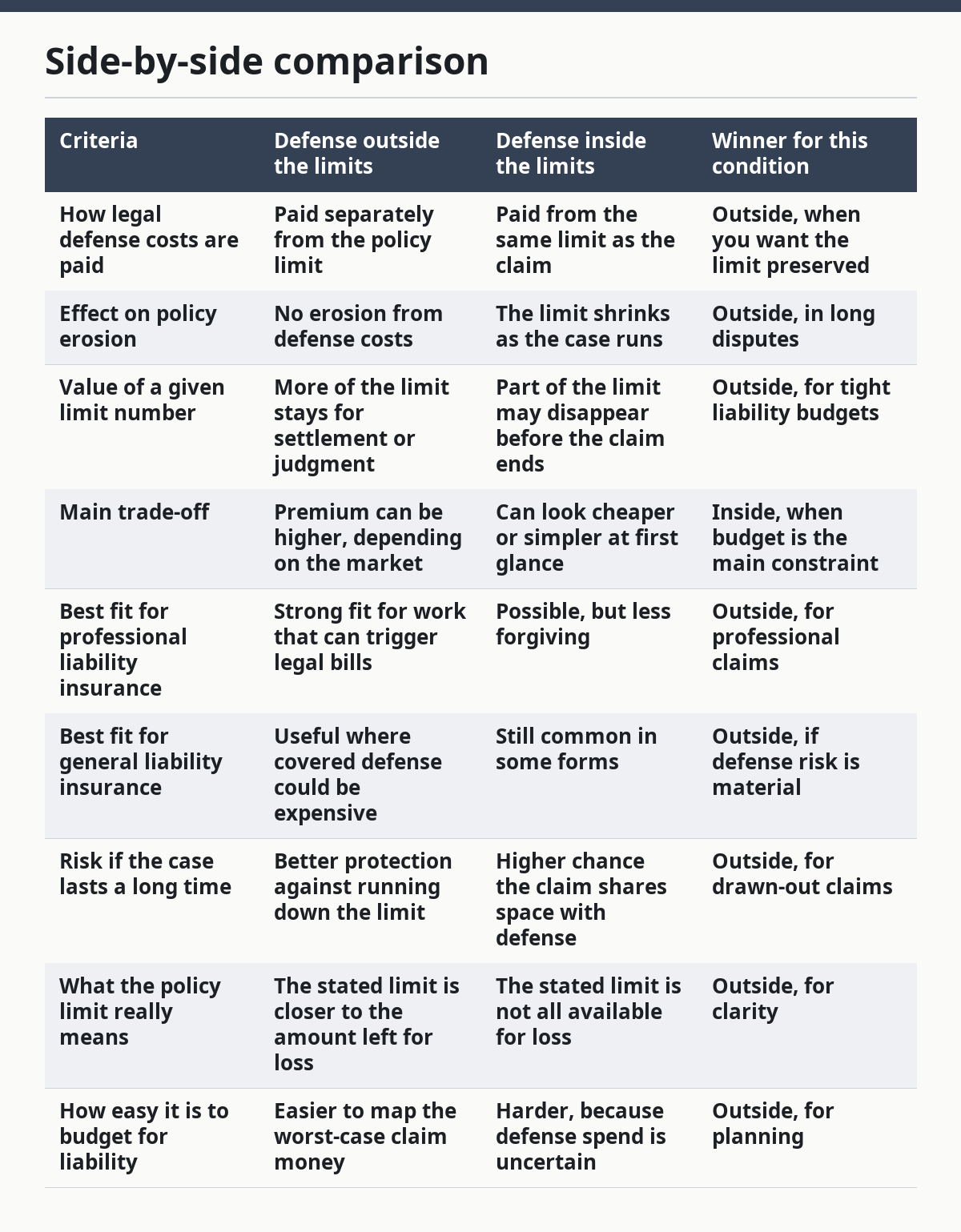
Side-by-side comparison
| Criteria | Defense outside the limits | Defense inside the limits | Winner for this condition |
|---|---|---|---|
| How legal defense costs are paid | Paid separately from the policy limit | Paid from the same limit as the claim | Outside, when you want the limit preserved |
| Effect on policy erosion | No erosion from defense costs | The limit shrinks as the case runs | Outside, in long disputes |
| Value of a given limit number | More of the limit stays for settlement or judgment | Part of the limit may disappear before the claim ends | Outside, for tight liability budgets |
| Main trade-off | Premium can be higher, depending on the market | Can look cheaper or simpler at first glance | Inside, when budget is the main constraint |
| Best fit for professional liability insurance | Strong fit for work that can trigger legal bills | Possible, but less forgiving | Outside, for professional claims |
| Best fit for general liability insurance | Useful where covered defense could be expensive | Still common in some forms | Outside, if defense risk is material |
| Risk if the case lasts a long time | Better protection against running down the limit | Higher chance the claim shares space with defense | Outside, for drawn-out claims |
| What the policy limit really means | The stated limit is closer to the amount left for loss | The stated limit is not all available for loss | Outside, for clarity |
| How easy it is to budget for liability | Easier to map the worst-case claim money | Harder, because defense spend is uncertain | Outside, for planning |
Why does defense inside the limits feel cheaper on paper?
Defense inside the limits often feels cheaper because it can reduce the insurer’s exposure, which may show up in the quote structure. That lower-looking premium can tempt a freelancer who only wants a quick yes or no, especially when the policy limit already seems high enough.
The problem is simple: the first 1 serious defense can consume a large share of the limit before the claim is even resolved. If the insurer spends on attorneys, expert reports, or other covered defense work, the money left for the actual claim can shrink fast. That is policy erosion, and it is the core risk of an inside-the-limits form.
This structure can still make sense for a freelancer who is buying a policy mainly to satisfy a contract and who has a separate cushion elsewhere. But it is a weaker fit for anyone whose business depends on the full limit staying intact through a dispute. The lower upfront cost can come with a hidden cap on real protection.
If you are comparing professional liability insurance, this detail matters more than the label “liability insurance” by itself. Two policies can share the same number on the declarations page and still offer very different protection once defense costs start. The NAIC’s consumer guidance on liability insurance and professional liability coverage is a useful check, and IRMI’s explanation of expense erosion shows why the same limit can produce different outcomes.
When does defense outside the limits help more?
Defense outside the limits helps more when a freelancer can face slow, legal-heavy claims and needs the limit kept intact. That includes work where the dispute may turn on advice, design, code, content, or a service result rather than a simple physical accident.
The strength of this structure is easy to see in a long claim. If the case stretches over months, defense bills can mount while the settlement question stays open. With outside-the-limits wording, the policy limit is not steadily eaten away by those legal bills. The freelancer gets a clearer cap on the amount available to resolve the claim.
This matters most when your liability budget is tight. If your plan is built around one limit protecting you against 2 different risks—defense and payout—then you are taking a bigger gamble with inside-the-limits wording. Outside the limits gives more room for the event that actually damages you: the claim payment.
The drawback is not minor. Policies with defense outside the limits may cost more, and that higher cost can strain a small solo business. A freelancer with very low exposure, short claims, and a separate financial cushion may not need the extra layer. Still, for most people who want the policy limit to mean what it says, outside the limits is the stronger structure. For readers comparing policy forms, the liability insurance guide and insurance for freelancers pages can help frame the trade-off.
How do freelancers decide which one fits?
A freelancer should choose by looking at the size of the limit, the kind of work, and how much of that limit could disappear to lawyers. The limit structure is not a side detail; it is part of the promise.
Start with the work itself. If your work can trigger professional disputes, then defense costs are not a rare extra. They are part of the normal risk profile. Professional liability insurance is where that issue is most visible, but general liability insurance can also include costly defense work after a covered event. The NAIC and other consumer sources both note that liability policies can vary in how they pay legal expenses, so the wording matters.
Then look at the claim path. A fast, clean claim uses less defense. A disputed claim can consume a lot more. If you need the policy limit to be there when the case ends, outside-the-limits wording fits that need better. If your main goal is simply to have some coverage and the budget is tight, inside-the-limits wording may still be the form you are handed, but you should understand exactly what you lose.
The better comparison is not “which policy is cheaper?” It is “how much of the limit survives after defense costs?” That is the real value question for freelancers. For a broader buying framework, the hub on freelance insurance policy options and buying decisions sits above this topic and helps place this choice in context.
What should the honest pros and cons look like?
The honest list favors defense outside the limits, but it is not free of trade-offs. The point is not that one structure is perfect; it is that one structure protects the limit more cleanly.

Defense outside the limits — pros:
- Keeps legal defense costs from shrinking the claim limit.
- Makes the policy limit easier to understand in a real dispute.
- Works better when defense may last a long time, such as a contested professional liability claim.
- Gives a freelancer more room inside a fixed liability budget.
Defense outside the limits — cons:
- Can cost more.
- May not be the form some insurers or policy types offer.
- Can still leave gaps if the overall limit is too low for the work.
Defense inside the limits — pros:
- Can be easier to afford.
- May be adequate for lower-risk work or a contract minimum.
- Can still provide useful protection if the claim and defense stay small.
Defense inside the limits — cons:
- Defense costs erode the limit.
- A long claim can leave very little for settlement.
- The number on the policy can be misleading if you do not read the defense wording.
- It is a weaker fit when you need the limit to stay whole.
When should the verdict flip?
The verdict flips in a few specific situations, even though outside the limits is usually the better structure for freelancers. Those exceptions matter because a blanket rule can mislead someone with a very different risk profile.

First, if the policy is only a stopgap and your real concern is meeting a short contract requirement, inside the limits can be acceptable. The same is true when the work is low-risk and the likely defense is small, not long and expensive.
Second, if the premium difference is large enough that buying outside-the-limits coverage would force you to carry no insurance at all, an inside-the-limits policy can be the only practical option. A weaker policy that you can actually keep is better than no policy at all, though it should be chosen with open eyes.
Third, if your exposure is mostly ordinary third-party injury or property damage and not professional error, the most important issue may be the rest of the form, not just defense treatment. General liability insurance can be more relevant there than the defense structure alone. If that sounds like your business, consult a qualified insurance professional before you decide, because policy forms and legal rules differ by market and the coverage details can change the answer.
Fourth, if you already have a separate reserve for legal fees and a clear liability budget, inside-the-limits wording may fit your plan. That does not make it better in the abstract; it just means the erosion risk is less likely to break your budget.
Which one should you choose?
Choose defense outside the limits if your freelance work can lead to drawn-out claims and you want the policy limit protected from legal defense costs. Choose defense inside the limits if budget pressure is severe, the risk is lower, and you understand that the limit can erode before the claim is paid. Neither if you have not checked whether the policy is for professional liability insurance, general liability insurance, or both.

That is the cleanest call. For most freelancers, the outside-the-limits structure is the better comparison point because it preserves the value of the limit. It is especially strong when legal defense costs are likely to be part of the claim story.
Do not stop at the headline limit. Read the policy limits, the defense wording, and the liability budget together. A freelancer who compares only the top-line number can miss the part that matters most when a claim actually lands.
For this topic, the most useful next check is the policy form itself. If the language on defense costs is unclear, ask a qualified adviser to explain how the wording works in your country and for your business type, because insurance rules and policy forms change. External references such as the NAIC consumer insurance pages and IRMI’s liability policy guidance can help you verify the wording before you buy.
Drafted with AI; not yet reviewed by a person.
