

Last updated: November 25, 2026
Monthly vs Annual Freelance Insurance Payments
Quick answer: for many freelancers, the annual payment plan is easier when a full 12-month premium fits the budget, while the monthly payment plan is easier when cash flow is uneven. If you are deciding on How to Choose Between a Monthly and Annual Payment Plan for Freelance Insurance, start with the size of the bill, the 12 monthly payments, and the renewal date. This is information, not financial advice; a qualified adviser should be consulted for your own situation.
Key takeaways
- Annual billing usually means fewer payment dates and less chance of missing a monthly charge.
- Monthly billing helps if freelance income comes in uneven waves and a single annual bill would strain cash flow.
- An installment plan can make budgeting easier, but it may come with a policy fee or other billing costs.
- Automatic renewal matters because the billing plan and the renewal date can work together; missing either can create avoidable stress.
- The right choice depends less on the policy label and more on timing, cash on hand, and how steady your income is.
What is the real difference between monthly and annual billing?
The real difference is timing: monthly billing spreads the premium across 12 billing dates, while annual billing asks for one payment tied to the policy term and renewal date. An installment plan sits between those two, since it still breaks the cost up but may add a policy fee or other billing charge.
For a freelancer, that timing matters as much as the total bill. A month with a slow client payment can feel very different from a month where the insurance bill is already paid. Annual billing removes monthly reminders, but it also concentrates the cash hit into one date.
A generic article often stops at “monthly is easier” or “annual is cheaper,” but that skips the actual decision. The real question is whether the plan helps or hurts your cash flow during the months when invoices run late. The billing frequency, the renewal date, and any installment plan fee all affect that answer.
The Consumer Financial Protection Bureau’s general guidance on budgeting is useful here, and the National Association of Insurance Commissioners has consumer education on insurance billing and policy management:
- https://www.consumerfinance.gov/
- https://content.naic.org/
Which plan fits uneven freelance income?
Monthly billing fits uneven freelance income better because it lets the payment follow the rhythm of client work instead of demanding one large outflow. If income arrives in bursts, a smaller recurring bill can be easier to absorb than a single annual charge.
That does not make monthly billing the cheaper or cleaner choice in every case. It can still create friction if the insurer uses an installment plan with a policy fee, and it adds more dates to watch each year. If the bill lands on the same day as rent, software subscriptions, or tax transfers, the extra monthly date can become another pressure point.
Annual billing fits best when the cash is already reserved and you prefer fewer moving parts. If a freelance business keeps a separate reserve for insurance, paying once can reduce the chance of missing a due date. It also lines up well with people who already budget in 12-month blocks.
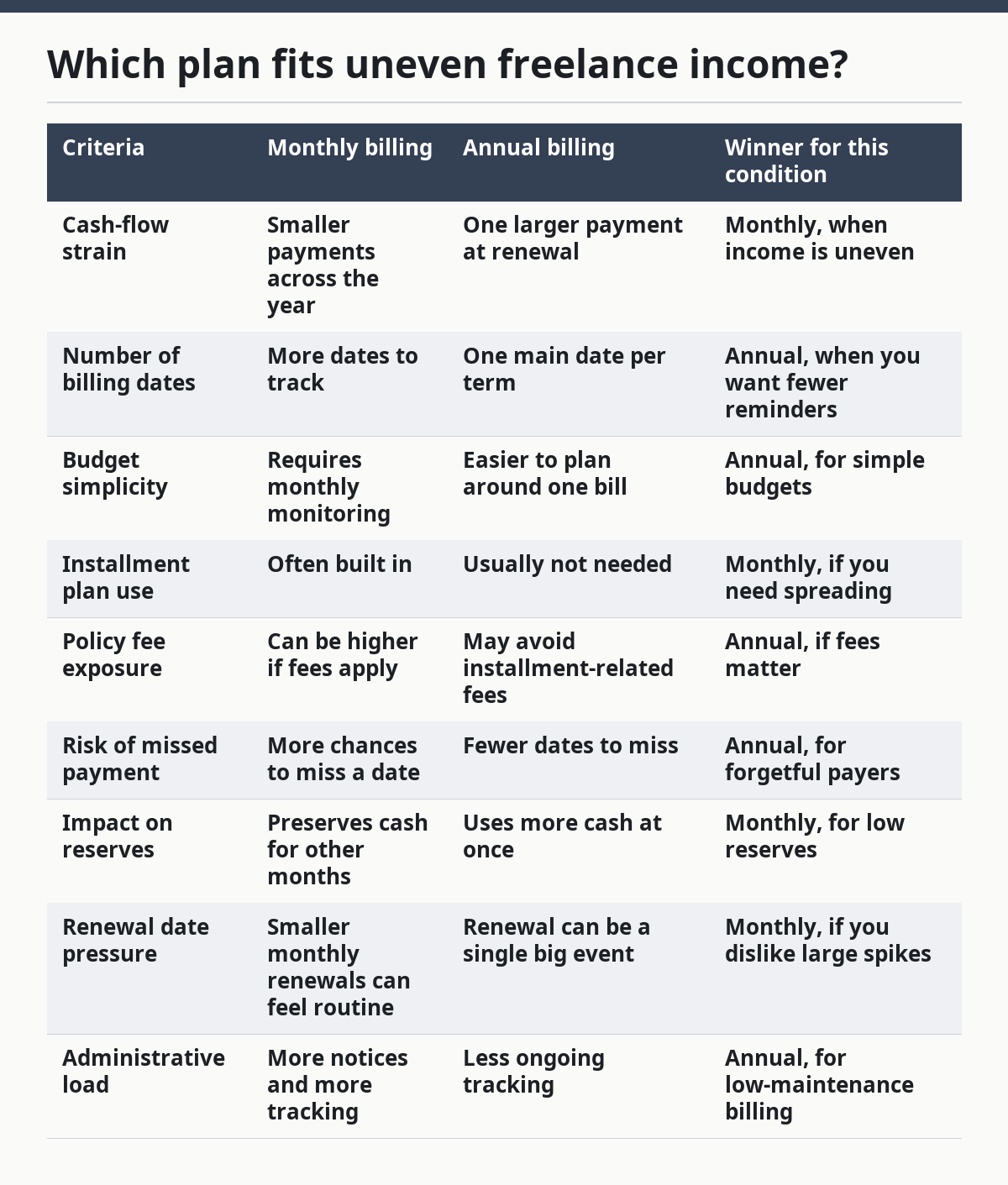
Here is the head-to-head view:
| Criteria | Monthly billing | Annual billing | Winner for this condition |
|---|---|---|---|
| Cash-flow strain | Smaller payments across the year | One larger payment at renewal | Monthly, when income is uneven |
| Number of billing dates | More dates to track | One main date per term | Annual, when you want fewer reminders |
| Budget simplicity | Requires monthly monitoring | Easier to plan around one bill | Annual, for simple budgets |
| Installment plan use | Often built in | Usually not needed | Monthly, if you need spreading |
| Policy fee exposure | Can be higher if fees apply | May avoid installment-related fees | Annual, if fees matter |
| Risk of missed payment | More chances to miss a date | Fewer dates to miss | Annual, for forgetful payers |
| Impact on reserves | Preserves cash for other months | Uses more cash at once | Monthly, for low reserves |
| Renewal date pressure | Smaller monthly renewals can feel routine | Renewal can be a single big event | Monthly, if you dislike large spikes |
| Administrative load | More notices and more tracking | Less ongoing tracking | Annual, for low-maintenance billing |
For a related walkthrough, see insurance renewal dates and managing freelancer subscriptions.
When does monthly billing make the most sense?
Monthly billing wins when cash flow is the main problem, not the total premium. If you are building a reserve, chasing late invoices, or keeping a tight operating buffer, a monthly plan can make the policy feel manageable without forcing a large withdrawal from business cash.
Monthly billing also fits freelancers who already review finances every month. If you look at bank balances, tax set-asides, and business expenses on a monthly cycle, the insurance bill slots into that routine. The trade-off is that the same regularity can become a burden if you hate admin or you already have several subscriptions on autopay.
The weakness is obvious: monthly billing can encourage a “small enough to ignore” habit. That can backfire if a payment fails or if the policy fee makes the installment plan less attractive than it first looked. It also means more chances to miss a due date over a 12-month term.
Monthly billing is not always the best fit for a freelancer who has steady cash, a large reserve, and a strong preference for simplicity. In that case, the extra billing dates may not add much value.
When does annual billing win?
Annual billing wins when you can absorb the larger outlay and want the cleanest possible billing schedule. One payment date is easier to remember than 12, and that matters when the policy also has an automatic renewal date that needs attention.
This option is often better for freelancers with predictable income, a separate insurance reserve, or a habit of setting aside money as soon as invoices clear. It also reduces the number of times billing details need to be checked during the policy term.
The downside is the size of the bill. A once-a-year payment can crowd out other business needs if the timing is wrong, especially if it lands near a tax deadline, equipment purchase, or quiet month for client work. Annual billing also does not fix coverage issues; it only changes how the bill is collected.
Annual billing is not a good match for someone who is still stabilizing income or who cannot comfortably set aside the full amount before renewal. In that case, the clean schedule can become a cash-flow squeeze.
What are the honest trade-offs on fees and renewal?
The honest trade-off is that monthly billing can cost more in billing friction, while annual billing can cost more in cash at once. Some insurers use a policy fee or installment plan charge, and that changes the math even when the coverage itself is the same.
Automatic renewal matters because the billing plan shapes what happens next at the end of the term. If the policy renews automatically, annual payers need to watch the renewal date carefully so a large charge does not arrive as a surprise. Monthly payers still need to watch, but the payment pattern can feel more continuous and less dramatic.
A payment plan is not just an admin detail. It changes the way the policy behaves in a business budget. If a freelancer has a thin buffer, a fee on the installment plan can be enough to make monthly billing less attractive than it first appears. If a freelancer dislikes large surprises, annual billing can still be the better choice even with a higher one-time cash need.
For policy language and consumer protections, the NAIC and CFPB are useful starting points:
- https://content.naic.org/
- https://www.consumerfinance.gov/
When should the choice flip?
The overall choice flips in a few specific situations. If the insurer adds a policy fee that is large enough to erase the convenience of monthly billing, annual billing becomes the cleaner option. If a freelancer’s income arrives in uneven chunks and cash reserves are thin, monthly billing becomes the safer budgeting shape.

The choice also flips if the renewal date falls at the same time as another major business expense. In that case, annual billing can pile pressure onto one month, while monthly billing spreads the strain across the year. A payment plan that looks tidy on paper can be the wrong one if it collides with rent, tax set-asides, or seasonal downtime.
A final flip happens when the main risk is forgetting dates rather than lacking cash. Annual billing has fewer dates to manage. Monthly billing has more, which means more reminders, more chances for a failed payment, and more time spent watching the account.
The verdict: which one should you choose?
Choose annual billing if you can comfortably set aside the full premium before renewal, want fewer billing dates, and prefer a simpler budget. Choose monthly billing if your freelance income is uneven, your cash reserve is tight, or one large payment would put too much pressure on the month. Neither is ideal if the policy fee, installment plan terms, or automatic renewal date are unclear enough to budget around.

How monthly and annual plans affect freelance insurance decisions
This choice matters because it changes how the policy fits into a freelance business, not because one plan is always better. A monthly plan can be a cash-flow tool. An annual plan can be an admin tool. The right answer depends on which problem is harder for the business right now.
A reader who treats insurance as a fixed overhead often prefers annual billing, but a qualified adviser should check whether that assumption fits the budget and policy terms. A reader who treats insurance as one more moving expense often prefers monthly billing, and a qualified adviser should still confirm that the installment plan charges do not change the outcome. The wrong answer is the one that looks easy today but creates a payment problem at renewal.
If the budget is still unstable, it is usually better not to focus on the billing label alone. It is better to ask whether the payment schedule matches the way money actually enters the business.
Is monthly billing more expensive for freelance insurance?
Monthly billing can be more expensive if the insurer adds a policy fee or installment plan charge. That is not universal, and rates differ by country, insurer, and policy terms. The only reliable way to know is to compare the billing total shown on the quote and read whether the fee is tied to monthly billing, renewal, or both.
Should I pay annual or monthly for insurance?
Annual billing makes more sense when the full amount is easy to reserve and you want fewer payment dates. Monthly billing makes more sense when cash flow is uneven and one large charge would be hard to absorb. A qualified adviser can help if the choice affects your broader budget or tax planning.
How do payment plans affect policy cancellation?
Payment plans can affect cancellation because the timing of billed amounts, installments, and renewal dates may determine what is still owed when the policy ends. The exact rules vary by insurer and country, so the policy wording matters. If cancellation is a concern, read the billing terms before choosing a plan and ask the insurer or adviser about the consequences.
Drafted with AI; not yet reviewed by a person.
