
Last updated: November 26, 2026
Quick answer: most freelancers who use temporary studio or coworking space need at least commercial general liability insurance plus an inland marine floater, and the exact limit is usually set by the space agreement and your insurer.
To protect freelance work that uses temporary studio or coworking space, secure commercial general liability insurance paired with an inland marine floater. A coworking membership agreement or personal renters policy will not cover your liability or stolen gear in a communal work facility. Commercial property operators often require proof of coverage before granting access to shared facilities, production suites, or event spaces.
This guide provides informational analysis rather than individual legal or financial advice. Insurance limits, policy definitions, and lease requirements vary by jurisdiction and carrier. Consult a qualified, licensed insurance broker to evaluate specific contracts. This analysis supports the broader framework for freelance insurance for solo businesses, including commercial general liability insurance and inland marine insurance.
Key Takeaways
- Shared facility memberships cover the building owner’s real estate, leaving member property and member-caused accidents completely uninsured.
- Personal renters or homeowners insurance policies routinely deny claims for business gear lost or stolen outside the home.
- Facility licenses generally may demand a minimum liability limit, but you should confirm the exact requirement with the operator, carrier, or broker.
- Mobile equipment floaters protect field laptops, cameras, and audio rigs across multiple transient working hubs.
- Adding a facility manager as an additional insured requires explicit endorsement forms rather than simple email acknowledgments.
Who is this coverage for, and who needs a different policy?
This coverage is for solo contractors, independent consultants, digital designers, commercial photographers, and creative directors who rent hot desks, dedicated workstations, or day-use soundstages in temporary studio or coworking space settings. It assumes the freelancer operates as an independent contractor, sole proprietor, or single-member limited liability company (LLC) carrying portable computing hardware, production tools, or client presentation kits into properties owned by third parties.
Because of that setup, the framework is wrong for businesses that maintain long-term physical headquarters, manage direct retail foot traffic, or store inventory exceeding $50,000 in dedicated warehouse space. Those operations require a traditional commercial package policy (CPP) or a business owner policy (BOP) that ties coverage to a dedicated street address. Contractors who handle hazardous materials, pyrotechnics, structural set alterations, or heavy mechanical industrial work should consult a licensed broker about specialized commercial surplus lines insurance.
Why is coworking space insurance for freelancers necessary?
Coworking space insurance for freelancers is necessary because flexible office agreements often transfer property and injury liability to the member through mandatory indemnification clauses. When an independent worker signs a month-to-month hot desk contract or a 48-hour studio rental license, that document can contain a waiver of subrogation and a hold-harmless provision. These contractual terms mean that if an incident occurs in your rented boundary—or stems from your equipment—the building operator’s carrier may not defend you, and may seek recovery from you instead.

“`
+—————————————————————————————————+
| Typical Workspace Contract Transfer: |
| [Landlord / Master Policy] —> Demands Indemnification —> [Freelancer Member Policy] |
| Covers: Structural walls, Transfers: Member claims, Covers: Third-party slips, client |
| common HVAC, building fires. slips, guest injuries. injuries, accidental property damage.|
+—————————————————————————————————+
“`
As a result, four distinct categories of risk emerge the moment business operations occur on shared property:
- Third-party bodily injury: A member of the public, an office guest, or another member trips over your laptop charging wire or light stand in a hallway, resulting in medical expenses and legal action.
- Facility property damage: A lithium-ion battery on your charging station fails, causing a local electrical fire that chars an antique hardwood floor or sets off the commercial sprinkler system, flooding three suites beneath you.
- Property theft exposure: An unattended laptop, high-end cinema camera, or drawing tablet disappears from an unmonitored communal bench or phone booth while you step away for coffee.
- Client visits in shared spaces: A visiting corporate client slips on a recently waxed floor inside your booked conference room, naming your sole proprietorship in the resulting liability lawsuit alongside the building operator.
Personal insurance policies fail here. The standard ISO HO 00 03 homeowners policy form explicitly restricts or excludes coverage for property used primarily for business purposes when away from the insured residence. Off-premises business property sub-limits on personal lines policies often cap out at $500 or $1,500, with zero liability protection for commercial activities. Relying on personal policies for communal office operations leaves the worker personally exposed to lawsuits and capital loss.
What coverage types apply to temporary studios and shared desks?
Covering independent work across temporary sites requires separating third-party physical injury protection from first-party equipment recovery. General commercial policies handle the public, while specialized equipment floaters follow the gear as it moves between an apartment, an airport lounge, a downtown hot desk, and a commercial photo rental bay. According to the National Association of Insurance Commissioners, inland marine is the broad category commonly used for mobile property coverage, and the Insurance Information Institute explains that commercial general liability addresses third-party injury and property damage.
| Complete Coverage Shield: |
| |
| [Commercial General Liability (CGL)] <– Third-Party bodily injury & rented premises damage |
| [Inland Marine / Mobile Floater] <– First-Party equipment theft & transit accidental drop |
| [Business Personal Property (BPP)] <– Fixed inventory/fixtures inside a leased office unit |
+—————————————————————————————————+
“`
General Liability Insurance
A standard commercial general liability (CGL) policy, written on ISO form CG 00 01 or its equivalent, covers third-party bodily injury, property damage, and personal and advertising injury. In a flexible workspace, CGL defends against claims if a visitor injures themselves within your assigned meeting room or if you accidentally drop a heavy monitor through a rented glass partition. Shared spaces often ask for a liability limit in the range of $1,000,000 per occurrence and $2,000,000 aggregate, along with damage to premises rented to you limits of at least $100,000, but you should confirm the exact amount with the operator and carrier.
Business Personal Property (BPP) vs. Inland Marine
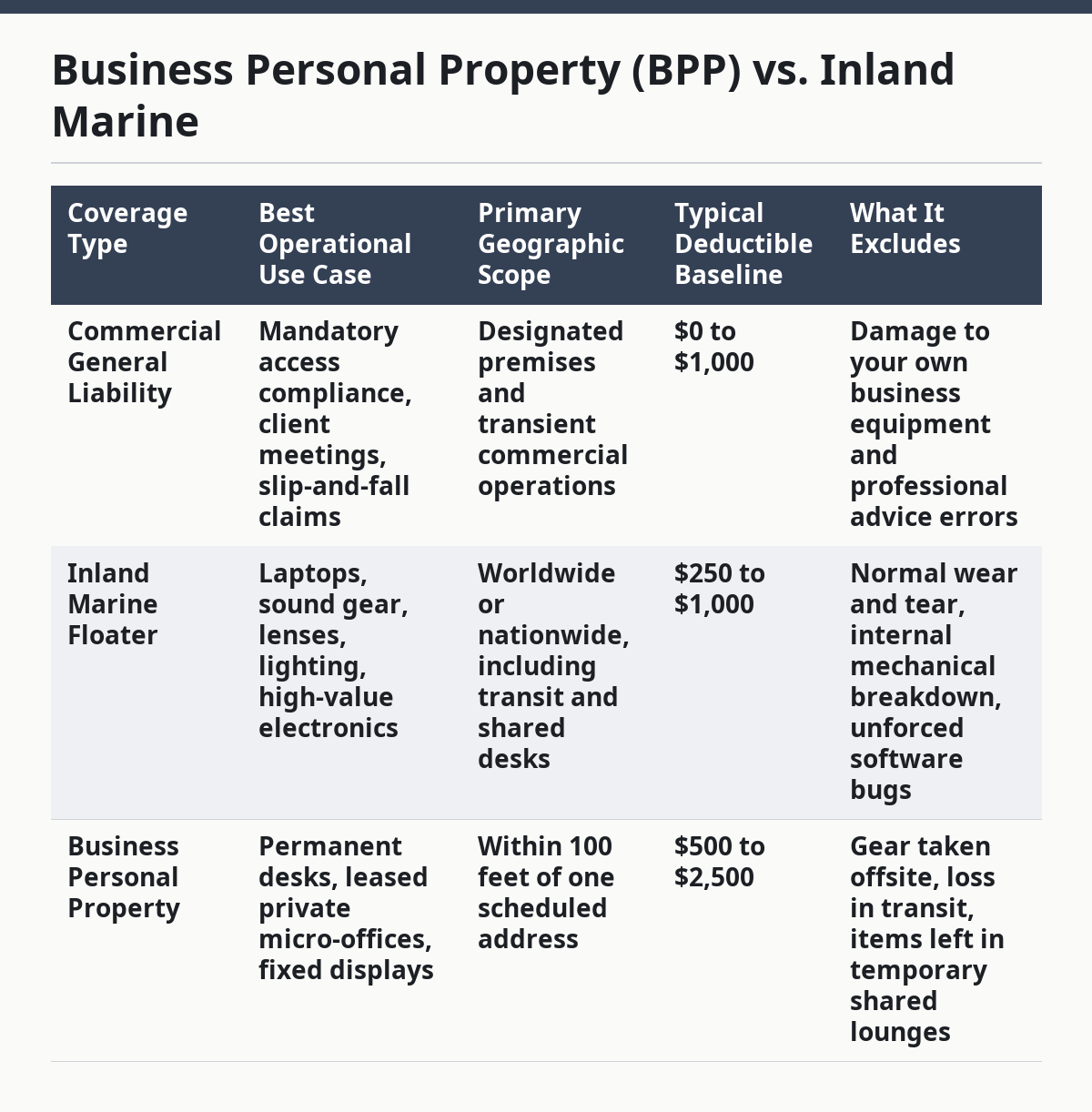
Business personal property coverage protects office furniture, inventory, and computers located within an assigned commercial address. BPP forms commonly state that coverage terminates or shrinks drastically once that property moves 100 feet away from the listed commercial premises. If you rent an open flex desk or hot desk without an assigned private suite, BPP frequently fails because you have no fixed commercial premises schedule.
Inland marine insurance, despite its maritime name, is the industry-standard policy designed for mobile, high-value commercial property that travels. Governed conceptually under the Nationwide Marine Definition maintained by the National Association of Insurance Commissioners (NAIC), inland marine floaters cover tools, computing hardware, audio kits, and studio cameras wherever they go. Unlike standard property insurance, an inland marine policy provides broad perils protection, shielding against theft, transit accidents, and mysterious disappearance, whether the loss happens in a rideshare vehicle, on an airport carousel, or on an open-plan coworking table.
| Coverage Type | Best Operational Use Case | Primary Geographic Scope | Typical Deductible Baseline | What It Excludes |
|---|---|---|---|---|
| Commercial General Liability | Mandatory access compliance, client meetings, slip-and-fall claims | Designated premises and transient commercial operations | $0 to $1,000 | Damage to your own business equipment and professional advice errors |
| Inland Marine Floater | Laptops, sound gear, lenses, lighting, high-value electronics | Worldwide or nationwide, including transit and shared desks | $250 to $1,000 | Normal wear and tear, internal mechanical breakdown, unforced software bugs |
| Business Personal Property | Permanent desks, leased private micro-offices, fixed displays | Within 100 feet of one scheduled address | $500 to $2,500 | Gear taken offsite, loss in transit, items left in temporary shared lounges |
How do you insure freelance work in a shared space step by step?
Securing compliant, cost-effective coverage for temporary production and desk rentals usually starts before you sign the facility license, and a broker can help you match the contract to the policy. Follow these eight sequential steps to secure your coverage, obtain access badges, and prevent uninsured exposure.

- Inspect the workspace membership lease agreement for mandatory limits. Review the facility agreement terms under the indemnification, insurance, or liability sections. Note the exact minimum limits required, which may be $1,000,000 per occurrence, $2,000,000 general aggregate, and $100,000 to $300,000 for damage to premises rented to you. Verify whether the operator demands a 30-day notice of policy cancellation. An issue occurs if the contract requires commercial auto or workers’ compensation coverage when you operate as a sole contractor without vehicles or staff; if this happens, request a written contractual waiver from the facility director before buying coverage.
- Complete a physical inventory of all mobile production hardware. Compile an itemized equipment register containing serial numbers, brand names, purchase dates, and replacement values for every laptop, external hard drive, monitor, camera body, lens, and lighting kit used away from your residence. Total the replacement values calculated at current market cost rather than depreciated value. Verify that all single items valued over $1,500 are highlighted with proof of purchase. A problem is indicated if custom modifications or specialty accessories lack sales receipts, which will delay inland marine claims adjusters during proof-of-loss examinations.
- Request commercial lines proposals through an independent broker. Contact an independent property and casualty broker with commercial lines access, requesting quotes for an ISO-standard CGL policy alongside an inland marine scheduled floater. Instruct the broker that operations occur at variable, non-permanent desk leases and temporary commercial studio locations. Verify that the insurer carries an A.M. Best financial strength rating of “A-” (Excellent) or higher, as commercial facilities routinely reject policies written by unrated carriers. A red flag appears if a quoted package contains an off-premises property exclusion or a non-standard unattended auto theft warranty. See also our [how to choose a commercial insurance broker](/commercial-insurance-broker/) guide.
- Review the policy terms for communal space exclusions. Read the proposed policy definitions, exclusions, and endorsements before paying the premium. Check the policy for “unattended property” warranties, “locked compartment” restrictions, or communal storage limitations. Confirm that the inland marine floater provides full replacement cost valuation rather than actual cash value (ACV), which subtracts depreciation. An issue occurs if the general liability quote includes an absolute exclusion for water damage legal liability, which would leave you exposed if an incident involves plumbing or sprinkler activations inside the temporary facility.
- Issue payment and secure direct policy numbers. Submit the down payment or full annual premium via wire or verified corporate credit card to bind the coverage. Obtain the official binder document showing active effective dates, policy numbers, and primary classification codes (such as standard North American Industry Classification codes for consulting or photographic services). Verify that the policy takes effect at least 24 hours prior to your scheduled move-in or studio booking date. A problem exists if the agency issues an informal email confirmation without policy declaration forms or insurance carrier binder paperwork.
- Request an ACORD 25 Certificate of Insurance. Request that your broker issue a standardized ACORD 25 certificate of insurance (COI) that satisfies the shared space operator requirements. Provide the broker with the full legal corporate entity name and primary administrative billing address of the coworking facility or studio landlord. Verify that the coverage boxes for commercial general liability show the active limits matching your membership contract. A certificate that lists a trading name instead of the landlord’s exact registered corporate entity will lead to administrative rejection at the check-in desk.
- Add the workspace operator as an additional insured. Instruct the insurance carrier to attach an additional insured endorsement (such as ISO form CG 20 26 or CG 20 11) naming the space operator, their management firm, and the building owner. Verify that the endorsement extends coverage strictly to liability arising out of your ongoing operations on their premises. A problem arises if the facility demands “primary and non-contributory” status alongside a waiver of subrogation, but the carrier charges extra fees or refuses to issue those specific forms; resolve this directly with your broker before your booking starts.
- Deliver the documentation to the space operator and file copies. Upload the executed ACORD 25 form and accompanying endorsements to the coworking member portal or email them directly to the community operations manager. Require written email confirmation that the documentation has been accepted and that your building security badges or smart-lock door permissions are authorized. Store digital duplicates of the certificate, endorsements, and any acceptance email in a secure folder so they are easy to resend if access control systems are updated or a landlord changes. Keep the policy number, effective dates, insurer name, and certificate holder details together, since front-desk staff may ask for them again during renewals or access audits. If the facility has a blanket insurance requirement, note the submission deadline on your calendar and send refreshed documents before the current policy expires to avoid interruptions in workspace access.
Having your insurance paperwork organized in advance helps prevent delays, denied entry, and last-minute compliance issues. Review the workspace agreement carefully, compare it against your policy terms, and keep a current certificate ready for every new location you use.
Drafted with AI; not yet reviewed by a person.
