

Last updated: November 25, 2026
Quick answer: in 3 checks—trigger, proof, and pass-through—you can tell whether a subcontracted work insurance clause applies only when you hire someone else or whether it reaches farther. In How to Interpret a Freelance Contract That Requires Insurance Only for Subcontracted Work, start with the exact trigger words, then compare the master services agreement, statement of work, and any subcontractor agreement before work begins.
A subcontracted work insurance clause means the contract only asks for insurance when you hire another person or firm to do part of the job. It does not automatically mean every freelance project needs the same policy setup, but it does mean you need to read the trigger, the pass-through terms, and the certificate wording before anyone starts work.
Who this applies to
Therefore, this applies to freelancers who may use a subcontractor, an assistant, or another specialist on a project, and who already have a draft contract in hand. It assumes you can identify the contract documents by name, such as the master services agreement, the statement of work, and any subcontractor agreement.
This is financial and legal information, not financial advice. A qualified adviser should be consulted for your own situation, especially if the contract ties insurance to indemnity, adds an additional insured requirement, or says the client can reject your proof of coverage. If the wording is unclear in more than 1 place, stop and get help before signing. For background on contractor status, see the IRS: Independent Contractor Defined page and the UK government’s guidance on employment status.
The key question is simple: does the insurance duty attach only when you pass work to a subcontractor, or does it quietly spread to everything you do under the contract? That is the difference between a narrow clause and a broad one, and it changes what you need to verify.
For the contract language itself, the phrase to watch is usually tied to flow-down clauses. A flow-down clause passes duties from the main contract to a lower-tier agreement, which matters if your subcontractor must mirror your obligations. The UK government’s guidance on employment status and the IRS page on independent contractors are useful background references on worker classification, but they do not replace the contract text: IRS: Independent Contractor Defined.
Key takeaways
- The insurance trigger may be limited to work you pass to someone else, not work you perform yourself.
- The contract documents matter as a set: the master agreement, the statement of work, and any subcontractor paper can work together.
- A certificate of insurance should match the clause exactly, including any additional insured language if the clause asks for it.
- If the contract uses flow-down language, your subcontractor may have to carry the same duties in a shorter form.
- The biggest risk is assuming “subcontracted only” means “no insurance issue unless I hire someone later.”
How do I read the clause?
So you read the clause by finding the trigger, the scope, the proof required, and the parties it applies to. Start with the exact words around “subcontracted work,” “third party,” “pass-through,” and “certificate of insurance,” then compare those words against the statement of work and any subcontractor agreement.
- Highlight every insurance reference in the master services agreement and statement of work, including any 1-page exhibit or schedule, then verify whether the clause names subcontracted work only or all services. If the clause says “when subcontractors are used,” that is narrower than “throughout the term”; if the wording is vague, that is a problem.
- Mark the trigger words, then verify whether the duty starts before subcontracted work begins, at contract signing, or only after the subcontractor is engaged. If the trigger is tied to “use of subcontractors,” a problem appears if the clause seems to apply even when you do all the work alone.
- Compare the insurance clause with the subcontractor agreement and check whether the lower-tier contract must pass the same duties down to the subcontractor. If the main contract requires the subcontractor to carry insurance but the subcontractor agreement says nothing, the chain breaks.
- Check the certificate of insurance against the wording required by the client, including any specific policy names, limits, or endorsement text mentioned in the clause. If the certificate omits an additional insured requirement that the clause names, the proof may be rejected.
- Review the definitions section for “subcontractor,” “independent contractor,” and “affiliate,” because those terms can change who counts as lower-tier labor. If the contract defines subcontractor broadly enough to include a specialist you hire for 1 task, the clause may apply sooner than you expect.
- Trace the clause to the payment section and the compliance section to see whether missing proof can delay invoicing or stop work. If the contract lets the client withhold payment for missing insurance paperwork, that is a problem even if the job itself is complete.
- Confirm whether the clause asks for an additional insured endorsement, not just a certificate, because those are different documents. If the clause wants additional insured status and your certificate only lists a policy, the proof is incomplete.
- File the final version of the clause with the signed subcontractor agreement so the requirement is visible before work starts. If you cannot explain the duty in one sentence, the contract is still unclear.
The practical test is whether the clause changes your obligations only when subcontracting happens. If yes, the issue is about vendor compliance and proof management, not a blanket insurance demand on your whole freelance business.
What is a flow-down insurance clause?
A flow-down insurance clause is language that pushes the client’s insurance requirements into your subcontractor agreement. It means your subcontractor may need to meet the same or similar coverage terms that you agreed to in the main contract.
The mechanism matters because the client is not talking directly to your subcontractor; the contract makes you the bridge. If your subcontractor is required to carry insurance but your paper does not say so, you can end up with a gap at the exact point the clause was meant to close.
A flow-down clause is common in vendor compliance settings, especially when a larger client wants consistent proof across multiple tiers. It is not the same thing as an automatic rule in every freelance contract, and it is not a promise that the subcontractor’s policy will satisfy the client’s wording. The terms still have to match.
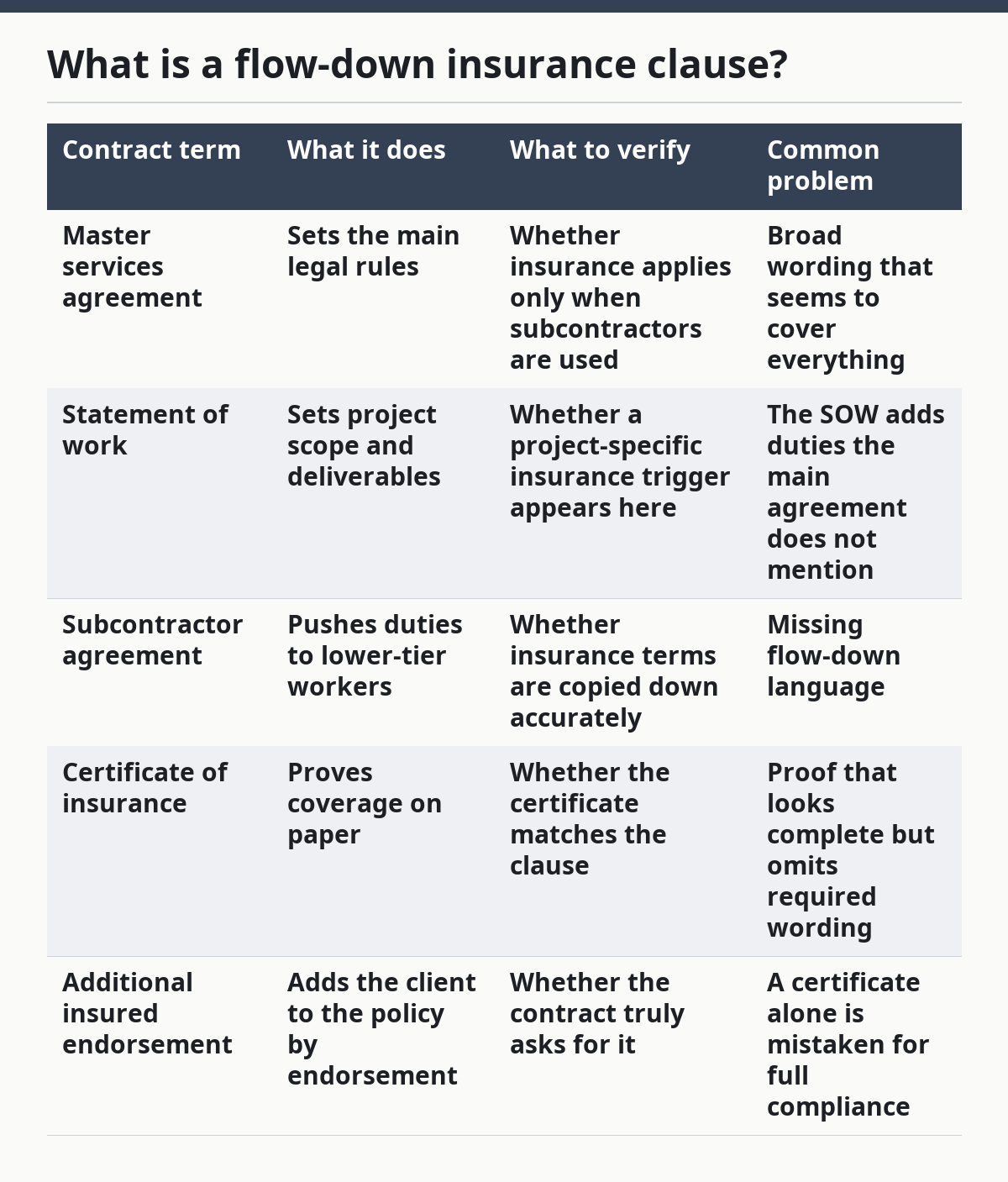
One useful comparison is below:
| Contract term | What it does | What to verify | Common problem |
|---|---|---|---|
| Master services agreement | Sets the main legal rules | Whether insurance applies only when subcontractors are used | Broad wording that seems to cover everything |
| Statement of work | Sets project scope and deliverables | Whether a project-specific insurance trigger appears here | The SOW adds duties the main agreement does not mention |
| Subcontractor agreement | Pushes duties to lower-tier workers | Whether insurance terms are copied down accurately | Missing flow-down language |
| Certificate of insurance | Proves coverage on paper | Whether the certificate matches the clause | Proof that looks complete but omits required wording |
| Additional insured endorsement | Adds the client to the policy by endorsement | Whether the contract truly asks for it | A certificate alone is mistaken for full compliance |
What should I check before signing?
You should check the subcontracting trigger, the pass-through duty, the proof language, and the remedy if you miss the paperwork. A clause that only applies to subcontracted work is narrower than one that applies to “all services,” but it can still create real exposure if it requires specific certificate wording or an additional insured endorsement.

Look for 3 details first. Does the clause say subcontracted work, subcontractor services, or work “performed through others”? Does it require insurance only if you use another party, or does it require evidence at the start of the contract regardless of who performs the labor? Does it ask for a certificate of insurance, or a certificate plus an endorsement?
The most common problem is scope drift. A client may place the clause in the master services agreement, but the statement of work may add a second insurance sentence, or the subcontractor agreement may be silent. If the documents disagree, the safer reading is not to guess; it is to compare all 3 together and resolve the conflict before work begins.
When the clause is narrow, your own direct work may not trigger it. That is helpful, but only if you can prove the subcontracted work limit is real and not implied. An unclear clause is not a green light; it is a cue to ask for a written clarification.
When should I stop and get help?
However, you should stop when the contract’s insurance duty no longer reads like a simple proof-of-coverage check. These are the situations where a quick interpretation is the wrong tool.

The clause asks for an additional insured endorsement: that is more than a certificate and can change the policy relationship — get qualified help before you sign or send proof.
The wording uses “all work,” “any services,” or “through subcontractors and otherwise”: that may extend beyond subcontracted work — do not assume the clause is narrow.
The contract lets the client reject insurance “in its sole discretion”: that gives the client wide control over compliance — get the wording reviewed before you rely on it.
The subcontractor agreement has no insurance clause at all: the pass-through chain is broken — add the missing duty before work starts.
The clause ties insurance to indemnity or defense obligations: the paperwork may affect who pays for what after a claim; consult a qualified professional before you treat it as routine admin. See the IRMI explanation of additional insureds and the CNA overview of additional insured coverage.
The contract bundles multiple documents with conflicting dates or versions: you may be reading the wrong 2-page exhibit — identify the controlling version first.
The consequence of missing one of these points is not just a paperwork issue. It can mean delayed payment, breach claims, or a subcontractor who never agreed to the standard the client expects.
What mistakes do freelancers make here?
Therefore, freelancers usually make 5 mistakes, and each one has a different cost. The fix is usually in the wording, not in guessing what the client “must have meant.”
First, they read a subcontracted-work clause as if it applies to the whole business. That can lead to overreading the contract and creating unnecessary paperwork. The correct alternative is to tie the duty to the specific trigger words in the agreement.
Second, they send a certificate of insurance when the clause asks for additional insured status. That can fail vendor compliance even when the certificate is real. The correct alternative is to match the proof to the exact request in the contract.
Third, they ignore the subcontractor agreement. That leaves the lower-tier worker outside the same insurance chain. The correct alternative is to mirror the duty in the subcontractor paper before the subcontractor starts.
Fourth, they miss a second source of terms in the statement of work. That can create a conflict between the main contract and the project paper. The correct alternative is to read both documents together and treat the tighter wording as the one to clarify, with help from counsel or another qualified professional if the conflict is material.
Fifth, they assume a narrow clause means no documentation is needed. That can still create a payment hold if the client wants proof on file. The correct alternative is to confirm whether the clause asks for proof at signing, before billing, or only after subcontracting begins.
How do I tell whether the clause applies to me?
So, you tell by checking whether the clause is triggered by your use of a subcontractor, not by your freelance status alone. If the wording only turns on subcontracted work, then the insurance duty usually starts when you pass part of the job to another person or firm.
The cleanest way to test the clause is to ask: if I do the work myself, does this language still mention me? If the answer is no, the clause may be limited to subcontracted work. If the answer is yes, the contract may be broader than the heading suggests.
This is where document order matters. The master services agreement often sets the general rule, the statement of work can narrow or expand the project terms, and the subcontractor agreement should carry the same rule down the chain. If all 3 line up, the clause is easier to follow; if they conflict, that is the point to stop.
A narrow clause is not a free pass. It still matters if you plan to bring in a designer, editor, developer, or other specialist for even part of the job. In that case, you need to check the proof wording before the subcontractor starts, not after the invoice is due.
Does subcontracted work mean I need different coverage?
Specifically, subcontracted work can mean different proof or different wording, and in some contracts it may mean a different policy. The clause may ask for a certificate of insurance, an additional insured endorsement, or specific pass-through language in the subcontractor agreement. The important point is what the contract requires for that subcontracted tier, not what a generic template says.
What is a flow-down insurance clause?
A flow-down insurance clause is language that pushes the client’s insurance terms into your subcontractor agreement. It tells you to make the lower-tier contract carry the same or similar duties, often with the same proof standard. If the subcontractor paper does not echo that duty, the flow-down may fail.
How do I tell whether the clause applies to me?
You tell by looking for the trigger words and the scope words in the contract. If the clause only activates when you use a subcontractor, it is limited to that situation; if it also mentions your services generally, it may reach further. When the master services agreement, statement of work, and subcontractor agreement do not match, get the mismatch clarified before work starts.
Drafted with AI; not yet reviewed by a person.
