

Last updated: November 26, 2026
Quick Answer: use 2 coverage parts — general liability insurance and professional liability insurance — when your freelance work includes occasional client training sessions. Freelance training session insurance usually means pairing those coverages, then checking whether your client visits, handouts, and waiver language fit the way you teach. If you only do occasional training as part of freelance work, the main job is to cover two different risks: someone getting hurt during a session, and a client claiming your instruction caused a loss. This is information, not financial advice; a qualified adviser should review your own situation. For a plain-language overview, see the Insurance Information Institute and the U.S. Small Business Administration.
Key takeaways
- Training changes the risk profile because you are not only delivering work, you are also directing people.
- General liability tends to address bodily injury and property damage at the session site.
- Professional liability tends to address bad advice, missed instruction, or a failed handoff.
- Course materials can create separate exposure if a client says a handout or slide deck caused loss.
- A waiver can help set expectations, but it does not replace insurance or remove every claim.
- If your sessions happen at a client site, ask how the policy treats additional insured status; consult a qualified insurance professional before you rely on it.
What counts as freelance training work?
Freelance training work is any project where you teach, demonstrate, or hand off a process to a client or their staff, even if the main job is something else. A one-hour software walkthrough, a half-day onboarding session, or a 2-day workshop can all create instructional risk because you are guiding other people’s actions, not just delivering files.
That matters because a generic freelance policy may be built for design, writing, coding, or consulting, not for live instruction. The practical difference is simple: a typo in a report and a mistake in a live training session can lead to different claims. One may look like professional liability; the other may involve general liability if a participant slips, trips, or is injured during the session.
This page is for freelancers who already know the basics of their business insurance and now need to sort out occasional teaching work. It is not for someone trying to rewrite a client contract, set policy wording, or choose among policy forms line by line. For that larger base, the hub on freelance insurance for solo businesses is the better starting point.
How do I insure freelance training sessions?
You insure freelance training sessions by matching the work to the risk, then checking the policy terms before the session is booked. The core move is to make sure both the training itself and the setting where it happens are inside the scope of the insurance, not just the underlying freelance service.

- List every training task on one page, including live teaching, site visits, Q&A, handoff calls, and slide decks, then mark the setting for each one; verify whether each task happens online, at your office, or at the client site; a problem is any task that has no location or no clear delivery method.
- Check the general liability policy for bodily injury and property damage language, especially if people will gather in one room for 30 minutes or more; verify that client-site training, visitor injury, and damage to the room or equipment are not excluded; a problem is a policy that only covers office-only work or silent errors.
- Check the professional liability policy for instruction-related claims, including bad advice, incomplete guidance, or an alleged failure in the training material; verify that training, coaching, education, or handoff work is treated as covered professional services; a problem is a policy that covers design work but not teaching.
- Review the training materials, including slides, worksheets, checklists, and recorded demos, before you use them; verify that the material matches the service you promised and does not make guarantees you cannot support; a problem is a handout that overpromises results or gives the wrong process.
- Ask the insurer or broker about additional insured status if the client wants to be named on the policy for the session site; verify what proof they need and whether the endorsement applies only to the training date or to the larger project; a problem is assuming a certificate alone changes the policy.
- Use a waiver for participant acknowledgement before the session starts, especially for in-person demonstrations or equipment use; verify that the waiver is clear about voluntary participation and any physical activities; a problem is a waiver that is vague, unsigned, or too broad to match the session.
- Match the limit structure to the work volume, then confirm whether one claim could involve both liability types at once; verify the per-claim structure, any aggregate cap, and whether the same session could trigger more than one coverage part; a problem is discovering too late that one incident can touch both policies.
- Keep attendance records, versioned materials, and follow-up emails for each training session; verify the date, attendees, topic, and file version; a problem is no paper trail when someone says the handoff was different from what was taught.
Therefore, the insurance language matters more than the label on the policy. A freelance writer who teaches a 45-minute client workshop and a freelance developer who trains staff on a system rollout may need similar checks, even though the underlying services are different. The issue is not the job title; it is the mix of instruction, site access, and potential injury.
What should I check before I add training to a policy?
You should check the policy wording, the session setting, and the client’s contract requirements before you treat training as covered work. Those three pieces decide whether a claim is likely to sit inside general liability, professional liability, both, or neither. Because of that, a qualified insurance professional should review any close call.
Start with the service description on the declarations page or policy schedule. If it lists only one type of freelance service, and the training is a recurring part of your work, the insurer may treat the training as outside the insured activity. Then look at exclusions for education, seminars, bodily injury, or third-party premises, because those are common places where the gap shows up. A broker or insurer can help confirm whether the wording fits your exact service mix.
Then look at the session itself. An online training session with no physical attendance has a different exposure from a workshop at a client office, where people can trip over cables, bump into chairs, or damage a projector. The room matters. So does the equipment. A 90-minute training session in a conference room is not the same as a remote screen-share call from your desk.
If the client wants a certificate, a waiver, or additional insured wording, compare those requests with what the policy actually allows. A certificate of insurance is proof of coverage on a date; it is not a promise that every claim will be paid. Additional insured status, when available, is a separate endorsement and may apply only to certain liability claims.
For a plain-language overview of general liability and professional liability, a reliable place to compare the terms is the Insurance Information Institute, and the U.S. Small Business Administration also has general guidance on business insurance basics. Those sources do not replace policy wording, but they help anchor the terminology.
Which insurance parts matter most for training?
General liability and professional liability matter most for training, but they do different jobs. General liability is the part that usually addresses bodily injury and property damage. Professional liability is the part that usually addresses claims about the quality of your advice, instruction, or service.
| Coverage part | What it usually responds to | Typical training example | Main limit |
|---|---|---|---|
| General liability | Bodily injury or property damage | A participant falls in the training room or damages client property | Depends on policy |
| Professional liability | Instructional error, bad advice, missed handoff | A client says your training caused a bad process or loss | Depends on policy |
| Waiver | Risk acknowledgement, not insurance | A participant signs before hands-on practice | Not a coverage limit |
| Additional insured | Client’s request to be named for certain claims | A client wants protection tied to the training site | Set by endorsement |
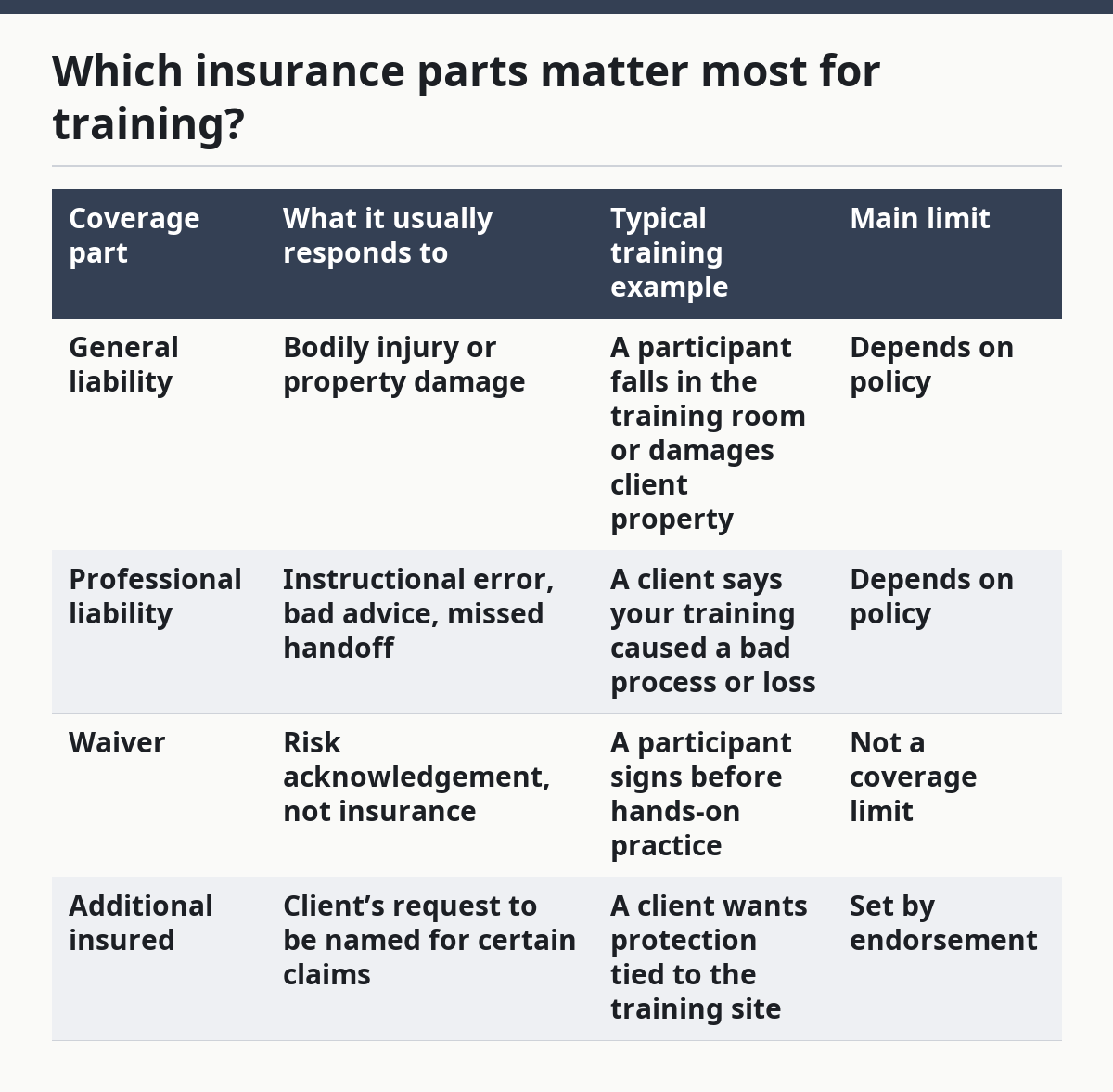
A waiver helps document that the client and participants understood the session had some risk, especially if the training includes walking tours, tools, or live equipment. It does not wipe away all liability, and it does not replace insurance. A waiver is a paper shield, not a policy.
Training materials matter too. Slides, PDFs, templates, and recorded demos can become evidence in a claim if a client says the material was incomplete or wrong. That is why professional liability should not be treated as a “consulting only” policy if your work includes instruction. If your service mix includes both advice and live teaching, ask a qualified insurance professional whether the wording fits both.
When should I stop and get qualified help?
You should stop treating this as a simple policy check when the training work starts to change the risk in ways a normal freelance policy may not fit. In those situations, the issue is not just coverage wording; it may be the structure of the work itself.
The session includes physical demonstrations or equipment use: This raises the chance of bodily injury or property damage — ask for a review of general liability terms before you run the session.
The client wants you on-site for more than a short handoff: A longer site visit creates more exposure to slip, trip, and damage claims — check whether the policy treats premises work differently.
The training materials are client-facing and promise a result: That can turn a simple handout into a source of professional liability — have the wording reviewed before you circulate it.
The client requires additional insured wording: That request changes the insurance setup, not just the paperwork — verify the endorsement before you agree to the session.
The training is now a repeat service rather than occasional work: A repeating pattern can change how the insurer sees the business — ask whether the policy should reflect education or instruction as a regular activity.
The session is tied to a contract with strict insurance terms: The policy may not match the contract even if the work feels routine — pause until the language is checked against the insurance documents.
This is the point where a broker or other qualified insurance professional is useful, because the problem is no longer “Do I have insurance?” It is “Does my policy match the work I am now doing?” That difference can be expensive if ignored.
What mistakes do freelancers make with training coverage?
The most common mistake is assuming that a training session is covered because the main freelance service is covered. That can leave a gap when the claim is about the instruction, not the deliverable. The correct move is to read the service description and the exclusions before the first client lesson.
Another mistake is using a waiver as if it were a substitute for insurance. A waiver may help with expectations, but it does not pay a claim and does not stop every lawsuit. The safer alternative is to treat the waiver as one layer, with the policy doing the actual risk transfer.
A third mistake is forgetting the site risk. A client office can look harmless until someone trips over a bag, a cable, or a chair leg during setup. General liability is the part that usually matters there, not just professional liability.
A fourth mistake is handing out training materials without checking whether they reflect the exact session. A slide deck from last month can create a mismatch if the process changed. The fix is simple: date the material, keep versions, and retire anything that no longer matches current practice.
A fifth mistake is saying yes to additional insured requests without checking the endorsement. That can create a false sense of protection. The better path is to confirm the policy language first, then accept the request only if the coverage really fits.
When does standard guidance change?
Standard guidance changes when the training is tied to a higher-risk setting, a larger audience, or a more complex service mix. A 15-minute screen-share is not the same as a 2-day in-person workshop with equipment, visitors, and client staff moving through the room.

It also changes when your work crosses from explanation into operational direction. If you are only teaching a process, the claim profile may stay close to professional liability. If you are supervising hands-on work, the injury and property damage side grows faster, and general liability becomes harder to ignore.
If your training is recorded, reused, or sold later as a material asset, the legal and insurance questions multiply. A recording can keep circulating long after the live session ends, which means the exposure does not end when the meeting closes. That is a reason to check the policy terms before the recording goes out.
How do I tell if the setup is working?
The setup is working when the policy matches the work, the client knows what you are doing, and the records show the training was planned rather than improvised. A good result is not “I hope the insurer understands.” It is “I can point to the policy section, the waiver, the materials, and the session record.”
A practical test is simple. If a participant trips, if a slide deck is challenged, or if the client asks for proof of coverage, you should be able to trace the issue to the right insurance part within minutes. If you cannot, the setup is too vague.
That is why freelance training session insurance is less about buying a special product and more about making sure the teaching piece is visible to the policy. General liability, professional liability, training materials, waiver language, and additional insured status all matter because they answer different questions after a claim.
Does teaching a client count as a different service?
It can, depending on how the policy describes your work. If training is occasional and clearly tied to the main freelance project, it may still fit under the same service class. If training becomes a distinct offer with its own materials, site visits, or live instruction, the insurer may view it differently.
Do training sessions increase liability risk?
Yes, because they add two extra exposure points: injury during the session and claims about the quality of the instruction. A 60-minute client walkthrough can still create a bodily injury claim if it happens on-site, and a bad handoff can still lead to a professional liability claim. The risk changes with the setting and the level of instruction.
Should I separate training from project work in my policy?
I should only separate it if the policy or a qualified insurance professional says the split matters for my own setup. Sometimes one policy can cover both the project and the occasional session; sometimes the training needs to be shown more clearly as part of the insured work. The right answer depends on the wording, not the job title.
Drafted with AI; not yet reviewed by a person.
