
Last updated: November 26, 2026
Quick answer: most freelance voice actors should start with 3 core coverages — professional liability insurance, media liability insurance, and general liability insurance — and add home studio equipment cover if the gear is business-critical. This article uses “freelance voice actors” as the main keyword, but it is information, not financial advice; rates, limits, and rules differ by country and change often, so a qualified adviser should check the reader’s own situation. For a general starting point, see the U.S. Small Business Administration’s business-insurance guidance: https://www.sba.gov/business-guide/launch-your-business/get-business-insurance, and the NAIC consumer resources on insurance basics: https://content.naic.org/consumer.
Key takeaways
- Voiceover work brings 2 main risk buckets: client disputes over the finished audio and physical accidents tied to sessions or a home studio.
- Professional liability insurance and media liability insurance can respond to claims about mistakes in the service or in the recorded content.
- General liability insurance is about third-party injury or property damage, not the audio file itself.
- A home studio can create its own gap if computers, mics, interfaces, or acoustic treatment are damaged, stolen, or cause a loss; a qualified adviser can confirm whether business property cover is needed.
- The right setup depends on what is in the contract, how the recordings are used, and whether the actor records at home, in a rented studio, or both.
What insurance do freelance voice actors need?
Freelance voice actors usually need 3 core coverages: professional liability insurance, media liability insurance, and general liability insurance. Those cover different problems, and confusing them is where many people get caught.
Professional liability insurance is often called errors and omissions insurance, or E&O. It is meant for claims that the service was wrong, late, incomplete, or failed to meet a professional standard. Media liability insurance is narrower and more specific to content work; it can matter when a client says the audio created a rights problem, a defamation issue, or another publication-related claim. General liability insurance covers third-party bodily injury or property damage, such as a client tripping over a cable at a recording session.
For a freelancer who only records simple scripts and delivers files, general liability alone is rarely enough. For someone whose work is reused in ads, online campaigns, courses, or other media, media liability becomes the coverage that tends to matter most. A basic home studio can also create an equipment gap that liability insurance does not fill.
The U.S. Small Business Administration’s business-insurance guidance is a useful starting point for the general idea of matching cover to risk: https://www.sba.gov/business-guide/launch-your-business/get-business-insurance. The National Association of Insurance Commissioners is another useful reference point for understanding policy basics, even though the exact cover names and rules vary by market.
Which risks are unique to voiceover work?
Voiceover work creates risk around usage rights, client revisions, and the final recorded content, not just around the microphone. That is why generic business insurance often leaves holes.
A client may dispute how long it may use the audio, where it may appear, or whether the recording was cleared for a certain campaign. Those are contract and content issues, and they are not the same as a broken chair or a spilled drink. A script can also be revised after recording, which can turn a simple pickup session into a claim about missed timing, added labor, or a delivery that no longer fits the brief.
The recorded file itself can also trigger a claim. If a script includes a name, slogan, or reference that later causes a dispute, the issue may be tied to the published media rather than the act of recording. That is the point at which media liability insurance can be relevant. A generic liability policy may not be built for that kind of claim.
A home studio adds another layer. A power surge, equipment theft, or a client visit gone wrong is a different problem from a disputed voice file, and one policy usually does not solve both. This is why a voice actor should read the policy wording, not just the headline name on the quote.
How do the main policy types compare?
The main policy types compare by what they protect, who they suit, and where they fall short. A quick comparison helps separate file disputes from physical losses.
| Policy type | What it usually addresses | What it does not usually address | Best fit for |
|---|---|---|---|
| Professional liability insurance | Errors in the service, missed instructions, late delivery, claims tied to professional work | Bodily injury, property damage, and many content-specific claims | Freelancers who deliver voiceover as a service |
| Media liability insurance | Claims tied to recorded content, publication, usage rights, and some defamation-style disputes | Damage to studio gear, injuries, and every contract dispute | Voice actors whose work is used in ads, courses, or other media |
| General liability insurance | Third-party injury or property damage during business activity | Audio disputes, delivery failures, and content claims | Freelancers who meet clients, host sessions, or work in a space where third parties are present |
| Equipment cover or property cover | Mics, interfaces, computers, and other studio gear | Liability claims and contract disputes | Home-studio users whose gear would be costly to replace |
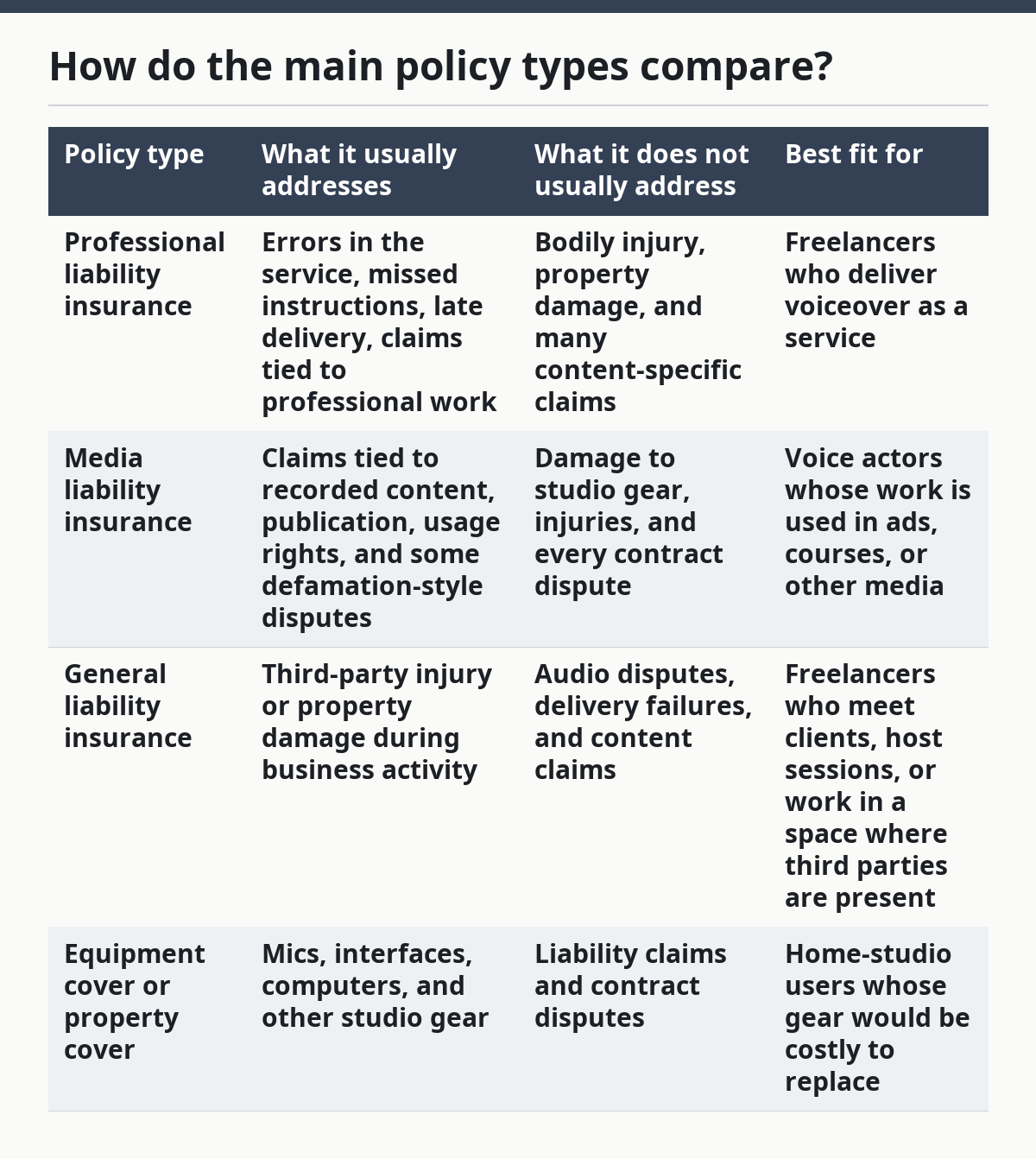
The table shows the main trade-off: a policy that looks broad may still miss the exact problem that a voice actor faces. Media liability is the one that a generic business owner may never need, but a freelance voice actor often should understand first. General liability is still useful, yet it is not a substitute for content coverage.
That distinction matters because a dispute over usage rights is not the same as a broken preamp. One is about the recorded work; the other is about the physical tool that made it.
How do I set up the right cover step by step?
The right cover starts with the work you actually do, then checks each policy against that work. A voice actor should treat this like a 7-step review, not a one-question purchase, and a qualified adviser can help if the wording is unclear.
- List every service you sell. Write down at least 3 items that you actually sell, and verify whether each one creates a content risk, a delivery risk, or a physical risk. A problem shows up if the policy only describes “business services” and never mentions audio recordings or media use.
- Gather the contract language before shopping. Pull the clause on usage rights, revisions, retakes, and delivery deadlines from the last 2 or 3 jobs. Verify whether any term shifts responsibility for rights clearance or content approval to the voice actor. A problem shows up if the policy excludes the kind of dispute the contract can create.
- Check whether media liability is included or separate. Read the declarations page and the wording that explains what the policy covers. Verify the phrases tied to publication, advertising, or recorded content. A problem shows up if the policy only talks about bodily injury and property damage.
- Confirm how professional liability is defined. Look for wording about errors, omissions, failure to deliver, or failure to meet professional standards. Verify whether client revisions or missed instructions fall inside the definition. A problem shows up if the policy excludes work that is “creative,” “media,” or “advertising” without explanation.
- Check the home studio line item. List the value of the microphone, interface, computer, and any other 4 major gear items you rely on. Verify whether the policy covers theft, accidental damage, or power-related loss. A problem shows up if the policy covers liability only and leaves the studio itself exposed.
- Match the policy territory to where the work is done. Confirm whether the work is recorded at home, in a rented room, or at a client site. Verify whether the policy applies in each location. A problem shows up if the policy is tied to one address and the work happens in more than one place.
- Ask for the exact exclusions in writing. Request the exclusions page and the definition pages together. Verify whether there is an exclusion for defamation, copyright, trademark, or content used after delivery. A problem shows up if the policy language is too broad to tell what is actually covered.
- Recheck the policy after a change in work. If the voice actor starts doing more ads, more retakes, or more direct-to-client recording, review the cover again within 30 days. Verify that the cover still fits the new risk. A problem shows up if the business has grown but the policy has not changed.
Does a home studio change the cover you need?
Yes, a home studio can change the cover you need because it adds property risk and sometimes visitor risk. The voice actor is no longer only selling a recording service; the business now depends on physical equipment and a recording space.
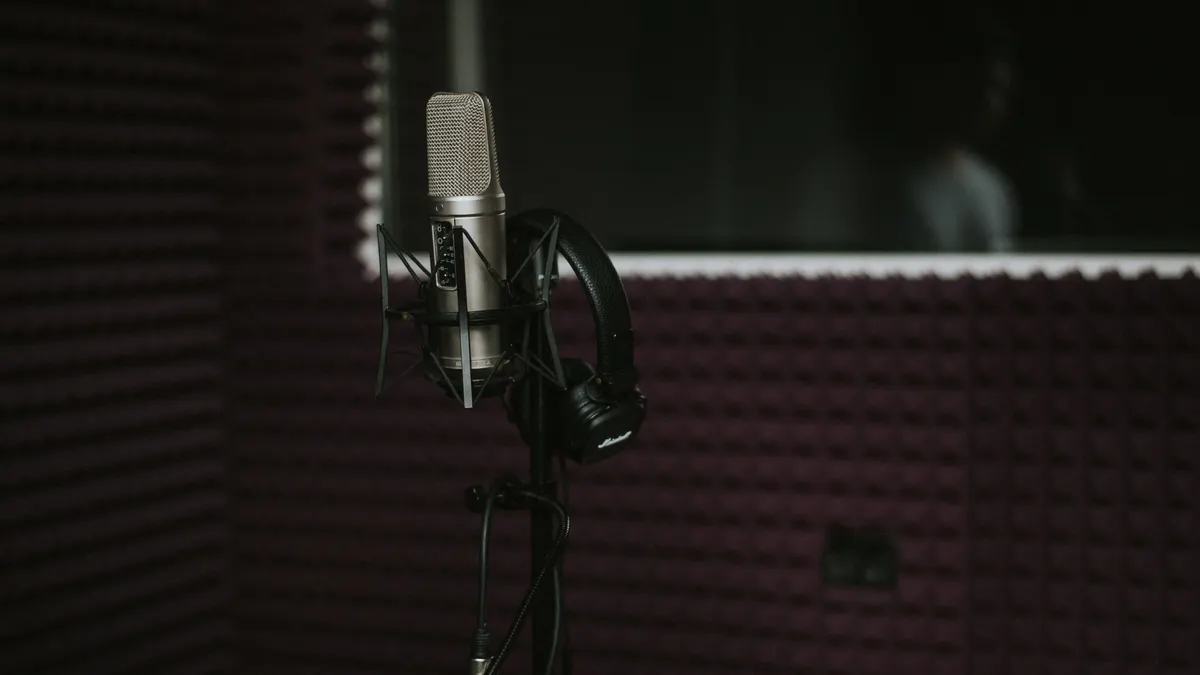
A home studio raises questions about microphones, computers, interfaces, lighting, acoustic panels, and storage. If one of those items is stolen or damaged, liability insurance alone will not fix the loss. That is why some freelancers look for equipment cover or a property policy element that addresses business gear, and a qualified adviser can help check whether a casual home setup is still covered.
The studio setup also matters if a client, contractor, or courier enters the space. A general liability policy can matter if someone is injured or if property is damaged during a session. That is separate from the voiceover file itself. A common mistake is to think “I work from home, so personal insurance covers it.” That is not something to assume without checking the policy wording.
A home studio does not automatically mean the cover must be complex. It does mean the freelancer should separate 3 buckets: the work product, the physical gear, and the people who may come into the space.
When should a voice actor stop and get qualified help?
A voice actor should stop trying to fit the risk into a generic policy when the contract, the distribution channel, or the studio setup creates claims that are hard to separate. That is where a qualified insurance broker or adviser can check the wording against the actual work.
The contract includes indemnity language: that can shift a claim in a way a standard policy may not track — get the wording reviewed before relying on the policy.
The work is used in paid advertising or wide release: the publication risk is bigger and the media liability question matters more — compare the policy definitions carefully.
The client demands proof of cover before work starts: the certificate may need specific wording or limits — ask for a precise review rather than guessing.
The home studio holds expensive gear: the loss exposure can be higher than a casual freelancer setup, so it is worth checking whether the policy treats gear as business property.
The work crosses borders or uses foreign clients: territory, law, and claim handling can change — confirm where the policy applies before accepting the job.
This is the point where a blanket answer stops being useful. The wrong policy can leave a gap that only shows up after a claim.
What mistakes do voice actors make with insurance?
The most common mistake is buying a policy that protects the room, not the recording. That leaves usage-rights disputes, retake disputes, and content claims exposed. The fix is to look for the parts of the policy that talk about professional liability or media liability, not just premises risk.
A second mistake is assuming general liability covers everything. It does not. General liability is useful for injury and property damage, but it is usually not built to answer whether a script, voice recording, or published clip caused a dispute.
A third mistake is ignoring revisions and retakes. A voice actor who offers 2 rounds of revisions in a contract has a different risk from one who only records a final script. If the policy does not address delivery errors or service mistakes, the freelancer may be underinsured for the real workflow.
A fourth mistake is treating home studio gear as personal household property. That can leave business equipment underprotected or improperly described. The alternative is to check whether the policy distinguishes business equipment from personal items and whether the computer, mic, and interface are listed or covered as a group. A qualified adviser can help confirm the right classification.
A fifth mistake is never rereading exclusions. An exclusion for copyright, trademark, defamation, or publication-related loss can change the whole answer. The right alternative is to read the exclusions before the premium, not after the claim.
What should a first-time buyer check on the policy?
A first-time buyer should check 5 things on the declarations page and the wording pages: the policy name, the covered activity, the exclusions, the location, and the effective dates. Those details matter more than the marketing label.
The policy name should match the real risk, not just a generic business label. The covered activity should mention voiceover, media work, or professional services in a way that matches the actual job. The exclusions should be read line by line for publication, content, intellectual property, and equipment gaps.
The location matters if the freelancer works from a home studio, a rented booth, or a client site. The effective dates matter because a policy that starts after a job begins may not help with a claim tied to that job. A quick 1-page certificate is not enough if it does not match the wording behind it.
If the answer is unclear in any of those 5 areas, the policy may not fit the business yet. That is the point to pause and ask for a review of the wording itself.
Do freelance voice actors need media liability insurance?
Freelance voice actors often do need media liability insurance when their recordings are used in ads, online video, courses, or other published content. It is the coverage that is most closely tied to claims about the audio itself, not just the recording session. A plain liability policy may not answer that kind of dispute.
What insurance covers voiceover usage disputes?
Media liability insurance is the coverage most likely to address voiceover usage disputes. Those disputes can involve where the audio is used, how long it may be used, or whether the recording created a content-related claim. A professional liability policy may help with some service errors, but it is not always the right fit for publication issues.
Does a voice actor need coverage for home studio work?
A voice actor may need coverage for home studio work because the studio brings equipment and property risk into the business. General liability does not usually cover damaged microphones or computers, and it does not protect against every studio-related problem. A policy review should separate business gear, client visits, and the recording work itself.
Drafted with AI; not yet reviewed by a person.
