
Last updated: November 26, 2026
Quick answer: most freelance animators usually need 3 coverages to start: professional liability insurance, media liability insurance, and equipment coverage; many also need inland marine insurance when they move gear between home, studio, and client sites. The right mix depends on how your animation services are delivered, how much client work you handle, and whether your job involves digital assets, revisions, or file-based production. This is information, not financial advice, so a qualified adviser should be consulted for your own situation. For a baseline on business insurance, see the U.S. Small Business Administration and NAIC.
Key takeaways
- Animation work creates two main risk buckets: client claims about your work and claims tied to files, rights, and use of content.
- Professional liability insurance is about alleged mistakes in your service; media liability insurance is about content and rights issues.
- Equipment coverage matters if your laptop, tablet, drives, or other gear are part of your income.
- Inland marine insurance is often used for portable tools and gear that move with you.
- Insurance prices are based on rating plans that may vary by state, and the contract guarantees the rating formula, according to State Farm and the definition of insurance on Wikipedia.
- If you are unsure how your contracts, rights clauses, or asset handoffs work, get qualified help before you rely on a policy guess.
What risks does a freelance animator face?
Freelance animators face claims about work quality, rights to content, and damage or loss to the tools used to produce the work. A simple animation job can involve storyboards, source files, renders, sound sync, revisions, and final delivery, and each step creates a different kind of exposure.
The most common mistake is treating every problem as if one policy type will fix it; if you are unsure, consult a qualified insurance professional before you rely on a policy guess. A late render, a disputed edit, a copyright complaint, and a broken tablet are not the same event, so they do not point to the same coverage. That is why a freelance animator usually looks at more than one policy line.
A useful way to think about it is by where the loss starts. If the problem begins with your service, professional liability insurance is the first place to look. If the problem begins with the content itself or how it is published, media liability insurance may matter more. If the problem begins with a stolen or damaged laptop, monitor, drive, or camera gear used in production, equipment coverage or inland marine insurance is the better fit.
This page is for solo freelance animators who already know they work on client projects and store digital assets of some kind. It is not a guide for choosing software, pricing jobs, or sorting out a contract clause about confidentiality breaches. Those are separate problems with separate answers.
What insurance do freelance animators need?
Freelance animators usually need professional liability insurance, media liability insurance, and some form of equipment coverage, with inland marine insurance often used when gear moves off-site. The exact mix depends on whether your work is mostly service-based, content-based, or equipment-heavy.
Here is the short version of what each one is for:
| Coverage type | What it is for | Why an animator might need it | Common gap |
|---|---|---|---|
| Professional liability insurance | Claims that your service caused a financial loss | Missed specs, revision disputes, late delivery, or work that fails to meet the brief | It may not focus on rights or publication issues |
| Media liability insurance | Claims tied to published content, digital assets, or rights issues | Copyright claims, asset licensing disputes, or content errors in delivered animation services | It may not cover physical equipment |
| Equipment coverage | Loss or damage to production tools | Laptop, tablet, drive, display, or similar gear used in daily work | It may not respond to content claims |
| Inland marine insurance | Portable business property that travels | Gear taken between home, studio, and client site | It is about moveable property, not client disputes |
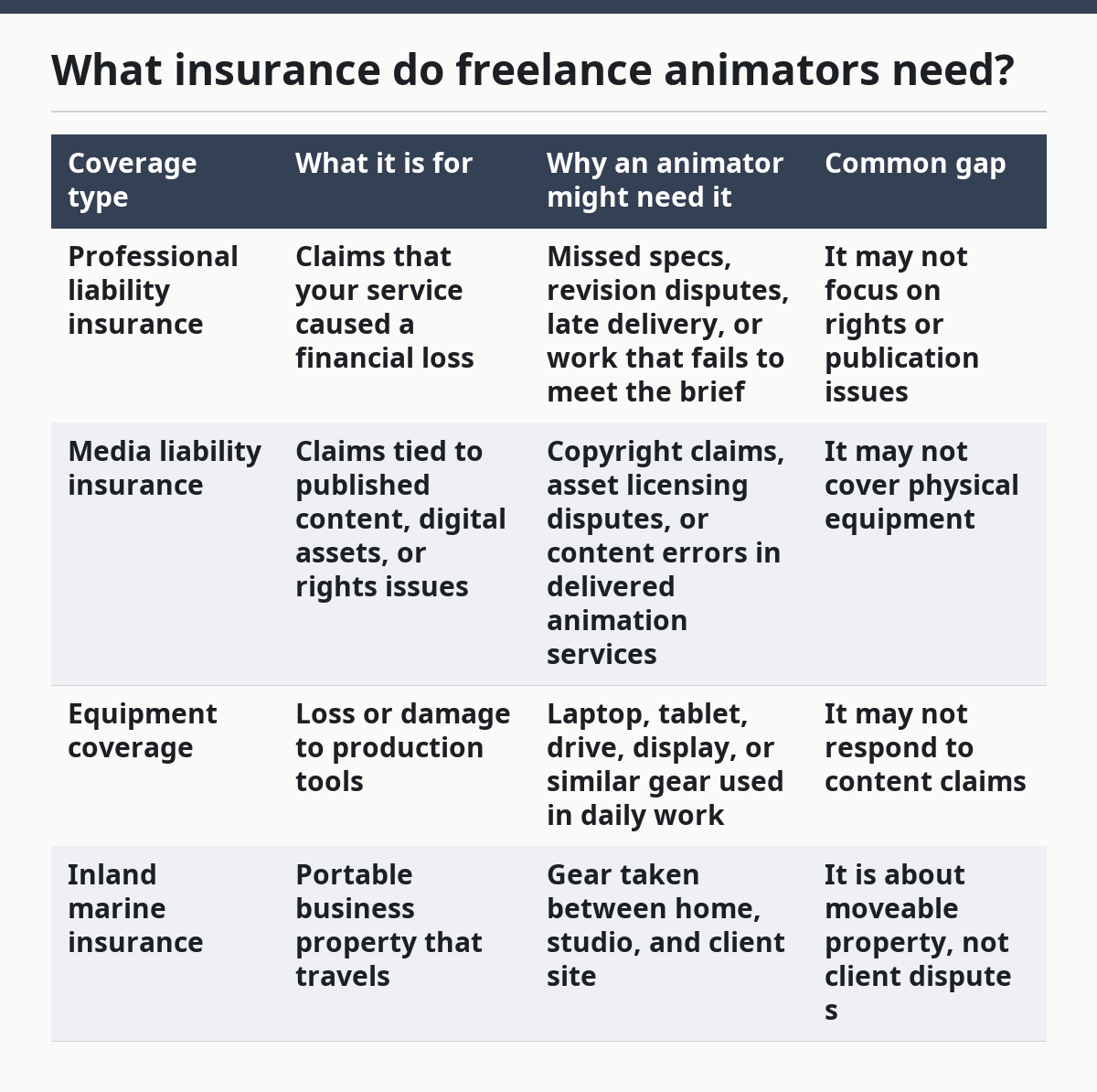
The plain rule is this: if your work only fails in the eyes of the client, professional liability is usually the first line to understand. If the issue is that someone says your animation used material you did not have the right to use, media liability is the line to examine. If the issue is a cracked screen or failed drive, equipment coverage or inland marine insurance is the issue.
A generic article often stops there and misses the real trade-off. Some policies are better at service claims, while others are better at publication and rights claims. That means a freelancer who animates explainer videos, social clips, or branded motion graphics may need a different emphasis than someone doing internal-only edits or one-off design tasks.
How do revisions and digital assets change the risk?
Revisions and digital assets change the risk because they create more points where a client can say the work missed the brief, used the wrong file, or crossed a rights line. Animation services often move through several versions before final delivery, and each version can become part of a later dispute.
The first issue is scope. If a project includes several rounds of client revisions, the chance of a disagreement over what was promised goes up. The second issue is file handling. Source files, exported clips, reference files, and asset libraries can be copied, overwritten, mislabeled, or reused in ways that create a claim.
The third issue is licensing. Animation often depends on fonts, stock elements, textures, music, or other digital assets. If a client later says an element was not licensed for the actual use, that can turn into a rights dispute instead of a simple service complaint. Media liability insurance is the category most likely to come up when the dispute is about the content itself rather than the workmanship.
A helpful habit is to separate your files into three groups: working files, delivered files, and third-party assets. That does not replace insurance, but it makes it easier to see where the risk sits. When a claim starts, that distinction matters because a policy may respond differently depending on whether the problem came from your own original work, a licensed asset, or a published final product.
How do you compare the main coverages?
You compare them by asking what starts the claim, not by asking which one sounds broader. That is the practical test freelance animators should use before they decide which policy conversation comes next.
| Question to ask | Professional liability insurance | Media liability insurance | Equipment coverage / inland marine |
|---|---|---|---|
| Did the client say the service was wrong? | Often the most relevant | Sometimes relevant | No |
| Did the dispute involve copyright or licensing? | Sometimes relevant, but usually not the best fit | Often the most relevant | No |
| Was the problem a lost or damaged laptop or tablet? | No | No | Yes |
| Did the issue involve revisions, missed specs, or delivery problems? | Often relevant | Sometimes relevant | No |
| Did the issue come from a published animation file or digital asset? | Sometimes | Often | No |
The main drawback of a comparison table is that it can make coverage look cleaner than it is. Real claims can overlap. A project dispute may include both a service complaint and a rights complaint, so the policy language matters. That is why the contract and the rating formula matter too: according to Wikipedia, the insurance contract guarantees the rating formula, and insurance prices are based on rating plans that may vary by state, according to State Farm.
That last point matters more than many freelancers expect. Insurance companies are rated by agencies such as AM Best, and independent rating agencies provide information and rate insurers’ financial viability, according to Wikipedia. A freelance animator does not need to become an insurance analyst, but it helps to know that the price is not random and the company’s financial strength is part of the picture.
What should you check before you apply?
You should check what kind of work you actually do, what files you hand over, and what gear you rely on before you ask for quotes or read a policy. A freelancer who animates only from a home setup with one laptop has a different risk profile from someone who moves drives, tablets, and monitors between locations.
Start with your work history over the last 12 months, or your expected work pattern if you are new. Count the kinds of jobs you handle: short social clips, longer motion pieces, explainer videos, edits, or design-heavy animation services. Then note whether you deliver only final exports or also source files, working files, and reusable digital assets.
Next, list the tools that would stop your work if they were damaged. That might include a laptop, tablet, storage drive, or external monitor. If those items travel, inland marine insurance may matter more because it is built around portable business property.
Then review the rights side. Look at whether your projects use stock footage, music, fonts, templates, or client-supplied assets. A file-based production workflow can create a rights dispute even when the animation itself is technically good. That is where media liability insurance is more likely to matter.
Finally, ask how claims are framed in your contracts. If your agreement focuses on deliverables, revisions, and ownership of files, that can signal where the biggest exposure sits. If you do not know how to read that language, get qualified help before you decide what coverage to ignore. For a simple checklist, the SBA’s business insurance guide is a useful starting point.
When should you stop and get qualified help?
You should stop and get qualified help when the policy question turns into a contract question, a rights question, or a state-specific pricing question. This is a money matter, and the wrong guess can leave a gap between what you think you bought and what a claim actually needs.
Your projects involve licensing, reuse, or publication rights: That means the claim may be about content, not workmanship — get help matching the exposure to media liability insurance.
Your clients require special wording about revisions or ownership of files: That means the insurance question depends on contract language — do not assume a standard policy will match it.
Your work moves between home, studio, and client locations: That means portable tools are in play — ask how inland marine insurance or equipment coverage is handled.
Your gear is the only way you earn income: That means a loss can stop production, not just delay it — check the equipment side before you file anything under a service policy.
You work across state lines or live somewhere with different rating plans: That means price and policy structure can change by state — compare carefully instead of assuming one setup fits everywhere.
You are unsure whether a claim is about the animation itself or the file delivery: That means the boundary between professional liability and media liability is blurry — ask a qualified adviser to map it.
The wrong move is to treat all of these as if a single policy label settles them. It does not. The right move is to identify the loss first, then see which coverage category is built for that kind of loss.
What mistakes do freelance animators make?
Freelance animators usually make five mistakes: they buy for the gear and forget the content, they buy for the content and forget the gear, they ignore revisions, they ignore file handoff risk, or they assume all policies work the same way.
The first mistake is focusing only on equipment. That leaves a freelancer exposed if a client says the animation missed the brief or created a rights problem. The better alternative is to think in two lanes: service risk and content risk.
The second mistake is the reverse. A freelancer may buy coverage that addresses media or publication issues but still leave a laptop, tablet, or drive exposed. The better alternative is to check whether equipment coverage or inland marine insurance belongs in the picture.
The third mistake is treating revisions as harmless admin. Revisions can become the place where scope changes, deadlines slip, and disputes start. The better alternative is to assume revision cycles are part of the insured work environment, not a side note, and to ask a qualified adviser if the policy language fits that workflow.
The fourth mistake is overlooking the file trail. Source files, exports, and digital assets are the evidence of the work. The better alternative is to store them in a way that makes ownership and version history easier to explain if a claim ever arises.
The fifth mistake is choosing by premium alone. Insurance prices are based on rating plans that may vary by state, and the contract guarantees the rating formula, according to the sources named above. That means the lowest-priced option may not fit your kind of animation work.
What does a good setup look like?
A good setup is one where your coverage matches the way you actually earn money, the way you hand off files, and the way your gear moves. For many freelance animators, that means understanding professional liability insurance first, adding media liability insurance where rights and publication risk exist, and checking equipment coverage or inland marine insurance for the tools that keep production going.
It also means knowing what the policy is not for. If the only problem is a broken mouse, insurance may be the wrong tool. If the problem is a client saying your animation used the wrong asset, equipment coverage will not solve it. The categories have different jobs.
A good setup also respects the fact that insurance prices are not fixed in stone. They are based on rating plans that may vary by state, according to State Farm, and the insurance contract guarantees the rating formula, according to Wikipedia. That makes the written policy and the rating structure part of the decision, not paperwork to ignore.
For a broader view of how solo businesses handle core coverages, the hub on freelancer insurance for solo businesses can help frame the rest of the decision.
Do freelance animators need media liability insurance?
Freelance animators often do need media liability insurance when their work involves published content, digital assets, or rights-sensitive material. It is the coverage most likely to matter when a claim is about copyright, licensing, or the final animation itself rather than a service mistake.
What insurance covers animation file disputes?
Animation file disputes are usually connected to professional liability insurance or media liability insurance, depending on what the dispute is really about. If the issue is a service failure, the professional line is more likely to matter; if the issue is a rights or content problem, media liability is the better fit.
Does animation work need equipment coverage?
Animation work often needs equipment coverage if your gear is essential to your income and could be lost, damaged, or stolen. If your laptop, tablet, drives, or display are part of your daily production, inland marine insurance may also come into play when that gear travels.
Drafted with AI; not yet reviewed by a person.
