
Last updated: November 28, 2026
Quick answer: general liability for freelancers can cover client-site accidents, but only when a third party has bodily injury or property damage; it does not cover every on-site loss. In practice, the policy is usually about third-party bodily injury and third-party property damage, and the policy language decides the outcome. For general liability for freelancers: what client-site accidents it covers, a licensed insurance professional should review the form if the site, the item, or the claim is unclear. SBA, III
Key takeaways
- General liability is about harm to other people and their property, not mistakes in your advice or finished work.
- A client-site claim often starts with a slip, trip, fall, or broken item.
- Coverage depends on the policy wording, exclusions, and where the accident happened.
- Rented rooms, shared offices, and off-site meetings can create the same kind of third-party claim as a client headquarters.
- If the claim involves your professional judgment, a contract dispute, or your own injury, general liability is usually the wrong bucket.
This article is information, not financial advice. Insurance terms vary by country, insurer, and policy form, so a qualified adviser should be consulted for your own situation.
What does general liability cover at a client site?
General liability covers some third-party accidents at a client site, but only when the loss fits the policy’s bodily injury or property damage rules. In plain terms, it is meant for harm to someone else or damage to someone else’s things, not for your own medical bills or a dispute over your work quality. For example, the Insurance Information Institute explains that general liability is designed for third-party injury and property damage claims. (Source: III)

The two parts that matter most here are simple to define. Bodily injury means physical harm to a person, such as a fall, cut, or other injury. Property damage means physical damage to a tangible item, such as a laptop, fixture, or office surface.
A common example is a client visiting your workstation and slipping on a cable you left across a walkway. Another is a camera bag or laptop knocking over a client-owned object during a meeting. These are the kinds of claims general liability is built to handle, subject to the policy terms.
That said, the policy is not a blank cheque. Many policies exclude damage to your own tools, damage to property in your care or control, and losses tied to professional advice or errors. A generic article often skips that point, which is how freelancers end up assuming too much coverage from a policy that was never meant to do the whole job. For a quick cross-check, the Freelancer Liability Insurance hub can help separate general liability from professional liability.
Which client accidents are usually covered?
General liability usually covers accidents where a third party is hurt or their property is physically damaged during ordinary client-facing work. The setting does not have to be a traditional office; the same idea can apply at a rented conference room, a shared studio, or an off-site meeting. A 2024 Hiscox survey found many small businesses still face liability risks outside a permanent office, which is why location alone does not decide coverage.
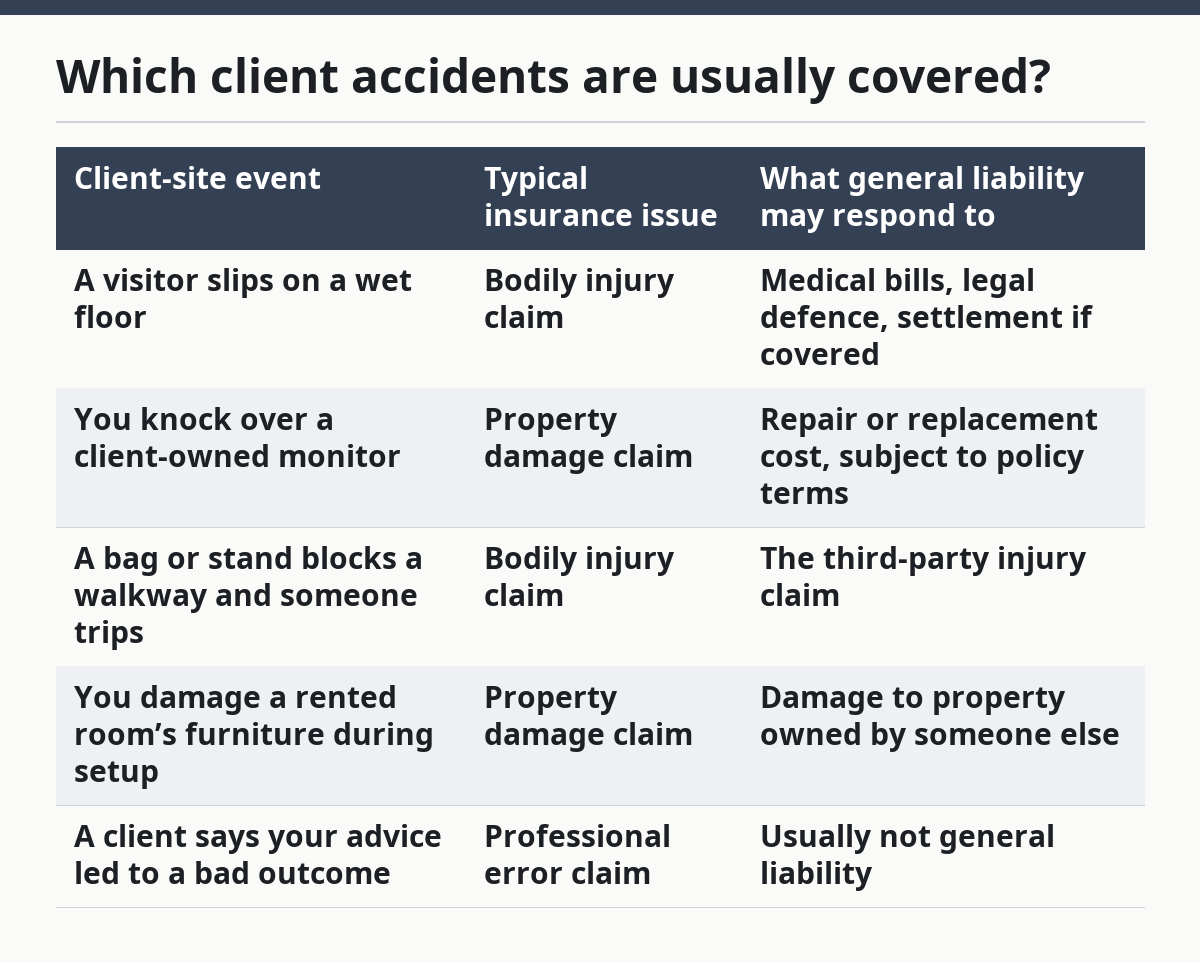
Here is the basic pattern, with the insurance bucket each event tends to fall into:
| Client-site event | Typical insurance issue | What general liability may respond to |
|---|---|---|
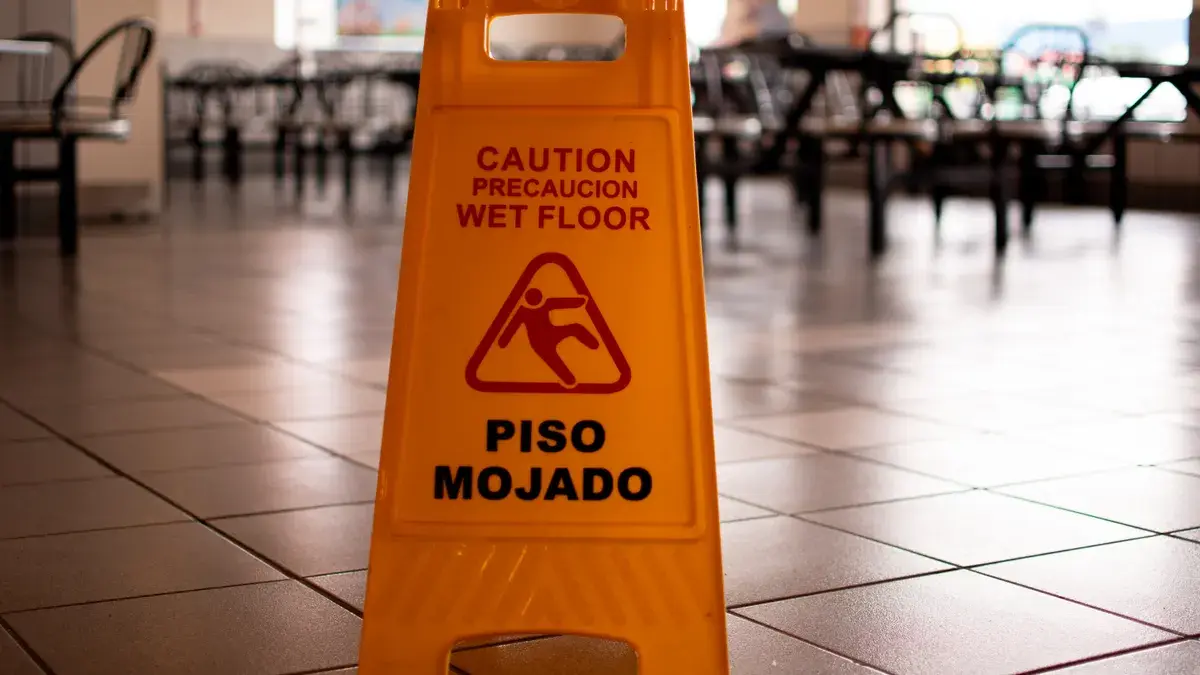
| A visitor slips on a wet floor | Bodily injury claim | Medical bills, legal defence, settlement if covered |
| You knock over a client-owned monitor | Property damage claim | Repair or replacement cost, subject to policy terms |
| A bag or stand blocks a walkway and someone trips | Bodily injury claim | The third-party injury claim |
| You damage a rented room’s furniture during setup | Property damage claim | Damage to property owned by someone else |
| A client says your advice led to a bad outcome | Professional error claim | Usually not general liability |
The detail that matters is whether the accident caused physical injury or physical damage. If the complaint is about delayed work, a bad recommendation, or a missed deadline, the claim often points away from general liability and toward a different policy type.
The site context also matters. A rented space may be treated differently from a client’s own premises, and some policies treat premises you rent temporarily as part of the insured location for the day. Still, “covered” and “likely covered” are not the same thing. The policy wording controls the result, not the label on the room. Because of that, a broker or adviser should review the policy before you assume the room is covered.
For a broader overview of how liability cover fits together, the Freelancer Liability Insurance hub should sit alongside this page, not replace it.
How does a claim start?
A client-site claim starts when a third party says your presence or physical setup caused injury or damage, and the claim is then reported to the insurer. That sounds simple, but the details decide whether the loss fits the policy.
Follow this basic process when an accident happens:
- Stop the hazard right away. Move the cable, clean the spill, or clear the blocked path within minutes if it is safe to do so. Verify that no one else is still at risk. If the danger remains in place, the incident can worsen and the claim can grow.
- Check for injury and damage. Confirm whether a person was hurt or property was physically damaged, and note the exact item or body part involved. A claim with no bodily injury or property damage may fall outside general liability. If the issue is only an unhappy client, that points elsewhere.
- Document the scene before it changes. Take clear photos from more than one angle, ideally within 10 to 15 minutes of the incident if conditions allow. Verify the date, time, room, and object involved. If you wait until later, the insurer may have less evidence to assess the loss.
- Record who was there. Write down names, job titles, and contact details for the injured person, witnesses, and the client contact. Keep it factual and short. If the account shifts from person to person, that can signal a coverage dispute or a liability dispute.
- Save the property details. Note whether the damaged item belongs to the client, the landlord, or another third party, and describe the item as precisely as possible. Verify whether it was being used, stored, or moved when the loss happened. If the item was in your care for a long period, a policy exclusion may come into play.
- Report the event under the policy terms. Notify the insurer as soon as the policy requires, which is often described in the policy conditions section. Verify the reporting method and any deadline in the paperwork. Late reporting can complicate a third-party claim even when the accident itself looked minor.
- Avoid admitting fault on the spot. Give the facts, not guesses about blame or coverage. If you speculate, the insurer may still investigate the loss, but your statement can make the claim harder to sort out. The correct question is not “who sounds sorry?” but “what does the policy say?”
- Track every repair or treatment bill tied to the event, if your insurer or adviser asks for documentation. Keep copies of invoices, clinic notes, and replacement estimates if the insurer requests them. Verify that each cost relates to the specific incident. If costs are mixed with unrelated work or old damage, the claim can be trimmed or denied. III claims basics
A good result looks boring: the incident is documented, the loss is classified correctly, and the insurer can decide whether the claim falls under bodily injury or property damage. A bad result usually starts with vague notes, missing photos, or the wrong policy being treated as a catch-all, so a licensed insurance professional should review the file if the facts are unclear.
Does a rented room count as a client site?
Yes, a rented room can count as a client site for a general liability claim if the accident happens while you are using it for work and a third party is harmed. A conference room, studio, classroom, or temporary event space can all create the same type of exposure as a permanent office. The Nolo overview of general liability is consistent with that basic risk pattern.
This is where freelancers get tripped up by the word “premises.” In insurance language, premises means the location where the incident happened, not only the building you lease every month. A one-day meeting in a rented room can still create a premises-related claim if someone slips on a floor mat, bumps into your equipment, or gets hurt by a setup you control.
The trade-off is that rented-space incidents can be messy. The property owner, client, venue, and freelancer may all point in different directions about who caused the hazard. That does not mean general liability never applies; it means the facts need to be clear, and the policy needs to match the kind of site you use.
This is also where a generic “I work from home” answer fails. A freelancer who mostly works remotely may still need coverage if they meet clients in person 2 or 3 times a month, because one accident at a rented room can still become a third-party claim.
When does general liability not fit the accident?
General liability does not fit every client-site incident, and forcing it into the wrong box is a common mistake. The wrong policy bucket can delay the claim or leave the freelancer paying costs that looked covered on paper.
Your own tools are damaged: That is usually your property, not a third party’s — general liability usually does not pay for your own laptop, camera, or case. Use the policy terms to check whether a separate property or inland marine form would be needed for that kind of loss.
The complaint is about bad advice, a missed detail, or a finished deliverable: That is a professional liability issue, not a simple premises accident — a general liability policy usually does not pay for errors in judgement or services. The harm is financial, not physical, which changes the claim.
No one was injured and nothing was physically damaged: A frustration claim is not the same as bodily injury or property damage — general liability may have nothing to respond to. The right next step is to look at the contract, not assume insurance will settle it.
The item was in your care or control for a long time: Some policies exclude property you are actively using, storing, or holding — the loss may sit outside standard coverage. Read that exclusion closely, because a client’s device can shift into your care faster than many freelancers expect. For that reason, a licensed insurance professional should check the wording before you rely on it.
The accident happened away from any work-related activity: A purely personal errand at the client building, with no work connection, may not fit the policy purpose. The link between the accident and the business use of the space matters.
The claim is about your own injury: General liability is for third parties, not for your medical costs. That is a different insurance question altogether.
A plain rule helps here: if the loss is about someone else’s body or someone else’s property, general liability may be in play; if the loss is about your service quality, your own stuff, or your own injury, it usually is not.
What mistakes do freelancers make most often?
Freelancers usually make the same few mistakes, and each one has a clear cost. The claim gets delayed, denied, or shifted to a different policy because the accident was described too loosely.
First, people assume “client site” means any place they work. That can hide the fact that the policy still needs bodily injury or property damage to a third party before it responds. The better approach is to classify the loss first, then ask where it happened.
Second, people mix up general liability and professional liability. The cost of that mistake is obvious when the insurer says the problem is a service error, not a slip-and-fall. The fix is to read the claim against the policy wording, not the job title on the invoice. For a cleaner handoff, link the claim notes to your professional liability guide if the dispute is about your work.
Third, people forget to check exclusions for rented space or property in their care. That can leave them surprised when a damaged chair, monitor, or rented fixture is treated differently from an ordinary premises claim. The correct move is to look for exclusions before the accident, not after.
Fourth, people give a quick verbal admission and then try to sort out coverage later. That can complicate liability without helping the claim. The right alternative is a factual report: what happened, where, when, and who was present.
Fifth, people keep poor records of the site setup. A missing photo of a cable run, spilled drink, or broken chair can make a simple claim harder to verify. A few minutes of documentation can matter more than a polished explanation.
Should a remote freelancer care about this?
Yes, a remote freelancer can still care about general liability if they ever meet clients in person, use rented space, or handle property that belongs to someone else. The coverage question is not “Do I have an office?” but “Can I cause a bodily injury or property damage claim somewhere other than my own home?”
A purely remote business with no client visits may have less exposure to premises-related claims, but “less exposure” is not “no exposure.” One off-site meeting at a coworking room, client headquarters, or rented venue can create the same kind of claim as a full-time office visit. That is why some freelancers keep the policy even when most work is done at a kitchen table.
The limit is simple. If the reader only wants protection for bad advice, missed deliverables, or contract disputes, general liability is the wrong tool. If the reader wants to understand what happens when a visitor gets hurt or a client’s property is damaged at a work location, this is the right policy type to examine.
Does general liability cover client injuries?
Yes, it can cover client injuries if the injury is a bodily injury claim tied to a covered accident and the policy conditions are met. A slip, fall, or other physical injury at a client site is the classic example. The injury still has to fit the policy wording and exclusions, so the answer is not automatic.
Does general liability cover damage at a client’s location?
Yes, it can cover property damage at a client’s location when you physically damage someone else’s property during covered business activity. A knocked-over monitor, broken fixture, or damaged chair can fit that pattern. If the item is yours, or the loss is about poor work rather than physical damage, the answer usually changes.
Do remote freelancers need general liability insurance?
Maybe, if they ever meet clients in person or work in rented space where third-party injury or property damage could happen. A fully remote setup lowers the odds of a premises-related claim, but it does not remove them. The right question is how often client-site contact actually happens, not whether the business has a permanent office.
Drafted with AI; not yet reviewed by a person.
