

Last updated: November 19, 2026
The answer is to compare the contract clause word by word against the declarations page, endorsements, exclusions, and effective dates in the actual policy, then ask the broker or carrier to confirm any gap before you sign. This is a contract insurance clause problem, not a guess-the-meaning problem. If the clause asks for coverage that your policy does not name, trigger, or date-match, the language does not match.
Key takeaways
- Start with the exact contract clause, not a summary of it.
- Match four items first: coverage name, trigger, dates, and exclusions.
- The declarations page is only the start; endorsements can change the answer.
- If one sentence in the contract asks for broader coverage than the policy gives, treat it as a mismatch.
- This is information, not financial advice; a qualified adviser should review your own situation if the clause affects money or risk.
Who should check this themselves?
This applies to freelancers who already have a policy, a client contract, and the policy documents in hand. It assumes the reader can read the declarations page, spot an endorsement number, and compare plain contract wording without trying to infer coverage from marketing language. For personal finance reasons, this is information rather than financial advice, and a qualified adviser should be consulted for the reader’s own situation.
It is not a good fit for anyone who only has a certificate of insurance, a screenshot, or a promise from a client that “standard insurance language” will be fine. A certificate is a summary, not the policy. It also is not the right tool if the clause is asking for a type of coverage that the policy might not contain at all, such as a specific professional liability trigger or a named additional insured requirement.
The core job is simple: line up the contract clause with the policy’s exact wording. The hard part is that a clause can look close and still fail on one small point, like an effective date, an exclusion, or a missing endorsement. One wrong assumption can make the clause useless when a claim appears.
What should you gather first?
You should gather the contract clause, the declarations page, the full policy form, and every endorsement that changes coverage. A 3-page packet is not enough if the policy refers to extra forms or schedules. The declarations page shows the policy number, named insured, effective dates, limits, and covered lines; the endorsements and exclusions show what was added, removed, or narrowed.
The contract clause should be copied exactly, not paraphrased. If it says “client must be named as additional insured,” “must maintain professional liability,” or “must provide 30 days’ notice of cancellation,” those phrases matter separately. Treat each phrase as a separate test, because one line can pass while another fails.
The most common mistake is reading only the declarations page and stopping there. That page can make coverage look broader than it is. The policy form and endorsements are where the real limits live.
How do you match a contract insurance clause to a policy?

You match it by comparing the clause to the policy in seven steps, then checking anything unclear with the broker or carrier. The goal is not to prove the policy is “good enough”; it is to find exact language that either supports the clause or conflicts with it.
- Copy the clause into a clean note. Pull the exact sentence or subsection from the contract and keep it beside the policy packet. Verify the words, not the intent. If the clause is vague, that is a problem because vague wording can hide a missing requirement.
- Identify the coverage type named in the clause. Label it as general liability, professional liability, cyber, workers’ compensation, or another line if the policy uses that term. Verify the policy uses the same line of coverage. If the contract asks for one line and the policy lists another, the match is weak or absent.
- Check the declarations page for the policy number, named insured, and effective dates. Compare the policyholder name and the start and end dates with the contract. Verify the dates cover the whole project period or the date range the client cares about. If the policy starts after the contract work begins, or ends before the work finishes, the clause may not be satisfied.
- Read the insuring agreement and the trigger language. Trigger means the event that makes the policy respond, such as a claim made during the policy period or an occurrence during the policy period. Verify that the contract’s risk matches that trigger. If the clause expects coverage for a different timing rule, the policy may not respond when needed.
- Scan exclusions and limitations. Look for exclusions on subcontracted work, digital acts, prior knowledge, bodily injury, property damage, or specific professional services if those appear in the policy form. Verify none of the exclusions wipe out the exact risk named in the contract. If the clause is broad but the exclusion is narrow in the wrong place, that is a mismatch.
- Review endorsements one by one. An endorsement is a written change to the policy. Check each endorsement number and title against the clause’s requirements, especially if the contract asks for additional insured status, primary and noncontributory wording, waiver of subrogation, or a notice requirement. If an endorsement limits the coverage the contract expects, the clause is not fully matched.
- Check whether the clause asks for proof the policy cannot give. Some clauses ask for a certificate, a named status, or a cancellation notice period that the policy documents do not actually promise. Verify whether the policy form or endorsement really contains that promise. If it is only on a certificate or in an email, treat it as unconfirmed.
- Record the result in a short table or note. Mark each clause item as matches, unclear, or does not match. Keep the page number or endorsement name beside each item. If even one key item is unclear after 10 minutes of review, the problem is not solved yet.
A good result is not “this seems close.” A good result is “the clause’s required coverage appears in the policy form, the dates line up, and no endorsement removes it.” If the policy is from a carrier and the broker has not confirmed the wording, the file is still open.
What if the contract wording does not match coverage?
It does not match if one required term is missing, broader, or tied to different dates. A contract can ask for “coverage for all services performed” while the policy only covers a narrower class of work, or it can ask for notice language that the policy does not promise. That is a real mismatch even if the policy name sounds close.
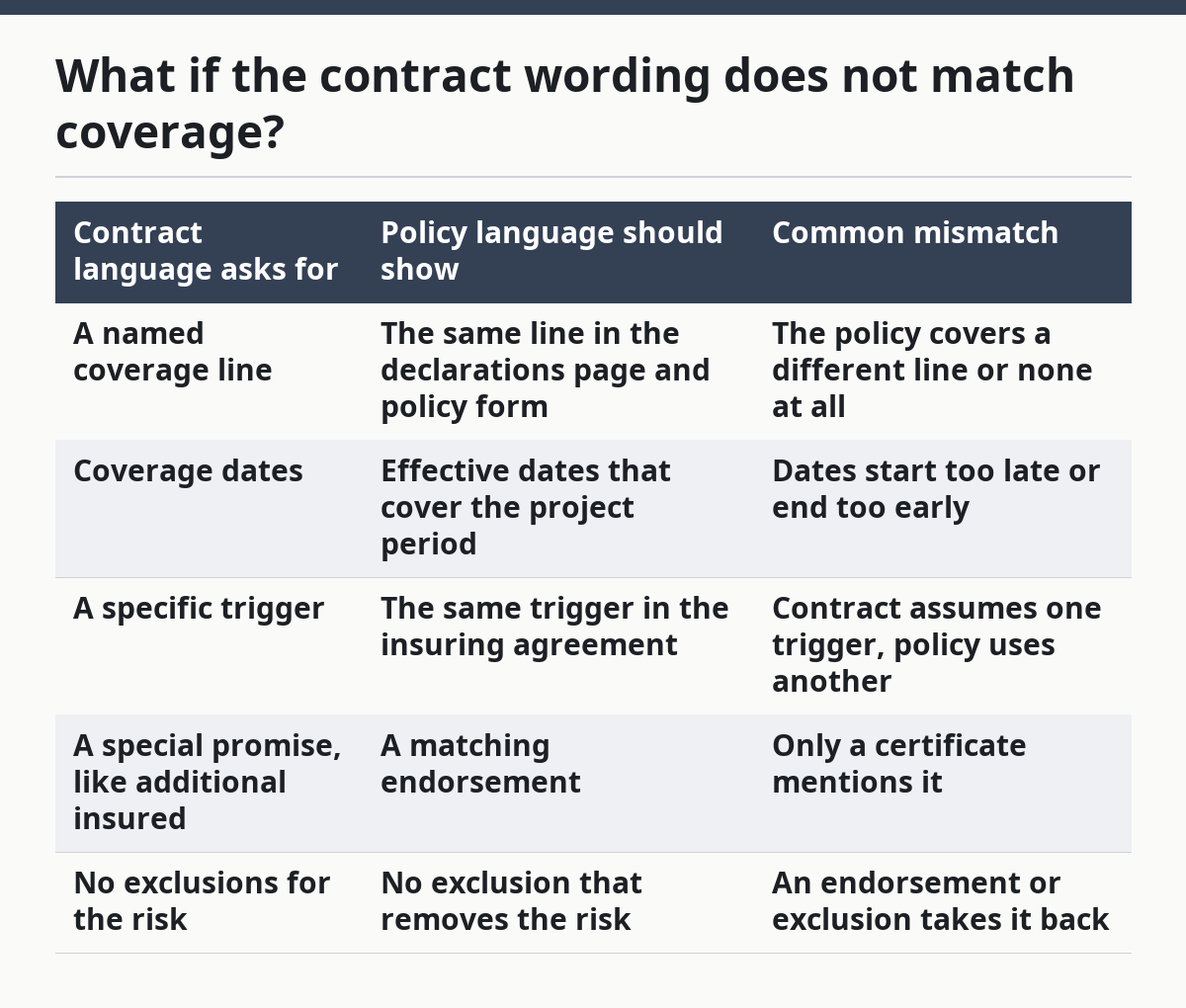
The cleanest way to think about this is by category. The table below shows the usual comparison points and what a mismatch looks like.
| Contract language asks for | Policy language should show | Common mismatch |
|---|---|---|
| A named coverage line | The same line in the declarations page and policy form | The policy covers a different line or none at all |
| Coverage dates | Effective dates that cover the project period | Dates start too late or end too early |
| A specific trigger | The same trigger in the insuring agreement | Contract assumes one trigger, policy uses another |
| A special promise, like additional insured | A matching endorsement | Only a certificate mentions it |
| No exclusions for the risk | No exclusion that removes the risk | An endorsement or exclusion takes it back |
If the mismatch is minor, the issue may be documentation. If the mismatch is about the actual grant of coverage, the issue is the policy language itself. A broker can help explain the policy, but the broker cannot rewrite the contract with a guess. The carrier controls the policy form, not the client contract.
When should you stop and get help?
You should stop when the clause depends on wording that only the carrier or a qualified adviser can confirm. This is where money risk gets real, because the wrong reading can leave a gap between the work and the policy.
The contract asks for a coverage line that is not on the declarations page: That means the policy may not respond at all — stop and ask the broker or carrier for the exact form number and whether the line exists.
The clause names an endorsement number or special status you cannot find: That means the promise may be missing or altered — stop until the endorsement is in hand.
The policy period does not cover the project dates: That means there may be no response for part of the work — stop and verify the timing with the carrier.
An exclusion seems to remove the main risk in the contract: That means the clause and the policy are talking past each other — stop and get a plain explanation before relying on it.
The only proof you have is a certificate of insurance: That means you still do not know the policy wording — stop, because the certificate can be narrower than the policy.
The client wants wording tied to a legal or industry standard you do not recognize: That means the clause may use technical insurance language — stop and have the wording reviewed by someone who works with policy forms every day.
A short pause is cheaper than a bad assumption. The cost of guessing is often an uncovered claim, a rejected requirement, or a delayed start date.
What mistakes do people make most often?
The first mistake is trusting the certificate of insurance as if it were the policy. A certificate can confirm that a policy exists, but it often does not carry the endorsement language or exclusions that decide coverage. The correct alternative is to inspect the declarations page, policy form, and endorsements together.
The second mistake is matching only the policy name. “Professional liability” and “general liability” can sound related, but they are not interchangeable. The correct alternative is to match the contract’s exact risk to the policy’s exact line of coverage.
The third mistake is ignoring effective dates because the policy is “current.” A current policy on the wrong date can still fail the clause. The correct alternative is to compare the contract period, the work period, and the policy period side by side.
The fourth mistake is skipping endorsements because they are dense. Endorsements are where the policy often changes in a material way. The correct alternative is to check every endorsement title and number, even if that takes 15 minutes.
The fifth mistake is assuming a broker’s summary equals the policy form. A broker can help interpret language, but the policy itself controls the coverage grant. The correct alternative is to ask for the exact form and endorsement language in writing.
The sixth mistake is treating “close enough” as enough. Contract insurance language is usually binary: the requirement is met, or it is not. The correct alternative is to mark unclear items as unclear until the wording is confirmed.
When does the standard approach need a tweak?
The standard approach needs a tweak when the policy is written on a claims-made basis, when the contract names a third party, or when the work crosses more than one policy period. Claims-made policies depend on when the claim is made and sometimes when the incident is reported, so the effective date check matters more than usual. If the policy period or retroactive date is unclear, do not assume the clause is covered.
The approach also changes when the contract asks for additional insured status. That phrase is not just a label; it depends on endorsement wording and may apply only to certain liabilities. A clause that asks for this status should be checked against the exact endorsement, not against the declarations page alone.
Cross-border work needs extra care because rates, limits, and legal rules differ by country and can change often. A clause that looks ordinary in one place may not map cleanly to a policy issued elsewhere. If the work, client, or insurer sits in different countries, the matching job becomes a policy-reading exercise, not a simple checkbox task.
How do you know the match is good enough?
The match is good enough when every required item in the contract has a clear home in the policy documents and nothing in the exclusions takes it back out. That usually means you can point to the exact page or endorsement for each requirement and explain why it fits. If you cannot do that in plain language, the match is not yet clean.
A good result also leaves no orphan terms. If the contract asks for a 30-day notice promise, but the policy only offers a different notice rule, that is not a clean match. If the contract wants a broader class of services than the policy lists, that is not a clean match either.
The safest habit is to keep a simple comparison note for each client. One line for the clause, one line for the policy language, one line for the result, and one line for the source page or endorsement. That note can save time later if the client asks for proof or if a claim question comes up.
How do I match a contract to my policy language?
You match the contract clause to your policy by checking the exact words for coverage type, dates, trigger, and exclusions. The declarations page tells you what the policy is called and when it runs, but the policy form and endorsements tell you what it really covers.
What if contract wording does not match coverage?
If the wording does not match, the contract requirement and the policy are not in sync. That means the gap should be treated as unresolved until the broker or carrier confirms the actual language in writing.
How do I verify insurance terms before signing?
You verify insurance terms before signing by reviewing the clause, then the declarations page, then the endorsements, and only then asking questions about anything unclear. If the clause depends on a special promise or a date that the policy does not show, stop before you sign and get qualified help for your own situation.
Drafted with AI; not yet reviewed by a person.
