

Last updated: November 19, 2026
Quick Answer: in most cases, updating freelance insurance after you switch accounting methods means sending 3 matching items — the new income records, the matching financial statements, and a short explanation for the underwriter. If you moved from cash basis to accrual basis, or the other way around, the main task is to make sure the underwriter sees the same picture you now keep in your financial statements and income records. This is information, not financial advice; a qualified adviser should check your own situation.
Key takeaways
- A bookkeeping change can change how your income looks on paper, even if your client work has not changed.
- The insurer usually cares about consistency: the figures on your insurance file should match the method used in your books and tax records.
- Cash basis and accrual basis do not show the same timing for income, so old documents may no longer tell the right story.
- The cleanest update usually uses the same method across tax returns, income records, and underwriting documents.
- If your insurance application asks for past revenue, send the version that matches your current method and explain the switch clearly.
Who should update the insurer now?

This applies to freelancers who have switched from cash basis to accrual basis, or from accrual basis to cash basis, and who use financial statements or income records when an insurer asks for underwriting documents. It assumes you already know your new accounting method, have at least 2 versions of your records, and can tell which documents cover the same 12-month period.
The change matters because cash basis records income when money lands in the account, while accrual basis records it when you earn it. That timing difference can make the same work look larger or smaller on paper, which is why a stale insurance file can confuse an underwriter. For background on accounting methods, see IRS Publication 538 and HMRC guidance on cash basis accounting.
This is not a page for someone who has no bookkeeping trail at all. If you only have bank deposits and no income records, or if your books mix business and personal money, the insurance update can wait until the records are cleaned up. The same is true if the policy has special reporting terms that you do not understand; in that case, a qualified adviser or the insurer’s own support team should review the file before any change is sent.
How do you update freelance insurance after an accounting method change?
You update freelance insurance by changing the income documents first, then sending the insurer a short explanation that the accounting method changed and the numbers now follow the new method. The goal is not to “improve” the application; it is to make the file consistent across insurance paperwork, tax records, and financial statements.
- Identify the old method and the new method in writing, using the exact terms cash basis or accrual basis, and note the switch date or tax year. Verify that one method does not appear in one document and the other method in another without explanation. A problem is a file that mixes both methods on the same income page.
- Pull the last 12 months of income records, bank statements, and invoices, then separate earned income from received cash if you moved to accrual basis. Verify that each invoice ties to a job and a date. A problem is missing invoices or deposits that cannot be matched to work.
- Rebuild the financial statements so they follow the new method, using the same 12-month period the insurer already has on file if possible. Verify that revenue totals, open invoices, and unpaid bills are shown in one method only. A problem is an income figure that still reflects the old timing rule.
- Compare the old insurance application, renewal form, or quote sheet against the new records line by line. Verify that the revenue figure, business description, and policy period still make sense together. A problem is a renewal form that still uses a cash-basis number after you changed to accrual basis.
- Draft a 1-paragraph explanation for the underwriter that says the accounting method changed, when it changed, and which records now support the numbers. Verify that the note stays factual and short. A problem is a vague explanation that makes the underwriter guess which figures to trust.
- Send the updated underwriting documents to the insurer, including income records and the matching financial statements, and keep copies of everything you send. Verify that the same totals appear across the packet. A problem is sending only a summary without backup records.
- Confirm with the insurer how the file was updated and whether the change affects the current renewal review or only future paperwork. Verify that the insurer has recorded the new accounting method. A problem is assuming the policy file was changed when only an email was acknowledged.
However, the hard part is not the forms; it is the timing. Cash basis can make income look lower in a slow-paying month, while accrual basis can show earned income before payment arrives. That difference is normal, but it means the insurance file should not keep using an old method as if nothing changed.
What should match in the paperwork?

The income total, the accounting method, and the time period should all match in the paperwork. If one document shows cash basis and another shows accrual basis for the same 12 months, the underwriter may treat the file as inconsistent, even if the business itself is stable. If that happens, it is usually worth checking the packet with a qualified adviser before you send it.
Use the table below as a simple check before you send anything.
| Item | Cash basis file | Accrual basis file |
|---|---|---|
| Income timing | When money is received | When income is earned |
| Main proof | Bank deposits and receipts | Invoices, ledgers, and financial statements |
| Common mismatch | Unpaid invoices left out of the story | Paid invoices shown twice |
| Best use in insurance paperwork | When the insurer asks for received income | When the insurer asks for earned revenue |
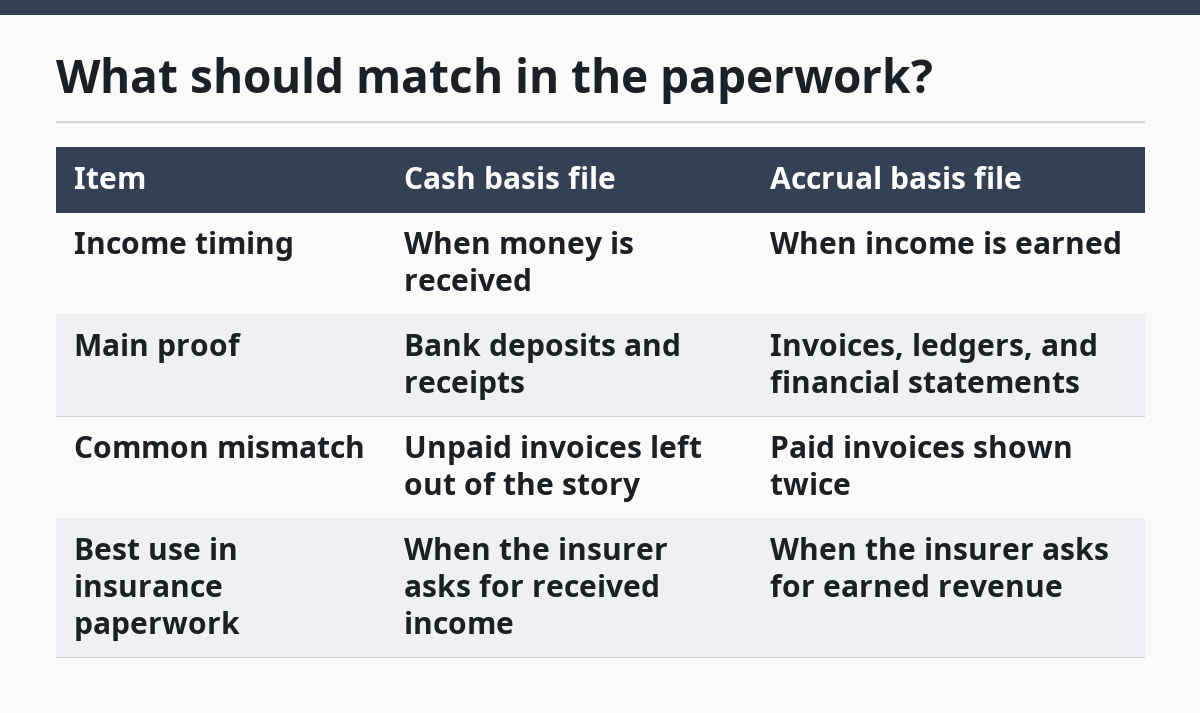
A good update is usually the one that shows the same method in every place that matters. If the insurer wants last year’s figures and this year’s figures, the method should be obvious in both. If the numbers were copied from a tax return, the return and the insurance file should not tell different stories.
What mistakes create trouble?
The most common mistake is sending old numbers after a bookkeeping change. That can make the file look sloppy or incomplete, and the insurer may ask for a fresh set of documents before it continues the review. The safer alternative is to send the figures that match the new method and label them clearly.
Another mistake is mixing cash basis and accrual basis in one packet. A freelancer might send bank deposits for some months and invoices for others, which creates a 2-system file that is hard to read. The fix is to choose one method for the update and keep the supporting records consistent.
A third mistake is forgetting the timing gap created by unpaid invoices or delayed client payments. On accrual basis, that gap belongs in the financial statements; on cash basis, it does not. If the gap is ignored, the income story can look wrong even when the work is real.
A fourth mistake is treating the insurance update like a tax return amendment. Insurance underwriting is a different process, so the insurer may want a short note, not a full accounting lecture. If you are unsure how the insurer wants that note handled, ask the insurer or a qualified adviser before you send it. The clean alternative is a plain explanation, 2 or 3 lines long, with the records attached.
A fifth mistake is waiting until the last day of renewal. That leaves little room for questions, and a missing invoice or bank record can slow the process. A better approach is to gather the records early and give the underwriter enough time to read them.
When should you stop and get help instead?
You should stop the self-update and get qualified help when the records stop matching the real business. This is the point where the insurance file can become misleading, and the fix is not another form but a proper review of the books.
The switch happened in the middle of a policy period: the file now has two accounting methods in one coverage term — ask the insurer how it wants the transition documented before you send the packet.
Invoices are missing for a large part of the year: the financial statements may not support the income figure — rebuild the records before using them for underwriting.
Bank deposits do not match client invoices: the insurer may see unexplained gaps — reconcile the records first or have a bookkeeping professional review them.
The policy asks for certified or reviewed statements: your own summary may not be enough — use the document standard the insurer asked for.
The business changed at the same time as the accounting method: a new service mix or new clients can confuse the file — separate the bookkeeping change from the business-change explanation.
The insurer asks for a specific format you do not understand: the request may be tied to underwriting rules — get the format explained before you answer.
Therefore, a generic update can do more harm than good. A tidy but wrong packet can be harder to unwind than a late packet with a clear explanation.
What if cash basis and accrual basis both seem to fit?
Cash basis and accrual basis can both describe parts of the same freelance year, but only one should drive the insurance update. The right choice is the method that matches the records the insurer is actually reviewing, not the method that makes the income look tidier.
If the insurer is reviewing bank deposits, cash basis is usually the cleaner fit. If it is reviewing invoicing, outstanding receivables, and financial statements, accrual basis is usually the better fit. The trade-off is simple: cash basis is easier to read, while accrual basis can show work already earned but not yet paid.
If the policy file already uses one method, changing methods should be explained, not hidden. A short note that says the accounting method changed on the relevant tax year is often better than letting the underwriter guess why the totals no longer line up. For broader context on business changes and policy updates, this page sits within the freelance business changes and policy updates hub.
How long does the update usually take?
The update usually takes as long as it takes to gather 3 things: the new income records, the matching financial statements, and the explanation for the underwriter. If those are already clean, the paperwork step is short; if they are not, the delay is in the books, not the insurance form.
A good result is easy to spot. The insurer can see which accounting method is current, the totals match across the packet, and the file no longer depends on a stale 12-month summary from the old method. A poor result is a packet where the numbers change from one page to the next with no reason given.
That is why the best update is usually plain and consistent. It does not try to hide the switch, and it does not over-explain it either. It simply gives the underwriter the same accounting method in every document that matters.
Does a bookkeeping change affect my premium?
It can affect how the insurer reads the file, but not every change leads to a different premium. The main issue is whether the new accounting method changes the income picture, the risk story, or the consistency of the paperwork. Because insurance pricing rules differ by country and policy, a practical step is to ask the insurer how it treats method changes.
What financial records should I provide?
Provide the records that match the method now used in your books: bank statements and receipts for cash basis, or invoices, ledgers, and financial statements for accrual basis. The key is that the figures line up across the same 12-month period. If a record is missing, say so plainly instead of filling the gap with an estimate.
Should I mention the change at renewal?
Yes, if the accounting method changed since the last file the insurer saw. Renewal is the cleanest moment to explain the switch because the underwriter is already reviewing current income records. A short note and the matching documents are usually clearer than waiting for the insurer to spot the mismatch on its own.
Drafted with AI; not yet reviewed by a person.
