

Last updated: November 19, 2026
Quick answer: Track at least 5 dates for freelance insurance claims — the incident date, notice date, document request date, appeal date, and policy expiration date — in one dated log. For How to Track Claim Deadlines for Freelance Insurance, the deadline is usually a chain of dates tied to policy terms, claim notice, adjuster requests, the coverage period, and sometimes statute timing. This information is not financial advice, and a qualified adviser should be consulted for your own situation.
Key takeaways
- The first deadline is often the notice deadline, not the final claim deadline.
- A single spreadsheet or calendar can miss the point if it does not track each request separately.
- Keep the policy, the incident date, and every insurer message in the same place.
- Claims-made policies can care more about when you report than when the loss happened.
- If a deadline seems unclear, ask the insurer in writing and keep the reply.
What counts as a claim deadline?

A claim deadline is the date or time limit by which you must take a required action to keep the claim alive. For freelance insurance, that can mean reporting the incident, sending a form, supplying a receipt, answering an adjuster request, or filing an appeal.
The tricky part is that one policy can contain several deadlines. A notice requirement may sit inside the policy terms, while a separate appeal window may come from the insurer’s process, and statute timing may come from local law. Those dates can differ, so a single “claim due date” note may not be enough.
This topic applies to freelancers who already have the policy document, the incident date, and any insurer emails or letters. It is less useful if the policy is missing or the insurance type is unclear, because the clock starts from the wording in the contract, not from memory. If the claim affects a large amount, a disputed liability issue, or a deadline that may already have passed, get qualified help quickly from the insurer, broker, or a licensed adviser rather than guessing.
For more on the policy side, see the claims-made policy guide and the freelancer insurance claims hub.
How do you track claim due dates?
You track claim due dates by building one dated record for the event, one for the policy, and one for each insurer request. Use the same method every time so no date hides inside a long email chain.
- Write down the incident date and time first: record the exact date, local time, and place, then verify it matches any report, invoice, or message you already sent; if the date is uncertain, that is a problem because notice periods and coverage period checks may hinge on it.
- Pull the policy terms into one file: save the declarations page and the claim section in PDF form, then check for words like “notice,” “report,” “proof,” and “appeal”; if you cannot find those sections in under 5 minutes, the policy copy is incomplete.
- List every deadline as its own line: enter the notice requirement, each supplemental document due date, any adjuster request date, and the appeal window in separate rows; if two items share one row, one of them will get missed.
- Add the date each request arrived: note when the insurer sent the email, letter, or portal message, then verify the due date against that timestamp; if the due date is only in a phone call, follow up in writing right away.
- Set two reminders for each deadline: place one reminder 7 days before and one on the due date, then check that both appear on your phone and calendar; if a reminder does not repeat or show the right date format, fix it before you rely on it.
- Keep proof of every submission: store sent emails, upload confirmations, screenshots, and file names with the date in the title, such as YYYY-MM-DD; if you cannot prove delivery, the insurer may say the clock was missed.
- Track the response, not just the send: log when the insurer answers, because a new adjuster request can restart the next 3-to-5-day work cycle; if the reply asks for the same document again, your record should show whether the first upload was received.
- Review the claim file once a week: compare the log with the latest email or portal notice, then verify no date changed after a new request; if the file has more than 1 open request with no owner named, the claim needs attention now.
A simple spreadsheet works well if it has columns for deadline type, date received, due date, document needed, status, and proof of submission. A paper notebook can work too, but it is weaker when the insurer sends a second request 2 days later or when you need to search for a timestamp fast.
For a general framework on the incident side, the freelancer insurance claims and incident response page can sit alongside this one, but it should not replace the deadline log. The log is the tool that keeps the claim moving.
Which dates matter most?
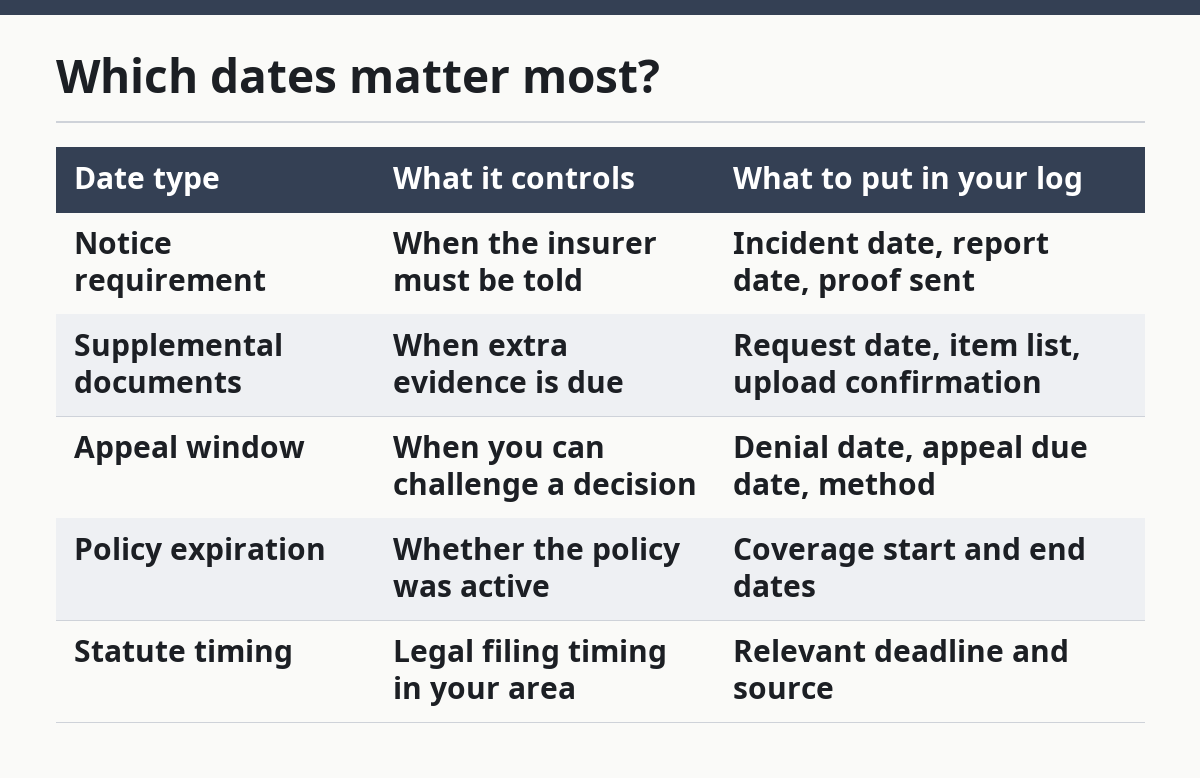
The dates that matter most are the notice date, the document due date, the appeal date, the policy expiration date, and any statute timing that applies in your country. Each one can affect a different part of the claim.
The notice date is often the first hard stop because some policies require prompt reporting. The document due date is separate and usually starts when the insurer asks for something specific, such as a contract, invoice, police report, or photo. The appeal date matters if the claim is denied or only partly approved. The policy expiration date matters because it can change whether a late report still fits the coverage period. Statute timing matters because local law may set a deadline outside the policy itself.
| Date type | What it controls | What to put in your log |
|---|---|---|
| Notice requirement | When the insurer must be told | Incident date, report date, proof sent |
| Supplemental documents | When extra evidence is due | Request date, item list, upload confirmation |
| Appeal window | When you can challenge a decision | Denial date, appeal due date, method |
| Policy expiration | Whether the policy was active | Coverage start and end dates |
| Statute timing | Legal filing timing in your area | Relevant deadline and source |
A generic calendar reminder is not enough if it only tracks one date. A claims-made policy, for example, may care deeply about when the claim was reported, while another policy may focus on when the event happened. That is why the wording in the policy terms matters more than a rough memory of “last month.” For background on notice timing, see the NAIC consumer insurance resources.
What should go in the deadline log?
The deadline log should hold 6 items: the policy name, the incident date, the deadline type, the due date, the person or department that asked for it, and proof that you sent it. Without those fields, the log cannot answer the question “what is still open?”
A good log also notes the time zone, especially if the insurer’s portal uses a different one from yours. A 5 p.m. cutoff in one zone can be a missed deadline in another. If you work across borders, the log should say which location controls the date, because rates, rules, and timing can differ by country and change often.
The log should be boring and exact. Use plain labels instead of shorthand. “Adjuster request for contract” is better than “doc thing,” because the first version tells you what happened if you return to the file 3 weeks later.
When does the standard approach stop working?
The standard spreadsheet-plus-calendar method stops working when the deadline is disputed, the policy wording is unclear, or the insurer is asking for legal or technical proof beyond a simple upload. In those cases, the record still helps, but it is not enough on its own.
The policy wording is vague: A notice clause that says “promptly” or “as soon as practicable” can leave room for argument — ask the insurer to confirm the expected timing in writing and keep the reply.
The claim involves more than one policy period: The incident date, discovery date, and report date may point to different years, so consult a qualified professional and check which coverage period the insurer says applies before you treat one deadline as final.
The insurer has asked for an appeal or review: An appeal window can be shorter than the original notice period — copy the denial date and due date into a new row instead of reusing the old claim line.
There is a missed or likely missed date: A late notice can change the claim’s path — stop guessing, gather the full paper trail, and get qualified help fast because delay can make the problem worse.
The document request is tied to liability exposure: If the claim could affect a disputed contract, a complaint, or a professional negligence issue, the answer may depend on both insurance language and local law — keep writing, but do not rely on memory alone.
What mistakes cost freelancers time?
The biggest mistakes are not dramatic; they are small recording errors that turn into lost days. A missing timestamp, a wrong due date, or a bad file name can make a valid claim look late.
One common error is using the incident date as the only date in the file, especially when the policy also asks for notice and request dates. That misses the notice deadline and the later document deadlines, so the log looks complete when it is not. The fix is to separate incident, notice, request, and appeal into different lines.
Another mistake is trusting a phone call without a written follow-up. A call may be useful, but it is hard to prove 10 days later. The better alternative is to send a short email after the call that repeats the date, the request, and the due date.
A third mistake is filing papers in different places. Some documents sit in email, some in cloud storage, and some in a chat thread. That split setup makes it easy to miss a 48-hour request. Put every file in one folder and name it with the date.
A fourth mistake is forgetting that deadlines can move after a new adjuster request. If the insurer asks for more details, the clock may restart for that item, not the whole claim. Mark the new request date and create a fresh reminder.
A fifth mistake is ignoring policy expiration. A freelance policy can end on a date that looks harmless in a calendar until a late report arrives. The fix is to keep the coverage period visible at the top of the log.
When should a freelancer ask for help?
A freelancer should ask for help when a deadline is already close, the insurer has raised a coverage question, or the claim affects a large part of the business. That is especially true if the policy terms are hard to read or if the claim crosses more than one reporting rule.
If the deadline is within 3 business days, the record should move from “organize” to “respond.” If a claim has been denied, partly denied, or marked late, a qualified adviser can help sort the policy language from the process issue. If the insurer asks for material that feels legal, technical, or outside normal business records, do not leave the question hanging for a week.
This is also the point where a freelancer should stop trying to solve everything by memory. A clean log helps, but it cannot replace advice when rights, deadlines, and coverage period questions overlap. For related policy terms, see the professional liability insurance guide and the insurance appeal timeline page.
How can a simple system stay accurate?
A simple system stays accurate when it is checked against the original policy and updated the same day a request arrives. The goal is not a fancy tool; it is a record that matches the insurer’s timeline.
Use one calendar, one folder, and one master log. Review them together for 10 minutes after every insurer message. If the dates disagree, the message wins over memory, and the policy wording wins over guesswork. That habit matters more than the software name.
A monthly clean-up is useful only if there is still an open claim. If the claim is active, weekly review is safer because document requests can arrive quickly and a 1-day delay can matter. If the claim is closed, keep the file anyway in case an appeal window or follow-up question reopens the issue.
What deadlines matter in a freelancer insurance claim?
The main deadlines are the notice requirement, any document deadline, the appeal window, the policy expiration date, and any statute timing that applies where the claim is handled. Those dates may come from different places, so a freelancer should list each one separately instead of assuming there is only one final due date.
How long do I have to report a claim?
The answer depends on the policy terms and sometimes the law where the claim is made. Some policies ask for prompt notice, while others use a more specific reporting rule, so the safest move is to check the policy wording and confirm the timing with the insurer in writing. For a regulator overview of policy timing and notice, see the NAIC consumer insurance resources.
How do I track claim due dates?
Track claim due dates in one log with the incident date, each request date, the due date, the document needed, and proof of submission. Add two reminders for each item and keep the policy copy beside the log so you can compare the wording before each deadline.
Drafted with AI; not yet reviewed by a person.
