
Last updated: November 20, 2026
Quick Answer: track 5 core milestones in a freelancer claim from notice to closure — acknowledgment, investigation, reservation of rights, settlement, and closure. In this article on How to Track a Freelancer Claim From Notice to Closure, the paper trail matters more than memory, and the question is usually a status question. According to NAIC, claim handling follows a documented process, and Investopedia explains that a reservation of rights letter preserves the insurer’s position while it investigates.
Key takeaways
- A freelancer claim moves through a few repeatable stages, even when the dates change from one insurer to another.
- The two documents that matter most for status are the reservation of rights letter and the closure letter.
- Your claim file should show who said what, when they said it, and what they asked for next.
- Gaps in updates usually mean the file is waiting on evidence, a decision, or an internal review.
- This is information, not financial advice; a qualified adviser should be consulted for your own situation.
Who this applies to
This applies to a policyholder or freelancer who has already opened a claim and now needs to understand what the status means. It assumes you have the claim number, the insurer’s contact details, and at least one written notice such as an acknowledgment email or a claim letter.
It is also for people using freelancer liability insurance and trying to read the claim timeline without guessing. I am not telling you what to decide about coverage or settlement; if your situation involves a disputed loss, a coverage question, or a deadline that could affect your rights, get qualified help from the insurer, broker, or another professional who can look at the actual policy.
The point of tracking is simple: you want to know where the claim file sits, what the claims adjuster is doing, and what document should come next. If you do not have even the claim number or the name of the adjuster, you are not ready to track status well yet.
What does the claim timeline actually include?
The claim timeline usually runs from notice to closure through a few named milestones: acknowledgment, investigation, reservation of rights, settlement, and closure. Those are the labels to look for in emails, letters, and portal updates, even when the insurer uses slightly different wording.
Notice is the point where the policyholder reports the loss or dispute. Acknowledgment is the insurer’s written confirmation that it opened the file. Investigation is the review of facts, documents, and policy terms. A reservation of rights letter means the insurer is continuing to investigate while reserving the right to deny or limit coverage later.
Settlement is the stage where the amount or handling is agreed, if the claim resolves that way. Closure is the end point, usually marked by a closure letter or a final status note. If one of these stages is missing from the paper trail, the file may still be active even if no one has written to you for 10 days or more.
How do I track the claim step by step?
You track a freelancer claim by building a dated record of every status change, every contact, and every document in the claim file. That record should be updated each time the claims adjuster speaks, writes, or asks for more information.
- Start with the notice date and claim number. Write the date you first reported the claim, the claim number, and the insurer’s contact name on one page. Verify that the number matches every email and letter. If the number changes or appears inconsistent, that is a sign the file may have been split or misrouted.
- Log the acknowledgment. Save the acknowledgment letter or email and note when it arrived. Check whether it confirms the policyholder name, the loss date, and the assigned claims adjuster. If the acknowledgment is missing those basics, the file may not be fully set up yet.
- Record every request for information. List each document request, the date it was made, and the due date the insurer gave you, even if that due date is only a general 7-day or 14-day request in the email. Verify exactly what was asked for. A vague request usually means the investigation is still open, not that the claim is stalled for no reason.
- Watch for a reservation of rights letter. If one arrives, note the reason given and the policy issue it refers to. Verify whether the insurer is still investigating or has only raised a coverage concern. A reservation of rights letter is not the same as a denial, but it is a warning that the file has moved into a more formal review.
- Track every adjuster contact. Write down phone calls, portal messages, and emails with the date and the subject. Confirm what was promised next, such as a document review or a decision. If the adjuster keeps repeating the same request without a next step, the file may be waiting on an internal review or missing evidence.
- Separate factual updates from status words. Put “under review,” “pending documents,” “coverage issue,” and “settlement discussion” in different columns. Verify which one is current. A claim can be open and active even when no settlement talk has started, so a qualified professional should be consulted before treating silence as closure.
- Capture any settlement terms in writing. If the insurer proposes a settlement, save the exact wording and note whether it is partial or final. Verify whether the offer resolves the whole claim or only one part of it. A settlement that leaves one issue open means the timeline is not finished yet.
- Wait for the closure letter before treating the matter as closed. File the closure letter, the final payment note, or the final denial letter together. Verify that the letter says the claim is closed or otherwise resolved. If no closure letter exists, the claim may still be administratively open even after the last payment, so consult a professional if the status matters.
A simple spreadsheet or notes app is enough for this timeline, as long as the dates stay in order. The goal is not a perfect archive; it is a clear chain of 5 to 8 milestones that shows where the file stands today. The National Association of Insurance Commissioners recommends keeping written records of claim contacts and documents, which supports this kind of log. (Source: NAIC)
What should I check in each update?
Each update should answer four questions: what stage is this, who said it, what changed, and what comes next. If the update does not answer those 4 things, it is not a useful status update.
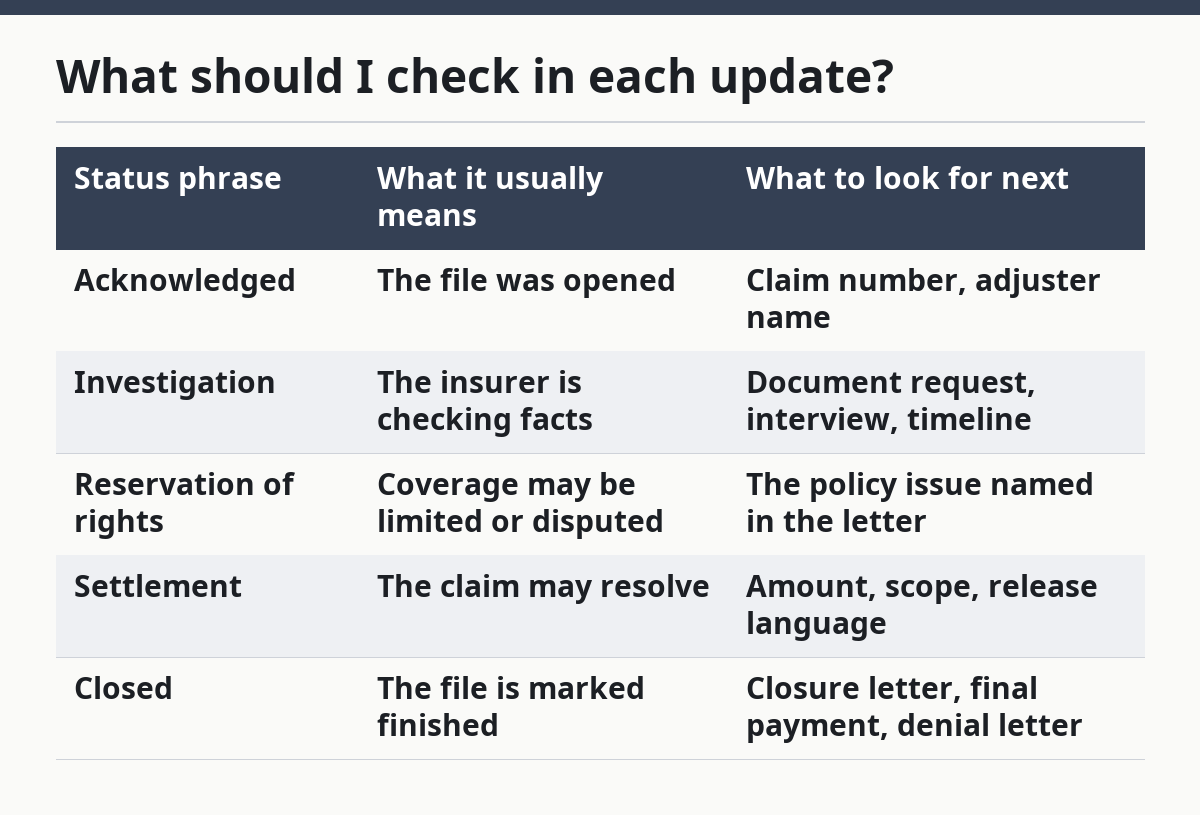
Check the sender first. A real status update usually identifies the claims adjuster, the insurer, or the claims department, and it should match the claim number you already have. Then check the stage language. “Acknowledged” means the file is open; “investigation” means facts are still being gathered; “reservation of rights” means coverage has not been decided cleanly; “settlement” means a resolution is being discussed or completed; “closed” should be backed by a closure letter or final notice.
Also check whether the update is about the whole claim or only one issue inside the file. One letter can close a payment issue while leaving another coverage issue open. That split happens more often than readers expect, and it is why a single status word can mislead you.
A good update usually gives at least 1 next step, even if the next step is just “waiting for policy review.” A bad update gives a broad phrase like “still in progress” with no date, no document, and no stated reason.
| Status phrase | What it usually means | What to look for next |
|---|---|---|
| Acknowledged | The file was opened | Claim number, adjuster name |
| Investigation | The insurer is checking facts | Document request, interview, timeline |
| Reservation of rights | Coverage may be limited or disputed | The policy issue named in the letter |
| Settlement | The claim may resolve | Amount, scope, release language |
| Closed | The file is marked finished | Closure letter, final payment, denial letter |
When should I stop relying on the standard timeline?
You should stop using the standard timeline as your main guide when the file shows signs of a coverage dispute, a split claim, or a missing decision point. In those situations, the status label can hide more than it reveals.
Reservation of rights letter arrives: This means the insurer is preserving coverage defenses while the file stays open — do not assume the claim is on a normal path, and get the exact issue in writing.
Claim is silent for 30 days or more with no written status: This means the file may be waiting in a queue or missing a response — ask for the current stage and the next action in writing.
Settlement talks start on only part of the loss: This means the claim may be splitting into pieces — track each issue separately so one resolved item does not hide another still-open item.
Final payment arrives but no closure letter follows: This means the payment may not equal closure — keep the file open until you receive written closure or a final denial.
Denial language appears in any letter: This means the timeline has turned into a coverage issue, not just a status issue — save the letter and seek qualified help on the policy terms.
The adjuster changes mid-file: This means the record can get messy fast — verify the new contact, the handoff date, and whether the new adjuster has the full file.
If the file is disputed, split, or close to a deadline that could affect rights under the policy, the standard tracking method is no longer enough. At that point, the practical job is to preserve the paper trail and get advice that fits the actual documents.
What mistakes cause the most confusion?
The biggest mistake is treating silence as closure. A claim can sit for 2 weeks or longer with no fresh email and still be active, especially if the investigation is waiting on documents or internal review. A qualified professional should be consulted before you treat silence as the end of the claim.
Another mistake is keeping status in email threads instead of one timeline. When messages are scattered across 3 inboxes, it becomes hard to tell whether the latest note is an acknowledgment, a request, or a settlement discussion. The fix is one running log with dates, names, and document titles.
A third mistake is ignoring the reservation of rights letter because it sounds technical. That letter matters because it tells you the insurer is not fully committing to coverage while the file stays open. The fix is to file it with the claim papers and, if needed, consult a professional so it is treated as a status change, not background noise. (Source: Investopedia)
A fourth mistake is assuming payment means closure. Some files close with a closure letter; others receive a payment first and close later, after internal paperwork catches up. The fix is to wait for written closure, not just a deposit or remittance note.
A fifth mistake is failing to separate the claim file from the project file. Those are different records, and mixing them can make it impossible to see what the insurer actually asked for. The fix is to keep the claim file focused on notice, investigation, settlement, and closure.
How do I know the claim is really closed?
A claim is really closed when the insurer says so in writing and the claim file reflects that final status. The cleanest sign is a closure letter that names the claim number and states that the file is closed, resolved, or otherwise finished.
Check for 3 things together: the closure letter, any final payment note, and the absence of open requests. If you still see unanswered document requests, a reservation of rights letter without follow-up, or a pending settlement term, the claim may not be fully closed yet.
If the insurer sent a denial instead of a closure letter, the file may be finished on their side but not in the way you hoped. That is why the wording matters. Closure usually means the claim file is done; it does not necessarily mean the outcome was favorable.
For a broader view of the insurance process, the hub on [Freelancer insurance claims management] can help you place this timeline in the larger claim process without mixing it up with deadlines or evidence issues. For how insurers describe claim handling, see the NAIC consumer guide on insurance claims.
FAQ
How long does a freelancer claim take?
There is no universal length for a freelancer claim, because timing depends on the policy, the issue being reviewed, and how quickly the claim file gets the information it needs. A file can move from acknowledgment to closure in a short time or remain open much longer if there is a coverage question, a reservation of rights letter, or a missing document.
What are the stages of an insurance claim?
The stages usually run from notice to acknowledgment, then investigation, then either settlement, denial, or closure. In a freelancer claim, those stages are often documented by the claims adjuster through emails, letters, and claim notes in the claim file. The wording can vary, but the sequence usually stays recognizable.
How do I know if my claim is closed?
You know the claim is closed when you receive written confirmation, usually in a closure letter or final status notice, and there are no open requests left in the file. A payment alone is not always enough; it can help, but it does not by itself prove the file is closed. If the insurer still has pending questions, the file may still be open even after the last payment.
Drafted with AI; not yet reviewed by a person.
