

Last updated: November 21, 2026
Quick Answer: In How to Read a Freelance Master Services Agreement for Insurance Triggers, focus on 5 clauses first: indemnity, additional insured, waiver of subrogation, notice, and defense. A freelance master services agreement can trigger insurance duties long before a project starts, so the key is to find the clauses that make coverage, notice, and endorsements matter. This guide is for freelancers, solo consultants, and small vendor shops reading an MSA, client contract, or vendor agreement for the first time. It assumes the agreement is already in hand and that the reader knows the basics of the deal, but not the insurance language. This information, not financial advice; a qualified adviser should be consulted for your own situation.
Key takeaways
- The trigger is usually not the word “insurance” alone; it is the clause that makes coverage mandatory, conditional, or time-bound.
- Indemnity, defense, additional insured status, and waiver of subrogation often do more damage than the basic insurance line.
- A 30-day notice rule, a 10-day certificate deadline, or a policy limit written into an insurance schedule can create a problem even when the project looks small.
- Some clauses affect your policy structure, not just your paperwork, so they need closer review than a simple certificate request.
- A clean reading means matching the obligation to the exact trigger, the policy form, and the timing rule.
What does an insurance trigger mean in an MSA?

An insurance trigger in a freelance master services agreement is the clause that makes a coverage duty start, expand, or change. It may say you must carry a certain policy, name the client as an additional insured, give notice before cancellation, or keep coverage alive after the job ends.
The trigger is often buried in an insurance clause, an indemnity section, or an exhibit called an insurance schedule. A generic certificate request is usually less important than a phrase like “shall maintain,” “as a condition precedent,” or “at all times during the term and for 2 years after completion,” because those words can change when the duty starts and how long it lasts.
Two useful references for the terminology are the National Association of Insurance Commissioners and the Insurance Information Institute. Those sources help with basic definitions, but they do not replace a review of the specific MSA language in front of you.
Which clauses should I read first?
Read the indemnity, limitation of liability, additional insured, waiver of subrogation, notice, and defense clauses first, because those are the spots where insurance duties usually get tied to payment risk. Each clause can create a different trigger, and each one can reach past the basic policy line item.
A limitation of liability clause may cap damages at 12 months of fees or another stated amount, but an indemnity clause can shift defense costs outside that cap. A defense obligation matters because defense is often more expensive and more immediate than an indemnity promise to pay a final loss. A waiver of subrogation stops the insurer from trying to recover from another party after a claim. If the waiver is required in the MSA, the policy must allow it.
An additional insured requirement is also a trigger. It asks the insurer to extend protection to the client, not just to the freelancer. If the MSA says “primary and noncontributory,” that is a signal the client wants its coverage paid first. That is a larger ask than a certificate alone.
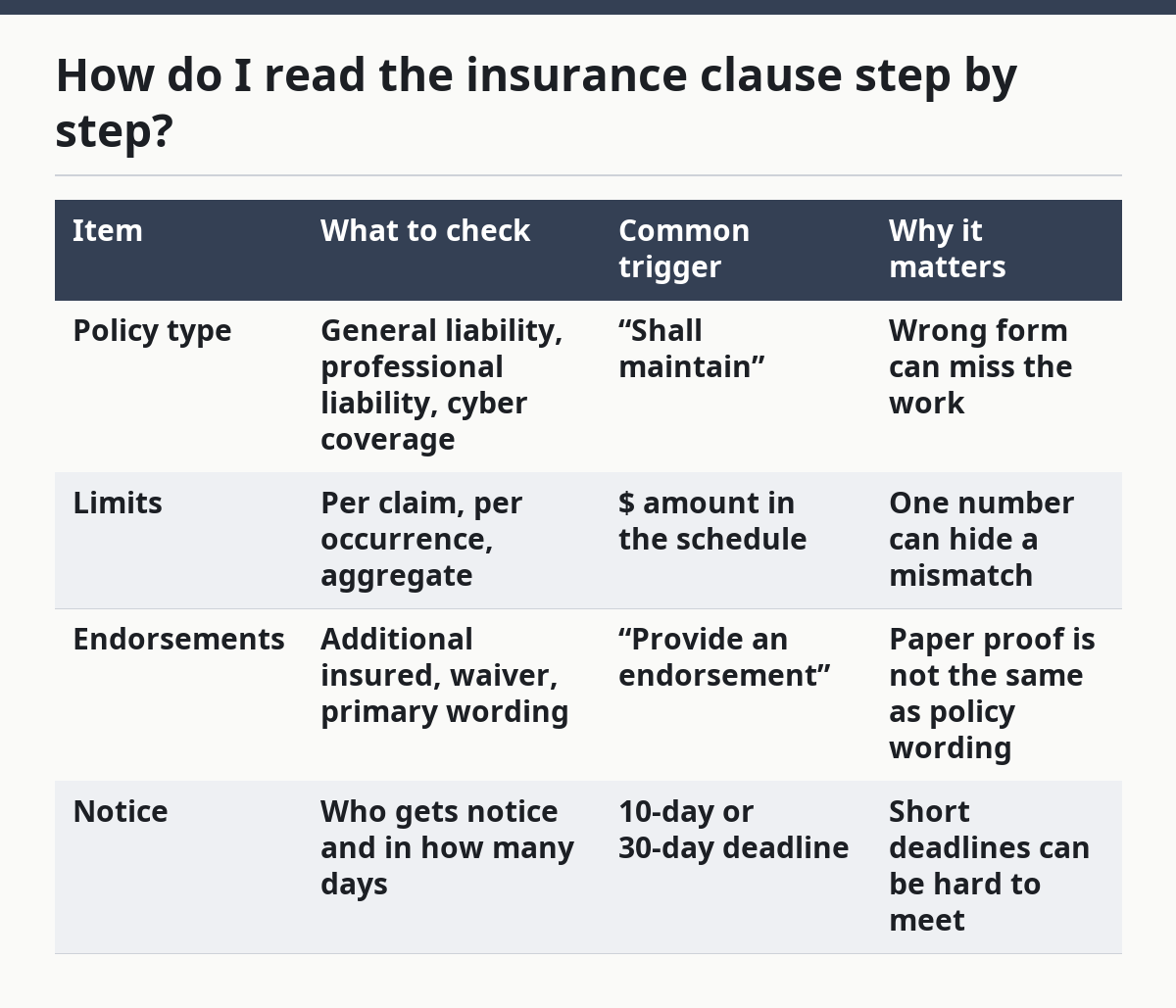
How do I read the insurance clause step by step?

Read the insurance clause in order, line by line, and then match each sentence to a policy term or endorsement. A careful pass through 7 steps is usually enough to find the real trigger.
| Item | What to check | Common trigger | Why it matters |
|---|---|---|---|
| Policy type | General liability, professional liability, cyber coverage | “Shall maintain” | Wrong form can miss the work |
| Limits | Per claim, per occurrence, aggregate | $ amount in the schedule | One number can hide a mismatch |
| Endorsements | Additional insured, waiver, primary wording | “Provide an endorsement” | Paper proof is not the same as policy wording |
| Notice | Who gets notice and in how many days | 10-day or 30-day deadline | Short deadlines can be hard to meet |
- Mark every mandatory verb. Circle “shall,” “must,” “agree,” and “at all times.” Verify whether the clause is a requirement, a promise, or a condition. A problem shows up when the duty applies before signature or after termination without any end date.
- List every required policy type. Note each line item, such as general liability, professional liability, or cyber coverage if named. Verify whether the MSA asks for one policy or several. A problem appears when the agreement requires a type that does not match the work.
- Check the policy limits language. Find whether the MSA states a dollar amount, a per claim limit, or an aggregate limit. Verify whether the limit is tied to each occurrence, each project, or the full term. A problem appears if the schedule requires a level that is not supported by the policy form.
- Read the endorsement requests. Look for additional insured, waiver of subrogation, primary wording, or notice-of-cancellation wording. Verify whether the clause asks for an endorsement or only a certificate. A problem appears when the MSA demands an endorsement but the policy cannot issue one in that form.
- Find the notice rule. Check who must be told, how notice must be sent, and how many days are allowed. Verify whether notice is required before cancellation, nonrenewal, or a claim. A problem appears if the deadline is so short that normal carrier notice will not fit.
- Match the defense wording. See whether the clause says the insurer must defend, reimburse defense costs, or indemnify after the fact. Verify whether defense is separate from indemnity. A problem appears when the client expects a defense duty that the policy does not provide.
- Check the insurance schedule. Compare the schedule to the body of the MSA and any statement of work. Verify that the named insured, dates, locations, and policy forms all line up. A problem appears if the schedule adds terms that the main text never mentions.
- Look for survival language. Identify whether the insurance duty survives project closeout for 1, 2, or more years. Verify whether completed operations, professional claims, or tail coverage are implied. A problem appears if the clause outlasts the policy period.
The practical test is simple: if a sentence changes who pays, who defends, or who must be listed on the policy, it is a trigger. If the wording only asks for proof of coverage, it may still matter, but it is usually a paperwork issue rather than a structure issue.
What makes a coverage problem?
A coverage problem starts when the MSA asks for more than the policy can legally or practically provide. The most common gap is not no insurance at all; it is the wrong form, the wrong timing, or the wrong endorsement.
An additional insured request can fail if the client wants completed-operations coverage but the endorsement only fits ongoing operations. A waiver of subrogation can be a problem if the policy or carrier will not allow it for the line of work. A notice clause can be a problem if the MSA demands direct notice from the insurer in 10 days, but the policy only gives the insured notice under its own rules. The issue is often mechanical, not dramatic.
A limitation of liability clause can also create a mismatch. If the cap is low but the indemnity carve-out is broad, the insurance trigger may point to a risk larger than the deal itself. That is why the MSA must be read as a system, not as isolated clauses.
When should I stop and get qualified help?
Stop and get qualified help when the MSA asks for a defense duty, an additional insured endorsement, or a waiver of subrogation that you cannot match to your policy forms. These are coverage-structure issues, not just reading issues, and a mistake can follow you into a claim.
The clause requires “primary and noncontributory” wording: that changes how your coverage responds — get the policy checked against the endorsement form.
The agreement names a 30-day or shorter notice deadline: that can be impossible to meet through normal carrier notice — ask for review of the notice mechanics.
The insurance schedule sets a specific limit you do not recognize: that may refer to per occurrence, aggregate, or claims-made terms — verify the limit structure.
The MSA ties insurance to an indemnity promise with no cap: that can expand exposure beyond the project fee — have the risk language reviewed.
The work crosses borders, industries, or regulated sites: local insurance rules may change the trigger — use a qualified adviser familiar with the location and work type.
If the document uses custom wording, a one-line certificate request is not enough. The right question is not “Do I have insurance?” but “Does this wording fit the policy form I actually hold?”
What mistakes do freelancers make here?
Freelancers usually miss the trigger, not the title. The section title may say “Insurance,” but the real demand sits in an indemnity paragraph or a vendor agreement exhibit.
One mistake is reading only the coverage names and skipping the endorsement language. The consequence is a policy that exists but does not satisfy the client’s exact demand. The correct move is to check whether the MSA asks for additional insured status, primary wording, or a waiver of subrogation.
Another mistake is treating a certificate of insurance as proof that the requirement is met. A certificate can summarize coverage, but it does not rewrite the policy. The safer move is to compare the certificate, the declarations page, and the endorsement forms, and to consult a qualified insurance professional if the MSA makes the certificate a condition of completion.
A third mistake is ignoring the timing language. If the MSA requires notice before cancellation or survival after project end, a policy that ends with the project may not match. The correct move is to map every date in the clause to the actual policy period.
A fourth mistake is reading the limit as if it were always a single total. Limits can be written in different ways, and the number only makes sense in context. The correct move is to see whether the clause names a per claim, per occurrence, or aggregate limit.
A fifth mistake is assuming the insurance schedule is just a summary. In many MSAs, the schedule is where the sharpest requirements hide. The safer move is to treat the schedule as part of the binding language, not as a note, and to seek professional review if the schedule conflicts with the body of the agreement.
What changes in edge cases?
Edge cases need a slower read because the standard pattern does not fit cleanly. A 1-page freelance quote is different from a 30-page vendor agreement, and a project with subcontractors is different from a solo consulting job.
If the MSA combines service terms and insurance terms across several exhibits, read the exhibits in the order the agreement says controls. If one exhibit says one thing and another says the opposite, the priority clause matters. If the work is professional in nature, the insurance clause may point to professional liability rather than general liability, and that changes the policy form that matters most.
If the agreement says the client can change the insurance requirements by written notice, the trigger is moving. That means the current version of the MSA may not be the last word. If the agreement is a vendor agreement with multiple projects, the trigger may apply across all work, not just the named assignment.
What should a clean read produce?
A clean read should leave you with a short list: what coverage is named, what endorsement is asked for, what notice is required, who must be protected, and when the duty starts and ends. If those five items are clear, the freelance master services agreement is readable enough to compare against the policy without guessing.
It should also leave one honest question: does the wording match the policy form, or only the headline name of the coverage? That question matters more than any single clause name. A good result is not a signed page; it is a clear map of what the client is asking for and where the policy may or may not answer.
What insurance terms in an MSA matter most to freelancers?
The terms that matter most are the ones that change who pays, who defends, and who gets added to the policy. Indemnity, additional insured status, waiver of subrogation, notice, and defense language usually matter more than the simple label “insurance.” Those are the clauses that can create a real trigger even when the policy name sounds familiar.
How do I spot insurance language hidden in an MSA?
The fastest way is to scan for verbs like “shall,” “must,” “maintain,” and “provide,” then look for any reference to limits, endorsements, or certificates. Insurance language is often tucked into indemnity sections, exhibits, or vendor terms, not just under a heading called “Insurance.” A 2-minute search of those words is often enough to find the main trigger.
What clauses create a coverage problem for freelancers?
The clauses that most often create a problem are additional insured, primary and noncontributory wording, waiver of subrogation, and broad defense obligations. Those clauses can ask the policy to do more than basic coverage. If the MSA also uses a short notice deadline or a survival period after project end, the mismatch can get worse fast.
Drafted with AI; not yet reviewed by a person.
