
Last updated: November 21, 2026
Quick Answer: Most freelancers can document prior business experience for insurance approval with 3 core items — a relevant resume, dated work samples or client records, and any current licenses or certificates. This article on How Freelancers Document Prior Business Experience for Insurance Approval explains how insurers read that file and where the proof usually comes from. For general recordkeeping and verification standards, see the National Association of Insurance Commissioners and the IRS recordkeeping guidance. This is information, not financial advice; a qualified adviser should be consulted for your own situation.
Key takeaways
- Insurers look for proof that the work is real, not just a claim on an application form.
- A resume, portfolio, and client or employer records usually work better together than any single document.
- Years in business help, but they are less persuasive when the work history has gaps or no matching evidence.
- Certificates and licenses matter most when the job is regulated or technical.
- A weak file does not always block approval; it may simply mean the underwriter needs more detail.
What counts as proof of prior business experience?

Proof of prior business experience is any document that shows you have done the kind of work you want insured. That can include a resume, portfolio, prior employer history, client testimonials, certificates, licenses, invoices, tax records, or a short project list with dates and duties.
An underwriter is the insurance company staff member who reviews risk. They are usually looking for one simple thing: does the evidence match the business activity you are asking them to cover? A graphic designer with a 5-year portfolio of brand work is easier to place than someone who only has a social profile and a vague job title.
The strongest files stay consistent. Your resume says one thing, your portfolio shows the same specialty, and your client references back it up. If one document says you are a copywriter and another shows web design only, the mismatch can slow approval or lead to follow-up questions.
A general rule helps here: the more specialized the work, the more specific the proof should be. A freelance bookkeeper may need different evidence than a freelance photographer, even if both have 10 years in business. The insurance question is not “Have you ever freelanced?” It is “Have you done this exact kind of work before?”
Which documents should you gather first?
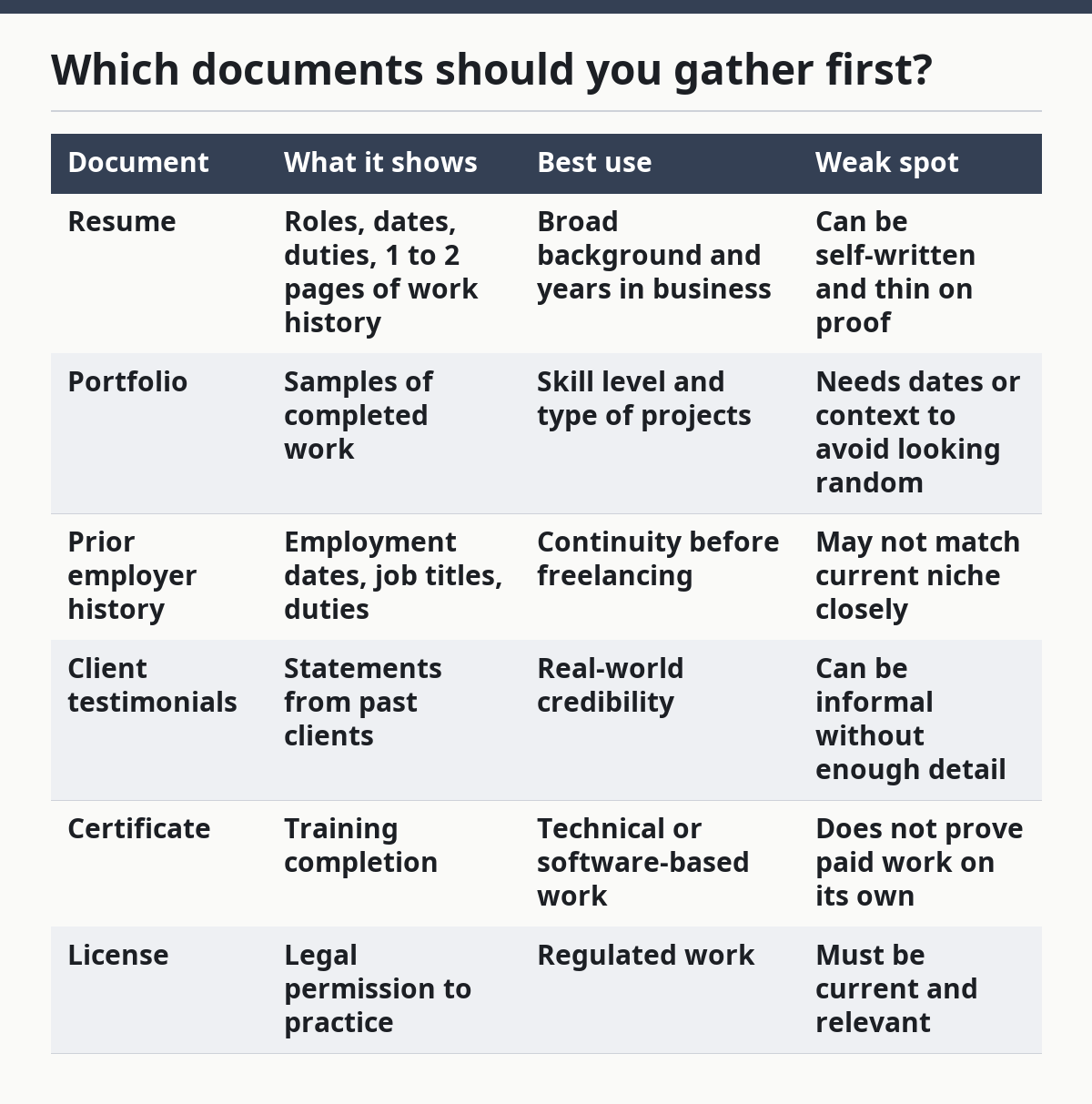
You should gather the documents that show continuity first: prior employer history, a resume, and a short portfolio summary. Those 3 items often give the underwriter the quickest path from “new application” to “real experience,” although the insurer may still ask for more detail. After that, add client testimonials, certificates, and licenses if they fit the work.
A useful comparison is below.
| Document | What it shows | Best use | Weak spot |
|---|---|---|---|
| Resume | Roles, dates, duties, 1 to 2 pages of work history | Broad background and years in business | Can be self-written and thin on proof |
| Portfolio | Samples of completed work | Skill level and type of projects | Needs dates or context to avoid looking random |
| Prior employer history | Employment dates, job titles, duties | Continuity before freelancing | May not match current niche closely |
| Client testimonials | Statements from past clients | Real-world credibility | Can be informal without enough detail |
| Certificate | Training completion | Technical or software-based work | Does not prove paid work on its own |
| License | Legal permission to practice | Regulated work | Must be current and relevant |
The point is not to collect everything. It is to collect the 2 or 3 items that answer the underwriter’s most basic doubt: what work did you do, for how long, and under what name or role? If your portfolio is strong but your resume is thin, the file still has a gap. If your resume is strong but nothing else supports it, the underwriter may ask for more.
For regulated work, check the issuer and the status date on the license. An expired license or a certificate from a short course may not carry much weight if the insurer expects current credentials. Rules vary by country and by insurer, so treat the application as a document check and, if needed, consult a licensed broker or adviser before you submit it; the NAIC and your local regulator can help you find the right standards.
How do you build the file step by step?
You build the file by matching each claim in the application to a document that can support it. Start with the application question, then attach the cleanest proof you have for each part of your background. The SBA also recommends keeping organized business records, which makes this step easier.
- Write down the exact business activity you want insured. Use one plain description, such as “freelance bookkeeping” or “commercial photography.” Verify that the wording matches your resume and portfolio. If the description changes across documents, the underwriter may treat the file as unfocused, so a broker or adviser can help you standardize it.
- List your years in business and years in the field separately. For example, you may have 2 years freelancing and 8 years of prior employer history in the same trade. Verify that the dates line up month by month. A problem shows up when the timeline has unexplained gaps or overlaps, and the insurer may ask a professional to clarify them.
- Prepare a 1 to 2 page resume focused on relevant work. Include job titles, employers or client types, dates, and 3 to 5 duty lines for each role. Verify that the resume avoids unrelated jobs unless they support the same skill set. A problem appears if the resume reads like a general career history with no link to the insured work.
- Create a portfolio summary before sending samples. Keep it to a short list of projects, each with a date, a client or industry label, and the service provided. Verify that each sample matches the work category you are applying for. If the samples are dated but not explained, the underwriter may not know what they prove.
- Add client testimonials or references only when they are specific. A useful testimonial names the service, the time period, and the result. Verify that the person can be contacted if the insurer asks. A vague line like “great to work with” is weak evidence.
- Include certificates and licenses in a single folder. Put the current certificate or license first, then older training records behind it. Verify the issue date, expiry date, and issuing body. A problem arises when the document is expired, unrelated, or missing the issuer’s name.
- Attach prior employer history if the freelance record is short. Use employment letters, offer letters, or records that show dates and role titles. Verify that the old role supports the new freelance service. If your past job was unrelated, it may not help much even if the dates are solid.
- Check the whole file against the application once more. Make sure names, dates, and business descriptions are consistent across every page. Verify that nothing conflicts with your stated years in business. The biggest problem is usually not missing proof; it is proof that contradicts itself.
The goal is a file the underwriter can read in under 5 minutes and follow without guessing. If a document needs explanation, add a 2 or 3 line note, not a long story. A tight file beats a thick file.
What do underwriters look for in years in business?
Underwriters look for continuity, not just a number on the form. “Years in business” only matters when it is backed by dates, roles, and work samples that show you were active during that time.
A freelancer with 4 years in business but no dated projects can look less established than someone with 18 months of clean records. The issue is proof, not pride. If you have switched from employment to freelancing, separate the periods clearly: prior employer history, then freelance activity, then the current request.
This is where a short timeline helps. Put the start and end months beside each role, even if the application does not ask for them. That makes it easier to explain how your career moved from employment to independent work. It also helps when the insurer wants to know whether your current specialty is new or long-standing.
Do not stretch a date to make the business look older. If the paperwork shows a later start date, the underwriter may question the rest of the file. A clean 18-month history with strong evidence is usually better than a padded 5-year claim that falls apart under review.
When should you stop and get help?
You should stop doing it yourself and get qualified help when the documents no longer match the question being asked. In insurance, that means the issue is not “more paperwork” but “the file does not accurately show your work history.”
Your services changed in the middle of the last 12 months: This can make your current experience harder to judge — ask for help organizing the timeline before you submit anything.
Your only proof is informal social posts or a website page: That may not be enough on its own — add resumes, invoices, references, or other dated records.
Your past employer history is in a different line of work: That history may not support the policy type — separate it from the work you want insured.
Your license or certificate has expired: An outdated credential can weaken the file — replace it or be ready to explain its status.
Your client testimonials are unsigned, vague, or impossible to verify: Weak references can slow review — use named references or other dated proof instead.
You cannot explain a major gap of more than 6 months: An unexplained gap can make the history look incomplete — gather records before you submit.
This is also the point where a broker or adviser who understands your market can help interpret what the insurer is asking for. That does not mean the application is doomed; it means the documentation needs to be organized around the risk question, not around what was easiest to upload.
What mistakes slow approval?
The most common mistake is sending a stack of files that do not agree with each other. A resume says one specialty, a portfolio says another, and a testimonial mentions a third. The consequence is usually follow-up questions, not instant rejection, but each round of questions slows the process.
Another mistake is relying on a certificate alone. A certificate proves training, not necessarily paid work. If the insurer wants evidence of actual prior business experience, a certificate without work samples can leave the main question unanswered.
A third mistake is leaving out dates. A portfolio with 12 samples and no dates looks polished but thin. The underwriter needs to see when the work happened to judge whether the experience is current or old.
A fourth mistake is using a broad resume that reads like a job application for any role. That can hide the exact business activity you want covered. The better alternative is a focused 1 to 2 page resume built around the insured work.
A fifth mistake is assuming a client testimonial is enough if it sounds positive. A line like “excellent service” helps less than a short note naming the project, the month, and the type of work. The right alternative is a testimonial that can be tied to a real assignment.
What if your background is limited or mixed?
A limited or mixed background can still be documented, but the file has to be tighter and more honest. If you have only a short freelance history, the insurer may rely more on prior employer history, training credentials, and current samples that fit the work category.
Mixed backgrounds need separation. Keep unrelated work out of the core file unless it supports the same skill set. For example, a person moving from in-house marketing to freelance content work should show the 2 roles as connected, not blended into one vague narrative. That helps the underwriter see where the experience came from.
If the work is regulated, the license or certificate becomes more important. If the work is not regulated, the portfolio and references may matter more. Either way, the best file is specific enough that the insurer does not have to guess what you have done.
For a broader overview of application readiness, the freelance insurance application and quote readiness hub page can help connect this step to the rest of the process. That page belongs to the bigger filing process; this one stays focused on prior business experience.
How should you present the documents?
You should present the documents in a simple order that mirrors the story of your work. Start with the resume, then the portfolio summary, then certificates or licenses, then prior employer history, and finally client testimonials or references. Keep the total file easy to skim in 5 minutes.
Use clear file names and keep every document readable on a phone screen. A scanned license with the corners cut off or a dark photo of a certificate can create a second round of questions. If a document is hard to read, assume the underwriter will not read between the lines.
The most useful presentation is consistent, not flashy. Same name, same business description, same dates, same specialty. That is what gives the underwriter confidence that your prior business experience is real and relevant.
What proof of experience do insurers accept for freelancers?
Insurers often accept a mix of documents, not just one item. A resume, portfolio, client testimonials, prior employer history, certificates, and licenses can all help if they line up with the work being insured. The exact mix depends on the insurer, the country, and the kind of work.
Can I get freelance insurance with limited experience?
Limited experience does not always block approval. It usually means the underwriter needs stronger support from training credentials, prior employer history, and a tighter portfolio summary. If the file is thin or inconsistent, approval may take longer or need more review.
Do certificates or licenses help with underwriting?
Certificates and licenses can help when they match the work and are current. A license is stronger for regulated work, while a certificate mainly supports training. On their own, they rarely prove full business experience, so they work best alongside dated work samples or employment history.
Drafted with AI; not yet reviewed by a person.
