

Last updated: November 21, 2026
Quick answer: If 1 client makes up most of your freelance income, disclose that client concentration in 1 to 3 plain sentences and match it to your 12-month records. On the application, that matters because an underwriter may see it as single-account risk, retainer dependency, or industry concentration, and those labels change how the book of business is read.
If you are filling out How to Explain Client Concentration on a Freelance Insurance Application and most of your revenue comes from 1 client, this article explains how to present that fact clearly. For recordkeeping and application accuracy, see the NAIC consumer guidance and the SBA bookkeeping resources; if you are unsure how to frame a specific insurance application, check the form instructions or speak with a licensed insurance broker or adviser.
Key takeaways
- A clear explanation is better than a vague one.
- The underwriter wants a simple view of your revenue breakdown, not a sales pitch.
- A client list and a 12-month book of business often matter more than a single headline number.
- Concentration is not the same as a broken application, but it can change follow-up questions.
- If your work depends on one account, show the structure of the work and the replacement plan if that account ends.
Who is this for?
This is for freelancers who have a small number of clients, one major client, or recurring retainer work and need to explain that setup on an insurance application. It assumes you already know your recent revenue split, your client list, and roughly how long each account has been active, usually over a 12-month period.
It is not for someone trying to hide a side business, compare one client’s insurance terms against a policy, or document a new service line. Those are different questions and different forms. If the application asks for a plain description of income sources, the job here is to make the pattern easy to read, not to defend it or dress it up.
A good rule is simple: if you can explain your book of business in 2 or 3 sentences and back it with the numbers you already use for tax or bookkeeping, you are in the right place. If the setup is unusual, such as one client making up nearly all of your billings or several clients inside the same industry, the underwriter may ask for more detail than a normal application does.
What does client concentration mean here?
Client concentration means a large share of your freelance revenue comes from one client, one contract stream, or a narrow group of related accounts. On an insurance application, the underwriter uses that fact to judge whether your income depends too heavily on a single source.
The term is not just about headcount. Two clients can still create concentration if one pays most of the invoices, if both are controlled by the same parent company, or if both come from the same industry and could disappear together. A retainer that renews every month can also count as dependency, even if the work looks steady on paper.
That is why a client list alone is not enough. The underwriter usually wants a revenue breakdown, the type of work each client buys, and the share of your book of business each account represents. If a “major client” has been active for 18 months and supplies most of your income, say that plainly instead of burying it in a paragraph about general freelance work.
How do I explain client concentration?
Client concentration is explained best with a short, direct summary, then a small amount of backup detail. The goal is to show the underwriter where the income comes from, how stable it has been, and whether the concentration is likely to continue.
Start with the biggest fact first. Name the type of client mix you have, then give the 12-month revenue pattern, then say whether the client relationship is ongoing or project based. If you have a retainer, say it is a retainer. If the work is seasonal, say that too.
A clean way to structure the explanation
-
State the concentration plainly.
Write one sentence that says whether one client or a few clients generate most of your income. Use the actual relationship, such as “one major client,” “3 recurring clients,” or “a retainer-based book of business.” Verify that the statement matches your revenue records. If it sounds vague, the underwriter may ask for more. -
Add the time frame.
Use the recent 12 months unless the application asks for a different period. Verify that the dates line up with invoices or bookkeeping reports. A problem appears when the period is unclear, because the underwriter cannot tell whether the pattern is current or old. -
Show the revenue breakdown.
List the client share in a simple order, from highest to lowest, or by major account first. Verify that the totals are consistent with your books. If the numbers do not match your records, the application can look unreliable. -
Identify the work type for each large client.
Say whether the work is ongoing, project based, or retainer based. Verify that the description fits the invoices. A problem appears when the work is described as steady, but the billing shows irregular bursts. -
Explain why the concentration exists.
Use a factual reason, such as a long-term relationship, a niche skill, or a single industry focus. Verify that the reason is concrete, not a guess. If the explanation sounds like a promise of future earnings, rewrite it. -
Note whether the client is expected to continue.
If the relationship is active and current, say so. Verify that there is no signed end date or known transition that would make the statement misleading. If the client is already ending the work, say that instead. -
Mention any backup sources of income.
Name the smaller clients, if any, or the pipeline of other accounts if the form asks about diversification. Verify that these sources are real and current. A problem appears when backup work is described as stable but has not produced revenue in months. -
Keep the tone factual.
Do not argue that concentration is harmless or that the insurer should ignore it. Verify that every sentence could be supported by an invoice, a ledger, or a client record. If you need to explain too much, the note is probably too long.
A short example of the right shape is: “Most of my freelance income comes from 1 major client and 2 smaller recurring clients over the last 12 months. The largest account is retainer based, and the smaller accounts are project based.” That is enough for many forms. If the underwriter wants more, you can add the client list and revenue breakdown in the next field or attachment.
For the broader form process, the freelance insurance application and quote readiness notes can help with the rest of the application.
What should I include with the client list?
A client list should show the names, the share of revenue, and the kind of work each account provides. In this context, a list without percentages or clear labels often creates more questions than it answers.
For a 12-month view, the underwriter usually does not need every small invoice. What matters is whether the larger accounts explain most of the book of business and whether the pattern matches the rest of the application. A simple table or attachment often works better than a paragraph.
| Item | What to show | Why it matters |
|---|---|---|
| Major client | Name, share of revenue, type of work | Shows single-account risk |
| Smaller client | Name, share of revenue, project or retainer status | Shows whether income is spread out |
| Industry link | Same parent company or same sector | Shows industry concentration |
| Billing pattern | Monthly retainer, project milestones, or ad hoc work | Shows whether income is recurring |
| Time period | Recent 12 months or the period requested | Keeps the picture current |
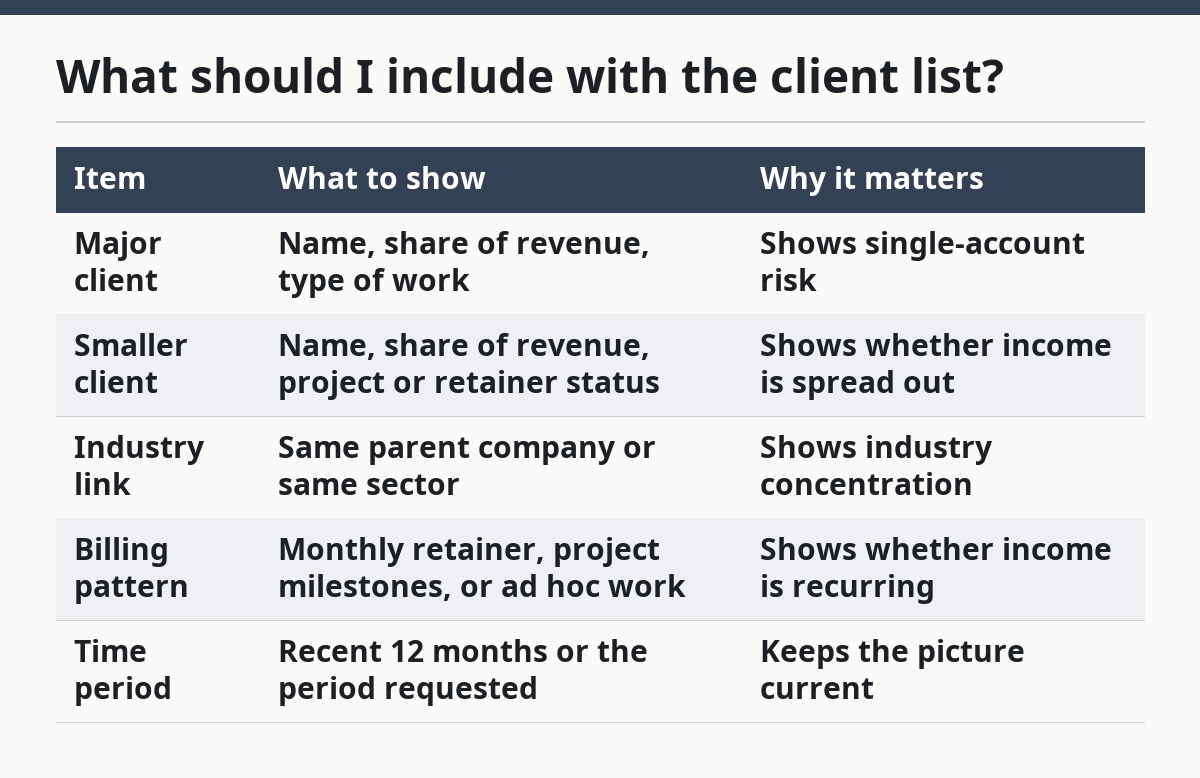
The list should match the revenue breakdown. If the client list names 5 accounts but the top 1 account produces most of the income, that is fine, as long as the numbers are clear. The problem comes when the list and the money story do not match.
This is also where the term book of business helps. In plain English, it means the set of clients and revenue that make up your freelance work. If the book of business is narrow, say so. If it is broad, show that with the list.
What do underwriters look for?
An underwriter looks for whether your income base is stable enough to understand, not whether it is perfect. In a freelance insurance application, concentration is usually a question of predictability, not a moral judgment about your business model.
The first thing underwriters often notice is whether one account drives most of the revenue. The second is whether that account is ongoing or ends after a short project. The third is whether the work sits in one industry, because industry concentration can create shared exposure if that sector slows down.
A retainer can cut both ways. It may show recurring income, but it can also show dependence on one ongoing client relationship. A major client can look strong on paper if the work has lasted for years, but weak if the work is easy to end or replace. The same setup can be read differently depending on the facts you provide.
Underwriters also pay attention to how you describe the business. “I have one major client and several smaller ones” is clearer than “I do work for many brands.” If the application asks for a figure, give the figure. If it asks for a description, keep it factual and brief. A clean answer saves time because it reduces the chance of follow-up questions.
When does concentration need a different approach?
Client concentration needs a different approach when the facts are unusual enough that a short note no longer tells the truth well. In those cases, the issue is not the application line itself; it is that the risk picture has changed.
One client produces nearly all revenue: This means the business depends on a single account — Say that plainly and expect questions about continuity, not just current income.
The client is a related company or parent group: This can hide real concentration inside separate names — Identify the shared control so the underwriter sees the full picture.
The work is fully retainer based and can end on short notice: This means the cash flow is recurring but fragile — Describe the retainer honestly and avoid implying long-term certainty.
The client is in a narrow industry: This raises industry concentration, even if there are several named clients — State the sector and the share of revenue tied to it.
The account recently changed size fast: A sudden jump can make the 12-month picture misleading — Use the period requested and explain the change in one sentence.
Your records do not match the numbers you plan to write: That means the application is not ready — Reconcile the figures before you submit anything.
These cases do not mean you must avoid the application. They mean the explanation should be specific enough that the underwriter can understand the risk without guessing. If the facts are messy or if the application asks for legal wording about contract terms, that is a point to slow down and get qualified help.
What mistakes do people make?
The most common mistake is trying to make concentration sound smaller than it is. That usually backfires, because the underwriter sees the revenue pattern in the client list or the bookkeeping. The better approach is to state the pattern and move on.
Another mistake is giving a long story with no numbers. “I work with several big names” says almost nothing. A clearer line is “1 major client and 2 smaller recurring clients make up most of my 12-month revenue.” The first version sounds polished; the second version is useful.
A third mistake is mixing project work and ongoing work in the same sentence. That blurs the cash flow picture and can make the account look unstable. The correct alternative is to label each client as project based, retainer based, or one-off work.
A fourth mistake is using old data. If the last 12 months changed after a client loss or a new retainer, the underwriter may see the old mix as irrelevant. The fix is to use the period requested and note the change if the form allows it.
A fifth mistake is adding unrelated material, such as pricing strategy or marketing goals, instead of the client concentration facts the application asks for.
How should you judge the final draft?
A good answer fits in a short paragraph and can survive a simple check against your records. If you can read it aloud in 20 seconds and every number matches the client list, the explanation is probably usable.
The final draft should answer 3 questions: who pays you, how much they pay relative to the rest, and whether the pattern is current. If one of those is missing, the underwriter may have to ask again. That extra round can slow the application even when the facts are normal.
A strong draft also avoids overpromising. It does not claim that concentration is harmless, and it does not pretend that a large client is automatically a problem. It simply shows the money flow in a way that makes sense to someone who has never seen your freelance business before.
FAQ
Should I disclose that most of my income comes from one client?
Yes. If most of your income comes from 1 client, that is the core fact the underwriter needs to see. A short, accurate client concentration disclosure is better than a vague answer that leaves the application incomplete.
Will one big client hurt my chances of getting insured?
It can affect how the application is reviewed, but it does not automatically stop coverage from being considered. The impact depends on the rest of the book of business, the type of work, and whether the income looks stable over the recent 12 months.
How much client concentration is too much?
There is no universal line, because thresholds differ by insurer, country, and policy type. If one client controls most of the revenue or the work depends on a single retainer, treat that as a concentration issue and explain it clearly on the application; if you are unsure how your insurer will view it, ask a licensed insurance broker or adviser and follow the form instructions.
Drafted with AI; not yet reviewed by a person.
