

Last updated: November 20, 2026
Quick Answer: A second freelance insurance quote usually takes 3 steps: send the declarations page, reuse the original application, and list any changes since the first quote. How to Get a Second Freelance Insurance Quote Without Reapplying from Scratch starts with the same facts you already gave the first carrier, so you do not have to rebuild your details from zero. The cleanest path is to give the new insurance carrier or insurance broker your current policy information, your declarations page, and any changes since the last quote. If you need a refresher on the paperwork, see the declarations page guide and the freelancer insurance application checklist.
Who this applies to
This applies to a freelancer who already has one quote, one application, or one active policy and wants a second quote for the same kind of freelance insurance coverage. It assumes you already know your basic business details, what work you do, and what your current coverage says on the declarations page, which is the summary sheet that lists the policy’s key terms.
Since this is information, not financial advice, a qualified adviser should be consulted for your own situation because insurance rules, limits, and forms vary by country and change over time. It is a poor fit if your business has changed shape since the first quote, if the prior application was incomplete, or if the new carrier asks for a full underwriting review with fresh documents. The right move depends on whether the second carrier accepts application reuse through a broker or wants a new quote request built from the same data.
The point of this process is not to chase the lowest number on a page. It is to carry the same facts into a second quote so the comparison is based on the same risk profile, not on missing fields or a different story.
Key takeaways

- A second quote can often be built from the same application data if the details are still current.
- The declarations page matters because it tells the carrier what is already in force.
- A broker can sometimes transfer information faster than a direct carrier request.
- Small changes in services, revenue mix, or claims history can force a fresh quote.
- The best result is often a like-for-like quote, not just a new number.
How do I ask for a second quote?
You ask for a second quote by sending the new insurance broker or insurance carrier the same core facts from the first application, plus your declarations page and any changes since the first quote. The goal is to avoid duplicate typing while giving the underwriter enough current information to price the risk.
Start with the exact policy type and effective date you want quoted. Then list your business name, legal entity, work category, location, revenue range if the form asks for it, and any prior losses or claims. If the first application was for a professional liability, general liability, or business owner’s policy, keep the wording consistent so the new carrier is answering the same question, not a different one.
A second quote works best when you keep the same underwriting facts and the same coverage limits. If you change the limit, deductible, or coverage scope, the quote may still be useful, but it is no longer a clean comparison. That matters because a quote for one policy form can look cheaper simply because it covers less.
What should I send first?
You should send the declarations page first, then the original application summary, then any updates that have happened since the first quote. That order helps the broker or carrier see what already exists before they rebuild the file.
The declarations page is the anchor document because it shows the named insured, policy period, limits, deductibles, and endorsements. Add any new information that affects underwriting, such as a new service line, a change in business address, or a new claims event. If you omit a material change, the second quote can come back fast and still be wrong for your situation.
A useful file for this step is usually short: one declarations page, one application copy, and a brief change list. If you cannot find the declarations page, ask for it before requesting the second quote. Without it, the carrier may have to guess at the current policy details, which slows the quote and can lead to a mismatch on terms. For a related checklist, use the quote readiness page before you send anything.
Which route is faster: broker or carrier?
A broker is usually faster when you want one application reused across more than one quote, while a direct carrier is usually simpler when you only want that carrier’s terms. Both can work, but they do not move the same way.
| Route | Best for | What to send | What to skip |
|---|---|---|---|
| Insurance broker | More than one quote request from the same data set | Declarations page, current application, changes since last quote | Re-entering every field into each carrier’s form |
| Insurance carrier | One specific carrier you already want to quote | Current policy details, application data, requested effective date | Comparing several carriers in the same step |
| New full application | Material changes or incomplete prior data | Fresh application with updated facts | Reusing old answers that no longer match the business |
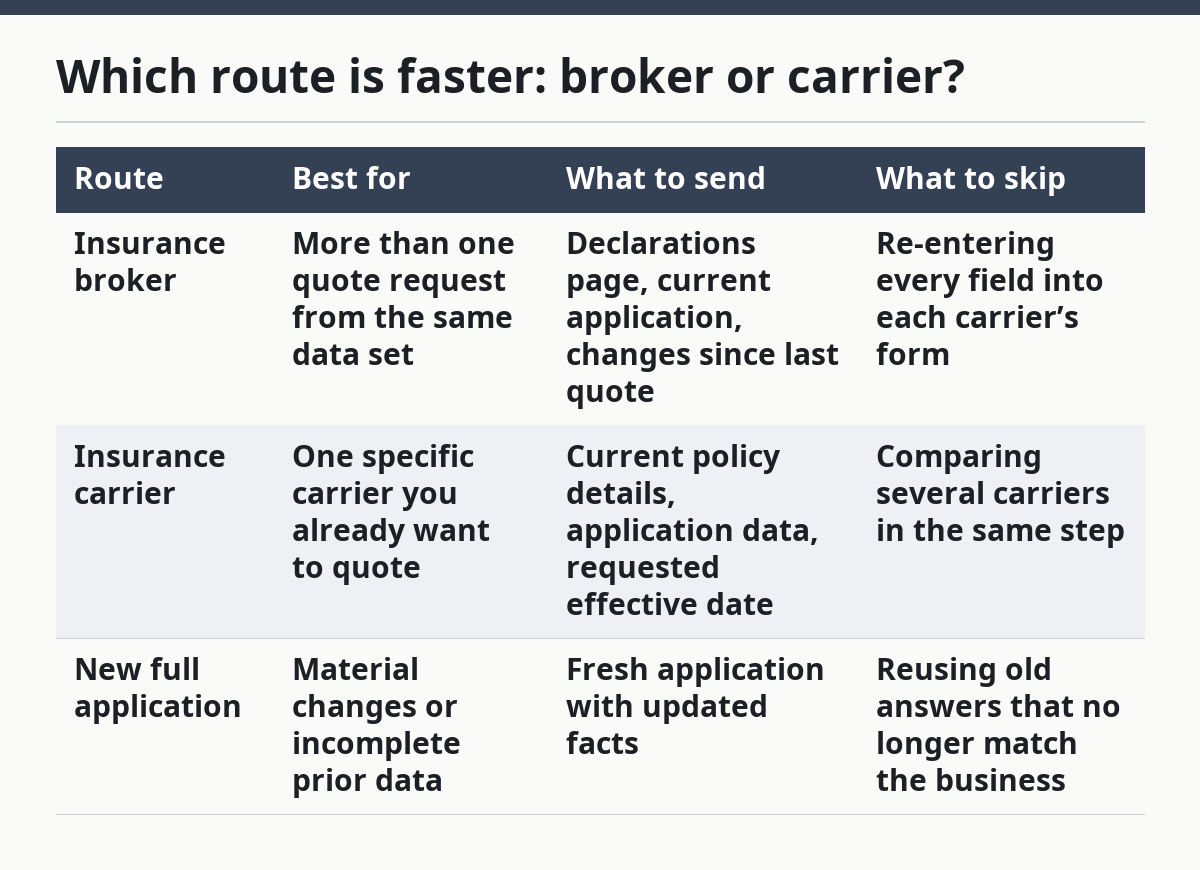
A broker is often the better first stop if the point is reuse. The broker can send the same underwriting package to different markets, then come back with separate quotes. A direct carrier is more useful when the carrier has its own form and wants the file in its own format. If the first quote came through a broker, ask whether the broker can transfer the same package rather than starting a second blank application. For a deeper comparison, see the broker vs carrier guide.
What should I check before I send it?
You should check for six things before you send the second quote request: the policy period, the insured name, the business description, the coverage limits, the deductible, and every change since the last application. Those details decide whether the quote is comparable or distorted.
Because the policy period drives pricing, make sure the start date is the one you actually want quoted. If the first policy starts on one date and the second quote uses a different effective date, the pricing may shift for reasons that have nothing to do with your risk. Second, confirm the insured name matches the legal entity you use for the business. Insurers may treat a sole proprietor, an LLC, and a company using a trade name differently depending on the policy form and state rules, so the exact named insured matters.
Third, check the business description line by line. If your services changed from one client type to another, or from one kind of work to another, the underwriter may need a fresh application instead of reuse. Fourth, check the current policy details on the declarations page against the first quote. A missing endorsement or different limit can make the second quote look cheaper when it is simply narrower.
How long should the second quote take?
A second quote can be faster than the first one when the carrier accepts reused application data, but the timing still depends on whether the file is complete and whether the underwriter needs to ask follow-up questions. If the broker has to collect missing facts, the clock resets.
A clean file is the shortest path: one current declarations page, one consistent application, and a clear note on what changed. A messy file takes longer because the carrier may stop to verify revenue, claims history, service details, or policy dates. If you are waiting on a binding timeline, ask whether the quote is only indicative or whether it can be bound once you accept it. “Bind” means to place coverage in force, usually after the carrier confirms final details and payment terms.
A good result is a second quote that uses the same risk facts as the first and shows whether the carrier is willing to insure the same work on the same terms. A bad result is a quote that arrives fast but leaves out a service, a limit, or a key endorsement. For a practical next step, compare it with your current policy on the coverage review page.
When should I stop and ask for a fresh application?
You should stop trying to reuse the old file when one of these situations applies, because the old answers are no longer a reliable base for the new quote.
1. Your business changed materially: That means the old application no longer describes the work you do — start a fresh application so the carrier prices the current risk.
2. The declarations page no longer matches your target quote: That means the current policy details are out of sync with what you want quoted — ask the broker to rebuild the file.
3. The new carrier asks for a different underwriting form: That means reuse is not available on that market — follow the carrier’s form instead of forcing the old one.
4. You do not know whether a prior claim is included: That means the risk picture is incomplete — gather the claim history before requesting another quote.
5. The first quote was based on incomplete or estimated facts: That means the second quote will inherit bad inputs — correct the data first, then re-request.
6. The binding date is close and details are still changing: That means a rushed quote may not match the final policy — slow down and confirm the final facts before you accept terms.
These are not small technicalities. In insurance, a quote built on stale information can turn into a coverage problem later, and that is the wrong place to find out the file was incomplete.
What mistakes do people make here?
The most common mistake is sending a second quote request without the declarations page. The consequence is usually a delay or a quote that is built on guessed policy details. The better move is to attach the page first so the carrier can see the current limits and endorsements.
Another mistake is treating a second quote like a brand-new shopping trip and changing the story each time. That can create quotes that are not comparable, because one carrier priced a different business from another carrier. If you are unsure what can change without breaking the comparison, consult a licensed insurance professional and keep a written record of the differences you ask for. The correct alternative is to keep the core facts fixed and change only the variables you actually want quoted, such as a limit or deductible. For consumer guidance, the NAIC consumer center explains how insurance shopping and policy details work.
A third mistake is leaving out a new service line because it seems small. The consequence can be a quote that looks fine but does not match the real business. The better alternative is to list every service category that is active, even if it seems minor.
A fourth mistake is asking for a second quote too late in the binding timeline. The result is often a rush, a missing document, or a decision made with one eye on the clock. The correct alternative is to request the second quote while there is still room to correct the file.
A fifth mistake is assuming the broker can automatically transfer everything without checking. The broker may be able to reuse the application, but the carrier still decides what it needs. The safer alternative is to ask what can be reused and what must be re-certified. Your state insurance department may also have filing and shopping guidance, and the NAIC state map can help you find the right office.
When does the standard approach change?
The standard approach changes when the second quote is for a different carrier form, a different policy period, or a materially different business profile. In those cases, reuse may still save time, but it will not replace a fresh underwriting review.
If your policy has a 12-month term and the new quote is for a different effective date, the carrier may re-rate the file because the dates are not aligned. If your work includes multiple service types, the underwriter may ask for a more detailed application than the first one. If the first quote was held by a broker but you now want to go direct to the carrier, you may need to provide the same facts in a different format.
This is also where comparison gets tricky. Two quotes that both say “freelance insurance” can still cover different exposures, use different endorsements, or carry different terms. That is why the declarations page and the current application matter so much: they show whether the second quote is actually answering the same question.
What should I do next if I want the second quote to be usable?
You should make the second quote usable by keeping the file consistent, current, and complete. That means one declarations page, one clean application record, and one short list of changes since the first quote. It also means checking that the quote you receive is a true match on policy type, limits, deductible, and effective date.
If the first quote came from a broker, ask the broker to reuse the underwriting data before rebuilding it. If the second carrier wants a new form, fill it out once and keep the answers aligned with the first file. For a broader step-by-step foundation, the site’s freelancer insurance application and quote readiness hub sits under the same topic and can help you organize the paperwork before you ask for another quote.
For a general external reference on insurance shopping and consumer questions, the National Association of Insurance Commissioners publishes consumer material, and your state insurance department may also explain how quote requests and policy details are handled where you live. Different countries use different rules, so local guidance matters when the quote turns into a binding decision.
Drafted with AI; not yet reviewed by a person.
