

Last updated: November 21, 2026
Quick answer: use 1 to 2 plain sentences that name your service, client type, cadence, and exclusions. Describe the project scope description in exact terms: list what you do, for whom, how long it usually lasts, and what you do not do. On an insurance application, that means matching the application form to your proposal, statement of work, service list, client contract, and the way an underwriter will read your work. For general guidance on insurance applications and underwriting, see the NAIC and the Insurance Information Institute.
This is information, not financial advice. Insurance rules, forms, and underwriting standards vary by country and by insurer, so a qualified adviser should be consulted for your own situation.
Key takeaways
- Say what you deliver in concrete terms, not in broad labels like “creative services.”
- Include boundaries, exclusions, and recurring work, because those facts change how an underwriter reads your risk.
- Keep your description consistent with your proposal, statement of work, service list, and client contract.
- If your work includes advice, data access, or repeated monthly work, say that clearly instead of hiding it in a generic sentence.
- If the application has only a small text box, compress the scope, but do not remove the parts that change risk.
What does the underwriter need to see?

The underwriter needs a short, clear map of what your freelance business actually does. That means deliverables, client industry, service boundaries, and any advisory tasks that sit beside the main work.
A vague label like “freelance marketing” tells the reader almost nothing. A sharper line such as “monthly blog writing, email copy, and light content strategy for small ecommerce clients” gives a much better picture because it names the work, the rhythm, and the type of client. That matters because the application form is not asking for your brand story; it is asking what kind of exposure your work creates.
The project scope description should fit the facts already sitting in your proposal or statement of work. If those documents say you create ad copy, revise two rounds, and do not manage ad spend, the application should say the same thing. If your service list includes consulting calls, website edits, or data handling, those details belong in the scope too.
How should you describe project scope on the form?
Use the application form to give a compact, factual description of the work, then check it against your proposal and statement of work line by line.
- Open the application form and find the business-activities box, then write a one-line scope such as “freelance graphic design for small businesses.” Verify that the sentence names the service, not just the title. A problem is any phrase so broad that it could cover half a dozen professions.
- Pull your proposal and list the main deliverables in 3 to 5 items, such as reports, ads, edits, or consulting calls. Verify that each item is a real output you hand over. A problem is using marketing language that hides the actual work.
- Check the statement of work for time shape, such as one-off projects, weekly work, or monthly retainers, and include that cadence. Verify that the scope reflects duration as well as task type. A problem is leaving out recurring work, which can make the job look smaller than it is.
- Review the service list and separate core services from extra services, then name only what you actually offer. Verify that the list matches your active client work. A problem is including a service you stopped offering 6 months ago.
- Scan the client contract for any advisory tasks, approvals, access to systems, or responsibility for third-party content. Verify that your description includes those duties if they matter to the risk. A problem is calling an advisory role “basic support” when you actually guide decisions.
- Add the client industry in ordinary language, such as ecommerce, health, education, or SaaS, if the form gives space. Verify that the industry is the one you truly serve, not the one you hope to serve later. A problem is guessing, because the underwriter may compare the answer with your invoices or site copy.
- State the boundaries by naming what you do not do, such as no legal advice, no tax filing, no ad budget management, or no custody of client funds. Verify that each exclusion is real and current. A problem is omitting boundaries, because the reader may assume a wider role than you intend.
- Check for scope drift by comparing the last 3 to 5 jobs with the current form entry. Verify that the description still fits your actual work if the business changed over time. A problem is describing last year’s services while your current work has shifted.
What details belong in the scope?

The scope should name the deliverables, timeline, client type, and any advisory work in enough detail for the underwriter to understand the job without guessing.
A useful format is simple: service + client type + cadence + boundary. For example, “monthly SEO blog writing for local service businesses, with no web development or paid ad management” tells the reader far more than “digital marketing.” The first version shows the work, the rhythm, and the edge of the role in one line.
Do not pad the scope with every tool you use. Software such as Google Docs, Figma, or QuickBooks is usually not the point; the point is what you deliver and what could go wrong if the work is delayed, changed, or mistaken. If a tool creates a special exposure, such as access to client systems or customer data, mention the exposure instead of the brand name.
Which boundaries and exclusions matter most?
Boundaries matter because they show where your work stops and the client’s or another professional’s work begins.
If you write copy but do not publish it, say that. If you advise on campaign structure but do not buy ads, say that too. If you review client data but do not keep it after delivery, that is worth stating because it changes how the work is read.
Exclusions are strongest when they are specific. “No legal advice,” “no medical diagnosis,” “no investment recommendations,” and “no payroll processing” are clearer than “limited services.” If an exclusion would surprise a client, it should also be visible in the scope description or service list.
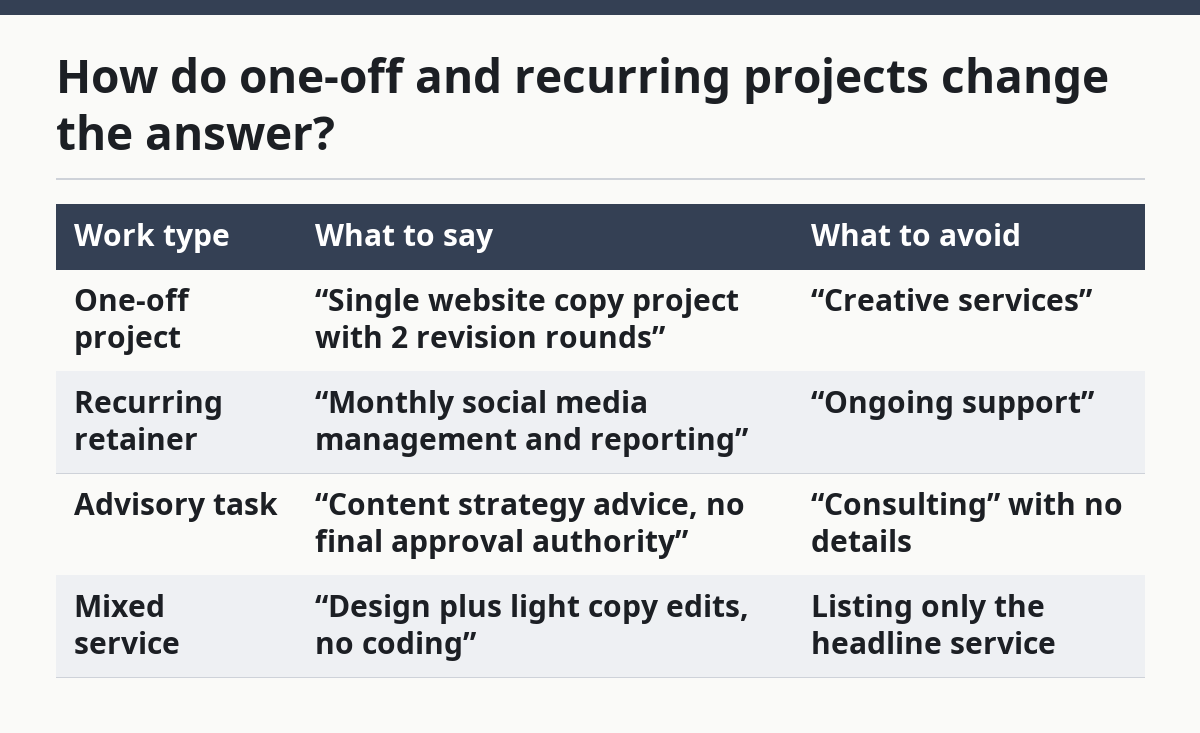
How do one-off and recurring projects change the answer?
Recurring work usually needs more detail than a one-off project because the exposure repeats over time.
A single logo project can be described as a one-time design task with a fixed deliverable and short timeline. A monthly content retainer needs more than that: the application should show that the work repeats, what repeats, and whether the client expects review, revisions, or advisory input each cycle. A 12-month retainer is not just a bigger project; it is a different pattern of risk.
The same idea applies to advisory tasks. If you only give occasional opinion-based feedback, say that plainly. If your role regularly shapes business decisions, that should be visible, because an underwriter may see it as a different exposure than simple production work.
| Work type | What to say | What to avoid |
|---|---|---|
| One-off project | “Single website copy project with 2 revision rounds” | “Creative services” |
| Recurring retainer | “Monthly social media management and reporting” | “Ongoing support” |
| Advisory task | “Content strategy advice, no final approval authority” | “Consulting” with no details |
| Mixed service | “Design plus light copy edits, no coding” | Listing only the headline service |
What if my work changes from client to client?
Describe the common pattern across clients, not the most unusual job you took once.
Freelancers often have a mix of small jobs and larger retainers. The application should reflect the work that appears most often or creates the main exposure. If most of your income comes from writing and a smaller share from strategy calls, the scope should not read like a pure consultant practice. The underwriter needs the real shape of the business, not the most polished version of it.
When your clients sit in different industries, group them into plain categories if the form allows it. “Small businesses,” “software companies,” and “nonprofits” are more useful than a long list of 15 client names. If one industry is unusual or higher-touch, note it. A short, accurate range is better than a long, messy list that hides the pattern.
What mistakes cause trouble?
The biggest mistake is using a title instead of a scope. “Freelance consultant” or “creative professional” sounds neat, but it leaves too much room for misreadings. The fix is to name the deliverable and the client type in the same sentence.
A second mistake is hiding advisory work inside a broad service label. If your work includes recommendations, approvals, or client-facing judgment calls, write that down. Leaving it out can make the application look cleaner, but it also makes it less accurate.
A third mistake is copying the proposal without trimming the sales language. The proposal may sell value; the application should state facts. Words like “transform,” “optimize,” and “full-service” can be too loose unless you pair them with concrete tasks.
A fourth mistake is ignoring exclusions. If you do not manage funds, do not give legal advice, and do not write code, say so. Those limits help the underwriter see where your risk starts and stops.
A fifth mistake is letting scope drift go unmentioned. If your last 6 projects no longer match your old service list, update the wording before the form goes in. Old language can create a mismatch between the application and your current business.
When should you stop and get help instead?
Stop and get qualified help if the form asks about work you do not understand, because a wrong answer can change how the application is read.
Your services include legal, medical, tax, or investment advice: that is a higher-stakes scope than basic production work — a qualified adviser should help you describe it accurately.
Your work touches client money, passwords, or customer data: that creates a different exposure than ordinary design or writing — the scope should be checked against the actual data flow.
Your service mix changed in the last 6 to 12 months: the old scope may no longer match the business — update the description before submitting anything.
The application gives only a tiny text box: compression can hide exclusions or recurring work — ask whether there is room for an attachment or an additional remarks field.
The underwriter asks a follow-up question you cannot answer cleanly: that usually means the scope is still too broad or too thin — pause and clarify the real work first.
How detailed should the description be?
The description should be detailed enough to show what you do, but short enough to fit the form without jargon.
A good rule is to include the service, the client type, the cadence, and any important exclusion in one or two plain sentences. That usually gives the underwriter enough to work with. If the form has room for more, add the most relevant extra detail, such as advisory work or recurring monthly tasks.
Too little detail makes the answer vague. Too much detail can bury the point, especially if you copy full proposal language into a box meant for a summary. The goal is not to impress the reader; it is to make the business easy to classify.
How detailed should project scope be on an insurance application?
It should be specific enough to show the real work, but short enough to stay readable. A sentence or two that names deliverables, client type, cadence, and exclusions is usually clearer than a long paragraph full of sales language. If the form has limited space, put the most risk-relevant facts first.
Should I include one-off projects or recurring clients on the application?
Yes, if they are part of the business you actually run. Recurring clients matter because repeat work changes the pattern of exposure, and one-off projects matter because they show the full range of services. If the mix is uneven, describe the main pattern rather than every exception.
What if my project scope changes after I submit the application?
If the scope changes in a meaningful way, the application may no longer match the business. That can matter for how the work is classified later. The safest move is to update the description or ask for guidance from the insurer or a qualified adviser before relying on the old wording.
FAQ
What is a project scope description on an insurance application?
It is a short summary of the work your freelance business actually performs. It should name the service, the client type, the cadence, and the main exclusions.
How many sentences should I use?
Usually 1 to 2 sentences are enough. Keep the wording plain, specific, and aligned with your proposal or statement of work.
Should I include exclusions in the scope description?
Yes, if they change the risk or prevent confusion. Common examples are no legal advice, no tax filing, no ad budget management, and no custody of client funds.
Do I need to update the scope if my services change?
Yes, if the change is meaningful. A description that no longer matches your current work can lead to a mismatch with how the business is classified.
Drafted with AI; not yet reviewed by a person.
