
Last updated: November 22, 2026
Quick Answer: in 3 steps, save the notice, report it to your insurer, and preserve the work before you reply. If you get a freelance copyright infringement notice, tell your insurer quickly, keep the notice and the related client work together, and do not admit fault or start removing files before you know what the policy requires. This is information, not financial advice; a qualified adviser should be consulted for your own situation.
Key takeaways
- A copyright notice is not the same as a court claim, but it can still trigger reporting duties under an insurance policy.
- A cautious first move is to preserve the notice, the client work, and any deadlines in one place before you reply.
- Your insurer may want the letter, the alleged work, and the timeline, but this page does not cover the full evidence pack.
- A takedown notice, a legal notice, and an intellectual property claim can overlap, so read the wording closely.
- If the notice threatens filing, payment, or a short deadline, get qualified help before you write a detailed response.
What is a copyright infringement notice under insurance?
A copyright infringement notice under insurance is a written allegation that your work may have used protected material without permission, and it can matter even before anyone files a lawsuit. The notice may come as a copyright notice, a takedown notice, or a broader intellectual property allegation tied to client work.
For a freelancer, the insurance issue is not just the accusation itself. It is whether the notice fits the policy’s reporting rules for an intellectual property claim, a legal notice, or a circumstance that could lead to a claim later. The same letter can carry different weight depending on the wording, the deadline, and whether a third party is asking for content removal.
The practical point is simple: the clock may start running before the dispute feels serious. If your policy says you must report potential claims promptly, waiting to “see if it blows over” can create a coverage problem. That risk is why this topic sits under freelance insurance claims and incident response, not under ordinary client complaints.
How should I respond first?
You should respond by preserving the notice, reading the policy language, and reporting the event in a short, factual form. The first response should not be a debate about who is right; it should make sure the insurer gets the incident in time and gets the facts in a clean order.
-
Save the notice in full within 1 day if possible. Keep the email, PDF, letter, attachment, and envelope scan in one folder. Verify the sender name, date, subject line, and any deadline. A problem is any missing page, hidden attachment, or voicemail that changes the deadline.
-
Read the policy wording for 3 things. Check the reporting clause, the intellectual property exclusion or cover grant, and any consent-to-settle language. Verify whether the policy talks about claims, circumstances, or legal notices. A problem is any wording that limits cover to written claims only, because the notice may still need reporting.
-
Mark every deadline on a calendar the same day. Put the notice deadline, any response date, and any insurer reporting date in one place. Verify whether the notice mentions content removal, takedown, or a request to stop using client work. A problem is a deadline that is shorter than your usual internal review time.
-
Write a 5-line summary, not a defense memo. Keep to who sent it, what is alleged, what work is named, when it was received, and what deadline is stated. Verify that you are using the notice’s exact title, such as “copyright infringement notice” or “intellectual property claim,” rather than your own label. A problem is adding blame, excuses, or admissions.
-
Tell your insurer through the channel the policy names. Use the email, portal, or phone number listed in the policy, and keep proof of sending. Verify the date, the policy number, and the incident type. A problem is reporting to a general inbox that cannot time-stamp the notice.
-
Do not change the work package unless the notice asks for removal and your insurer has seen it. Keep the client work, drafts, published files, and source material intact for now. Verify whether the complaint is about text, images, code, or a design asset. A problem is deleting a file before the insurer can review the allegation.
-
Reply only with a short acknowledgment unless you are instructed otherwise. A simple note that you received the notice and are reviewing it is usually safer than a detailed explanation. Verify that you do not admit copying, ownership, or liability. A problem is sending a full apology that could be treated as a concession; if you are unsure, consult a qualified professional and review U.S. Copyright Office guidance before replying.
The point of these steps is to keep the matter within the policy process. If the notice later becomes a formal claim, the insurer can usually work from a clean timeline instead of trying to reconstruct events from scattered emails.
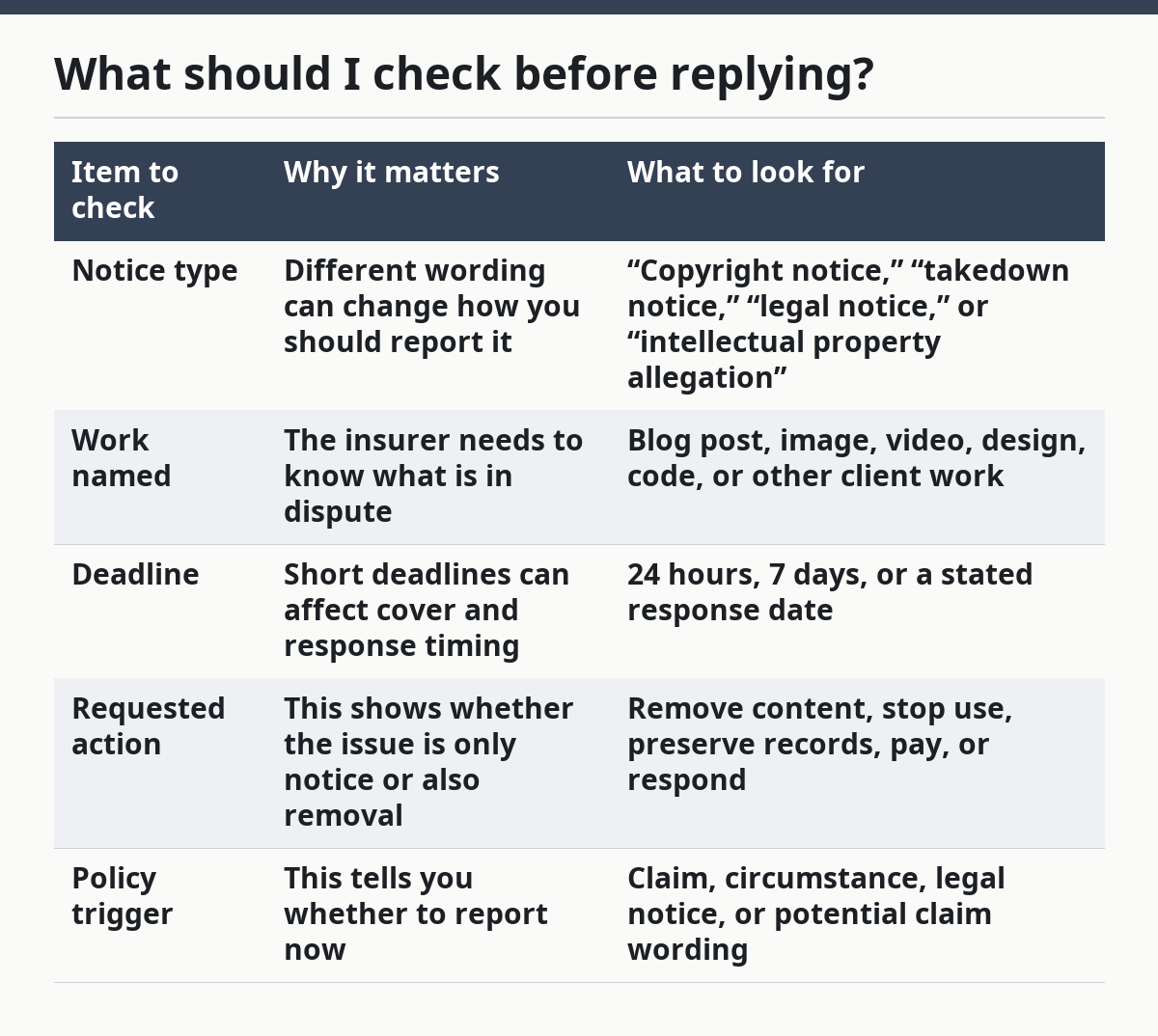
What should I check before replying?
You should check the notice language, the policy trigger, and the work at issue before you write anything substantive. The same 1-page letter can mean different things if it is only a warning, a takedown request, or a legal notice from a rights holder.
| Item to check | Why it matters | What to look for |
|---|---|---|
| Notice type | Different wording can change how you should report it | “Copyright notice,” “takedown notice,” “legal notice,” or “intellectual property allegation” |
| Work named | The insurer needs to know what is in dispute | Blog post, image, video, design, code, or other client work |
| Deadline | Short deadlines can affect cover and response timing | 24 hours, 7 days, or a stated response date |
| Requested action | This shows whether the issue is only notice or also removal | Remove content, stop use, preserve records, pay, or respond |
| Policy trigger | This tells you whether to report now | Claim, circumstance, legal notice, or potential claim wording |
If the notice includes a demand for content removal, the cautious move is to treat that request separately from the liability question. Removal may reduce exposure in some cases, but it can also change evidence if done carelessly. If the policy has a “notify as soon as practicable” clause, waiting to see whether the other side follows through can be the wrong choice.
A generic article often misses the difference between a notice and a claim. That difference matters because insurance policies are built around wording. The notice may start as a warning, but once the sender asks for money, legal action, or a formal defense, the file can move into a different category. For a plain-language overview of takedown notices, see the U.S. Copyright Office and compare it with your policy terms.
When should I stop handling this alone?
You should stop handling it alone when the notice moves beyond a simple allegation or when the policy language is unclear. These are the situations where a qualified adviser, broker, or lawyer can help interpret the notice against the policy and the facts.
The notice threatens a lawsuit or court filing: This means the issue may move from a warning into a legal notice — get qualified help before replying in detail.
The letter demands payment, not just removal: This can change the dispute from content use to compensation, so consult a qualified professional and check the policy wording before you respond.
The deadline is very short and the wording is formal: This may affect your reporting rights under the policy — notify the insurer first and avoid a rushed admission.
The notice names a published asset you cannot easily replace: That can affect how you respond to content removal and evidence retention — preserve the material before any change.
Your policy says you must not admit liability or settle without consent: That means a casual apology can create coverage trouble — wait for instructions.
You are unsure whether the notice is a claim or only a warning: That uncertainty is itself a reason to report it — the insurer can sort the classification. If needed, ask a broker or lawyer to review the wording, since coverage rules vary by policy and jurisdiction; see also IRMI on claims-made policies.
This is not the place to guess. If the notice could affect money, legal rights, or coverage, a 30-minute review with the right professional can save weeks of confusion later.
What mistakes do freelancers make here?
Freelancers usually make the same few mistakes, and each one makes the insurance response harder. The common thread is speed: people try to fix the notice before they have a record of it.
The first mistake is deleting or editing the work right away. That can create a gap in the record, especially if the insurer needs to compare versions. The better move is to preserve the current version and note what the notice says about the exact file or publication date.
The second mistake is sending a long reply that tries to win the argument line by line. A detailed defense can be useful later, but a premature explanation can box you in. A short acknowledgment plus a report to the insurer is usually the cleaner first move.
The third mistake is assuming every copyright notice is just a takedown request. Some are soft warnings, but some are the first step in a formal intellectual property claim. The difference is often in the last 2 or 3 paragraphs, not the subject line.
The fourth mistake is ignoring client work because the client published it. If your policy or contract makes you the insured party for the work, the insurer may still need to know. A notice tied to client work can still affect you even when the client ran the final publication.
The fifth mistake is waiting for a second letter. That can be costly if the first notice already triggered a reporting duty. Insurance often cares about when you first knew, not when the dispute escalated.
What if the notice is really a takedown notice?
A takedown notice is handled as a content removal problem first and a coverage question second, but the two can overlap. If the notice asks for removal from a site, platform, or public page, the action may need to happen quickly while the insurer is still reviewing the file.
This is where plain wording matters. A copyright notice may ask for removal only, while a legal notice may ask for removal plus payment or a response by a fixed date. If you work from a client brief, a portfolio page, or a social post, check which 1 item the notice actually targets rather than assuming the whole project is affected. The Digital Millennium Copyright Act is the main U.S. law behind many takedown processes.
The practical trade-off is obvious: removing content may reduce immediate friction, but it can also erase context if you do it before saving the record. That is why the safer sequence is usually preserve first, then report, then act under guidance. A fast takedown without records can leave you unable to explain what was removed or why.
What does a good response look like?
A good response is short, timely, and consistent with the policy wording. It identifies the notice, preserves the work, reports the issue, and avoids admissions that are not necessary at the start.
In practice, that means one clean record, one clear report, and one restrained reply. It does not mean arguing about copyright law in an email thread, and it does not mean publishing your side on social media. It also does not mean assuming the insurer will handle everything without input; the policy may still require facts, dates, and copies of the notice.
A strong result is usually boring: the notice is logged, the deadline is visible, the insurer has been told, and the work is still intact. That is a better outcome than a dramatic response that feels decisive for 10 minutes and causes a reporting problem later.
How does this fit into the rest of freelance incident response?
This topic fits into incident response because a copyright infringement notice is one of several possible triggers under freelance insurance. It sits alongside other intellectual property claims, content removal requests, and legal notices that can affect a policy even when the dispute starts small.
The main rule is to treat the notice as an event, not a mood. If you handle it like a normal client complaint, you may miss a reporting duty. If you treat it like a formal lawsuit when it is only a warning, you may overreact. The right response is controlled, documented, and tied to the policy language in front of you.
For the fuller claim path and related incident steps, this page sits inside the wider freelancer insurance claims and incident response hub. That matters because the same file may later need a claim decision, a defense review, or separate evidence handling.
FAQ
does copyright notice go to the insurer?
Yes, if your policy treats it as a claim, a circumstance, or a legal notice that must be reported. The safest course is to report it promptly and let the insurer classify it, because the wording of the notice and the policy can both matter. A short, factual report is better than waiting for the dispute to grow.
what should i preserve after a copyright notice?
Preserve the notice, the exact work named, the publication or delivery date, and any related client messages. Keep drafts, source files, attachments, and the deadline information together in one place. If the notice mentions content removal, save the page or file before changing anything so the record stays clear.
is an infringement notice a claim?
Sometimes it is, and sometimes it is only a warning or a request to remove content. The words on the page matter, as does your policy wording, so a notice should be treated as something to report and classify, not something to guess about. If the notice asks for payment, legal action, or formal response, it is closer to a claim.
Drafted with AI; not yet reviewed by a person.
