
Last updated: November 22, 2026
Quick answer: send 1 notice through the policy’s named channel as soon as you spot a possible claim. In How to Notify a Freelancer Insurer About a Potential Professional Liability Claim, the point is to alert the claims department, give the basic facts, and keep a record of when and how you sent it. This is a notice of claim issue, not a debate about fault or coverage.
Key takeaways
- A potential claim should be reported under the policy’s notice rules, even if no demand letter has arrived yet.
- The policy period matters because some professional liability policies are claims-made; timing can affect whether the insurer treats the notice as covered. Consult a professional if the wording is unclear. See the Insurance Information Institute on claims-made coverage and IRMI on claims-made policies.
- The notice should be factual and brief at the start: who is involved, what happened, when it happened, and what document or message triggered concern.
- The contact method matters. If the policy names a notice form, portal, or claims department address, use that route first.
- A reservation of rights means the insurer may investigate while still preserving the right to deny or limit coverage later.
Who should send the notice?
The freelancer should send the notice if the policy is in the freelancer’s name, and the notice should go out even when the event looks small. This applies to anyone who has a professional liability policy, a policy period already running, and a possible claim tied to work done under that policy.
It also applies when the issue starts as a complaint, not a lawsuit. A client email, a request to redo work, a threat to withhold payment, or a formal demand can all point to a potential professional liability claim. The key term is claim notice: the report sent to the professional liability insurer that tells it a covered event may have happened and asks it to open a file.
This is not for every dispute. If the policy is not a claims-made policy, or if the issue clearly falls outside the policy language, the timing and method can change. A qualified adviser should be consulted for the freelancer’s own situation, because insurance wording and country rules differ. The guide to freelancer insurance claims and incident response covers the larger process; this page stays on the notice step only. See also professional liability insurance.
How do you send the notice?
You send the notice by following the policy instructions exactly, then keeping proof that it reached the claims department. The safest approach is usually to use the notice form or portal named in the policy, and to treat email as backup unless the policy says email is enough.
- Open the policy and find the notice clause. Check the policy period, the claims-made wording, and any address, portal, or email listed for notice. Verify whether the policy asks for “prompt” notice, “immediate” notice, or a specific form. A problem is any gap between what the policy requires and how you plan to report it.
- Identify the event that triggered concern. Write down the date you first learned of the issue, the client name, the project, and the document that raised the risk, such as a complaint or demand. Verify that the event happened during the policy period or is tied to work done during it. A problem is waiting until the facts blur.
- Use the insurer’s notice channel first. If the policy names a notice form, submit it through that route; if it names a claims department email, send it there. Verify that the subject line and form title match the insurer’s instructions. A problem is sending it to a general inbox and assuming that counts.
- Give the core facts in 4 parts. State who is involved, what happened, when it happened, and why the matter may turn into a claim. Keep the first notice factual and short; leave out argument and blame. Verify that the notice says enough for the claims department to open a file. A problem is a notice that reads like a dispute letter instead of a report.
- Attach the documents the policy asks for. Include the demand letter, complaint, contract, statement of work, or client message if the policy requires them. Verify that each attachment is readable and dated. A problem is sending a file with missing pages or a blurry scan.
- Send it in a way you can prove. Save the sent email, portal confirmation, or stamped receipt in one folder. Verify the date, time, and recipient. A problem is having no record if the insurer later says it did not get notice.
- Ask for the file number or claim reference. If the insurer gives one, write it on every later message. Verify that the claims department acknowledges receipt. A problem is assuming the notice is logged without confirmation.
- Track any follow-up deadline in the same calendar. If the insurer asks for more detail, note the deadline and respond in the format requested. Verify that later messages stay tied to the same claim reference. A problem is starting a second thread that splits the record.
The clean result is simple: the insurer has enough information to open a file, the freelancer has proof of notice, and the policy period issue is preserved for review. If the policy says notice must be sent by a certain method, a different route may weaken the position later.
What should be in the first notice?
The first notice should include the minimum facts the claims department needs to identify the event and open a file. That usually means the insured freelancer’s name, the policy number if available, the client or third party involved, the project, the date of the work or complaint, and a short description of why the matter may become a professional liability claim.
A notice form often asks for the same items in a fixed layout, which helps prevent missing fields. If the form asks for the amount at issue, list the claimed amount only if the number is already in the demand or invoice dispute. If the policy asks for attachments, include them; if it does not, do not overload the file with irrelevant material.
Do not turn the notice into a defense brief. The first report is not the place for a 12-page explanation, witness analysis, or coverage argument. It is enough to show that a real issue exists. A short notice can be better than a long one if it is complete and timely.
One practical check helps: if a person at the insurer could not tell which project, which client, and which event the notice is about in 30 seconds, the notice is too thin. If the notice tries to prove the freelancer did nothing wrong, it is usually too busy.
Which policy details matter most?
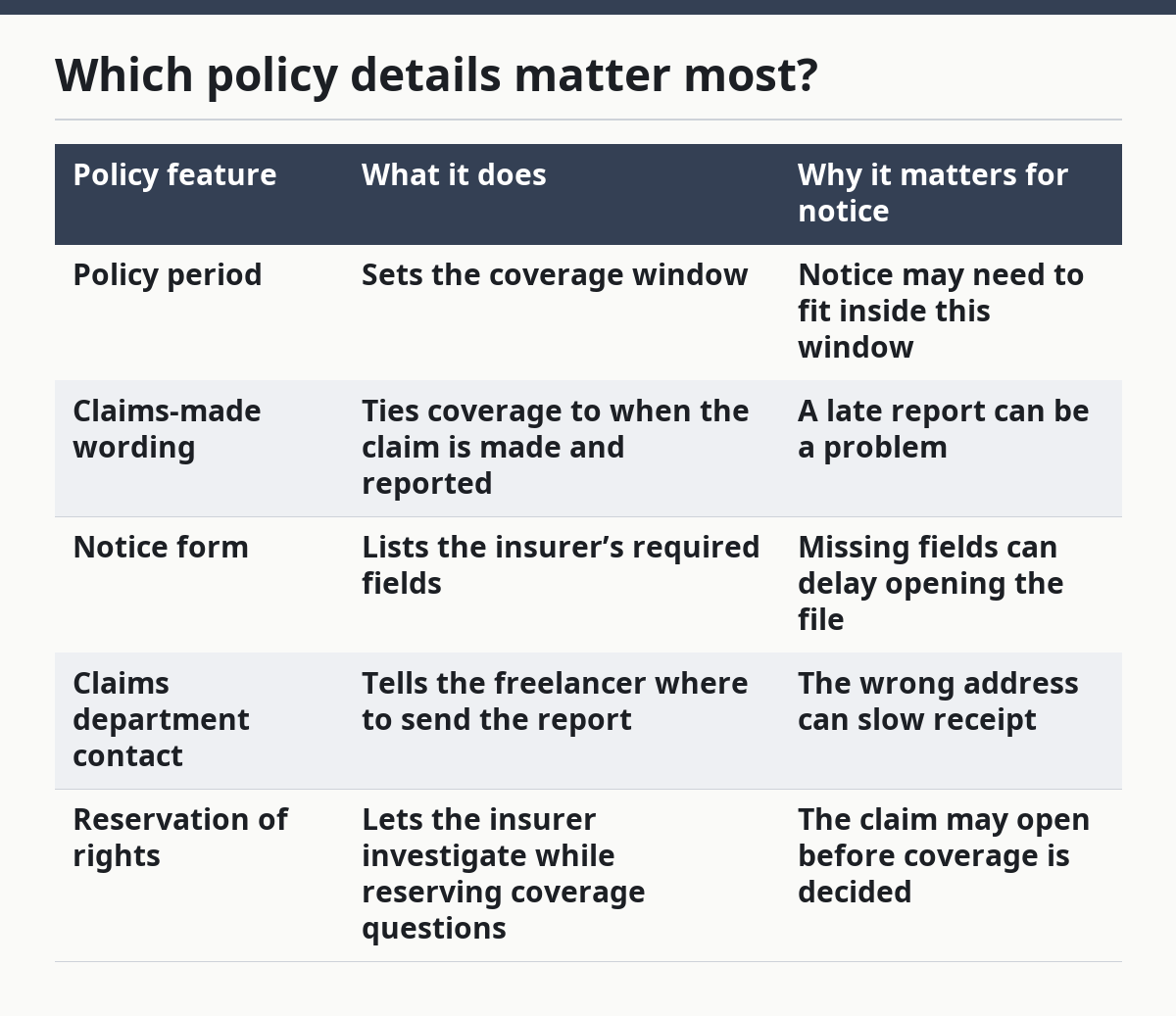
The policy period, notice language, and claims-made wording matter most because they control whether the insurer treats the event as timely. Professional liability policies for freelancers often depend on when the claim is first made and when it is reported, so the timing of notice can matter as much as the event itself. Consult a professional if the wording is unclear. See the Insurance Information Institute and IRMI.
A claims-made policy means the claim usually has to be made and reported during the policy period, or during any extended reporting window if the policy has one. A notice-to-insurer rule may also require prompt reporting once the freelancer becomes aware of a circumstance that could lead to a claim. Those are not the same thing, and the policy may use both.
| Policy feature | What it does | Why it matters for notice |
|---|---|---|
| Policy period | Sets the coverage window | Notice may need to fit inside this window |
| Claims-made wording | Ties coverage to when the claim is made and reported | A late report can be a problem |
| Notice form | Lists the insurer’s required fields | Missing fields can delay opening the file |
| Claims department contact | Tells the freelancer where to send the report | The wrong address can slow receipt |
| Reservation of rights | Lets the insurer investigate while reserving coverage questions | The claim may open before coverage is decided |
The trade-off is plain: being early is usually better than being polished. A weak, late notice can create more trouble than a simple notice sent quickly through the right channel.
What if the insurer sends a reservation of rights?
A reservation of rights means the insurer is handling the notice while reserving the right to deny or limit coverage later. It is not the same as a denial, and it does not end the claim. It is the insurer saying, in effect, “I am looking at this, but I have not given up any coverage arguments.”
If the freelancer gets one, the main move is to keep the claim file organized and keep every response tied to the same issue number. The notice step is still valid if the claim was reported properly. What changes is that the insurer may ask for more facts, more documents, or a clearer timeline before it decides what coverage position to take.
A reservation of rights can also mean the insurer sees a possible policy problem, such as late notice, a scope question, or a policy-period issue. That is why the first notice should be accurate and dated. The notice itself may become part of the coverage review.
This is one point where a qualified adviser is useful. The notice step can be handled by the freelancer, but the meaning of a reservation letter can affect rights in a way that depends on policy language and local law.
What mistakes cause the most trouble?
The most common mistake is waiting for a formal demand letter before reporting the issue. That can leave the notice outside the policy’s preferred timing, and in a claims-made setup timing is part of the coverage question. The better alternative is to report the circumstance as soon as it looks like it may become a claim.
A second mistake is sending a long, argumentative email instead of using the notice form or claims department channel named in the policy. That can confuse the file opening process and make the report harder to sort. The better alternative is a short factual notice with the required attachments.
A third mistake is leaving out the policy number, project name, or date of the event. That slows the claims department and can delay acknowledgement. The better alternative is to copy those identifiers from the policy and the client file before sending.
A fourth mistake is assuming a copied message to the broker or agent counts as notice to the insurer in every case. Sometimes it does not. The better alternative is to send notice to the insurer the policy names, then copy anyone else only as extra recordkeeping.
A fifth mistake is deleting drafts, sent emails, or portal receipts after the claim is filed. That creates a proof problem later. The better alternative is to save one clean folder with the notice form, confirmation, and any reply.
When should you stop and get qualified help?
You should stop and get qualified help when the notice issue is tangled with coverage, deadlines, or outside parties. That is where a do-it-yourself notice can still be sent, but the next move should be reviewed by a qualified adviser who can look at the policy wording and local rules.
The policy is claims-made and the date looks close: that can change whether the event belongs in the current policy period — get help before sending if the date of the claim and the date of notice are uncertain.
The insurer’s instructions conflict with the broker’s advice: that can create a record problem — follow the policy first and ask a qualified adviser to sort the conflict.
The notice involves more than one client or one project: that can affect how the insurer groups the claim — get help if one report might need more than one claim reference.
The insurer sends a reservation of rights or asks about late notice: that can affect coverage position — get help before answering with a long explanation.
The matter has a lawsuit, arbitration, or formal demand attached: that can bring procedural deadlines into play — get help if a response date is already running.
The policy uses unusual wording, such as a prior-knowledge condition: that can change when the duty to notify starts — get help before assuming the standard rule applies.
Can a freelancer notify before a formal demand arrives?
Yes, a freelancer can often notify before a formal demand arrives if the policy allows notice of a circumstance that may lead to a claim. This is common in professional liability policies, but the wording matters, so the notice should follow the policy language rather than a general rule.
A good example is a client complaint that says the work caused a loss, even if no demand letter has been sent. Another is a written threat that a claim will follow unless the issue is fixed. In those cases, the notice tells the insurer that the file should be opened now, not after the formal paperwork appears.
The benefit is timing protection. The drawback is that early notice can bring more questions, and the insurer may ask for follow-up facts before it decides anything. That is normal. A clear first notice is usually better than waiting for the dispute to grow into a bigger one.
What should be included in a claim notice?
A claim notice should include the insured freelancer’s details, the client or third party involved, the project or service, the date the issue arose, and a short factual description of the potential claim. If the policy requires a notice form, the same details should be entered in the fields it asks for, plus any documents the form requests.
How quickly should I notify the insurer?
The notice should go out as soon as the issue looks like it may become a claim, especially if the policy says “prompt” or “immediate” notice. The exact timing rule can differ by policy and country, so consult a professional if the deadline is unclear and do not wait for a formal demand if the claim is already possible.
Can I notify before a formal demand arrives?
Yes, and that is often the wiser path when the policy lets you report a circumstance that may lead to a claim. A complaint, threat, or written dissatisfaction can be enough to start the notice process. The claim form or claims department can then decide whether to open the file now or ask for more detail later.
Drafted with AI; not yet reviewed by a person.
