

Last updated: November 22, 2026
Explain the seasonality plainly, show the pattern over 12 months, and connect the busy months to the off-season without pretending the income is flat. A seasonal freelance income pattern is easier for an underwriter to read when you describe when work arrives, why it rises and falls, and how the quote application matches the business plan.
Key takeaways
- Seasonal income is not the problem; unexplained income is.
- An underwriter wants a clear 12-month pattern, not a guess about one strong month.
- A busy season, an off-season, and project cadence should all appear in the explanation.
- The goal is to make revenue variability understandable, not to hide it.
- If the pattern is unusual or the numbers do not line up, a qualified adviser should review the file.
Who should use this approach?

This approach fits freelancers whose income rises and falls in a predictable cycle, such as work tied to holidays, weather, school terms, or industry events. It assumes you already have basic records: invoices, bank deposits, a simple profit-and-loss summary, and a short business plan that explains how work comes in across the year.
This is information, not financial advice, and a qualified adviser should be consulted for your own situation. It is not the right fit if your income is random, if your records are missing for several months, or if you cannot explain why the revenue swings happen. In those cases, the underwriter is not seeing seasonality; they are seeing uncertainty.
A seasonal pattern is also easier to explain when the quote application asks for business type, years in business, and income figures in separate fields. If the forms ask for income by month, use them. If they ask for annual income only, do not force a monthly story into a yearly box unless the form invites it.
For broader context on the underwriting side of freelancer files, this page sits under the hub on freelancer insurance underwriting and eligibility. The point here is narrower: how to explain timing, not how to report income mix or client concentration.
What does “seasonal income pattern” mean?
A seasonal income pattern means revenue arrives in clusters that repeat around the same time each year. The pattern is the story an underwriter is looking for, because it shows the swings are tied to a business cycle rather than to weak recordkeeping.
The simplest way to say it is: “I earn most of my freelance income during [busy season], and I work lighter in [off-season].” That sentence works because it gives the underwriter a reason, a time frame, and a cue to look for consistency across 12 months, not just the last 30 days.
The term “revenue variability” means how much income changes from one month to the next. A little variability is normal for freelance work. What matters is whether the movement is explainable and whether the business plan shows how the lower months are handled.
An underwriter is not trying to punish seasonality. They are trying to answer a risk question: does this income pattern support the type of coverage being applied for, or does it suggest the file needs more review? Clear language helps them get to that answer faster.
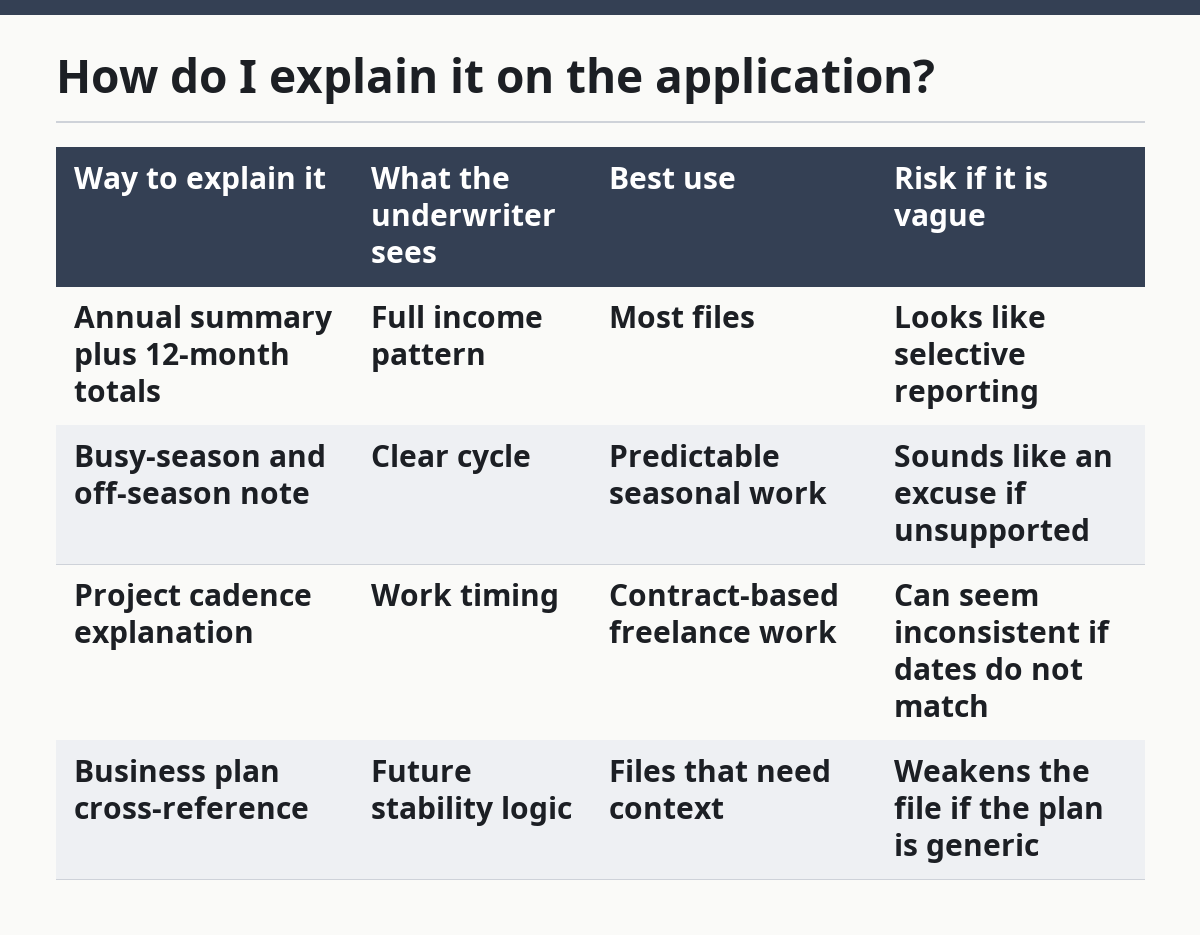
How do I explain it on the application?

You explain it by linking the numbers, the calendar, and the business plan in one consistent story. Start with the annual pattern, then show the months, then point to the reason the income rises and falls.
-
Write one plain sentence that names the cycle.
Say when the busy season starts and ends, and when the off-season usually appears. Use a time span the underwriter can picture, such as “late spring through early fall” or “November through February.” Verify that the dates match your invoices. If the months on the form do not match your own records, that is a problem. -
Show the last 12 months, not just the strongest month.
A 12-month view gives the underwriter context for revenue variability. Use bank statements, invoices, or a simple monthly summary if the application allows attachments. Verify that the total ties to your records. If the application only shows one strong month, the pattern can look inflated. -
Separate busy-season revenue from off-season revenue.
Point out which months usually carry the most work and which months are slower. This is not the same as hiding weak months; it is explaining them. Verify that the slower months are still present in the file. If the off-season is missing, the underwriter may think the records are incomplete. -
Connect the pattern to project cadence.
Project cadence means the rhythm of jobs, such as a few larger projects in peak months and fewer smaller jobs in slow months. State whether work comes from recurring clients, event cycles, renewals, or deadlines. Verify that your explanation matches the billing dates. If jobs cluster in one quarter for a reason, say so. -
Match the explanation to the business plan.
The business plan should say how the work is found, when it peaks, and how the slower stretch is managed. Keep the language consistent with the application. Verify that the plan and the income figures do not tell different stories. A mismatch is one of the fastest ways to trigger questions. -
Use ordinary language, not hype.
Say “income goes down in January and February” instead of dressing it up as “dynamic market timing.” Underwriters read many files a day; simple wording helps. Verify that each sentence can be checked against a record. If a sentence depends on hope or a future contract, leave it out. -
Attach a short note only when the form allows it.
A brief note can explain why a 3-month dip is normal or why a major contract moved the calendar. Keep it factual and tied to documents. Verify that it does not add new claims. If it introduces a new story, it creates more work, not less.
| Way to explain it | What the underwriter sees | Best use | Risk if it is vague |
|---|---|---|---|
| Annual summary plus 12-month totals | Full income pattern | Most files | Looks like selective reporting |
| Busy-season and off-season note | Clear cycle | Predictable seasonal work | Sounds like an excuse if unsupported |
| Project cadence explanation | Work timing | Contract-based freelance work | Can seem inconsistent if dates do not match |
| Business plan cross-reference | Future stability logic | Files that need context | Weakens the file if the plan is generic |
What should I show to the underwriter?
You should show records that make the seasonal income pattern easy to verify in 5 minutes, not 30. The best file is one where the underwriter can move from the quote application to the supporting numbers without guessing.
A simple packet usually includes a 12-month income summary, invoices, bank deposits, and a one-page business plan. If your application asks for recent income only, do not stop there if the recent period was unusually strong or weak. A 1-month snapshot is often misleading for seasonal work.
The business plan should explain the pattern in business terms: where work comes from, what months are strongest, and how the schedule repeats. It does not need to be long. It does need to match the records. If the plan says summer is busiest and the invoices show the opposite, the underwriter may question the whole file.
A clean explanation also helps the underwriter separate temporary dips from a broken revenue model. That matters because a seasonal slowdown is different from a business that cannot hold work at all. The first can be understood; the second may need more review.
If you are unsure how the insurer reads the paperwork, check the form instructions and the insurer’s own request list. For U.S. readers, the IRS Schedule C and Publication 334 are useful references for how income records are organized, even though they are tax forms rather than underwriting forms: IRS Schedule C and IRS Publication 334.
What mistakes make the explanation weaker?
The weakest explanations are the ones that sound polished but do not line up with the records. Underwriters usually notice that faster than a messy but honest file.
Smoothing the numbers into a fake average: This hides the real cycle and can make the file look staged — use the actual monthly pattern and explain it.
Only showing peak months: This makes the income look better than it is and leaves the off-season unexplained — include the slow months too.
Using vague phrases like “it varies a lot”: That tells the underwriter nothing useful — name the months and the reason for the swing.
Sending a business plan that does not match the deposits: That creates a credibility problem — revise the plan so it matches the records.
Treating one strong quarter as proof of stability: One quarter is not a full pattern — show at least 12 months when the form or reviewer asks for context.
These mistakes do not always lead to a denial, but they do lead to more questions. More questions mean more delay, and delay can matter if the quote application has a deadline.
When does the standard explanation not fit?
The standard explanation does not fit when the pattern is new, extreme, or hard to document. In those cases, the issue is not only seasonality; it is whether the file has enough proof to make the pattern believable.
First year in business: There is not enough history to show a repeatable cycle — use the strongest records you have and expect closer review.
One very large client drives the peak season: The pattern may look seasonal but really reflects client dependence — the underwriter may ask for more context.
Income changed after a major life event or contract shift: Last year may not represent the current business — explain the break in the timeline clearly.
Records are incomplete for 2 or 3 months: The underwriter cannot see the off-season properly — gather missing statements before you submit.
The business is seasonal in name only: If income is really irregular, not seasonal, calling it seasonal can backfire — describe the true pattern instead.
The right move in these cases is usually not to polish the wording harder. It is to slow down, gather the right records, and let a qualified adviser review the file if the application has serious money consequences.
How should I say it in plain English?
You should say it in one short paragraph that a stranger can understand without finance terms. Plain English is better than a polished paragraph that hides the actual cycle.
A workable version sounds like this: “My freelance income is seasonal. Most of my work comes in from April through September, and my income is lower in the winter months. The pattern matches my project schedule, and the attached records show the last 12 months.”
That kind of wording helps because it gives the underwriter the three things they need: a season, a reason, and a record trail. It also avoids sounding defensive. If the situation is more complex than that, add a second sentence rather than turning the note into a speech.
The goal is not to make seasonal income look steady. The goal is to make it understandable enough that the underwriter can judge it on facts instead of guesswork.
FAQ
Does seasonal income affect approval?
Yes, it can affect how the file is reviewed, because the underwriter has to understand the income pattern before deciding what it means. Seasonal income is not automatically a problem, but unclear seasonal income can slow the process or lead to more questions. The key is whether the records show a repeatable cycle across 12 months.
How do I show income stability to an insurer?
Show stability by showing consistency inside the cycle, not by pretending every month is equal. A 12-month summary, clean invoices, bank deposits, and a business plan that matches the records all help. If the off-season is regular and explained, that often reads as more stable than a messy attempt to flatten the numbers.
Should I expect questions about revenue swings?
Yes, you should expect them if the income rises and falls in a visible pattern. That is normal under underwriting review, especially when the quote application asks for recent income or business history. Short, factual answers tied to the records usually work better than long explanations that drift away from the numbers.
Drafted with AI; not yet reviewed by a person.
