

Last updated: November 24, 2026
Quick answer: check 3 things first — license, freelance experience, and how the person is paid — before you share business details. To pick a How to Pick a Freelance Insurance Broker or Agent intermediary, start with those 3 checks and do not hand over contracts or revenue until they pass. For a freelancer, the right intermediary should understand professional liability insurance, general liability insurance, and how your work changes from job to job. This is information, not financial advice; a qualified adviser should be consulted for your own situation.
Key takeaways
- A good broker or agent should be able to explain the difference between a captive agent and an independent broker in plain language.
- License status matters first. If the person cannot show a valid state insurance license, stop there.
- Freelance work brings messy risk: contracts, short projects, changing clients, and different liability exposures.
- Fee disclosure should be clear before any quote work starts, including whether the broker is paid by commission, fee, or both.
- A strong fit is someone who asks about your work, not someone who rushes straight to a price.
What should a freelance insurance broker do?
A freelance insurance broker should match your work, your contracts, and your risks to the right carrier options. That means the broker should know how professional liability insurance differs from general liability insurance, and why a graphic designer, consultant, contractor, or writer may need a different mix than a full-time employee.
A generic sales agent often starts with a product. A good broker starts with your work pattern: who you serve, what you promise in writing, whether you handle client data, and whether you go on-site. If the person cannot explain why one policy form fits freelance work better than another, that is a warning sign.
Here is the simplest way to think about the job. The broker helps you compare carriers and policy terms. The agent sells insurance, but the range of options can depend on whether that agent is captive or independent. A captive agent usually works for one insurer. An independent broker or independent agent can often quote from more than one carrier, though that still depends on the market and the states involved.
| Type | What they usually represent | What that means for you | Main trade-off |
|---|---|---|---|
| Captive agent | One insurance company | Fewer carrier choices, simpler sales process | Less room to compare across the market |
| Independent broker or agent | More than one insurer, depending on appointment | More room to compare terms and pricing | More variation in service quality |
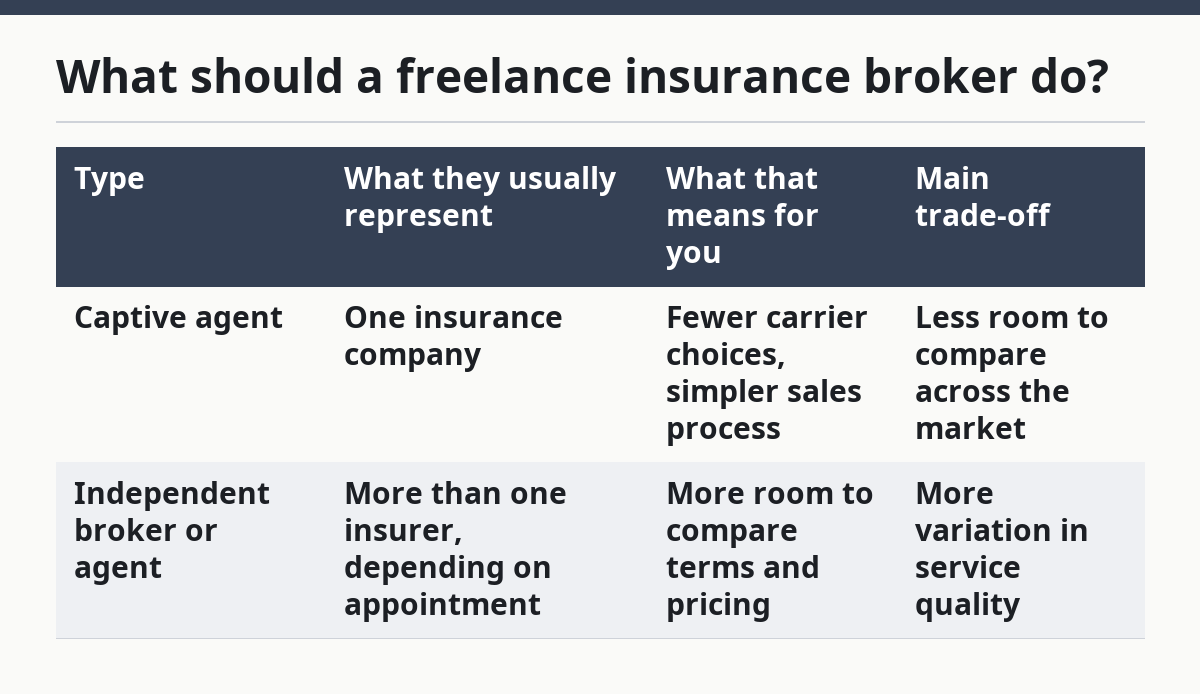
A freelance insurance broker is usually the better fit if you want choice and comparison. A captive agent can still work if that carrier already fits your needs, but it is harder to know whether a better option exists elsewhere.
How do I check a freelance insurance broker’s license?
You check a freelance insurance broker’s license by verifying the person’s state insurance license on the state regulator’s site before you discuss coverage. A valid license should match the state where they are allowed to sell or place insurance, and the name should match the person or agency you are dealing with.
Start with the state department of insurance or the state insurance regulator. Many states have online lookup tools, and the National Association of Insurance Commissioners points consumers toward state regulators through its consumer resources at https://content.naic.org/consumer. If the broker says they are “licensed nationwide,” ask which states that covers and whether they are licensed where you live or where your business is based.
Verify 3 things: the license is active, the name matches, and the license type fits the work. A problem appears if the broker dodges the question, gives you a business name only, or says license details are “not important.” They are important because insurance rules are state-based, and a license is the basic gatekeeper for legal sales and service.
A second check is complaints or disciplinary history if your state publishes it. That does not mean one complaint ends the conversation, but a pattern of license problems, missed appointments, or discipline is a clear warning. If you cannot verify the license in 5 minutes, do not move forward. If you are unsure what the record means, check with your state regulator or a qualified adviser.
How do you compare broker vs captive agent?
You compare a broker vs a captive agent by asking how many insurers they can approach and what happens if the first quote does not fit. That comparison matters because a freelancer may need a blend of policies, and one carrier may be strong on one line but weak on another.
A captive agent is usually tied to one company, so the process can be faster and more uniform. That can help if you already know the carrier or want a narrow set of choices. The downside is obvious: the person cannot shop the wider market, so you may not see how other carriers handle professional liability insurance, general liability insurance, or endorsements that matter for freelance contracts.
An independent broker or independent agent can bring more options to the table, but that does not guarantee better advice. Some only place certain lines, and some are better at personal policies than business coverage. Ask directly: “Which carriers do you place for freelancers, and how many of them write this kind of business?” If the answer is vague, the comparison is weak.
This choice is not about “best” in the abstract. It is about fit. If you need a narrow, simple transaction, a captive agent may be enough. If your work changes often, your contracts are picky, or you need to compare terms across carriers, an independent broker is usually the more useful starting point.
What questions should I ask before I share my business details?
You should ask a short set of direct questions before you hand over tax IDs, client contracts, or revenue details. A good first call lasts 10 to 20 minutes and should make the broker explain their process, not just yours.

Use these questions:
- What kind of freelance clients do you usually work with?
- Which carriers do you place for professional liability insurance and general liability insurance?
- Are you a captive agent, an independent agent, or a broker?
- How are you paid, and do you charge any fee on top of commission?
- What state insurance license do you hold, and where can I verify it?
- What information do you need from me before you can quote?
- What happens if my contract needs a certificate of insurance or a specific endorsement?
A useful answer should be concrete. If the person says they help “all businesses,” that is too broad. Freelance work often turns on details like project-based revenue, subcontracting, client-mandated limits, and whether you work from home or on-site. A broker who cannot speak to those details may still sell a policy, but that does not make them a good fit.
One more check: ask them to explain, in plain English, the difference between claims-made and occurrence-based coverage if they mention professional liability insurance. A broker does not need to lecture you, but they should be able to explain the basics without jargon. If they cannot, keep looking.
What fee disclosures should I get in writing?
You should get the broker’s fee structure in writing before any quote work begins. That disclosure should say whether the broker is paid by carrier commission, a client fee, or both, and whether the fee changes by policy line or carrier.

The reason is simple: compensation can affect incentives even when the broker is acting properly. A commission is not automatically bad, but you should know whether the broker is being paid by the insurer, by you, or by both. If a fee exists, ask what service the fee covers, such as market search, policy placement, certificate help, or renewal review.
A problem starts when the broker says, “Don’t worry about how I get paid.” You should worry enough to ask. Clear disclosure helps you compare offers fairly and avoids confusion if one broker charges a fee and another does not. It also helps you decide whether the service level matches the cost.
For freelancers, fee clarity matters because margins can be tight and policies can change with the job. If the broker cannot explain the cost structure in one sentence, ask for it in writing before you share documents.
When should I stop and choose someone else?
You should stop and choose someone else when the broker shows signs that they do not understand freelance risk or cannot verify the basics. In insurance, a weak intermediary can lead to the wrong policy form, missing endorsements, or a gap between your contract and your coverage.

No verifiable state insurance license: This means the person may not be authorized to place insurance in your state — do not continue until you can verify the license through the state regulator.
No clear answer on compensation: This means you do not know whether the person is paid by commission, fee, or both — pause until the cost is disclosed in writing.
Only one carrier, no comparison: This means you are talking to a captive agent or a very narrow market — keep going only if that limited choice is acceptable for your situation.
No freelance-specific examples: This means the person may not know how project work, client contracts, or home-based work affect coverage — look for someone who can discuss those issues plainly.
Rushed quote request without questions: This means the person is selling first and assessing risk later — stop and find someone who asks about your services, contracts, and client type.
There is one more reason to stop: if the broker pushes you to buy before you understand the difference between professional liability insurance and general liability insurance. Those are not interchangeable, and a broker who blurs them is not paying enough attention to your risk.
What mistakes do freelancers make most often?
Freelancers often make the same few mistakes when choosing an insurance intermediary, and each one has a clear cost. The fix is usually simple, but only if you slow down long enough to ask the right questions.
- Picking the first friendly person: This can leave you with a poor fit — ask at least one other broker or agent how they would handle the same freelance profile.
- Skipping license checks: This can put you in front of the wrong person — verify the state insurance license before sharing details.
- Confusing agent type with expertise: A nice captive agent is not the same as an independent broker — ask who they represent and how many carriers they can approach.
- Not asking about freelance experience: This can produce a policy that misses client-driven risks — ask for examples tied to freelance contracts, not general small business talk.
- Ignoring fee disclosure: This can hide the real cost of the service — get the compensation structure in writing before the quote process starts.
These mistakes matter because insurance is not just about price. A cheap quote that misses your actual work can be more expensive later if it fails to match your contract, your service model, or a claim scenario.
What if my work is unusual?
You need a more specialized broker if your freelance work includes unusual contracts, mixed business lines, or cross-state exposure. That can include work that combines consulting and hands-on services, projects with client-mandated limits, or work that changes often from one contract to the next.
In those cases, the standard “one policy, one quote” approach can miss key details. Ask the broker how they handle certificates of insurance, subcontractors, international clients, or home office work. If they cannot explain how those issues affect professional liability insurance or general liability insurance, the fit is weak.
This is also the point where a qualified adviser matters even more. Insurance rules and contract requirements can vary by state and by carrier, and a freelancer can easily end up underinsured for a specific job if the review is too casual.
For this page, the hub article on quote readiness is the next useful step because it shows how to organize your information before you ask for pricing. That helps you avoid back-and-forth with brokers and gives them a cleaner picture of your business.
Frequently asked questions
Do I need a broker to buy freelance insurance?
No, you do not always need a broker to buy freelance insurance. Some people work directly with a captive agent or buy through a direct channel, and a broker is optional in those cases. A broker can still help if you want to compare carriers or if your freelance work has unusual contract terms. The right choice depends on how much guidance you want and how complex your risk is.
What should I ask an insurance agent before getting a quote?
Ask how they are licensed, how they are paid, whether they work with freelancers, and which carriers they can approach. You should also ask what information they need from you and how they handle professional liability insurance, general liability insurance, and certificates of insurance. A short, direct conversation usually reveals whether they understand freelance work.
How do I check if an insurance broker is licensed?
Check the state department of insurance or state insurance regulator where the broker says they are licensed. The license should be active, the name should match, and the license type should fit the work. If the person cannot point you to a state lookup page or gives you a vague answer, consider pausing and checking directly with your state insurance regulator or a qualified adviser.
Drafted with AI; not yet reviewed by a person.
