

Last updated: November 24, 2026
Quick answer: start with the last 12 months of freelance gross receipts, then project that total across the next 12 months. In How to Estimate Freelance Revenue for an Insurance Quote, the goal is a reasonable, documented income projection that an insurer can trace back to records.
Key takeaways
- Insurance quotes usually rely on projected revenue, not just last year’s total.
- Gross receipts are the cleanest starting point because they show money earned before expenses.
- A short paper trail matters: invoices, tax return figures, and bookkeeping records all help support the number.
- Seasonal work and new businesses need a projection method, not a guess.
- If your income swings hard month to month, the number should be adjusted to match a full policy period, not a single busy month.
This page explains how to estimate freelance revenue for an insurance quote; if your case involves taxes or coverage decisions, consult a qualified adviser for your own situation.
Who needs projected revenue, and what does it mean?
For most freelance insurance quotes, projected revenue fits better than last year’s total because insurers want an estimate of future gross receipts, not a wishful number. Gross receipts means the total money you bring in from freelance work before expenses, refunds, or owner draws are taken out.
This applies to solo freelancers, part-time contractors, and new businesses that need to show a current-year figure. It assumes you can gather at least one of these: invoices, a recent tax return, bank statements, or bookkeeping records. If you only have rough memory and no records for the last 12 months, the estimate will be weak.
Because this page focuses on revenue for insurance, not tax preparation, it skips deductions and profit calculations. It also does not cover seasonal income mix in depth, which belongs on a different page. For the broader prep checklist, use the hub on freelance insurance application and quote readiness.
How do you estimate freelance revenue for an insurance quote?
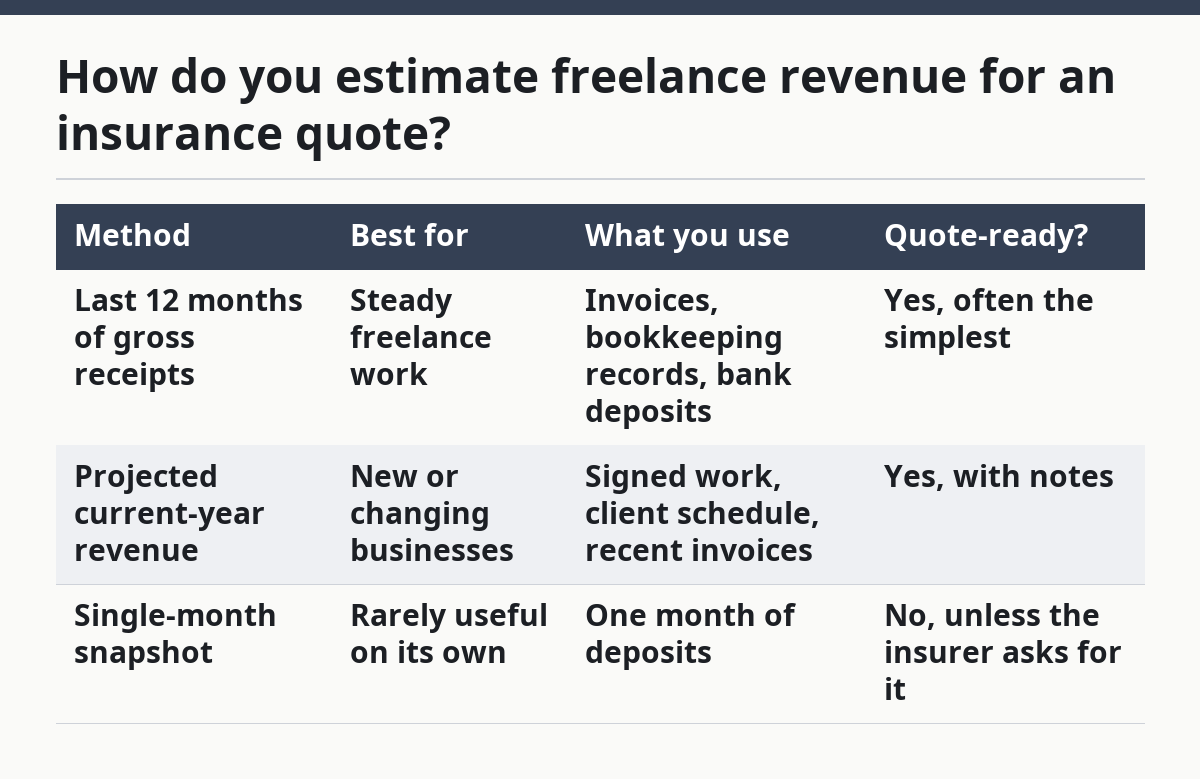
You estimate freelance revenue by starting with documented gross receipts, adjusting for the policy term, and then checking that the figure matches your recent work pattern. The point is to build an income projection that an insurer can trace back to records, not to create a polished sales forecast.
| Method | Best for | What you use | Quote-ready? |
|---|---|---|---|
| Last 12 months of gross receipts | Steady freelance work | Invoices, bookkeeping records, bank deposits | Yes, often the simplest |
| Projected current-year revenue | New or changing businesses | Signed work, client schedule, recent invoices | Yes, with notes |
| Single-month snapshot | Rarely useful on its own | One month of deposits | No, unless the insurer asks for it |
- Open your bookkeeping records and total freelance gross receipts for the most recent 12 months. Verify that the total includes only client payments from freelance work and not reimbursements, loans, or personal transfers. If the records are incomplete or mixed with non-business deposits, the estimate is too loose to use yet.
- Pull your tax return and find the business income line that matches your freelance activity. Verify that the tax return reflects the same work type you are insuring now. If the return is old, from a different line of work, or leaves out current clients, do not rely on it alone. The IRS explains the difference between cash and accrual reporting in Publication 538, so if you are unsure how unpaid invoices should be treated, consult a tax professional before you decide which figures to use.
- Review your invoices from the last 3 to 12 months and count what has actually been billed and paid. Verify that unpaid invoices are treated carefully, since billed work is not the same as cash in hand. If many invoices are still open, the number needs a lower confidence note in your own records.
- Measure seasonality with your monthly totals by listing income month by month for at least 12 months. Verify whether revenue clusters in a few months or stays even. If one quarter is much stronger than the rest, a flat monthly average may overstate or understate the quote figure.
- Set a policy-period figure by matching the estimate to the number of months the insurer is asking about, often 12 months. Verify that the estimate covers the full policy term rather than one busy month. If you only use a single high month, the result will usually be too high.
- Adjust for known changes such as a new client, a contract ending, or reduced hours. Verify that the adjustment is tied to evidence, such as signed work, cancelled work, or a new retainer. If the estimate depends on a hope rather than a signed job, the number is not reliable.
- Compare the final figure against your last tax return and your current records. Verify that the estimate falls in the same general range unless there is a clear reason for change. If the new figure is far above both your recent invoices and your tax return, recheck the math before submitting anything.
- Keep a short support file with the records used to build the estimate. Verify that the file includes the date range, the source document, and the final number in one place. If you cannot explain where the figure came from in two minutes, it is not ready for an insurer.
Because many freelancers already keep books by month, a simple method is enough for many quotes: use 12 months of gross receipts, then project that pattern across the next 12 months. For a freelancer with steady work, that often produces the cleanest number. For seasonal or new work, the projection needs more explanation, not less.
What counts as gross receipts?
Gross receipts are the starting point because they show revenue before business expenses are removed. They usually include client payments for services, retainers received for future work, and other amounts earned through the freelance business.
They do not include personal transfers, borrowed money, or money that was never business income in the first place. They also should not be reduced by software costs, travel, home office costs, or similar expenses when you are estimating revenue for insurance. That kind of subtraction belongs to tax work, not to a revenue estimate.
For clarity, the easiest check is simple: if the payment came from a client for freelance work, it likely belongs in gross receipts. If it came from a refund, a loan, or a move between your own accounts, it likely does not. That distinction matters because insurers usually want the size of the work stream, not your net profit.
What if your income changes from month to month?
Monthly swings do not make the estimate unusable, but they do make a one-month snapshot misleading. A quote based on a single strong month can overstate your annual revenue, while a weak month can understate it.
The fix is to use a 12-month view, then divide or average only if the insurer asks for a monthly figure. If the work is highly seasonal, note the pattern in your own records so the final number reflects the full policy period. For example, if work rises in one quarter and slows in another, a flat average can hide that pattern.
This is also where invoice timing matters. A freelancer may bill in one month and get paid in another, so the revenue method needs to stay consistent. Pick either cash received or billed income if the insurer specifies one, then use the same method across the full 12 months. The SBA recordkeeping guidance is a useful reminder to keep those records organized before you quote.
When should you stop and get qualified help?
You should stop using a simple estimate and get qualified help when the numbers no longer describe the business honestly. That is especially true if the policy application asks for a figure that affects coverage terms, or if your records are too mixed to separate business income from personal cash flow.
Your first year in business: there may be no full 12-month track record — use a current contract log, invoices, and any signed work agreement, then ask a qualified adviser how to present the projection.
Income from multiple freelance lines: if design, writing, consulting, and commissions all flow through one account, the revenue mix may be too messy for a quick estimate — separate the streams before you submit a figure.
Large one-time project revenue: a single project can distort annual gross receipts — spread it over the right policy period instead of counting the full amount as if it repeats every month.
Missing bookkeeping records: if bank deposits do not match invoices or tax return figures, the estimate can drift far from reality — rebuild the total from source documents before you quote it.
A big jump or drop from last year: if the new estimate is far above or below the latest tax return, something has changed — document the reason, or get help if you cannot support it.
What mistakes do freelancers make most often?
The most common error is using net income instead of gross receipts. That can understate revenue because expenses are subtracted too early, and the insurer may see a number that does not match the business record. The better alternative is to start with gross receipts and leave expenses out unless the application clearly asks otherwise.
A second mistake is using last year’s tax return without checking current work. That can lag behind a new client, a lost contract, or a changed schedule by 12 months. A current invoice trail and bookkeeping records give a better view of today’s income projection.
Another mistake is averaging a single busy month across 12 months. That inflates the estimate when work is seasonal, and it can make the quote look stronger than the business really is. Use the full year of monthly totals instead.
A fourth mistake is guessing when records exist. If invoices, bank deposits, and tax return figures are available, the estimate should come from those sources, not memory. Guessing creates a number that is hard to defend if the insurer asks for support.
How should new freelancers estimate revenue?
New freelancers should estimate revenue from signed work, expected billings, and any repeat work they can document. If there is no tax return yet, the estimate needs to lean on invoices, contracts, client schedules, and the work already booked for the next 12 months.
The main trade-off is uncertainty. A first-year estimate is often less stable than an established business, so it should be cautious and clearly tied to current work, not to hope. A signed retainer for 6 months is stronger support than a vague promise from a potential client.
If the business has only existed for a few months, do not inflate the figure to match a full year unless the work really supports that level. A conservative projection is often easier to defend than a sharp jump with no records behind it. When the estimate is thin, the right move is better documentation, not a bigger number. The IRS recordkeeping guidance can help you keep the source documents in order.
What should you have ready before you submit the quote?
You should have a short record set that shows how the number was built. At minimum, that means invoices, a recent tax return if you have one, and bookkeeping records that match the period you are estimating.

A clean support file usually includes the date range, the monthly totals, and the final projected revenue figure in one place. If the insurer asks how the number was formed, you should be able to point to the source documents in under 2 minutes. That level of clarity is often enough to keep the quote process moving.
FAQ
How do I estimate income for an insurance application?
Start with your gross receipts for the most recent 12 months, then match that to the policy period the insurer is quoting. Use invoices, tax return figures, and bookkeeping records to support the number. If the business is new or seasonal, note that the estimate is a projection rather than a fixed annual total.
What if my freelance income changes from month to month?
Use a full 12-month view instead of one strong or weak month. Monthly swings are common in freelance work, so the estimate should reflect the whole pattern, not the latest spike. If the insurer wants a monthly figure, divide the annual projection only after you have checked the seasonal pattern.
Should I use last year’s revenue or projected revenue?
Use projected revenue if the application asks for expected income over the coming policy period. Last year’s tax return is still useful as a check, but it may be too old if your client load has changed. If current work is very different from last year, the projection should be based on current invoices and bookkeeping records instead.
Drafted with AI; not yet reviewed by a person.
