

Last updated: November 23, 2026
Quick Answer: A freelance claim reservation of rights letter usually means 1 thing first: the insurer is defending or investigating now, but reserving the right to deny some or all coverage later. Read it as a coverage warning, not a denial, and look first for the policy conditions, the defense position, and any deadline to respond. For a more detailed overview of reservation-of-rights practice, see IRMI’s explanation and the NAIC consumer glossary.
Key takeaways
- The letter is about coverage, not just paperwork.
- If the insurer appoints defense counsel, that can happen while coverage questions stay open.
- The parts that matter most are the reason for the reservation, the policy terms cited, and any response date.
- A nonwaiver agreement is different from a reservation of rights letter, even though both protect the insurer.
- If the letter is unclear, silence can cost you more than a short written reply.
What does the letter mean?

A reservation of rights letter means the insurer may help with the defense in a freelance claim, but it is not admitting full coverage. In a freelance claim, that usually means the insurer sees a possible policy issue tied to the client dispute, the work product, the timing of notice, or another policy condition.
The letter is not just formal language. It is the insurer’s written coverage position at that moment, often sent within days or a few weeks after the claim is reported. The key idea is simple: the insurer is preserving options. It may defend you, pay some costs, or do both, while still reserving the right to deny coverage later if the facts or policy terms support that result. For general claims-handling context, the NAIC consumer resources are a useful starting point.
Read the first page like a headline. If it says “reservation of rights,” “coverage position,” or “nonwaiver,” the insurer is drawing a boundary. The letter may still sound polite, but the legal effect is serious. It can affect who controls the defense, whether defense counsel can share information with the insurer, and whether you need separate advice before you reply.
This is also why the letter is not the same thing as a claim denial. A denial says the insurer is out unless the decision changes. A reservation of rights letter says the insurer is still in the claim, but on guarded terms. That difference matters in the first 7 to 14 days after you open the letter, because that is when you decide how much risk you are willing to accept before you answer.
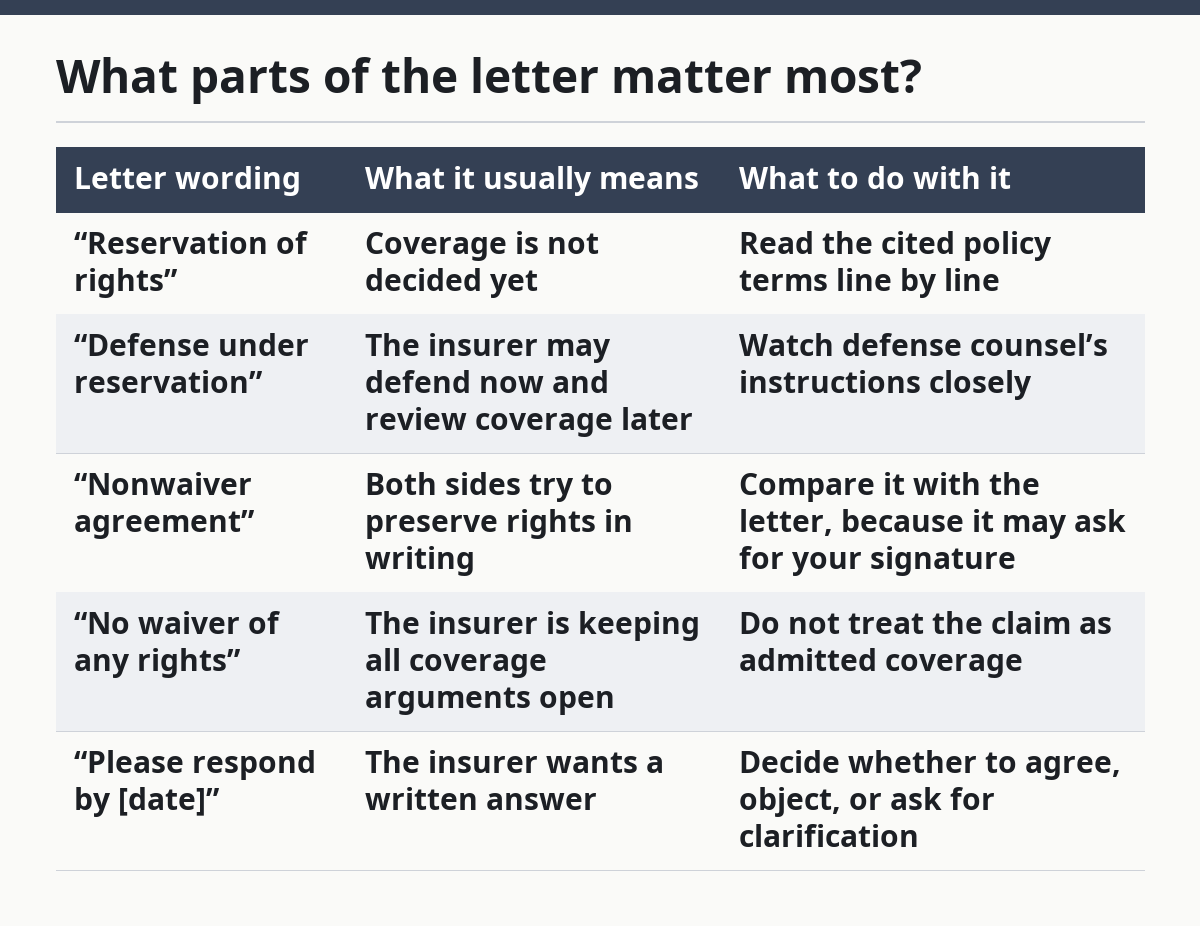
What parts of the letter matter most?
The parts that matter most are the coverage reason, the policy language, the defense instructions, and the response deadline. If you only skim the first paragraph, you can miss the real issue buried in the middle of a 3-page letter.
Start with the reason for the reservation. The insurer should identify why coverage may be limited. In freelance claims, that reason often points to a policy condition, an exclusion, a timing issue, or a disagreement about what counts as a covered wrongful act. If the letter names more than one reason, treat each one as separate, but it is wise to have a lawyer or licensed insurance professional review how the reasons interact before you respond.
Then read the policy citations. A good letter usually points to specific sections instead of vague labels. Look for the quoted condition, the exclusion, or the notice clause. If the insurer cites a policy condition, that is a sign the problem may be procedural, not just factual. If it cites an exclusion, the issue may be whether the claim fits outside the covered promise in the first place.
Then find the defense language. The letter may say the insurer will appoint defense counsel, may pay defense costs subject to limits, or may review the case again later. That tells you whether you have a defense now or only a conditional one. The phrase “subject to a full reservation of rights” often means the defense is real, but the coverage fight is not over.
Finally, look for any deadline. Some letters ask for a reply in 10 or 14 days. Others do not set a date at all. If a deadline appears, treat it as a practical response date, even if the letter does not call it a legal deadline, and consider getting legal advice before you miss it. Missing it can make the insurer think you accept the reservation by silence.
| Letter wording | What it usually means | What to do with it |
|---|---|---|
| “Reservation of rights” | Coverage is not decided yet | Read the cited policy terms line by line |
| “Defense under reservation” | The insurer may defend now and review coverage later | Watch defense counsel’s instructions closely |
| “Nonwaiver agreement” | Both sides try to preserve rights in writing | Compare it with the letter, because it may ask for your signature |
| “No waiver of any rights” | The insurer is keeping all coverage arguments open | Do not treat the claim as admitted coverage |
| “Please respond by [date]” | The insurer wants a written answer | Decide whether to agree, object, or ask for clarification |
How do I read it step by step?

You read it by pulling out 5 items in order: the claim issue, the policy basis, the defense status, the insurer’s reservation, and your reply date. That order keeps you from missing the one line that changes the case.
-
Circle the claim reason in the first paragraph.
Find the event that started the claim, such as alleged error, missed deadline, or bad advice. This tells you which project or client dispute the insurer is talking about. -
Mark every policy term the letter cites.
Look for section numbers, exclusions, conditions, or endorsements. A letter that names 2 sections gives you 2 places to check in the policy, not just one. -
Decide whether the insurer is defending you now.
If the letter appoints defense counsel or says it will pay defense costs, you have an active defense arrangement. If it says the insurer is only investigating, you may not yet have defense protection. -
Look for the reservation language itself.
This is the part that says the insurer keeps the right to deny coverage later. The result is that the defense and the coverage question travel together instead of being resolved in one step. -
Check for a request for a nonwaiver agreement or reply.
A nonwaiver agreement is a separate document that may ask you to sign. If the letter invites one, compare its terms with the reservation language before you agree. -
Write down the response date and the sender.
A date in the next 10 to 14 days means you should not let the letter sit in a folder. The sender matters too, because a claims adjuster, coverage attorney, or outside counsel may be signaling different levels of review. -
Match the tone to the risk.
If the letter is narrow, your reply can be short and factual. If it is broad or confusing, ask for clarification before you say yes to anything.
This method works best when you keep the letter and the policy side by side. A 3-page letter can quote only 1 sentence from a 20-page policy section, and that one sentence may carry the whole coverage dispute. For more on reading policy language, the Insurance Information Institute has a helpful glossary.
What should I watch for in policy conditions?
Policy conditions are the rules you must follow, and a reservation letter often points to them because the insurer thinks one may have been missed. In a freelance claim, the most common pressure points are notice, cooperation, and consent language.
Notice is usually the first place to look. If the insurer says the claim was reported late, the issue is not just timing; it may also be whether the delay affected the defense or the insurer’s ability to investigate. Cooperation is the next common point. If the letter says you must assist with documents, interviews, or defense counsel, that is not optional language.
Consent clauses matter too. Some policies require the insurer’s approval before admitting liability, settling, or taking a particular step. If the reservation letter highlights one of those clauses, the insurer may be worried that a later action could change the coverage picture. The letter may also refer to a policy condition tied to prior knowledge, prior acts, or the scope of services.
The drawback here is practical: policy language can feel repetitive, and people often skim the same paragraph 2 or 3 times without seeing the risk. The fix is to ask one question for each cited condition: “What fact does the insurer say I may have missed?” If you can answer that in one sentence, you are reading the letter correctly.
This part is also where many readers assume “defense counsel” means the coverage issue is solved. It does not. Defense counsel may handle the liability side of the claim while the insurer still keeps the coverage issue open under the policy conditions.
Should I sign a nonwaiver agreement?
A nonwaiver agreement is not the same thing as a reservation of rights letter, and you should not sign it without reading the exact terms. The letter is the insurer’s written notice; the agreement is usually a separate document that may ask you to confirm the insurer can defend without giving up coverage defenses.
The main difference is control. A letter is unilateral. A nonwaiver agreement is usually mutual, because it asks for your signature. That makes it more consequential. If you sign, you may be agreeing that the insurer’s defense does not count as an admission of coverage, which can help the insurer keep its rights intact.
There are times when signing makes sense and times when it does not. If the agreement only repeats what the letter already says, it may add little. If it expands the insurer’s rights, narrows your rights, or waives something you care about, that is a different matter. The trade-off is simple: faster defense handling on one side, less leverage later on the other.
A short written question is often enough: ask what changes, if any, the nonwaiver agreement adds beyond the letter. If the answer is “none,” you still have a choice, but you know the document is mostly confirmatory. If the answer is vague, that is a reason to slow down before you sign.
What if the letter is broad or unclear?
If the letter is broad or unclear, ask for a tighter coverage position in writing. A vague letter can leave you guessing about what the insurer is reserving, and that uncertainty can affect the defense from day one.
Watch for these common mistakes:
-
Mistake: ignoring the letter because defense counsel has already been assigned.
Cost: you may miss a coverage issue that later becomes the reason for denial.
Do instead: read the cited policy terms before the first defense call. -
Mistake: assuming a reservation means denial.
Cost: you may stop cooperating or miss a useful defense opportunity.
Do instead: treat it as an open claim with a guarded coverage position, but consider a lawyer or claims professional if you are unsure. -
Mistake: signing a nonwaiver agreement without comparing it to the letter.
Cost: you may give up leverage you did not mean to give up.
Do instead: compare both documents line by line. -
Mistake: missing the reply date.
Cost: the insurer may treat silence as agreement or lack of objection.
Do instead: send a brief reply within the stated time, even if only to ask for clarification.
A broad letter often uses phrases like “for avoidance of doubt” or “without limitation.” Those phrases usually mean the insurer is keeping its options open on more than one coverage issue. If the letter cites 4 different policy conditions and only one of them seems relevant, that is a clue the insurer is casting a wide net.
This is the point where a freelance claim can split into two tracks: the defense track and the coverage track. The defense track is about the client dispute. The coverage track is about what the insurer may or may not pay under the policy. Keeping those tracks separate in your mind makes the letter much easier to read.
What should I do next?
The next step is to answer the letter in writing, even if the reply is only a short request for clarification. A 1-paragraph response can be enough when the letter is narrow, but you should still keep a copy.
Your reply should do 3 things. First, confirm that you received the letter. Second, identify any policy term or statement that is unclear. Third, say whether you are accepting the defense under reservation, objecting to part of the language, or asking for more detail. If the insurer gave a 10-day window, use that as your guide.
Do not try to argue every point at once if the letter is long. Focus on the 1 or 2 coverage issues that matter most. A concise reply keeps the record clean and avoids accidental admissions. If you need more than a simple reply, that is a sign the letter is not routine.
This page belongs with the broader freelance claim communication hub, which groups the main insurer letters and replies in one place. Keep that hub in mind when you move from reading the reservation letter to handling the rest of the claim record.
What does a reservation of rights letter mean?
It means the insurer may defend or investigate your claim while still keeping the right to deny coverage later. The letter is a warning that the insurer sees a possible policy problem, but it has not finished the coverage decision.
In a freelance claim, that usually ties to policy conditions, exclusions, or timing. Read the cited sections first, because they show what the insurer thinks is at risk.
Do i need to respond to a reservation of rights letter?
Yes, if the letter asks for a response date or raises a point you want corrected. A short written reply keeps the record clear and shows you did not ignore the coverage issue.
If the letter has no deadline, a reply is still useful when the language is broad, unclear, or tied to a nonwaiver agreement. A brief response can preserve your position without turning the exchange into a fight.
can the insurer defend my claim and still reserve rights?
Yes, the insurer can appoint defense counsel and still reserve rights on coverage. That is one of the main purposes of the letter.
The defense side and the coverage side can run at the same time. The insurer may pay for the defense now while keeping the option to deny some or all coverage later if the policy terms support that outcome.
FAQ
Is a reservation of rights letter the same as a denial?
No. A reservation of rights letter means the insurer is keeping coverage questions open while it may still defend the claim.
How long do I have to reply?
If the letter gives a date, use that date as your practical deadline. If it does not, a prompt reply is still smart, especially if the letter asks for agreement or references a nonwaiver agreement.
Should I sign the nonwaiver agreement?
Not automatically. Read it against the letter first, and if the wording is unclear, ask a lawyer or insurance professional before signing.
Why does the insurer keep sending defense counsel if coverage is open?
Because the insurer can handle the defense first and still preserve coverage arguments later. That is common in claims where the policy issue is not resolved yet.
Drafted with AI; not yet reviewed by a person.
