

Last updated: November 23, 2026
Quick answer: A freelance certificate request checklist should usually track 7 core items: the client’s legal name, address, certificate holder name, policy number, additional insured wording, deadline, and notes before you ask for a certificate of insurance. The How to Create a Freelance Certificate Request Checklist process works best when each field is checked once, in the same order, every time. That is often the clearest way to reduce back-and-forth and avoid a wrong certificate request.
Key takeaways
- A good checklist keeps the request focused on facts, not guesses.
- The client name, address, certificate holder, policy number, deadline, and additional insured status are the core fields.
- Missing one field can delay client onboarding or force a corrected certificate.
- A one-page intake form is usually easier to use than a long email thread.
- If the request changes insurance terms, stop and confirm the wording before sending it on.
Who is this checklist for?

This freelance certificate request checklist is for freelancers who need to collect the right facts before asking a broker or insurer for a certificate of insurance. It assumes you already know the client is requesting proof of coverage and that you can name the policy number, if you have it, or know where to find it. It is also written for client onboarding, where a clean request matters more than a long explanation.
This approach is not for someone who still needs to decide whether a certificate is required at all, or whether the client is asking for contract terms that change the insurance itself. It also is not a substitute for reading the policy language. If the client wants a certificate holder listed as additional insured, or wants a special wording change, that is a different task from filling out a request form.
A checklist helps because certificate requests often depend on exact details, not general descriptions. A wrong legal name, a missing suite number, or a deadline stated as “soon” can slow the process by a full business day or more. The goal is not to make the request fancy. The goal is to make it complete enough that the next person can act on it without guessing.
For background on policy administration, the hub page on freelance insurance policy administration belongs beside this process. The checklist is the intake piece that comes before the certificate is issued.
What should go on the checklist?
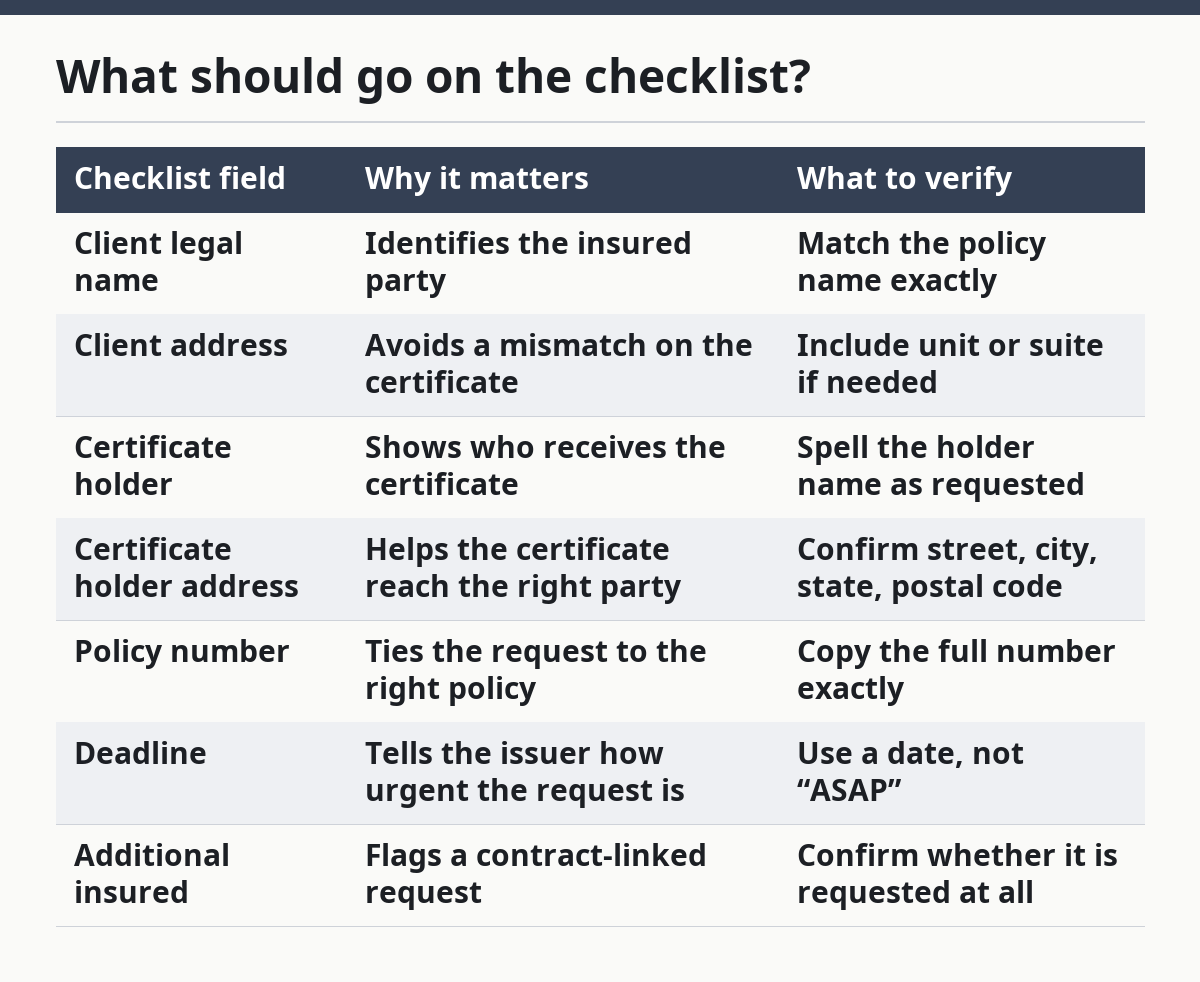
The checklist should include the facts that identify the client, the certificate holder, and the insurance request in one pass. The core fields are the client’s legal name, address, project name, certificate holder name, certificate holder address, deadline, policy number, and any request for additional insured status. A basic version fits on 1 page.
You also want a place to note what the certificate is for, because that helps spot mismatches. A landlord, general contractor, venue, or staffing company may ask for different wording, and that changes what gets checked before the request is sent. If the request comes in by email, the checklist should still force the same fields into the same order.
| Checklist field | Why it matters | What to verify |
|---|---|---|
| Client legal name | Identifies the insured party | Match the policy name exactly |
| Client address | Avoids a mismatch on the certificate | Include unit or suite if needed |
| Certificate holder | Shows who receives the certificate | Spell the holder name as requested |
| Certificate holder address | Helps the certificate reach the right party | Confirm street, city, state, postal code |
| Policy number | Ties the request to the right policy | Copy the full number exactly |
| Deadline | Tells the issuer how urgent the request is | Use a date, not “ASAP” |
| Additional insured | Flags a contract-linked request | Confirm whether it is requested at all |
A good checklist also leaves space for notes. That matters when the client’s request includes a named project, a lease, or a contract exhibit. If the checklist has only checkboxes and no notes field, you can end up with a clean form that still misses the one detail the certificate issuer needs.
How do you build the checklist?

You build the checklist by turning the client’s certificate request into a fixed sequence of fields. Start with a blank form or document, then add the 7 items that must be known before anyone asks for the certificate of insurance. That sequence should run from identity to deadline, not from “nice to have” to “maybe later.”
-
Write the client’s legal name exactly as it appears on the policy or contract. Use the full business name, not a nickname or brand name. Verify that the spelling matches the policy record, and flag any “doing business as” name that appears instead. A mismatch here can cause the certificate to be reissued.
-
Add the client’s address in full. Include street, city, state, and postal code, and add a suite or unit number if one exists. Verify the address against the contract or onboarding file. A partial address can cause the certificate holder to question the document later.
-
List the certificate holder exactly as requested. The certificate holder is the person or company receiving the certificate, and the name should match the request line by line. Verify the legal name, not just a trading name. If the holder name is vague, the request is incomplete.
-
Record the certificate holder’s address. Put the street address in the same format you would use on a formal business letter. Verify every line, because the wrong address can slow delivery and create another correction cycle. If the request uses a P.O. box, note that exactly as written.
-
Capture the deadline as a date and time, if given. Write the deadline in a clear format such as a calendar date, not “urgent” or “today.” Verify the time zone if the client gave one. A vague deadline is one of the main reasons certificate requests sit untouched in an inbox. If the deadline is next business day, write that as a date and time so the request can be handled in order.
-
Enter the policy number and policy type. Copy the policy number character for character, and note whether the request is for general liability, professional liability, or another policy. Verify the number against the policy documents before sending. A wrong digit can send the request to the wrong file.
-
Mark whether additional insured wording is requested. Additional insured means the certificate request asks for another party to be added under the policy’s terms, if the policy allows it. Verify whether the client asked for this directly, because it affects what the broker or insurer needs to review. If the contract demands it but the checklist is blank, the request is not ready.
-
Add a notes field for contract-specific wording. Use this for project names, lease references, or any special instruction that does not fit a checkbox. Verify that the note is short and specific, ideally one or two lines. If the note starts to read like legal drafting, stop and review it.
A simple checklist is better than a long one that no one finishes. The point is to make the request repeatable in under 10 minutes, not to create another form that gets ignored.
What details do clients forget most often?
Clients forget the certificate holder name, the deadline, and whether the request includes additional insured wording. Those gaps matter because each one changes how the request is handled. A missing holder name can stop the process immediately, while a missing deadline can push the request to the back of the queue.
The most common omission is a full legal name. A client may write a trading name, a short project name, or a landlord’s building name instead of the actual legal entity. That can create a certificate that looks close but still fails review.
Another common miss is the policy number. People often know they are insured but not the exact number, which means the request cannot be matched quickly. A checklist should leave a visible blank for the number so the omission is obvious before the request goes out.
Deadlines also get written badly. “Before the job starts” is not enough if the job starts on a specific date and the issuer needs 2 business days to process changes. The checklist should force a real date, even when the client’s own request is loose.
When should you stop and get help?
You should stop when the request would change the insurance terms, not just report them. A certificate request checklist can collect facts, but it cannot fix a contract problem or rewrite policy language. If the request stops being administrative, the checklist is no longer the right tool.
The client wants to be named as additional insured and the policy wording is unclear: this may affect coverage terms — pause the request and confirm the wording with the broker or insurer before sending anything.
The certificate holder name does not match the contract: this can cause rejection — verify the legal name and correct the source document first.
The deadline is same day and the request is incomplete: this raises the risk of errors — ask for the missing fields before submitting.
The policy number is missing or looks wrong: the request may be tied to the wrong policy — stop and locate the policy document.
The client asks for wording that sounds like legal drafting: the checklist cannot interpret contract language — route the request for qualified review.
These are not delays for their own sake. They are points where a rushed certificate can create a bigger problem than a slow one. A checklist should prevent that, not hide it. For general reference, ACORD’s certificate forms and certificate handling guidance are the standard starting point for this process, and many insurers also rely on the same basic certificate fields.
What mistakes cause the most delays?
The biggest mistake is treating the certificate request like a quick email instead of a fixed intake. When details arrive in pieces, the issuer spends more time sorting the request than handling it. The alternative is a single checklist with every required field on one page.
Another mistake is copying the client’s wording without checking the policy. That can produce a mismatch between the request and the actual coverage record. The correct move is to copy names exactly where needed, but verify them against the policy documents before sending.
A third mistake is leaving the deadline as a phrase instead of a date. “As soon as possible” does not tell anyone what comes first. Put a date on the checklist and confirm whether time zone matters.
A fourth mistake is hiding special wording in the body of an email. If the checklist does not show the request for additional insured status, the person reviewing it can miss it. The better alternative is a checkbox and a note field, both on the form.
A fifth mistake is building a checklist that is too long. If the form asks for 15 fields, people will skip the one that matters most. A short, 1-page checklist gets used more often than a perfect one nobody finishes.
When does the standard checklist need to change?
The standard checklist needs to change when the request involves a lease, a contract exhibit, or more than one certificate holder. Those situations often need extra notes, because the same certificate may need to go to different parties or include different wording. The form should still stay short, but it may need one extra line for each holder.
It also needs to change when the request comes from a repeat client with the same holder but a different project. In that case, keep the core fields the same and add a project line. That keeps the file clean without forcing a full rewrite every time.
If the client is asking for multiple policies, add a separate policy number line for each one. Do not stack the numbers in one field, because that increases the chance of matching the wrong policy. A second line takes less than 30 seconds to add and can save a much longer correction cycle.
A final adjustment is needed when the request comes in late in the day. Mark the deadline clearly, but do not hide the missing fields just to make it look complete. A checklist works only when it shows what is known and what is still missing.
What does a good checklist look like?
A good checklist is short, specific, and easy to read in under 2 minutes. It uses the same order every time: client name, address, certificate holder, address, policy number, deadline, additional insured, and notes. That consistency is what makes it useful in client onboarding.
It also leaves no room for guessing. If a field is blank, the reader should know it is missing, not optional. If the request includes a special contract term, the checklist should show it plainly rather than burying it in a paragraph.
The best sign of a good result is simple: the person reviewing the request can send it forward without asking 3 follow-up questions. That does not mean every certificate is instant. It means the request is complete enough to process without another round of cleanup.
FAQ
What information should I collect for a certificate request?
You should collect the client’s legal name, address, certificate holder name, certificate holder address, policy number, deadline, and any additional insured request. That set of fields gives the issuer the basic facts needed to prepare a certificate of insurance without chasing missing details. A notes field helps if the contract includes a project name or special wording.
How do I avoid delays when requesting a certificate?
You avoid delays by sending one complete request instead of several partial messages. Put the deadline in a real date format, verify the policy number, and make sure the certificate holder name matches the request exactly. If a field is missing, pause and fill it in before you submit.
What details are needed for a client certificate request?
The main details are the client’s legal name, address, certificate holder, policy number, deadline, and whether additional insured wording is requested. Those details let the request move through client onboarding without extra clarification. If the request involves a lease or contract, add a short note with the relevant project or document name.
Drafted with AI; not yet reviewed by a person.
